SDG indicator 15.3.1 Proportion of land that is degraded over total - - PowerPoint PPT Presentation

sdg indicator 15 3 1
SMART_READER_LITE
LIVE PREVIEW

SDG indicator 15.3.1 Proportion of land that is degraded over total - - PowerPoint PPT Presentation

SDG indicator 15.3.1 Proportion of land that is degraded over total land area The UNCCD is the custodian agency leading an Inter-Agency Advisory Group on 15.3.1 composed of our key partner FAO as well as the CBD, UNFCCC, UNEP and UNSD to further


slide-1
SLIDE 1

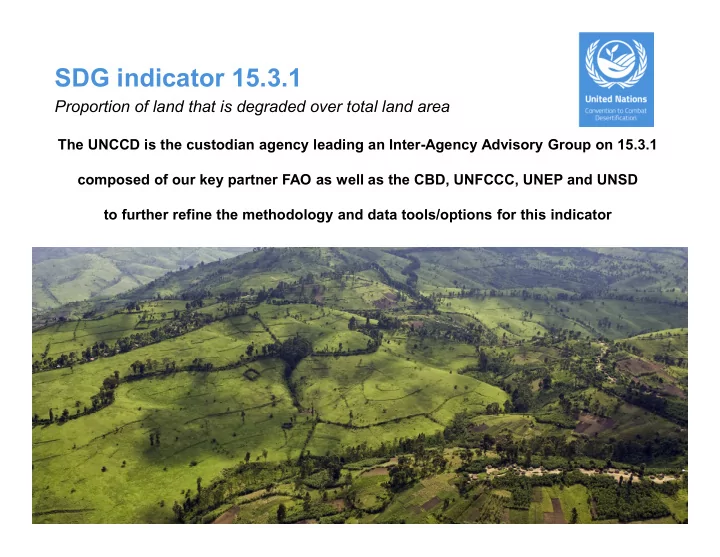
SDG indicator 15.3.1

Proportion of land that is degraded over total land area

The UNCCD is the custodian agency leading an Inter-Agency Advisory Group on 15.3.1 composed of our key partner FAO as well as the CBD, UNFCCC, UNEP and UNSD to further refine the methodology and data tools/options for this indicator

slide-2
SLIDE 2

Established Methodology

The methodology for the three sub-indicators is well established and recognized in the scientific literature, multilateral agreements and other international processes (essential climate and biodiversity variables) Land cover (ISO standard) – flexible classification system provides compatibility in terms of aggregation/disaggregation, between existing/future monitoring, and can accommodate national circumstances Land productivity – well-established methods for the use of vegetation indices (NDVI) to evaluate trends in net primary productivity (NPP) – variety of corrections techniques given national circumstances (rainfall, cloud cover, growing season, and other inter-annual variability, etc.) Carbon stocks – IPCC published methodology (IPCC, 2006) for carbon stocks can be employed to estimate the change in stocks based on land cover change

  • r national calculations based on FAO SOC cookbook
slide-3
SLIDE 3

UNCCD Progress Indicators

As adopted at COP.11 (decision 22)

SO1

SO1-1: Trends in population living below the relative poverty line and/or income inequality in affected areas SO1-2: Trends in access to safe drinking water in affected areas

SO2

SO2-1: Trends in land cover SO2-2: Trends in land productivity or functioning of the land

SO3

SO3-1: Trends in carbon stocks above and below ground SO3-2: Trends in abundance and distribution of selected species Poverty severity OR Income inequality Proportion of population using an improved drinking water source Vegetative land cover Land productivity dynamics Soil organic carbon stock Global Wild Bird Index

Associated metrics/proxies

slide-4
SLIDE 4

Secretariat’s Support

The COP requested the UNCCD secretariat, in cooperation with relevant specialized institutions, to:

  • Compile and make available to affected country Parties national estimates
  • f the metrics/proxies associated with these indicators from available

global datasets as default data for validation in accordance with the procedure established in decision 22/COP.11;

  • Prepare methodological guidelines and provide technical assistance to

affected country Parties on the compilation and use of such default data;

  • Undertake measures aimed at strengthening the capacities of affected

Parties to validate, replace or reject the default data.

(decision 15/COP.12)

slide-5
SLIDE 5

Responsibility of National Authorities

  • 1. Setting the baseline to determine the initial status of the sub-indicators.
  • 2. Detecting and validating the type of change in each of the sub-indicators per land

unit (e.g., pixel, polygon).

  • 3. Deriving the indicator by summing all areas subject to “negative” change (i.e.,

degraded) and dividing by the total land area using “One Out, All Out” area-based approach where if any of the sub-indicators is determined to show significant negative change, it is considered degraded.

slide-6
SLIDE 6

Good Practice Guidance

Good Practice Guidance (GPG) is now being developed based on the established methods for deriving the three sub-indicators together with a method of computation for SDG indicator 15.3.1

  • GPG is intended to allow countries to select the most appropriate

datasets for the sub-indicators and determine their own pathway for deriving the indicator

  • Significant negative change (i.e., land degradation) is to be determined

by national authorities External review and consultation with the IAEG-SDGs Working Group on Geospatial Information (including GEO/CEOS), NSOs/countries (CEEA/GGIM) and other stakeholders. Future collaboration with data providers to build national capacities, set standards and increase frequency of reporting.

slide-7
SLIDE 7

Data Collection & Availability

Engaging NSOs in data collection, validation and reporting For some countries, data on land cover are being collected by National Statistical Systems; for many, land cover data is spread among different statistical fields (agriculture, environment, forestry, etc.) and related agencies

  • r ministries. Many of national space agencies have land cover products.

For land productivity and carbon stocks, data collection remains with specialized institutions at the national, regional and global levels. National official data sources will be used to the greatest extent possible, and complemented by data derived from Earth observation and geospatial information with availability back to at least 2000. Default data will be sent to national teams or focal points to be shared and validated with NSOs and then reported back to the UNCCD

slide-8
SLIDE 8

Land Cover

IPCC (6) GLC-Share (11) SEEA (15) ESA CCI-LC classes (22) National Legend Forest Land Tree Covered Areas Forest tree cover Tree broadleaved evergreen, Tree broadleaved deciduous, Tree needle leaved evergreen, Tree needle leaved deciduous, Tree mixed leaf type, Mosaic tree, shrub / herbaceous cover, Tree flooded, fresh water Grassland Grassland Shrub Covered Areas Sparse Vegetation Pasture and natural grassland Shrubland, bushland, heathland Sparsely vegetated areas Natural vegetation associations and mosaics Mosaic natural vegetation / cropland, Mosaic herbaceous cover / tree, shrub, Scrublands, Grassland, Lichens and mosses, Sparse vegetation Cropland Cropland Medium to large fields of rain-fed herbaceous cropland Medium to large fields of irrigated herbaceous cropland Permanent crops, agriculture plantations Agriculture associations and mosaics Cropland rain fed, Herbaceous cover Tree or shrub cover Cropland, irrigated or post- flooding, Mosaic cropland / natural vegetation Wetlands Herbaceous Vegetation, aquatic and regularly flooded Mangrove Open wetland Tree cover, flooded, saline water, Shrub or herbaceous cover, flooded Water bodies Settlements Artificial Surfaces Urban and associated developed areas Urban areas Other land Bare soil Snow and Glacier Barren land Permanent snow and glaciers Bare areas, Permanent snow and ice Water Bodies Inland water bodies Coastland Water bodies Sea

Alignment with SEEA Land cover is a change indicator which can be used to assess land degradation and also a classification tool to make indicator 15.3.1 more policy relevant and actionable A common ontology allows for multiple uses across processes and the SDGs For the LDN-TSP, default data is given based on ESA’s 22 classes for validation or to complement data at the national level

slide-9
SLIDE 9

Upgrading Tier Status of Indicator

Currently Tier III –methodology development to be finalized with metadata available for review at least one month before Nov 2017 IAEG-SDGs meeting >Engaging with NSOs in the methodological development (Short-term) Tier II: indicator is conceptually clear, has an internationally established methodology and standards are available but data are not regularly produced by countries >International standards approved by a governing body (Long-term) Tier I: indicator is conceptually clear, has an internationally established methodology and standards are available and data are regularly produced by countries (>50%)

slide-10
SLIDE 10

The Way Forward

Engage NSOs where there is a convergence of SEEA pilot and LDN-TSP countries (8-10) Ask CEEA members (30) to formalize collaboration and help validate methodology at country level as we seek to align reporting processes and create int’l standards Engage with NSO representatives involved in LDN-TSP national teams (~50) The GPG and metadata document The UNCEEA and in particular its technical committee, which has been established to work on advancing the methodology of the SEEA, could serve as one body to engage the statistical community considering its membership and its mandate.

  • Review the revised GPG to be made available in mid-July
  • Review and support for the revised metadata document to be submitted to IAEG-

SDGs in mid-September