Searching for neutrino-less double beta decay The Weakly Interaction - - PowerPoint PPT Presentation

searching for neutrino less double beta decay
SMART_READER_LITE
LIVE PREVIEW

Searching for neutrino-less double beta decay The Weakly Interaction - - PowerPoint PPT Presentation

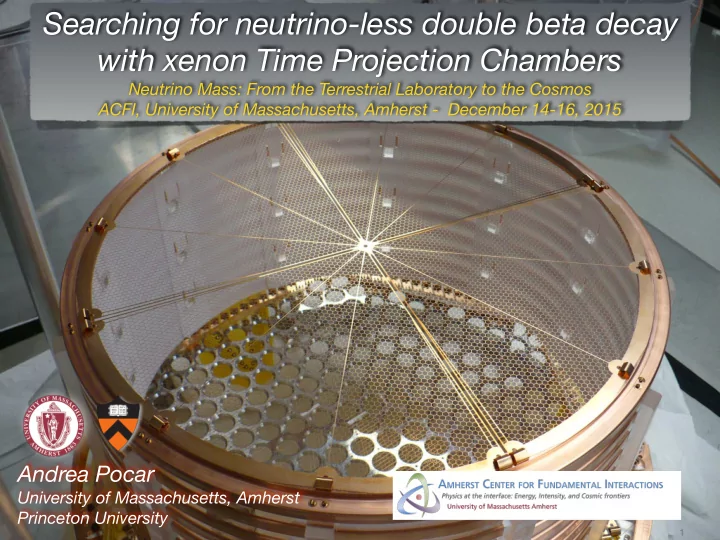
Searching for neutrino-less double beta decay The Weakly Interaction with xenon Time Projection Chambers Neutrino Mass: From the Terrestrial Laboratory to the Cosmos ACFI, University of Massachusetts, Amherst - December 14-16, 2015 Andrea


slide-1
SLIDE 1

Andrea Pocar - UMass Amherst Neutrino Mass — ACFI, UMass Amherst — December 15, 2015

The Weakly Interaction

Searching for neutrino-less double beta decay with xenon Time Projection Chambers

Neutrino Mass: From the Terrestrial Laboratory to the Cosmos ACFI, University of Massachusetts, Amherst - December 14-16, 2015

Andrea Pocar

University of Massachusetts, Amherst Princeton University

1

slide-2
SLIDE 2

Andrea Pocar - UMass Amherst Neutrino Mass — ACFI, UMass Amherst — December 15, 2015

  • utline

e e n n ?

  • 0νββ decay with xenon TPCs
  • a case for xenon
  • Gas TPCs for DBD
  • History: Gotthard
  • ~near future: NEXT-100
  • LXe TPCs for DBD
  • present: EXO-200
  • future: LZ
  • future: nEXO
  • Ba tagging
slide-3
SLIDE 3

Andrea Pocar - UMass Amherst Neutrino Mass — ACFI, UMass Amherst — December 15, 2015

2νββ

single β decay energetically forbidden/disfavored

Nucleon binding energy (MeV) Atomic number (Z)

Physics: Neutrino-less double beta (0νββ) decay

3

0νββ

  • bservation of 0νββ decay:
  • massive, Majorana neutrinos
  • lepton number violation

0νββ rate

  • absolute neutrino mass (model dependent)

[Schechter and Valle, PRD 25 (1982) 2951]

slide-4
SLIDE 4

Andrea Pocar - UMass Amherst Neutrino Mass — ACFI, UMass Amherst — December 15, 2015

why xenon TPCs?

4

Purification (stand alone, continuous)

  • purification from chemical impurities —> getters
  • purification from other radioactive noble elements (Ar, Kr, Rn) —> distillation, adsorption

Enrichment

  • enrichment 8.9% —> 80-90% proven at the many100’s kg scale


(~1 tonne of enriched xenon for science procured in the past decade) Xenon is reusable

  • transferable between detectors

Monolithic detector, remarkable self-shielding, scalable

  • proven by the dark matter detectors (low energy)
  • quickly improves with mass

Energy resolution

  • Ge/bolometers — GXe — LXe (ionization+scintillation) — scintillators
  • slowest 2νββ decay of all ‘practical’ isotopes (2×10²¹ yr)

Particle ID (α/β), ββ/γ discrimination

  • ionization/scintillation
  • event topology: multiplicity of energy depositions in the detector
  • event topology: β/ββ discrimination (GXe)
  • active, unsegmented detector to contain and measure external background (LXe)

Final state ID

  • coincident detection of daughter Ba ion/atom (spectroscopic techniques)
  • M. Moe, PRC 44, R931 (1991)
slide-5
SLIDE 5

Andrea Pocar - UMass Amherst Neutrino Mass — ACFI, UMass Amherst — December 15, 2015

Gas vs Liquid Xenon TPC

5

pros:

  • tracking
  • energy resolution

cons:

  • signal efficiency ~ 1/3
  • external background
  • pressure vessel
  • awaits 100 kg scale proof

pros:

  • compact
  • high signal efficiency
  • self-shielding
  • purity

cons:

  • cryogenics
  • no(?) β/ββ discrimination

GXe LXe

slide-6
SLIDE 6

Andrea Pocar - UMass Amherst Neutrino Mass — ACFI, UMass Amherst — December 15, 2015

0νββ decay vs WIMP searches

6

0νββ decay:

  • β/γ discrimination
  • ββ/β discrimination
  • energy resolution

WIMP direct detection:

  • nuclear / electron recoil discrimination
  • energy threshold
slide-7
SLIDE 7

Andrea Pocar - UMass Amherst Neutrino Mass — ACFI, UMass Amherst — December 15, 2015

Shielding a detector from gammas is difficult because the absorption cross section is small

Example: γ interaction length in Ge is 4.6 cm, comparable to the size of a germanium detector

Typical ββ0ν Q values Gamma interaction cross section

Shielding ββ decay detectors is harder than shielding Dark Matter ones We are entering the “golden era” of ββ decay experiments as detector sizes exceed int lengths

7

slide-8
SLIDE 8

Andrea Pocar - UMass Amherst Neutrino Mass — ACFI, UMass Amherst — December 15, 2015

First xenon TPC for DBD — Gotthard TPC

8

Luescher et al., Physics Letters B 434 (1998) 407 Vuilleumier et al., PRD 48 (1993) 1009

  • 180 liters
  • 3.3 kg 136Xe (62.5% enriched)
  • 5 atm

μs α β 58 cm

slide-9
SLIDE 9

Andrea Pocar - UMass Amherst Neutrino Mass — ACFI, UMass Amherst — December 15, 2015

First xenon TPC for DBD — Gotthard TPC

9

Luescher et al., Physics Letters B 434 (1998) 407 Vuilleumier et al., PRD 48 (1993) 1009

single electron event candidate double electron event

slide-10
SLIDE 10

Andrea Pocar - UMass Amherst Neutrino Mass — ACFI, UMass Amherst — December 15, 2015

  • NEXT: High Pressure Xenon (HPXe) TPC
  • perating in electroluminescent (EL) mode.
  • NEXT-100: 100 kg of Xenon enriched at 90%

in Xe-136 (in stock) at a pressure of 15 bar.

  • The event energy is integrated by a plane of

radiopure PMTs located behind a transparent cathode (energy plane),

  • PMTs also provide t0 – essential for the z

coordinate and fiducialization.

  • The event topology is reconstructed by a

plane of radiopure silicon pixels (SiPMs) (tracking plane).

NEXT-XX: A series of photonic TPCs

xenon gas

TPB coated surfaces ionization

EL mode is essential to obtain linear gain, therefore avoiding avalanche fluctuations and fully exploiting the excellent Fano factor in gas 10

Courtesy of Dave Nygren

slide-11
SLIDE 11

Andrea Pocar - UMass Amherst Neutrino Mass — ACFI, UMass Amherst — December 15, 2015

Energy resolution in Xenon depends strongly on density!

11

Here, the fluctuations are normal Fano factor F = 0.15 Unfolded resolution: δE/E ~0.6% FWHM For ρ <0.55 g/cm3, ionization energy resolution is “intrinsic”

Ionization signal only! ρ = 0.08 g/cm3

F = ~20

slide-12
SLIDE 12

Andrea Pocar - UMass Amherst Neutrino Mass — ACFI, UMass Amherst — December 15, 2015

Courtesy of JJ Gomez-Cadenas

slide-13
SLIDE 13

Andrea Pocar - UMass Amherst Neutrino Mass — ACFI, UMass Amherst — December 15, 2015

Courtesy of JJ Gomez-Cadenas

slide-14
SLIDE 14

Andrea Pocar - UMass Amherst Neutrino Mass — ACFI, UMass Amherst — December 15, 2015

Courtesy of JJ Gomez-Cadenas

energy plane tracking plane

slide-15
SLIDE 15

Andrea Pocar - UMass Amherst Neutrino Mass — ACFI, UMass Amherst — December 15, 2015

Courtesy of JJ Gomez-Cadenas

slide-16
SLIDE 16

Andrea Pocar - UMass Amherst Neutrino Mass — ACFI, UMass Amherst — December 15, 2015

Courtesy of JJ Gomez-Cadenas

slide-17
SLIDE 17

Andrea Pocar - UMass Amherst Neutrino Mass — ACFI, UMass Amherst — December 15, 2015

The Enriched Xenon Observatory (EXO)

17

Enrichment is relatively simpler and less expensive

  • 10% --> 80-90% proven on the 100’s kg scale

Continuous re-purification possible

  • from electronegative, radioactive contaminants

Xenon is reusable

  • could be transferred between experiments

Monolithic detector, remarkable self-shielding Good (enough) energy resolution

  • with combined scintillation + ionization

ββ/γ discrimination

  • event topology

Search for 0νββ decay of 136Xe (Q=2458 keV) with enriched xenon TPC’s (with scintillation readout) of increasing sensitivity and size

Xenon admits a novel coincidence technique

  • Ba daughter tagging
  • M. Moe, PRC 44, R931 (1991)

Limited cosmogenic activation

  • longest-lived 4 minutes
slide-18
SLIDE 18

Andrea Pocar - UMass Amherst Neutrino Mass — ACFI, UMass Amherst — December 15, 2015

The EXO-200 LXe Time Projection Chamber (TPC)

18

e"# e"# e"# e"# e"# e"# e"# e"# e"# e"# e"# e"# e"# Ioniza*on# Scin*lla*on#

376V/cm

  • ~150 kg enrLXe
  • Cathode in center
  • Light detected by


APDs on end caps

  • Charge detected by crossed

u- and v-wire planes

  • v-wire plane measures induction
  • u-wire plane collects charge
  • Energy from u-wire and APD signals

JINST 7 (2012) P05010

~40 cm

slide-19
SLIDE 19

Andrea Pocar - UMass Amherst Neutrino Mass — ACFI, UMass Amherst — December 15, 2015

HI PURITY HEAT TRANSFER FLUID (HFE-7000, 50 CM) (COPPER) (COPPER, 1.37 MM THICK) (25 CM)

JINST 7 (2012) P05010

Rn: ~6 Bq/m3 The EXO-200 detector at WIPP (~1,500 m.w.e.)

19

slide-20
SLIDE 20

Andrea Pocar - UMass Amherst Neutrino Mass — ACFI, UMass Amherst — December 15, 2015

EXO-200 Inner Detector

20

slide-21
SLIDE 21

Andrea Pocar - UMass Amherst Neutrino Mass — ACFI, UMass Amherst — December 15, 2015

half TPC

Cathode mesh (two ‘bikinis’) Field shaping rings acrylic supports Teflon reflector tiles

the EXO-200 TPC

21

~40 cm

slide-22
SLIDE 22

Andrea Pocar - UMass Amherst Neutrino Mass — ACFI, UMass Amherst — December 15, 2015

Energy resolution

22 cutting this region removes α particles and events with imperfect charge collection

228Th source

SS

Qββ

Qββ

[E. Conti et al. Phys. Rev. B 68 (2003) 054201]

Molecular properties of xenon cause increased scintillation to be associated with decreased ionization (and vice-versa)

Takes into account anti-correlation of charge and scintillation response to improve energy resolution Calibration performed with 60Co, 137Cs, 226Ra, and 228Th

slide-23
SLIDE 23

Andrea Pocar - UMass Amherst Neutrino Mass — ACFI, UMass Amherst — December 15, 2015

Low Background 2D SS Spectrum

α : larger ionization density more recombination more scintillation light

208Tl line

cut region

α zoomed-out

23

a diagonal cut (large scintillation, low charge) eliminates: 1) alphas
 2) edge events (partial charge collection)

slide-24
SLIDE 24

Andrea Pocar - UMass Amherst Neutrino Mass — ACFI, UMass Amherst — December 15, 2015

Event multiplicity and background discrimination

(EXO-200 data)

24

228Th Calibration

Source Low Background
 Data

Single Site (SS) Multiple Site (MS)

2νββ

slide-25
SLIDE 25

Andrea Pocar - UMass Amherst Neutrino Mass — ACFI, UMass Amherst — December 15, 2015

4

EXO-200 detector: JINST 7 (2012) P05010 Characterization of APDs: NIM A608 68-75 (2009) Materials screening: NIM A591, 490-509 (2008)

January 2010

25

slide-26
SLIDE 26

Andrea Pocar - UMass Amherst Neutrino Mass — ACFI, UMass Amherst — December 15, 2015 26

slide-27
SLIDE 27

Andrea Pocar - UMass Amherst Neutrino Mass — ACFI, UMass Amherst — December 15, 2015

~500 APDs (gangs of 7) Signal Cables charge detection wire triplets final TIG weld

no soldered connections no connectors

27

PTFE reflectors

slide-28
SLIDE 28

Andrea Pocar - UMass Amherst Neutrino Mass — ACFI, UMass Amherst — December 15, 2015

Xenon purity from electronegative species - Run 2

28

Xenon gas is forced through heated Zr getter by a custom ultraclean pump. At τe = 3 ms: 


  • drift time <110 μs 

  • loss of charge: 


3.6% at full drift length

Ultraclean pump: Rev. Sci. Instr. 82 (10) 105114 Xenon purity with mass spec: NIM A675 (2012) 40 Gas purity monitors: NIM A659 (2011) 215

5 ms (~15 slpm)

slide-29
SLIDE 29

Andrea Pocar - UMass Amherst Neutrino Mass — ACFI, UMass Amherst — December 15, 2015

EXO-200: radio-assay effort

Massive effort on material radioactive qualification using:

  • NAA
  • Low background γ-spectroscopy
  • α-counting
  • Radon counting
  • High performance GD-MS and ICP-MS

At present the database of characterized materials includes >300 entries

D.S. Leonard et al., Nucl. Ins. Meth. A 591, 490 (2008)

The impact of every screw within the Pb shielding is evaluated before acceptance This imposes huge constraints on the design of the detector

29

slide-30
SLIDE 30

Andrea Pocar - UMass Amherst Neutrino Mass — ACFI, UMass Amherst — December 15, 2015

Phase I, Run 2: precision measurement of 2νββ

30

(longest, yet most precisely (directly) measured 2νββ decay of all ‘practical’ isotopes)

(2014)

Start data taking in June 2011 Discovery of 2νββ decay of 136Xe [PRL 107, 212501 (2011)] Confirmation by KamLAND-Zen [PRC 85, 045504 (2012)] Precision measurement (~3%) [PRC 89, 015502 (2014)]

T2νββ

1/2

= (2.165 ± 0.016(stat) ± 0.059(syst)) × 1021yr

slide-31
SLIDE 31

Andrea Pocar - UMass Amherst Neutrino Mass — ACFI, UMass Amherst — December 15, 2015

the slowest, yet the better measured

31 yr)

21

10 × (

1/2

T β β ν 2 1 1.5 2 2.5 3

EXO-200 (this work) KamLAND-Zen (2012) EXO-200 (2011)

discovery of 2-neutrino mode PRL 107, 212501 (2011) confirmation by KL-Zen PRC 85, 045504 (2012) precision measurement of 2-neutrino mode

PRC 89 (2014) 015502

slide-32
SLIDE 32

Andrea Pocar - UMass Amherst Neutrino Mass — ACFI, UMass Amherst — December 15, 2015

Search for 0νββ decay (136Xe exposure: 100 kg yr)

32

background index

(1.7 ± 0.2) × 10−3 cts/(keV · kg · y)

σ E (Q) = 1.53

T 0νββ

1/2

> 1.1 · 1025 yr (90% C.L.)

energy resolution

[Nature, 510, 229-234 (2014)]

slide-33
SLIDE 33

Andrea Pocar - UMass Amherst Neutrino Mass — ACFI, UMass Amherst — December 15, 2015

Phase I, Run2: search for 0νββ decay of 136Xe

33

EXO-200 limit:

[GERDA: PRL 111, 122503 (2013)] [KL-Zen: PRL 110, 062502 (2013)]

T

0νββ 1/2 > 1.1 × 1025 yr (90% C.L.)

T0νββ

1/2

= 1.9 × 1025 yr

EXO-200 sensitivity:

< mββ >= 190 − 450 meV

[Nature, 510, 229-234 (2014)] Gerda II EXO-200 Run 2

slide-34
SLIDE 34

Andrea Pocar - UMass Amherst Neutrino Mass — ACFI, UMass Amherst — December 15, 2015

Radon products and alphas

34

214Po 218Po 222Rn

surface α’s 
 (210Po, etc) surface β,γ’s surface

214Po

222Rn-218Po

coincidences
 (3 minutes ) two drift velocities
 (related to purity) β-decay α-decay ~170 μs scintillation ionization

ion velocity (mm/s) Δt (sec)

  • Phys. Rev. C, 89, 015502 (2014).

Steady state radon activity: 360 ± 65 μBq (fiducial volume) ~200 atoms of 222Rn

  • Ion fraction of 218Po daughter from α-decay

is 50.3±3.0%

  • Ion fraction of 214Bi daughter from β-decay

is 76.4 ± 5.7%

slide-35
SLIDE 35

Andrea Pocar - UMass Amherst Neutrino Mass — ACFI, UMass Amherst — December 15, 2015

EXO-200 backgrounds were predicted very accurately

LXe TPC for double beta decay Oct 6, 2015

35

  • J.B. Albert, et al. "Investigation of radioactivity-induced backgrounds” PRC 92, 015503 (2015).
  • M. Auger, et al. "The EXO-200 detector…" J. Inst 7 (2012) P05010.

Events in ±2σ around Q Radioactive bkgd prediction during construction Radioactive bkgd prediction using present Monte Carlo

137Xe bkgd

Background from 0ν analysis fit 90%CL Upper

48 22 7 31.1 ± 1.8 ± 3.3

(39 events observed) 90%CL Lower

9.4 3.3

This is essential in scaling up from EXO-200 to nEXO as the

  • nly tool required to estimate the sensitivity is Geant4’s

ability to simulate Compton scattering

slide-36
SLIDE 36

Andrea Pocar - UMass Amherst Neutrino Mass — ACFI, UMass Amherst — December 15, 2015

Location of 232Th background in EXO-200

36

analysis based on ratio of sum peak (2615+582 keV) to 2615 keV peak best-fit and radio-assay backgrounds agree very well

PRC92, 015503 (2015)
 arXiv:1503.06241

slide-37
SLIDE 37

Andrea Pocar - UMass Amherst Neutrino Mass — ACFI, UMass Amherst — December 15, 2015 37

slide-38
SLIDE 38

Andrea Pocar - UMass Amherst Neutrino Mass — ACFI, UMass Amherst — December 15, 2015

What else from EXO-200?

38

Following the accidents, EXO-200 personnel is now granted regular access to the site and recovery operations are ongoing
 (close to detector cool-down)

  • EXO-200 can still contribute valuable science
  • Upgrades have been installed before the accident:
  • Radon suppression system for air around the detector
  • Upgraded electronics (could get to 1% energy resolution)
  • Expected sensitivity Τ1/20νββ ~ 5 × 1025 years
  • Approximately 2 years of data are still being worked on:
  • cosmogenic background induced by muons
  • DBD to excited states of 136Ba, and of 134Xe
  • exotic processes: Lorentz violation, electron decay
  • electron diffusion during drift
slide-39
SLIDE 39

Andrea Pocar - UMass Amherst Neutrino Mass — ACFI, UMass Amherst — December 15, 2015

DBD to excited states of Ba-136

39

KamLAND-Zen spectral fit EXO-200 multivariate analysis using the multi-site event topology

J.B. Albert et al., arXiv:1511.04770

  • K. Asakura et al., arXiv:1509.03724
slide-40
SLIDE 40

Andrea Pocar - UMass Amherst Neutrino Mass — ACFI, UMass Amherst — December 15, 2015

what has EXO-200 taught us?

40

  • Operated a 100 kg scale enriched-LXe TPC for 2 years
  • Measured residual backgrounds consistent with radio-assays
  • Reached design (anti-correlated) energy resolution, σ/E(Q)=1.5%
  • Stable electron drift time of ~3 ms or better
  • Demonstrated power of standoff distance in monolithic detector
  • Demonstrated power of single-/multi-site β/γ discrimination
  • Implemented novel detector solutions
  • 500x LAAPDs for VUV (175 nm) scintillation detection
  • Photo-etched, charge collection wires, cathode, and fasteners
  • Epoxy-potted, kapton flat cable feedthroughs
  • HFE-7000 thermal bath and radiation shield
  • Ultra-light design, no solder joints, no electrical connectors
slide-41
SLIDE 41

Andrea Pocar - UMass Amherst Neutrino Mass — ACFI, UMass Amherst — December 15, 2015

from EXO-200 to nEXO

41

Two years ago our roadmap included the following possibilities: 
 A. EXO-200 confirms Klapdor claim

  • build a GXe detetctor to study the decay in detail

B. EXO-200 has a hint of a signal

  • quickly build an EXO-500 in the same installation at WIPP

  • maybe at the same time design a large GXe detector

C. EXO-200 does not see any peak

  • build the largest LXe detector you think doable
  • pursue aggressive detector designs for a further upgrade (e.g. Ba-tagging)

EXO-200 performance and backgrounds guided the decision to design a large LXe “discovery” detector:


nEXO

slide-42
SLIDE 42

Andrea Pocar - UMass Amherst Neutrino Mass — ACFI, UMass Amherst — December 15, 2015

The nEXO detector

42

46 cm 130 cm

  • enhanced self-shielding
  • x100 better T1/2 sensitivity
  • < 1% energy resolution
  • no central cathode
  • ≳ 10 ms electron lifetime

the range of a 2.5 MeV γ-ray in LXe is 8.5 cm

EXO-200 data

EXO-200 nEXO

5 tonnes enriched xenon

slide-43
SLIDE 43

Andrea Pocar - UMass Amherst Neutrino Mass — ACFI, UMass Amherst — December 15, 2015

nEXO: a homogeneous detector

43

5kg 150kg 5000kg

take full advantage of: 1) Compton tag and rejection (if detector has double-hit

recognition ability)

2) External background identification and rejection The larger the detector the more useful this is. ➔ Ton scale is where these features become dominant.

  • Att. Length of 2.4MeV γ
slide-44
SLIDE 44

Andrea Pocar - UMass Amherst Neutrino Mass — ACFI, UMass Amherst — December 15, 2015

nEXO conceptual design (SNOLab)

44

  • APDs —> SiPMs
  • ~x100 better half-life

sensitivity than EXO-200

  • in-LXe electronics
  • no plastics
  • ~600 Rn atoms
  • 100 kV

NSAC Long Range Plan calls for a US-led 0νββ decay experiment

slide-45
SLIDE 45

Andrea Pocar - UMass Amherst Neutrino Mass — ACFI, UMass Amherst — December 15, 2015

nEXO: standoff distance, bg ID and suppression

45

Example: nEXO, 5 yr data, 0νββ @ T1/2=6.6x1027 yr, projected backgrounds from subsets of the total volume SS MS

  • Fid. LXe Mass = 4780kg 3000kg 1000kg 500kg

The fit gets to see all this information and use it in the optimal way

slide-46
SLIDE 46

Andrea Pocar - UMass Amherst Neutrino Mass — ACFI, UMass Amherst — December 15, 2015

Correlation matrix from the fit

46

The largest correlation term for 0νββ is with the 238U chain because of the 214Bi line.

Yet, this is a relatively small (anti)correlation that allows the 0νββ signal to be well identified. Entries <0.01 are suppressed and constraints are not listed for clarity/simplicity.

Note that an unknown gamma line would likely be identified by the same fit procedure.

APD +fieldring s Cathode

214Bi

TPC 232Th TPC 238U LXe 222Rn LXe 137Xe TPC 60Co 0νββ 2νββ APD+field rings 1

  • 0.25
  • 0.05

0.24

  • 0.78
  • 0.01

Cathode

214Bi

  • 0.25

1 0.28

  • 0.95

0.36 0.03 0.07 TPC 232Th

  • 0.05

0.28 1

  • 0.31
  • 0.03
  • 0.07

0.01

  • 0.01

TPC 238U 0.24

  • 0.95
  • 0.31

1

  • 0.05
  • 0.38
  • 0.10
  • 0.09

LXe 222Rn

  • 0.05

1

  • 0.05

LXe 137Xe

  • 0.03
  • 0.05

1

  • 0.07

TPC 60Co

  • 0.78

0.36

  • 0.07
  • 0.38

1 0.02

  • 0.06

0νββ

  • 0.01

0.03 0.01

  • 0.10
  • 0.07

0.02 1 0.04 2νββ 0.07

  • 0.01
  • 0.09
  • 0.06

0.04 1

slide-47
SLIDE 47

Andrea Pocar - UMass Amherst Neutrino Mass — ACFI, UMass Amherst — December 15, 2015

nEXO: background index

Background Index [in counts/(ROI·tonne·yr)] versus fiducial volume is shown for two choices of the ROI: ±2·σ and FWHM. Note that in nEXO the Background Index is not a single number

47

± This prediction is entirely made using existing materials and EM physics in GEANT

slide-48
SLIDE 48

Andrea Pocar - UMass Amherst Neutrino Mass — ACFI, UMass Amherst — December 15, 2015

LXe TPC for double beta decay

NSM: Menendez, Poves, Caurier, Nowacki, Nucl.Phys. A 818 (2009) 139

Sensitivity as a function of time for the worst-case NME (Shell Model)

Normal hierarchy Inverted hierarchy

Oct 6, 2015

48

slide-49
SLIDE 49

Andrea Pocar - UMass Amherst Neutrino Mass — ACFI, UMass Amherst — December 15, 2015

LXe TPC for double beta decay

GCM: Rodriguez, Martinez-Pinedo, Phys. Rev. Lett. 105 (2010) 252503

Sensitivity as a function of time for the best-case NME (GCM)

Inverted hierarchy Normal hierarchy

Oct 6, 2015

49

slide-50
SLIDE 50

Andrea Pocar - UMass Amherst Neutrino Mass — ACFI, UMass Amherst — December 15, 2015

nEXO sensitivity (5 year run)

50

NH and IH bands are also 90%CL Forero et al., PRD 90 (2014) 093006 Forero et al., Private Comm.

T1/2 = 6 x 1027 yr in 5 years of counting Majorana neutrino mass <mββ> sensitivity of 7-18 meV

slide-51
SLIDE 51

Andrea Pocar - UMass Amherst Neutrino Mass — ACFI, UMass Amherst — December 15, 2015

nEXO: radio-assays

We have proactively invested in several new facilities and have already been successful in specific and important areas.

▪ Low background Ge counting: SNOlab (underground), Alabama (surface), Alabama & Duke developing new underground capability at KURF ▪ Neutron activation analysis: Alabama ▪ ICPMS: IHEP Beijing, IBS Korea ▪ GDMS: NRC Canada ▪ Radon emanation: Laurentian U. Canada ➔ Already improved analytical sensitivity for U and Th in Cu by 3-fold (~1ppt)

Much work in progress to enhance capabilities and sensitivities for various specific issues/materials.

51

slide-52
SLIDE 52

Andrea Pocar - UMass Amherst Neutrino Mass — ACFI, UMass Amherst — December 15, 2015

nEXO: material procurement

52

136Xe enrichment easier and cheaper:

➔ 90% enriched 136Xe: ~10$/g

90% enriched 76Ge: ~90$/g (+xtal growth)

(EXO-200 uses 80% enriched Xe. It now seems customary to do 90% and it appears that there is no major cost difference) Exact centrifuge capacity in Russia is classified but our contacts indicate that 5000kg in 5 years is comfortable World nat’lXe production is ~40 tonnes/yr (~4000kg 136Xe), however large price fluctuations are not uncommon Almost a ton of Xe enriched in the isotope 136 has been produced in the world in the last 10 years. So this information is quite reliable.

slide-53
SLIDE 53

Considerations for Future 0νββ Experiments. AFCI Neutrino Mass Workshop
 14 December 2015

LZ natLXe

53

  • 7 tonnes of natXe, liquid TPC
  • 1000 days 90% CL sensitivity: T1/2 > 2·1025 to 2·1026 yr
  • The shorter value corresponds to an increase of 10 times
  • ver baseline radiopurity, an energy resolution of 2%, and a

spatial resolution of 6 mm.

  • For enrXe project T1/2 > 2·1027, also assumes improvements in

spatial and energy resolution, background reductions

LUX-ZEPLIN (LZ) Conceptual Design Report arXiv:1509.02910

Dark Matter experiment, scheduled to start data taking in 2019.

Scintillation - Ionization

slide-54
SLIDE 54

Andrea Pocar - UMass Amherst Neutrino Mass — ACFI, UMass Amherst — December 15, 2015

Barium tagging

54

[M. Moe, Phys. Rev. C 44 (1991) R931]

xenon admits a novel coincidence technique: drastic background reduction by Ba daughter tagging!

136Xe → 136Ba++ + 2e- (+ 2νe)

detect the 2 electrons (ionization + scintillation in xenon detector) positively identify daughter via

  • ptical spectroscopy of Ba+

CCD

  • bserve single ion

ion “tip”

  • ther Ba+ identification strategies are being

investigated within the EXO collaboration

slide-55
SLIDE 55

Andrea Pocar - UMass Amherst Neutrino Mass — ACFI, UMass Amherst — December 15, 2015

Ba tagging R&D — RIS

55

slide-56
SLIDE 56

Andrea Pocar - UMass Amherst Neutrino Mass — ACFI, UMass Amherst — December 15, 2015

Ba tagging in solid xenon on a cryogenic probe

56

slide-57
SLIDE 57

Andrea Pocar - UMass Amherst Neutrino Mass — ACFI, UMass Amherst — December 15, 2015

Ba tagging in solid xenon on a cryogenic probe

57

slide-58
SLIDE 58

Andrea Pocar - UMass Amherst Neutrino Mass — ACFI, UMass Amherst — December 15, 2015

Ba tagging in solid xenon on a cryogenic probe

58

slide-59
SLIDE 59

Andrea Pocar - UMass Amherst Neutrino Mass — ACFI, UMass Amherst — December 15, 2015

Ba tagging in solid xenon on a cryogenic probe

59

  • ice probe and extraction system being built at CSU
  • an analogous extraction system for RIS probe existing

already at Stanford

  • few atom sensitivity
slide-60
SLIDE 60

Andrea Pocar - UMass Amherst Neutrino Mass — ACFI, UMass Amherst — December 15, 2015

Fluo-3 converts from non-fluorescent to a fluorescent state by chelation!

60

Once Ca++ is captured by Fluo-3, its responsiveness to external excitation increases by a factor of 60 -80. Two-photon excitation with IR is also possible This might work for Barium as well since barium and calcium are congeners. Fluorophores exist for for Pb++, Hg++, Cu…) 2014 Nobel Prize in Chemistry awarded to three physicists for developing SMFI

Ba tagging with SMFI

Courtesy of Dave Nygren

slide-61
SLIDE 61

Andrea Pocar - UMass Amherst Neutrino Mass — ACFI, UMass Amherst — December 15, 2015

A Fluorescent indicator specific to Ba++!

61

Y . Nakahara, T . Kida, Y . Nakatasuji, M. Akashi,

  • Chem. Comm., Roy. Soc. of Chem., 2004, p224-225

“Monoazacryptand 1”

Courtesy of Dave Nygren

  • At UTA, we are starting

construction of a system that, in a phased approach, may demonstrate feasibility of the “biochemistry of 136Xe” for NLDBD search.

  • Three components:

– Ba++ source – Drift column, to allow separation by shutter of Ba++ from other ionic species – Cathode, with sensing of ionic ensemble by electronic signal, then fluorescent response, then single ion.

“The chelation process provides both a cage to hold on to and protect the ion from neutralization

  • r other chemistry, but also provides a

fluorescent enclosure that permits repeated interrogation by near UV, with a response stokes-shifted to a more convenient wavelength. Before chelation, fluorescent response is weak.”
slide-62
SLIDE 62

Andrea Pocar - UMass Amherst Neutrino Mass — ACFI, UMass Amherst — December 15, 2015

Summary

  • LXe and GXe TPCs provide a path to reach 0νββ decay

sensitivity >1027 years, with tonnes of enriched xenon, recyclable for other detectors

  • EXO-200 made the first observation of 2νββ in 136Xe, the

slowest yet most precisely measured of practical isotopes.

  • Current EXO-200 limit on T1/20νββ of 136Xe of 1.1×1025 years


Phase two sensitivity is ~5×1025 years (restart ongoing)

  • nEXO detector with 5 tonnes of enriched xenon is based on

measured EXO-200 performance

  • Ba tagging could further boost the sensitivity of this technology

to reach the normal neutrino mass hierarchy

stay hungry, my friend

62