Searching Consider the problem of searching an array for a given - - PDF document

searching
SMART_READER_LITE
LIVE PREVIEW

Searching Consider the problem of searching an array for a given - - PDF document

Searching Consider the problem of searching an array for a given value Hashing If the array is not sorted, the search requires O(n) time If the value isnt there, we need to search all n elements If the value is there, we


slide-1
SLIDE 1

1

Hashing

2

Searching

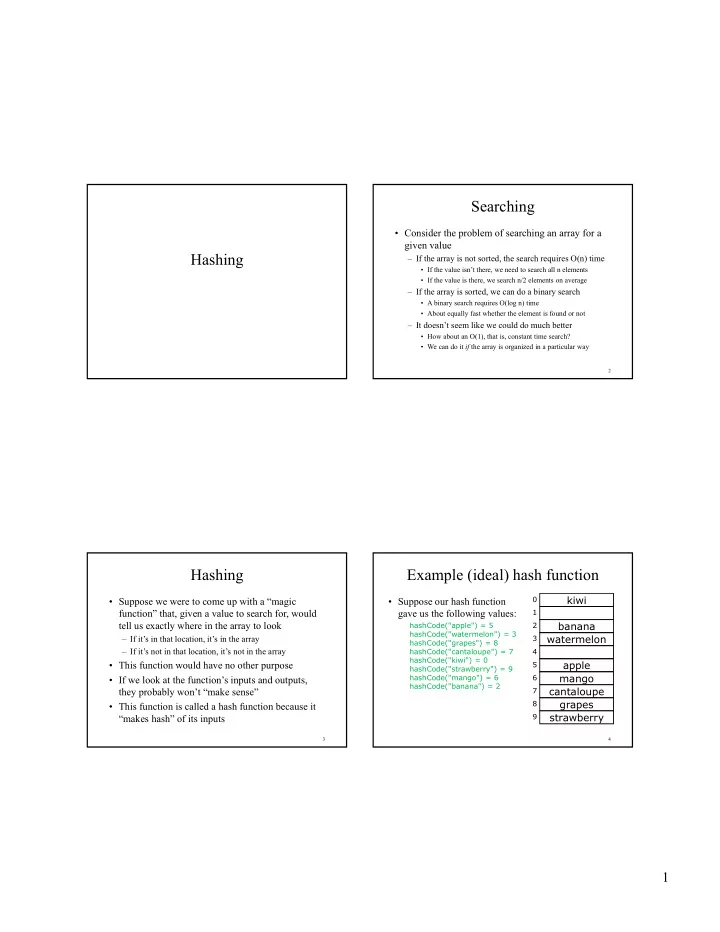
  • Consider the problem of searching an array for a

given value

– If the array is not sorted, the search requires O(n) time

  • If the value isn’t there, we need to search all n elements
  • If the value is there, we search n/2 elements on average

– If the array is sorted, we can do a binary search

  • A binary search requires O(log n) time
  • About equally fast whether the element is found or not

– It doesn’t seem like we could do much better

  • How about an O(1), that is, constant time search?
  • We can do it if the array is organized in a particular way

3

Hashing

  • Suppose we were to come up with a “magic

function” that, given a value to search for, would tell us exactly where in the array to look

– If it’s in that location, it’s in the array – If it’s not in that location, it’s not in the array

  • This function would have no other purpose
  • If we look at the function’s inputs and outputs,

they probably won’t “make sense”

  • This function is called a hash function because it

“makes hash” of its inputs

4

Example (ideal) hash function

  • Suppose our hash function

gave us the following values:

hashCode("apple") = 5 hashCode("watermelon") = 3 hashCode("grapes") = 8 hashCode("cantaloupe") = 7 hashCode("kiwi") = 0 hashCode("strawberry") = 9 hashCode("mango") = 6 hashCode("banana") = 2

kiwi banana watermelon apple mango cantaloupe grapes strawberry

1 2 3 4 5 6 7 8 9

slide-2
SLIDE 2

2

5

Why hash tables?

  • We don’t (usually) use

hash tables just to see if something is there or not—instead, we put key/value pairs into the table

– We use a key to find a place in the table – The value holds the information we are actually interested in

robin sparrow hawk seagull bluejay

  • wl

. . . 141 142 143 144 145 146 147 148 robin info sparrow info hawk info seagull info bluejay info

  • wl info

key value

6

Finding the hash function

  • How can we come up with this magic function?
  • In general, we cannot--there is no such magic

function 

– In a few specific cases, where all the possible values are known in advance, it has been possible to compute a perfect hash function

  • What is the next best thing?

– A perfect hash function would tell us exactly where to look – In general, the best we can do is a function that tells us where to start looking!

7

Example imperfect hash function

  • Suppose our hash function

gave us the following values:

– hash("apple") = 5 hash("watermelon") = 3 hash("grapes") = 8 hash("cantaloupe") = 7 hash("kiwi") = 0 hash("strawberry") = 9 hash("mango") = 6 hash("banana") = 2 hash("honeydew") = 6

kiwi banana watermelon apple mango cantaloupe grapes strawberry

1 2 3 4 5 6 7 8 9

  • Now what?

8

Collisions

  • When two values hash to the same array location,

this is called a collision

  • Collisions are normally treated as “first come, first

served”—the first value that hashes to the location gets it

  • We have to find something to do with the second

and subsequent values that hash to this same location

slide-3
SLIDE 3

3

9

Handling collisions

  • What can we do when two different values attempt

to occupy the same place in an array?

– Solution #1: Search from there for an empty location

  • Can stop searching when we find the value or an empty location
  • Search must be end-around

– Solution #2: Use a second hash function

  • ...and a third, and a fourth, and a fifth, ...

– Solution #3: Use the array location as the header of a linked list of values that hash to this location

  • All these solutions work, provided:

– We use the same technique to add things to the array as we use to search for things in the array

10

Insertion, I

  • Suppose you want to add

seagull to this hash table

  • Also suppose:

– hashCode(seagull) = 143 – table[143] is not empty – table[143] != seagull – table[144] is not empty – table[144] != seagull – table[145] is empty

  • Therefore, put seagull at

location 145

robin sparrow hawk bluejay

  • wl

. . . 141 142 143 144 145 146 147 148 . . .

seagull

11

Searching, I

  • Suppose you want to look up

seagull in this hash table

  • Also suppose:

– hashCode(seagull) = 143 – table[143] is not empty – table[143] != seagull – table[144] is not empty – table[144] != seagull – table[145] is not empty – table[145] == seagull !

  • We found seagull at location

145

robin sparrow hawk bluejay

  • wl

. . . 141 142 143 144 145 146 147 148 . . .

seagull

12

Searching, II

  • Suppose you want to look up

cow in this hash table

  • Also suppose:

– hashCode(cow) = 144 – table[144] is not empty – table[144] != cow – table[145] is not empty – table[145] != cow – table[146] is empty

  • If cow were in the table, we

should have found it by now

  • Therefore, it isn’t here

robin sparrow hawk bluejay

  • wl

. . . 141 142 143 144 145 146 147 148 . . .

seagull

slide-4
SLIDE 4

4

13

Insertion, II

  • Suppose you want to add

hawk to this hash table

  • Also suppose

– hashCode(hawk) = 143 – table[143] is not empty – table[143] != hawk – table[144] is not empty – table[144] == hawk

  • hawk is already in the table,

so do nothing

robin sparrow hawk seagull bluejay

  • wl

. . . 141 142 143 144 145 146 147 148 . . .

14

Insertion, III

  • Suppose:

– You want to add cardinal to this hash table

– hashCode(cardinal) = 147

– The last location is 148 – 147 and 148 are occupied

  • Solution:

– Treat the table as circular; after 148 comes 0 – Hence, cardinal goes in location 0 (or 1, or 2, or ...) robin sparrow hawk seagull bluejay

  • wl

. . . 141 142 143 144 145 146 147 148

15

Clustering

  • One problem with the above technique is the tendency to

form “clusters”

  • A cluster is a group of items not containing any open slots
  • The bigger a cluster gets, the more likely it is that new

values will hash into the cluster, and make it ever bigger

  • Clusters cause efficiency to degrade
  • Here is a non-solution: instead of stepping one ahead, step n

locations ahead

– The clusters are still there, they’re just harder to see – Unless n and the table size are mutually prime, some table locations are never checked

16

Efficiency

  • Hash tables are actually surprisingly efficient
  • Until the table is about 70% full, the number of

probes (places looked at in the table) is typically

  • nly 2 or 3
  • Sophisticated mathematical analysis is required to

prove that the expected cost of inserting into a hash table, or looking something up in the hash table, is O(1)

  • Even if the table is nearly full (leading to long

searches), efficiency is usually still quite high

slide-5
SLIDE 5

5

17

Solution #2: Rehashing

  • In the event of a collision, another approach is to rehash:

compute another hash function

– Since we may need to rehash many times, we need an easily computable sequence of functions

  • Simple example: in the case of hashing Strings, we might

take the previous hash code and add the length of the String to it

– Probably better if the length of the string was not a component in computing the original hash function

  • Possibly better yet: add the length of the String plus the

number of probes made so far

– Problem: are we sure we will look at every location in the array?

  • Rehashing is a fairly uncommon approach, and we won’t

pursue it any further here

18

Solution #3: Bucket hashing

  • The previous

solutions used open hashing: all entries went into a “flat” (unstructured) array

  • Another solution is to

make each array location the header of a linked list of values that hash to that location

robin sparrow hawk bluejay

  • wl

. . . 141 142 143 144 145 146 147 148 . . .

seagull

19

The hashCode function

  • public int hashCode() is defined in Object
  • Like equals, the default implementation of

hashCode just uses the address of the object—

probably not what you want for your own objects

  • You can override hashCode for your own objects
  • As you might expect, String overrides hashCode

with a version appropriate for strings

  • Note that the supplied hashCode method does not

know the size of your array—you have to adjust the returned int value yourself

20

Writing your own hashCode method

  • A hashCode method must:

– Return a value that is (or can be converted to) a legal array index – Always return the same value for the same input

  • It can’t use random numbers, or the time of day

– Return the same value for equal inputs

  • Must be consistent with your equals method
  • It does not need to return different values for

different inputs

  • A good hashCode method should:

– Be efficient to compute – Give a uniform distribution of array indices – Not assign similar numbers to similar input values

slide-6
SLIDE 6

6

21

Other considerations

  • The hash table might fill up; we need to be

prepared for that

– Not a problem for a bucket hash, of course

  • You cannot delete items from an open hash table

– This would create empty slots that might prevent you from finding items that hash before the slot but end up after it – Again, not a problem for a bucket hash

  • Generally speaking, hash tables work best when

the table size is a prime number

22

Hash tables in Java

  • Java provides two classes, Hashtable and

HashMap classes

  • Both are maps: they associate keys with values
  • Hashtable is synchronized; it can be accessed

safely from multiple threads

– Hashtable uses an open hash, and has a rehash method,

to increase the size of the table

  • HashMap is newer, faster, and usually better, but it

is not synchronized

– HashMap uses a bucket hash, and has a remove method

23

Hash table operations

  • Both Hashtable and HashMap are in java.util
  • Both have no-argument constructors, as well as

constructors that take an integer table size

  • Both have methods:

– public Object put(Object key, Object value)

  • (Returns the previous value for this key, or null)

– public Object get(Object key) – public void clear() – public Set keySet()

  • Dynamically reflects changes in the hash table

– ...and many others

24

The End