Second Programming Assignment l Parallel Implementation of Minimum - - PowerPoint PPT Presentation

second programming assignment
SMART_READER_LITE
LIVE PREVIEW

Second Programming Assignment l Parallel Implementation of Minimum - - PowerPoint PPT Presentation

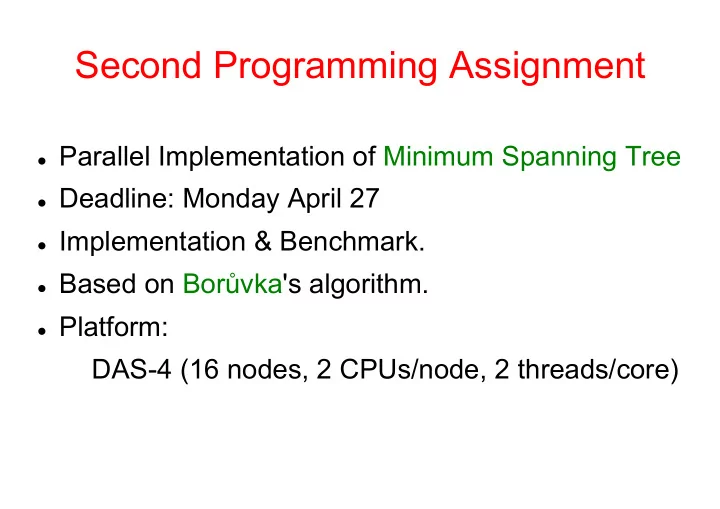
Second Programming Assignment l Parallel Implementation of Minimum Spanning Tree l Deadline: Monday April 27 l Implementation & Benchmark. l Based on Bor vka's algorithm. l Platform: DAS-4 (16 nodes, 2 CPUs/node, 2


slide-1
SLIDE 1

Second Programming Assignment

l Parallel Implementation of Minimum Spanning Tree l Deadline: Monday April 27 l Implementation & Benchmark. l Based on Borůvka's algorithm. l Platform:

DAS-4 (16 nodes, 2 CPUs/node, 2 threads/core)

slide-2
SLIDE 2

Second Programming Assignment

l Parallelization only to be done by distributing

the work over different nodes. So, per node

  • nly one CPU core and one thread will be used.

So, the maximum degree of parallelism is limited to 16 !!!

l Test graphs are taken from the UF Matrix

  • Collection. Three of which were selected:

mouse_gene ( 29M nnz), ldoor ( 42M nnz), nkpkkt240 (760M nnz).

slide-3
SLIDE 3

A Short DAS History (1)

l DAS configurations at Leiden University. l DAS3 (2007): 32 nodes

  • Each node: 2 CPUs (single core), 4GB RAM
  • Totals: 64 CPUs / 64 cores / 64 threads, 256GB

RAM

l DAS4 (2011): 16 nodes

  • Each node: 2 CPUs (4 cores, 2 threads/core), 48GB

RAM

  • Totals: 32 CPUs / 128 cores / 256 threads, 768GB

RAM

slide-4
SLIDE 4

A Short DAS History (2)

l DAS5 (2015): 24 nodes

  • Each node: 2 CPUs (8 cores, 2 threads/core), 64GB

RAM

  • Totals: 48 CPUs / 384 cores / 768 threads, 1536GB

RAM

200 400 600 800 1000 1200 1400 1600 1800 2007 2011 2015 Cores Threads Memory (GB)

slide-5
SLIDE 5

MPI

l Communication between processes in a

distributed program is typically implemented using MPI: Message Passing Interface.

l MPI is a generic API that can be implemented

in different ways:

  • Using specific interconnect hardware, such as

InfiniBand.

  • Using TCP/IP over plain Ethernet.
  • Or even used (emulated) on Shared Memory for

inter process communication on the same node.

slide-6
SLIDE 6

Some MPI basic functions

l #include <mpi.h> l Initialize library:

MPI_Init(&argc, &argv);

l Determine number of processes that take part:

int n_procs; MPI_Comm_size(MPI_COMM_WORLD, &n_procs); (MPI_COMM_WORLD is the initially defined universe

intracommunicator for all processes)

l Determine ID of this process:

int id; MPI_Comm_rank(MPI_COMM_WORLD, &id);

slide-7
SLIDE 7

Sending Messages

MPI_Send(buffer,count,datatype,dest,tag,comm);

Ø buffer: pointer to data buffer. Ø count: number of items to send. Ø datatype: data type of the items (see next slide).

All items must be of the same type.

Ø dest: rank number of destination. Ø tag: message tag (integer), may be 0.

You can use this to distinguish between different messages.

Ø comm: communicator, for instance MPI_COMM_WORLD.

Note: this is a blocking send!

slide-8
SLIDE 8

MPI data types

You must specify a data type when performing MPI transmissions.

l For instance for built-in C types:

  • "int" translates to MPI_INT
  • "unsigned int" to MPI_UNSIGNED
  • "double" to MPI_DOUBLE, and so on.

l You can define your own MPI data types, for

example if you want to send/receive custom structures.

slide-9
SLIDE 9

Other calls

l MPI_Recv() l MPI_Isend(), MPI_Irecv()

  • Non-blocking send/receive

l MPI_Scatter(), MPI_Gather() l MPI_Bcast() l MPI_Reduce()

slide-10
SLIDE 10

Shutting down

l MPI_Finalize()

slide-11
SLIDE 11

Example: Computing Pi

Source: http://www.mcs.anl.gov/research/projects/mpi/tutorial/ mpiexmpl/src/pi/C/ int main(int argc, char *argv[]) { int done = 0, n, myid, numprocs, i; double PI25DT = 3.141592653589793238462643; double mypi, pi, h, sum, x; MPI_Init(&argc,&argv); MPI_Comm_size(MPI_COMM_WORLD,&numprocs); MPI_Comm_rank(MPI_COMM_WORLD,&myid);

slide-12
SLIDE 12

while (!done) { if (myid == 0) { printf("Enter number of intervals: (0 quits)"); scanf("%d",&n); } MPI_Bcast(&n, 1, MPI_INT, 0, MPI_COMM_WORLD); if (n == 0) break; h = 1.0 / (double) n; sum = 0.0; for (i = myid + 1; i <= n; i += numprocs) { x = h * ((double)i - 0.5); sum += 4.0 / (1.0 + x*x); } mypi = h * sum; MPI_Reduce(&mypi, &pi, 1, MPI_DOUBLE, MPI_SUM, 0, MPI_COMM_WORLD); if (myid == 0) printf("pi = approximately %.16f, Error is %.16f\n", pi, fabs(pi - PI25DT)); } MPI_Finalize(); return 0; }

slide-13
SLIDE 13

Compiling and Running

l Compile using "mpicc", this automatically links

in necessary libraries.

l Run the program using "mpirun". On systems

like DAS, mpirun is started from a "job script”.

l The job script is submitted to the job scheduler,

which will run your job once your resource reservation can be fulfilled.

l See assignment text for links to more detailed

manuals.