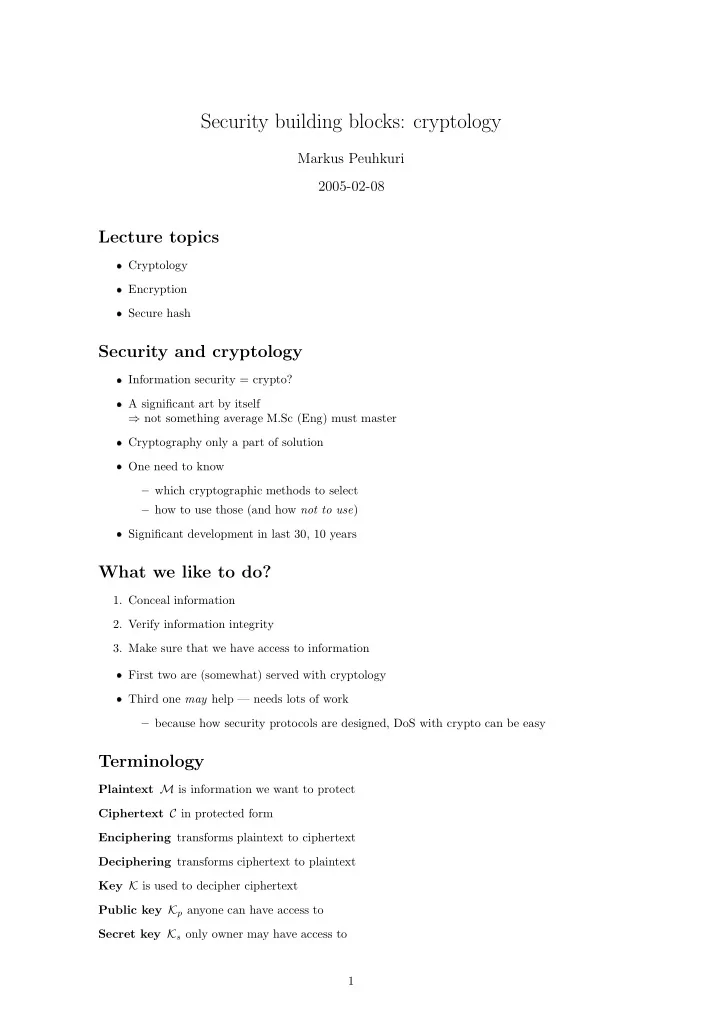
Security building blocks: cryptology Markus Peuhkuri 2005-02-08 - - PDF document

security building blocks cryptology
SMART_READER_LITE
LIVE PREVIEW

Security building blocks: cryptology Markus Peuhkuri 2005-02-08 - - PDF document

Security building blocks: cryptology Markus Peuhkuri 2005-02-08 Lecture topics Cryptology Encryption Secure hash Security and cryptology Information security = crypto? A significant art by


slide-1
SLIDE 1

Security building blocks: cryptology

Markus Peuhkuri 2005-02-08

Lecture topics

  • Cryptology
  • Encryption
  • Secure hash

Security and cryptology

  • Information security = crypto?
  • A significant art by itself

⇒ not something average M.Sc (Eng) must master

  • Cryptography only a part of solution
  • One need to know

– which cryptographic methods to select – how to use those (and how not to use)

  • Significant development in last 30, 10 years

What we like to do?

  • 1. Conceal information
  • 2. Verify information integrity
  • 3. Make sure that we have access to information
  • First two are (somewhat) served with cryptology
  • Third one may help — needs lots of work

– because how security protocols are designed, DoS with crypto can be easy

Terminology

Plaintext M is information we want to protect Ciphertext C in protected form Enciphering transforms plaintext to ciphertext Deciphering transforms ciphertext to plaintext Key K is used to decipher ciphertext Public key Kp anyone can have access to Secret key Ks only owner may have access to 1

slide-2
SLIDE 2

Message digest H = h(M), fixed length value Attacks to defeat crypto ciphertext only is known, and one tries to find corresponding plaintext (and key) known plaintext and corresponding known ciphertext: one tries to find key chosen plaintext attack: attacker can feed plaintexts to system and receive ciphertexts

Kerckhoffs’ six design principles

  • 1. The system must be practically, if not mathematically, indecipherable;
  • 2. It must not be required to be secret, and it must be able to fall into the hands of the enemy

without inconvenience;

  • 3. Its key must be communicable and retainable without the help of written notes, and change-

able or modifiable at the will of the correspondents;

  • 4. It must be applicable to telegraphic correspondence;
  • 5. It must be portable, and its usage and function must not require the concourse of several

people;

  • 6. Finally, it is necessary, given the circumstances that command its application, that the

system be easy to use, requiring neither mental strain nor the knowledge of a long series of rules to observe. The more system has secrets, the more brittle it is. The key is the easiest component to change. This is also known as Shannon’s Maxim.

Design principles

  • Confusion

– complex relationship between K and C – e.g. substitution

  • Diffusion

– no statistical relationship between M and C – one-bit change in M results change in every bit in C with P = 1

2

– avalanche effect – e.g. transposition

Ciphers

  • Substitution cipher

– plaintext M enciphers always to C with key K – Caesar cipher: C = (M + K) mod 26, K = 3 – modern block ciphers (block size 64 bits(8 bytes: 1.8 ∗ 1019 different blocks) or more)

  • One-time pad

– unbreakable cipher (Vernam cipher) – if K used only once – K as long as M – stream ciphers emulate

  • Message digests

– take arbitrary long M producing fixed-length digest D 2

slide-3
SLIDE 3

Block ciphers

  • Few basic types

– SP-networks (substitution-permutation networks) – Feistel ciphers

  • data halved, halves mixed with round function
  • Operation modes

electronic code book (ECB) used as substitution cipher – same M encrypts to same C with same K – vulnerable to cut-and-splice cipher block chaining (CBC) uses previous ciphertext Ci−1 ⊕ Mi – initialisation vector IV1 ⇒ randomises first block IV ⊕ M1 – still possible to defeat integrity

  • utput feedback (OFB) used as stream cipher K1 = {IV}k, Ki = {Ki−1}k

counter encryption Ki = {IV + i}k – possible to parallelise cipher feedback C is encrypted with K and XOR with plaintext – recovers from transmission errors message authentication code (MAC) to verify integrity – CBC mode, all but latest block discarded: keyed hash function

Data Encryption Standard (DES)

  • Feistel cipher
  • Developed by IBM in 1970s, modified by NSA, federal standard (FIPS-46) 1976
  • Key length 56 bits

⇒ too short for nowadays – 1998 EFF “Deep Crack” (cost USD250,000) broke DES challenge in 56 hours with brute force

  • Four weak and 16 semi-weak keys
  • More lifetime with Triple DES

– C = DESK3(DES−1

K2(DESK1(M)))

– efficient key length 112 bits, while some advertise 168 bit key The second step could be also DES encryption, but on some hardware-based systems decrypting gives better performance.

Advanced Encryption Standard (AES)

  • SP-network
  • Subset of Rijndael (fixed block length 128 bits)
  • Efficient also on small systems (smartcards etc.)

– AES-128 about as fast as DES2 ⇒ 3 times faster than Triple DES

  • Key length 128, 196 or 256, the shortest not for Top Secret in US
  • FIPS-197

1Can be embedded into message 2On modern 32-bit computer.

3

slide-4
SLIDE 4

Stream ciphers

  • Cryptographic secure pseudo-random number generator
  • XOR by bit or by byte (synchronous stream cipher)
  • Popular in communications

– byte-sized: no need to pad blocks – simple implementation on hardware: for example A5/1 needs only three shift registers (19, 22, and 23 bits) and some XOR ports

  • Vulnerable to bit-fiddling: if one knows that interesting bit at position N should be inverted,
  • ne can just change it from bit stream. On the other hand this provides some protection

from transmission errors: with block ciphers one will end with invalid data onwards.

  • RC4 used in SSL, WEP
  • A5/1 and A5/2 in GSM
  • Both have security problems, A5/2 very weak

Asymmetric ciphers

  • Symmetric cipher provides us secrecy only if we can communicate key to other party secretly

⇒ key management becomes problem

  • Problem that is

– easy to construct – hard solve without – specific knowledge (private key)

  • NP complete problems are candidate
  • Providing digital signatures without third party

RSA

  • Factoring large numbers is hard
  • Public key:

– n = pq, p and q large primes – e relatively prime for (p − 1)(q − 1)

  • Private key:

– d = e−1 mod ((p − 1)(q − 1))

  • Encrypting: c = me mod n
  • Decrypting: m = cd mod n

ElGamal

  • Discrete logarithm in finite field
  • y = gx mod p, prime p, random numbers g < p, x < p
  • Public key: y, g, and p
  • Private key: x
  • Signature: random k (relatively prime for p − 1, must be kept secret)

4

slide-5
SLIDE 5

– a = gk mod p, solve b from M = (xa + kb) mod (p − 1) – verify: yaabmod = gM mod p

  • Encrypting: a = gk mod p, b = ykM mod p
  • Decrypting: M = b/ax mod p

Message digest functions

  • Calculating signature for a long document

– time-consuming – as long (or longer) than original document

  • Verifying document integrity

– signed digest – digest stored / communicated securely. For example, there can be a list of hashes of all system programs. If any of those is modified, it may be detected comparing hashes.

  • Cryptographic checksum function
  • 1. H = h(M) easy to compute
  • 2. infeasible to find M for given H
  • 3. infeasible to find M, M′ such that h(M) = h(M′)
  • Birthday attack: 2

n 2

Secure hash algorithms in use

MD5 designed in 1991

  • 128-bit
  • some weakness found, maybe insecure for demanding applications

SHA-1 federal standard 180-2

  • 160-bit
  • riginal SHA (1993, SHA-0) vulnerable to 240
  • longer versions to 512 bits; not analysed in depth

RIPEMD-160 European algorithm

  • 160-bit, also longer ones

HMAC: keyed hash

  • Used for authentication with shared secret
  • h(K ⊕ opad||h(K ⊕ ipad||M))

– ipad and opad select different bits from K

  • Protects K from eavesdropping

What cipher to choice

  • How to distribute keys
  • What trust model one has
  • Any performance constrains
  • Using public algorithms gives comfort

5

slide-6
SLIDE 6

Failures on ciphers

  • Even if you take a good algorithm, wrong use may result bad results
  • Bad algorithm is always bad
  • Do not modify cryptographic algorithm: adding rounds or increasing key length may result

in worse algorithm.

  • Check that you use cryptographic as planned

– stream ciphers: use different IV each time – MS Office uses same IV for all saves of same document

WEP: Wired Equivalent Privacy

  • Use of encryption optional

⇒ system administration failures

  • No key management: use of shared key
  • CRC-32 used for integrity check

– linear protocol: possible to fix changes with stream cipher

  • IV only 24 bit

– wraps around in a day (or faster) – shared key ⇒same IV by multiple hosts

  • Attacks

– statistical analysis for packets with same IV – injecting known traffic e.g. from Internet enables decrypting packets with same IV – if RC4 stream for one packet is known, it is possible to send encrypted packets with same IV – bit-fiddling attacks to change content or destination of packets – bad key generators in software: key space is 221, not 264 – dictionary attack on keys

Key lengths: what is safe

  • How long information must stay secret
  • Symmetric ciphers

– risk: fundamental weakness will be found or advances in computing – 64 bit cipher broken: RSA RC5 challenge – 128 bits should be OK – 196 – 256 bit AES key for Top Secret

  • Asymmetric ciphers

– risk: advance in mathematics or in computing – 576-bit key factored prime bits symmetric 1024 80 2048 112 3072 128 15360 256 – elliptic curves: double to symmetric keys 6

slide-7
SLIDE 7

Some performance figures for 1 KiB blocks

Algorithm relative speed DES CBC 1000 RC4 3638 AES 128 921 AES 196 796 AES 256 705 RSA 1024 sign 7 / 1000 RSA 1024 verify 132 / 1000 RSA 4096 sign 0.2 / 1000 RSA 4096 verify 12 / 1000 MD5 4992 SHA-1 3360

Summary

  • Bits do not matter (much)
  • Important to select right algorithm for right use
  • Hardware used may impose some limitations

7