Security aid in producing vulnerability free code (bounds primary - - PowerPoint PPT Presentation

security
SMART_READER_LITE
LIVE PREVIEW

Security aid in producing vulnerability free code (bounds primary - - PowerPoint PPT Presentation

Security aid in producing vulnerability free code (bounds primary topic of the paper for today protect code from people with access to hardware checking, no-execute bit) aid in producing vulnerability free code (bounds secondary topic of the


slide-1
SLIDE 1

Security

1

To read more…

This day’s papers:

Smith and Weingart, “‘Building a high-performance, programmable secure coprocessor”, 1998, Sections 1-6, 10

Supplementary reading:

Anderson, Security Engineering, Chapter 16. http://www.cl.cam.ac.uk/~rja14/book.html Costan and Devadas, Intel SGX Explained

1

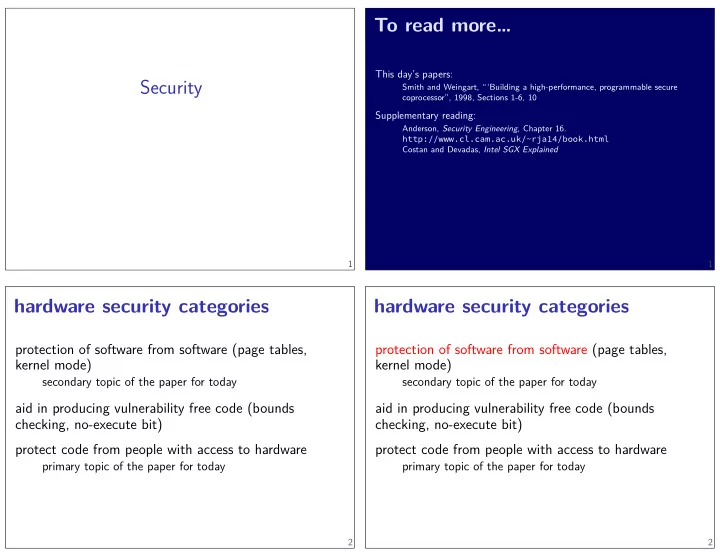
hardware security categories

protection of software from software (page tables, kernel mode)

secondary topic of the paper for today

aid in producing vulnerability free code (bounds checking, no-execute bit) protect code from people with access to hardware

primary topic of the paper for today

2

hardware security categories

protection of software from software (page tables, kernel mode)

secondary topic of the paper for today

aid in producing vulnerability free code (bounds checking, no-execute bit) protect code from people with access to hardware

primary topic of the paper for today

2

slide-2
SLIDE 2

major comments on the paper

use cases for secure coprocessors? performance loss?

3

some secure coprocessor use cases

authentication tokens certifjcate authorities banking usual goal: confjdence private key isn’t stolen if device lost — plan to switch to new one

4

protection: dual-mode operation

kernel mode — operating systems runs with extra privileges privileged instructions require kernel mode kernel mode entered only using OS-controlled code example privileged instructions:

set page table disable interrupts confjgure I/O device

5

multiple protection levels

a lot of hardware supports multiple protection levels lower level/outer ring — strictly more access e.g. x86:

system management mode (“ring -2”) hypervisor mode (“ring -1”) ring 0 (“kernel mode”) ring 1 ring 2 ring 3 (“user mode”)

6

slide-3
SLIDE 3

emulating multiple levels

program ‘guest’ OS virtual machine monitor hardware conceptual layering user mode kernel mode system call (to kernel mode) run handler set page table to user mode run handler

7

emulating multiple levels

program ‘guest’ OS virtual machine monitor hardware conceptual layering user mode kernel mode system call (to kernel mode) run handler set page table to user mode run handler

7

emulating multiple levels

program ‘guest’ OS virtual machine monitor hardware conceptual layering user mode kernel mode system call (to kernel mode) run handler set page table to user mode run handler

7

recall: page tables

0x12345678 program (virtual) address 0x00044678 real (physical) address page table lookup

virtual page # physical page # permissions 00000 (invalid)

none

00001 00434

read/exec

00002 00454

read/write

00003 00042

read/write

… …

12344 00145

read/execute

12345 00149

read/execute

12346 00151

read/execute

… …

page table

8

slide-4
SLIDE 4

recall: hierarchical page tables

CR3 32 39 40 47 48 55 56 63 8 16 24 31 15 7 23

... ...

4K memory page Linear address: 64 bit PD entry

... ...

page directory

... ...

PDP entry page-directory- pointer table 64 bit PT entry

... ...

page table

... ...

PML4 entry PML4 table 9 9 40* 9 9 12 sign extended *) 40 bits aligned to a 4-KByte boundary

Diagram: Wikimedia / RokerHRO

9

tagged architectures

key trick: seperate pointer instructions

  • therwise pointer tag becomes 0

Figure from Carter et al, “Hardware Support for Fast Capability-Based Addressing”

10

hardware ratchets

11

hardware ratchets: code loading

12

slide-5
SLIDE 5

hardware security categories

protection of software from software (page tables, kernel mode)

secondary topic of the paper for today

aid in producing vulnerability free code (bounds checking, no-execute bit) protect code from people with access to hardware

primary topic of the paper for today

13

hardware-assisted bounds checking

“page table” for array bounds pointer passed “bounds-check” instruction

14

hardware-assisted bounds checking

“page table” for array bounds pointer passed “bounds-check” instruction

14

hardware-assisted bounds checking

“page table” for array bounds pointer passed “bounds-check” instruction

14

slide-6
SLIDE 6
  • ther hardware assistence (1)

write XOR execute

memory can only be writable or executable, not both makes bufger overfmows hardware (not impossible)

trap on access to user-accessible memory in kernel mode

Intel name: “Supervisor Mode Access Pervention”

  • perating system disables when intentionally accessing

user data prevents accidental use of user pointers by OS

15

hardware security categories

protection of software from software (page tables, kernel mode)

secondary topic of the paper for today

aid in producing vulnerability free code (bounds checking, no-execute bit) protect code from people with access to hardware

primary topic of the paper for today

16

tamper ____

tamper evidence tamper resistence tamper detection tamper response

17

tamper ____

tamper evidence tamper resistence tamper detection tamper response

17

slide-7
SLIDE 7

tamper-evidence

Appel, “Security Seals on Voting Machines: A Case Study”

18

tamper ____

tamper evidence tamper resistence tamper detection tamper response

19

tamper-resistence/evidence

2nd image: HexView “Inside YubiKey Neo” http://www.hexview.com/~scl/neo/

20

tamper ____

tamper evidence tamper resistence tamper detection tamper response

21

slide-8
SLIDE 8

tamper-detection

add sensor to detect tampering e.g. checksum of code e.g. switch if case is opened

22

tamper ____

tamper evidence tamper resistence tamper detection tamper response

23

tamper-response

tamper-detection erase data! disable machine!

24

secure co-processor protection goals

device has secret data tampering must not reveal secrets tampering must not let new software access secrets

25

slide-9
SLIDE 9

kinds of “tampering”

replacing software accessing the memory with another device physically manipulating the device

26

kinds of “tampering”

replacing software accessing the memory with another device physically manipulating the device

26

securing the software

basic idea: load new software = erase old secrets

27

supporting software upgrades

verify with cryptography!

28

slide-10
SLIDE 10

public key cryptography (1)

Smith and Weingart make extensive use of digital signatures digital signatures use a public/private keypair example use case: A wants to email B and have B know A wrote the email

29

public key-cryptography (2)

A generates keypair for communicating with B public key: given to B; serves as identity/name

assumed known by/safe to tell everyone

private key: kept secret by A

assumed no one else has private key

30

public key cryptography (3)

two mathematical functions: signature = Sign(A’s private key, message) correct? = Verify(A’s public key, message, signature) Verify will only say correct if private key was used

computationally infeasible to “forge” signature

A uses Sign operation, sends message and signature B uses Verify operation; rejects if it says “not correct”

31

cryptographic software update

application is loaded with public key updates to application must include Sign(private key, the code) if not, secrets are wiped on update

32

slide-11
SLIDE 11

signature chain

33

verifying signature chain

You get:

Sign(factoryprivkey, “Device PubKey 1 is a device key”) Sign(deviceprivkey1, “Device PubKey 2 is a device key”) Sign(deviceprivkey2, “I generated this output”)

need to check all signatures in the chain can be used for application updates/messages

chain is device to OS to application

34

enforcing updates zeroing

checks signatures zeroes data

35

kinds of “tampering”

replacing software accessing the memory with another device physically manipulating the device

36

slide-12
SLIDE 12

secure(?) packaging

Figure from Ross Anderson, Security Engineering: A Guide to Building Dependable Distributed Systems

37

secure(?) packaging

Figure from Ross Anderson, Security Engineering: A Guide to Building Dependable Distributed Systems

38

power analysis

Messerges et al, “Investigations of Power Analysis Attacks on Smartcards”

39

memory permanence

values can be “burned” into some memories even RAMs that “go away” when they lose power

40

slide-13
SLIDE 13

IBM’s solution

circuitry to “bufger” power to processor

limit information available from power consumption

active SRAM erasing circuitry

cannot just cut power and hope

move values in SRAM to avoid “burning” them in

41

kinds of “tampering”

replacing software accessing the memory with another device physically manipulating the device

42

ways to make devices do weird things

all these can break CPU operation, or SRAM zeroing: temperature ionizing radiation changing voltages changing clock signals … probably lots more

43

IBM’s way of dealing with weirdness

sensors: temperature sensor radiation sensor voltage sensor phase-locked loops to sync clocks

44

slide-14
SLIDE 14

focused ion beam (on a smart card)

Kommerling and Kuhn, “Design Principles for Tamper-Resistant Smartcard Processors”

45

attestation

attestation — know what code is running mechanism private key loaded at factory loading code (miniboot) signs message saying:

what application it loaded the public part of a keypair it generated

this message is a certifjcate for the application

46

attestation — verifying

application signs “yes, I really computed X” using its private key anyone can verify this with miniboot’s certifjcate

47

attestation use case — public cloud

I run a VM on Amazon How can I verify Amazon is really running my code? How can I keep Amazon from getting my data?

48

slide-15
SLIDE 15

attestation use case — public cloud

I run a VM on Amazon How can I verify Amazon is really running my code? How can I keep Amazon from getting my data?

48

attestation use case — public cloud

I run a VM on Amazon How can I verify Amazon is really running my code? How can I keep Amazon from getting my data?

48

cryptography assumption

known public keys for signatures can setup encrypted communication … even in the presence of insecure networks

49

Secure Enclaves and SGX

Intel CPU extension called “SGX” “Secure Enclaves” provides isolated execution and remote attestation

50

slide-16
SLIDE 16

trusted computing

Costan and Devadas, “Intel SGX Explained”

51

SGX isolation

run on same CPU as potentially malicious OS CPU must enforce protections OS gives memory to enclave CPU prevents OS from accessing enclave memory

modifjcation to pagetable lookup memory encryption/authentication

efgectively CPU microcode has mini-OS

52

SGX paging

OS can’t control memory?? SGX can ask for pages to be removed from enclave memory memory is encrypted before being released to OS

53

SGX and physical attacks

SGX includes memory encryption processor encrypts data that goes ofg-chip also uses a message authentication code to detect tampering with data in memory

54

slide-17
SLIDE 17

SGX and side-channel attacks

SGX doesn’t protect against side-channels how long does computation take? cache timing — like in the Bernstein paper (much earlier in semester?) OS/HW owner can do a lot to observe system

much more than scenario in Bernstein

55

SGX and physical attacks

hope — physically reading key is hard

very small process size hard to use key

56

  • bserving cache behavior

normally, it’s hard to isolate OS behavior from efgects of other things on the caches, but the OS can fjx that

Costan and Devadas, “Intel SGX Explained”

57

  • ther side-channel tricks

OS can get make every enclave access page fault

full page-level memory access pattern

OS can run on other hyperthread!

sometimes with shared branch predictors

OS can make interrupts happen all the time is this a security problem?

58

slide-18
SLIDE 18

research areas in HW security

hardware verifjcation

what if I don’t trust Intel? what if I don’t trust my outsourced fab?

running sensitive code efficiently on same HW support for OS security

with low overhead easy to verify correctness

efficient side-channel resistence

59