Selv-optimaliserende og eksplisitte metoder for online - - PDF document

selv optimaliserende og eksplisitte metoder for online
SMART_READER_LITE
LIVE PREVIEW

Selv-optimaliserende og eksplisitte metoder for online - - PDF document

Selv-optimaliserende og eksplisitte metoder for online optimalisering Sigurd Skogestad Department of Chemical Engineering Norwegian University of Science and Tecnology (NTNU) Trondheim, Norway Effective Implementation of optimal operation


slide-1
SLIDE 1

1

1

Selv-optimaliserende og eksplisitte metoder for online

  • ptimalisering

Sigurd Skogestad Department of Chemical Engineering Norwegian University of Science and Tecnology (NTNU) Trondheim, Norway

Effective Implementation of optimal operation using Off-Line Computations

Servomøtet, Trondheim, Oktober 2009

2

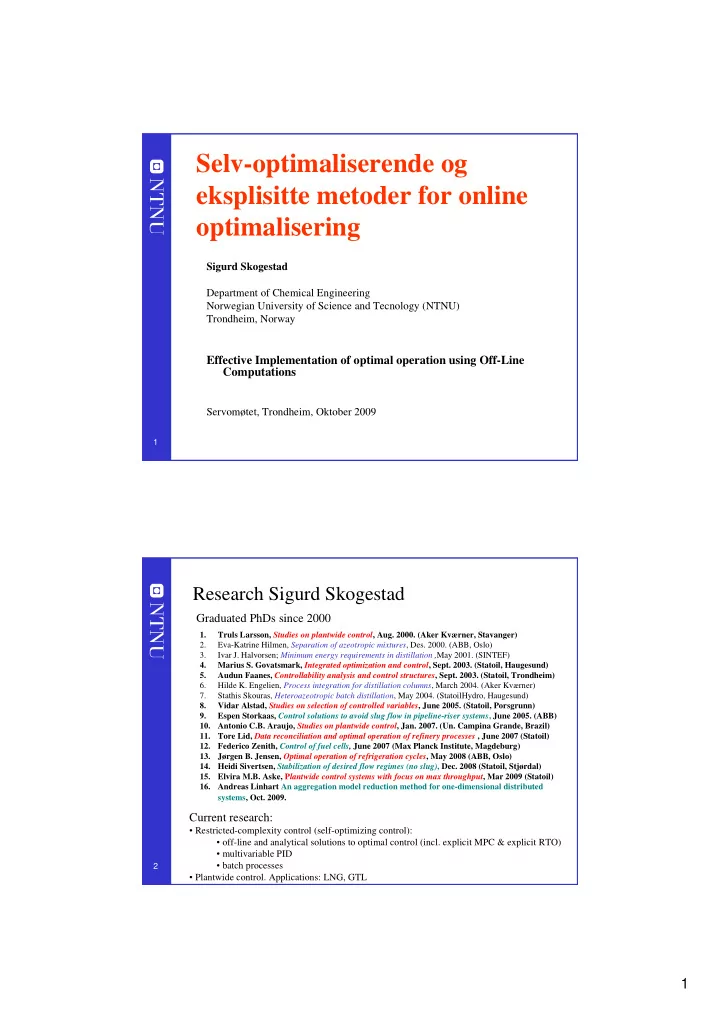
Research Sigurd Skogestad

1. Truls Larsson, Studies on plantwide control, Aug. 2000. (Aker Kværner, Stavanger) 2. Eva-Katrine Hilmen, Separation of azeotropic mixtures, Des. 2000. (ABB, Oslo) 3. Ivar J. Halvorsen; Minimum energy requirements in distillation ,May 2001. (SINTEF) 4. Marius S. Govatsmark, Integrated optimization and control, Sept. 2003. (Statoil, Haugesund) 5. Audun Faanes, Controllability analysis and control structures, Sept. 2003. (Statoil, Trondheim) 6. Hilde K. Engelien, Process integration for distillation columns, March 2004. (Aker Kværner) 7. Stathis Skouras, Heteroazeotropic batch distillation, May 2004. (StatoilHydro, Haugesund) 8. Vidar Alstad, Studies on selection of controlled variables, June 2005. (Statoil, Porsgrunn) 9. Espen Storkaas, Control solutions to avoid slug flow in pipeline-riser systems, June 2005. (ABB) 10. Antonio C.B. Araujo, Studies on plantwide control, Jan. 2007. (Un. Campina Grande, Brazil) 11. Tore Lid, Data reconciliation and optimal operation of refinery processes , June 2007 (Statoil) 12. Federico Zenith, Control of fuel cells, June 2007 (Max Planck Institute, Magdeburg) 13. Jørgen B. Jensen, Optimal operation of refrigeration cycles, May 2008 (ABB, Oslo) 14. Heidi Sivertsen, Stabilization of desired flow regimes (no slug), Dec. 2008 (Statoil, Stjørdal) 15. Elvira M.B. Aske, Plantwide control systems with focus on max throughput, Mar 2009 (Statoil) 16. Andreas Linhart An aggregation model reduction method for one-dimensional distributed systems, Oct. 2009.

Current research:

  • Restricted-complexity control (self-optimizing control):
  • off-line and analytical solutions to optimal control (incl. explicit MPC & explicit RTO)
  • multivariable PID
  • batch processes
  • Plantwide control. Applications: LNG, GTL

Graduated PhDs since 2000

slide-2
SLIDE 2

2

3

Outline

  • Implementation of optimal operation
  • Paradigm 1: On-line optimizing control
  • Paradigm 2: "Self-optimizing" control schemes

– Precomputed (off-line) solution

  • Examples
  • Control of optimal measurement combinations

– Nullspace method – Exact local methom – Link to optimal control / Explicit MPC

  • Conclusion

4

y1s

MPC PID

y2s

RTO

u (valves)

Process control: Implementation of optimal operation

slide-3
SLIDE 3

3

5

Optimal operation

  • A typical dynamic optimization problem
  • Implementation: “Open-loop” solutions not robust to disturbances or

model errors

  • Want to introduce feedback

6

Implementation of optimal operation

  • Paradigm 1: On-line optimizing control where measurements are

used to update model and states

  • Paradigm 2: “Self-optimizing” control scheme found by exploiting

properties of the solution

slide-4
SLIDE 4

4

7

Implementation: Paradigm 1

  • Paradigm 1: Online optimizing

control

  • Measurements are primarily

used to update the model

  • The optimization problem is

resolved online to compute new inputs.

  • Example: Conventional MPC
  • This is the “obvious” approach

(for someone who does not know control)

9

Example paradigm 1: On-line optimizing control of Marathon runner

  • Even getting a reasonable model

requires > 10 PhD’s  … and the model has to be fitted to each individual….

  • Clearly impractical!
slide-5
SLIDE 5

5

10

Implementation: Paradigm 2

  • Paradigm 2: Precomputed solutions based on off-line optimization
  • Find properties of the solution suited for simple and robust on-line

implementation

  • Proposed method: Turn optimization into feedback problem.

– Find regions of active constraints and in each region:

  • 1. Control active constraints
  • 2. Control “self-optimizing ” variables for the remaining unconstrained

degrees of freedom

  • “inherent optimal operation”
  • Examples

– Marathon runner – Hierarchical decomposition – Optimal control – Explicit MPC

11

Solution 2 – Feedback (Self-optimizing control)

– What should we control?

Optimal operation - Runner

slide-6
SLIDE 6

6

12

Self-optimizing control: Sprinter (100m)

  • 1. Optimal operation of Sprinter, J=T

– Active constraint control:

  • Maximum speed (”no thinking required”)

Optimal operation - Runner 13

  • Optimal operation of Marathon runner, J=T
  • Any self-optimizing variable c (to control at

constant setpoint)?

  • c1 = distance to leader of race
  • c2 = speed
  • c3 = heart rate
  • c4 = level of lactate in muscles

Optimal operation - Runner

Self-optimizing control: Marathon (40 km)

slide-7
SLIDE 7

7

14

Implementation paradigm 2: Feedback control of Marathon runner

c = heart rate Simplest case: select one measurement

  • Simple and robust implementation
  • Disturbances are indirectly handled by keeping a constant heart rate
  • May have infrequent adjustment of setpoint (heart rate)

measurements 15

Further examples self-optimizing control

  • Marathon runner
  • Central bank
  • Cake baking
  • Business systems (KPIs)
  • Investment portifolio
  • Biology
  • Chemical process plants

Define optimal operation (J) and look for ”magic” variable (c) which when kept constant gives acceptable loss (self-

  • ptimizing control)
slide-8
SLIDE 8

8

16

More on further examples

  • Central bank. J = welfare. u = interest rate. c=inflation rate (2.5%)
  • Cake baking. J = nice taste, u = heat input. c = Temperature (200C)
  • Business, J = profit. c = ”Key performance indicator (KPI), e.g.

– Response time to order – Energy consumption pr. kg or unit – Number of employees – Research spending Optimal values obtained by ”benchmarking”

  • Investment (portofolio management). J = profit. c = Fraction of

investment in shares (50%)

  • Biological systems:

– ”Self-optimizing” controlled variables c have been found by natural selection – Need to do ”reverse engineering” :

  • Find the controlled variables used in nature
  • From this possibly identify what overall objective J the biological system has

been attempting to optimize

17

Example paradigm 2: Optimal operation of chemical plant

  • Hierarchial decomposition based on

time scale separation

Self-optimizing control: Acceptable operation (=acceptable loss) achieved using constant set points (cs) for the controlled variables c cs

Controlled variables c 1. Active constraints 2. “Self-optimizing” variables c

  • for remaining unconstrained

degrees of freedom (u)

  • No or infrequent online
  • ptimization.
  • Controlled variables c are found

based on off-line analysis.

slide-9
SLIDE 9

9

18

Summary feedback approach: Turn

  • ptimization into setpoint tracking

Issue: What should we control to achieve indirect optimal operation ?

Primary controlled variables (CVs):

  • 1. Control active constraints!
  • 2. Unconstrained CVs: Look for “magic” self-
  • ptimizing variables!

Need to identify CVs for each region of active constraints

19

“Magic” self-optimizing variables: How do we find them?

  • Intuition: “Dominant variables” (Shinnar)
  • Is there any systematic procedure?
  • A. Senstive variables: “Max. gain rule” (Gain= Minimum singular value)
  • B. “Brute force” loss evaluation
  • C. Optimal linear combination of measurements, c = Hy
slide-10
SLIDE 10

10

20

Optimal operation

Cost J Controlled variable c c copt

  • pt

J Jopt

  • pt

Unconstrained optimum

21

Optimal operation

Cost J Controlled variable c c copt

  • pt

J Jopt

  • pt

Two problems:

  • 1. Optimum moves because of disturbances d: copt(d)
  • 2. Implementation error, c = copt + n

d

n

Unconstrained optimum

slide-11
SLIDE 11

11

22

Candidate controlled variables c for self-optimizing control Intuitive

  • 1. The optimal value of c should be insensitive to disturbances (avoid

problem 1)

  • 2. Optimum should be flat (avoid problem 2 – implementation error).

Equivalently: Value of c should be sensitive to degrees of freedom u.

  • “Want large gain”, |G|
  • Or more generally: Maximize minimum singular value,

Unconstrained optimum

BAD Good Good

23

Quantitative steady-state: Maximum gain rule

Maximum gain rule (Skogestad and Postlethwaite, 1996): Look for variables that maximize the scaled gain (Gs) (minimum singular value of the appropriately scaled steady-state gain matrix Gs from u to c)

Unconstrained optimum

G u c

slide-12
SLIDE 12

12

24

Why is Large Gain Good?

u J, c Jopt uopt copt

c-copt

Loss G

With large gain G: Even large implementation error n in c translates into small deviation of u from uopt(d) - leading to lower loss

Variation of u

25

  • Operational objective: Minimize cost function J(u,d)
  • The ideal “self-optimizing” variable is the gradient (first-order optimality condition (ref:

Bonvin and coworkers)):

  • Optimal setpoint = 0
  • BUT: Gradient can not be measured in practice
  • Possible approach: Estimate gradient Ju based on measurements y
  • Here alternative approach: Find optimal linear measurement combination

which when kept constant ( § n) minimize the effect of d on loss. Loss = J(u,d) – J(uopt,d); where input u is used to keep c = constant § n

  • Candidate measurements (y): Include also inputs u

“Self-optimizing” variable combinations

Unconstrained degrees of freedom:

slide-13
SLIDE 13

13

26

Optimal measurement combination

H

Unconstrained degrees of freedom:

27

Amazingly simple!

Sigurd is told by Vidar Alstad how easy it is to find H

Optimal measurement combination

  • 1. Nullspace method for n = 0 (Alstad and Skogestad, 2007)

Basis: Want optimal value of c to be independent of disturbances

  • Find optimal solution as a function of d: uopt(d), yopt(d)
  • Linearize this relationship: yopt = F d
  • Want:
  • To achieve this for all values of  d:
  • Always possible to find H that satisfies HF=0 provided
  • Optimal when we disregard implementation error (n)
  • V. Alstad and S. Skogestad, ``Null Space Method for Selecting Optimal Measurement Combinations as Controlled Variables'',

Ind.Eng.Chem.Res, 46 (3), 846-853 (2007).

Unconstrained degrees of freedom:

slide-14
SLIDE 14

14

28

Optimal measurement combination

  • 2. “Exact local method”

(Combined disturbances and implementation errors)

  • V. Alstad, S. Skogestad and E.S. Hori, ``Optimal measurement combinations as controlled variables'', Journal of Process Control, 19,

138-148 (2009).

Optimization problem for optimal combination:

Theorem 1. Worst-case loss for given H (Halvorsen et al, 2003):

Unconstrained degrees of freedom:

Applies to any H (selection/combination)

29

Example: CO2 refrigeration cycle

Unconstrained DOF (u) Control what? c=? pH

slide-15
SLIDE 15

15

30

CO2 refrigeration cycle

Step 1. One (remaining) degree of freedom (u=z) Step 2. Objective function. J = Ws (compressor work) Step 3. Optimize operation for disturbances (d1=TC, d2=TH, d3=UA)

  • Optimum always unconstrained

Step 4. Implementation of optimal operation

  • No good single measurements (all give large losses):

– ph, Th, z, …

  • Nullspace method: Need to combine nu+nd=1+3=4 measurements to have zero

disturbance loss

  • Simpler: Try combining two measurements. Exact local method:

– c = h1 ph + h2 Th = ph + k Th; k = -8.53 bar/K

  • Nonlinear evaluation of loss: OK!

31

Refrigeration cycle: Proposed control structure

Control c= “temperature-corrected high pressure”

slide-16
SLIDE 16

16

32

Summary: Procedure selection controlled variables

  • 1. Define economics (cost J) and operational constraints
  • 2. Identify degrees of freedom and important disturbances
  • 3. Optimize for various disturbances
  • 4. Identify active constraints regions (off-line calculations)

For each active constraint region do step 5-6:

  • 5. Identify “self-optimizing” controlled variables for remaining degrees
  • f freedom
  • 6. Identify switching policies between regions

33

What about optimal control and MPC (model predictive control)?

Paradigm 1: On-line optimizing control where measurements are used to update model and states Paradigm 2: “Self-optimizing” control scheme found by exploiting properties of the solution MPC Optimal control = “Explicit MPC”

slide-17
SLIDE 17

17

34

Example paradigm 2: Feedback implementation of optimal control (LQ)

  • Optimal solution to infinite time dynamic optimization problem
  • Originally formulated as a “open-loop” optimization problem (no

feedback)

  • “By chance” the optimal u can be generated by simple state feedback

u = KLQ x

  • KLQ is obtained off-line by solving Riccatti equations
  • Explicit MPC: Extension using different KLQ in each constraint region

35

Example paradigm 2: Explicit MPC

  • A. Bemporad, M. Morari, V. Dua, E.N. Pistikopoulos, ”The Explicit Linear Quadratic Regulator for Constrained Systems”, Automatica, vol. 38, no. 1, pp. 3-20 (2002).
  • Summary: Two paradigms MPC
  • 1. Conventional MPC: On-line optimization
  • 2. Explicit MPC:

Off-line calculation of KLQ for each region (must determine regions online)

slide-18
SLIDE 18

18

36

Summary Paradigm 2: Precomputed on-line solutions based on off- line optimization

Issues (expected research results for specific application):

  • 1. Find analytical or precomputed solutions suitable for on-line

implementation

  • 2. Find structure of optimal solution for specific problems
  • Typically, identify regions where different set of constraints are active
  • 3. Find good “self-optimizing” variables c to control in each region:
  • Active constraints
  • Good variables or variable combinations (for remaining unconstrained)
  • 4. Find optimal values (or trajectories) for unconstrained variables
  • 5. Determine a switching policy between different regions

37

Conclusion

  • Simple control policies are always preferred in practice (if they exist

and can be found)

  • Paradigm 2: Use off-line optimization and analysis to find simple

near-optimal control policies suitable for on-line implementation

  • Current research: Several interesting extensions

– Optimal region switching – Dynamic optimization – Explicit MPC