SEM Feedback Mostly positive feedback Some issues: Normalisation - - PDF document

sem feedback
SMART_READER_LITE
LIVE PREVIEW

SEM Feedback Mostly positive feedback Some issues: Normalisation - - PDF document

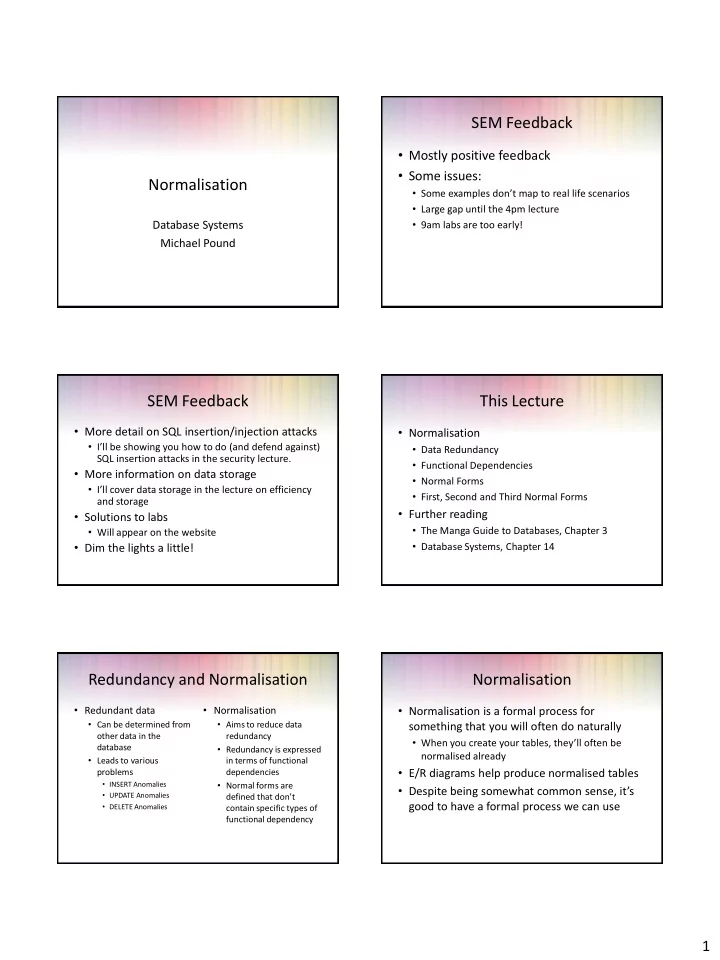
SEM Feedback Mostly positive feedback Some issues: Normalisation Some examples dont map to real life scenarios Large gap until the 4pm lecture 9am labs are too early! Database Systems Michael Pound SEM Feedback This


slide-1
SLIDE 1

1

Normalisation

Database Systems Michael Pound

SEM Feedback

  • Mostly positive feedback
  • Some issues:
  • Some examples don’t map to real life scenarios
  • Large gap until the 4pm lecture
  • 9am labs are too early!

SEM Feedback

  • More detail on SQL insertion/injection attacks
  • I’ll be showing you how to do (and defend against)

SQL insertion attacks in the security lecture.

  • More information on data storage
  • I’ll cover data storage in the lecture on efficiency

and storage

  • Solutions to labs
  • Will appear on the website
  • Dim the lights a little!

This Lecture

  • Normalisation
  • Data Redundancy
  • Functional Dependencies
  • Normal Forms
  • First, Second and Third Normal Forms
  • Further reading
  • The Manga Guide to Databases, Chapter 3
  • Database Systems, Chapter 14

Redundancy and Normalisation

  • Redundant data
  • Can be determined from
  • ther data in the

database

  • Leads to various

problems

  • INSERT Anomalies
  • UPDATE Anomalies
  • DELETE Anomalies
  • Normalisation
  • Aims to reduce data

redundancy

  • Redundancy is expressed

in terms of functional dependencies

  • Normal forms are

defined that don’t contain specific types of functional dependency

Normalisation

  • Normalisation is a formal process for

something that you will often do naturally

  • When you create your tables, they’ll often be

normalised already

  • E/R diagrams help produce normalised tables
  • Despite being somewhat common sense, it’s

good to have a formal process we can use

slide-2
SLIDE 2

2

First Normal Form

  • In most definitions of

the relational model

  • All data values should be

atomic

  • This means that table

entries should be single values, not sets or composite objects

  • Simplifies queries and

data comparisons

  • A relation is said to be

first normal form (1NF) if all data values are atomic

Normalisation to 1NF

  • To convert any relation into 1NF, split any non-

atomic values

Unnormalised Module Dept Lecturer Texts M1 D1 L1 T1, T2 M2 D1 L1 T1, T3 M3 D2 L2 T4 M4 D2 L3 T1, T5 M5 D2 L4 T6 1NF Module Dept Lecturer Text M1 D1 L1 T1 M1 D1 L1 T2 M2 D1 L1 T1 M2 D1 L1 T3 M3 D1 L2 T4 M4 D2 L3 T1 M4 D2 L3 T5 M5 D2 L4 T6

Problems with 1NF

  • INSERT Anomalies
  • Can’t add a module with

no texts

  • UPDATE Anomalies
  • To change the lecture for

M1, we will need to update two rows

  • DELETE Anomalies
  • If we remove M3, we will

remove L2 as well

1NF Module Dept Lecturer Text M1 D1 L1 T1 M1 D1 L1 T2 M2 D1 L1 T1 M2 D1 L1 T3 M3 D1 L2 T4 M4 D2 L3 T1 M4 D2 L3 T5 M5 D2 L4 T6

Functional Dependencies

  • Redundancy is often

caused by a functional dependency

  • A functional dependency

(FD) is a link between two sets of attributes in a relation

  • We can normalise a

relation by removing undesirable FDs

  • A set of attributes, A,

functionally determines another set, B, if whenever two rows of the relation have the same values for all the attributes in A, then they also have the same values for all the attributes in B.

  • In this case, we can say

there exists a functional dependency between A and B (A  B),

Example

  • Three notable functional dependencies exist in this

relation:

  • {ID}  {First, Last}
  • {moduleCode}  {moduleName}
  • {ID, moduleCode}  {First, Last, moduleName}

ID First Last moduleCode moduleName 111 Joe Smith G51PRG Programming 222 Anne Jones G51DBS Databases

Properties of FDs

  • In any relation
  • The primary key

functionally determines any set of attributes in that relation K  X

  • K is the primary key, X is a

set of attributes

  • Same for candidate keys
  • Any set of attributes is

FD on itself X  X

  • Rules for FDs
  • Reflexivity: If B is a

subset of A then A  B

  • Augmentation: If A  B

then A  C  B  C

  • Transitivity: If A  B and

B  C then A  C

slide-3
SLIDE 3

3

FDs and Normalisation

  • We define a set of

'normal forms'

  • Each normal form

has fewer FDs than the last

  • Since FDs represent

redundancy, each normal form has less redundancy than the last

  • Not all FDs cause a

problem

  • We identify various

sorts of FD that do

  • Each normal form

removes a type of FD that causes problems

FD Example

  • The Primary Key is

{Module, Text} so

  • {Module, Text}  {Dept,

Lecturer}

  • 'Trivial' FDs, eg:
  • {Text, Dept}  {Text}
  • {Module}  {Module}
  • {Dept, Lecturer}  { }

1NF Module Dept Lecturer Text M1 D1 L1 T1 M1 D1 L1 T2 M2 D1 L1 T1 M2 D1 L1 T3 M3 D1 L2 T4 M4 D2 L3 T1 M4 D2 L3 T5 M5 D2 L4 T6

FD Example

  • Other FDs are
  • {Module}  {Lecturer}
  • {Module}  {Dept}
  • {Lecturer}  {Dept}
  • These are non-trivial and

the determinants (left hand side of the dependency) are not candidate keys.

1NF Module Dept Lecturer Text M1 D1 L1 T1 M1 D1 L1 T2 M2 D1 L1 T1 M2 D1 L1 T3 M3 D1 L2 T4 M4 D2 L3 T1 M4 D2 L3 T5 M5 D2 L4 T6

FD Diagrams

  • Rather than an entire table, FDs can be

represented simply using the headings:

Module Dept Lecturer Text

  • {Module , Text} is a candidate key, so we put a double box around them
  • {Lecturer}  {Dept}, so we have an arrow from Lecturer to Dept
  • {Module}  {Dept} and {Module}  {Lecturer} , so we have

{Module}  {Dept, Lecturer} Note: Trivial FDs and FDs dependent on an entire candidate key are not included

Second Normal Form

  • Partial FDs:
  • A FD, A  B is a partial

FD, if some attribute of A can be removed and the FD still holds

  • Formally, there is some

proper subset of A, C  A, such that C  B

  • Second normal form:
  • A relation is in second

normal form (2NF) if it is in 1NF and no non-key attribute is partially dependent on a candidate key

  • In other words, no C  B

where C is a strict subset

  • f a candidate key and B

is a non-key attribute.

Normalising to 2NF

  • ‘1NF’ is not in 2NF
  • We have the FD

{Module, Text}  {Lecturer, Dept}

  • But also

{Module}  {Lecturer, Dept}

  • And so Lecturer and

Dept are partially dependent on the primary key

1NF Module Dept Lecturer Text M1 D1 L1 T1 M1 D1 L1 T2 M2 D1 L1 T1 M2 D1 L1 T3 M3 D1 L2 T4 M4 D2 L3 T1 M4 D2 L3 T5 M5 D2 L4 T6 Module Dept Lecturer Text

slide-4
SLIDE 4

4

Normalising to 2NF

  • Suppose we have a relation

R with scheme S and the FD A  B where A  B = { }

  • Let C = S - (A  B)
  • In other words:
  • A – attributes on the left

hand side of the FD

  • B – attributes on the right

hand side of the FD

  • C – all other attributes
  • It turns out that we can split

R into two parts:

  • R1, with scheme A  C
  • R2, with scheme A  B
  • The original relation can be

recovered as the natural join of R1 and R2:

  • R = R1 NATURAL JOIN R2

Normalising to 2NF

  • We need to remove FD A  B in order to

convert the relation to 2NF

Module Dept Lecturer Text

Normalising to 2NF

  • We need to remove FD A  B in order to

convert the relation to 2NF

Module Dept Lecturer Text

A A – The determinant of the functional dependency

Normalising to 2NF

  • We need to remove FD A  B in order to

convert the relation to 2NF

Module Dept Lecturer Text

B B – The dependant attributes of the functional dependency

Normalising to 2NF

  • We need to remove FD A  B in order to

convert the relation to 2NF

Module Dept Lecturer Text

C C – All remaining attributes in the relation

Normalising to 2NF

  • To convert to 2NF, create two relations A  B

and A  C

Module Dept Lecturer Text

C B A

slide-5
SLIDE 5

5

Normalising to 2NF

Module Dept Lecturer Text Module Dept Lecturer Module Text

1NF 2NF A  B 2NF A  C

Normalising to 2NF

2NFa Module Dept Lecturer M1 D1 L1 M2 D1 L1 M3 D1 L2 M4 D2 L3 M5 D2 L4 2NFb Module Text M1 T1 M1 T2 M2 T1 M2 T3 M3 T4 M4 T1 M4 T5 M5 T6 Module Dept Lecturer Module Text

Problems Resolved in 2NF

  • INSERT Anomalies
  • We can now add a

module without texts

  • UPDATE Anomalies
  • We only need to change

a single row when changing a module lecturer

2NFa Module Dept Lecturer M1 D1 L1 M2 D1 L1 M3 D1 L2 M4 D2 L3 M5 D2 L4

Problems Remaining in 2NF

  • INSERT Anomalies
  • We can’t add lecturers

who don’t currently teach modules

  • UPDATE Anomalies
  • To change the

department for L1, we must change two rows

  • DELETE Anomalies
  • To delete module M3,

we must delete L2

2NFa Module Dept Lecturer M1 D1 L1 M2 D1 L1 M3 D1 L2 M4 D2 L3 M5 D2 L4

Transitive FDs and 3NF

  • Transitive FDs:
  • A FD, A  C is a

transitive FD, if there is some set B such that A  B and B  C are non-trivial FDs

  • A  B non-trivial means:

B is not a subset of A

  • Essentially

A  B  C

  • Third normal form
  • A relation is in third

normal form (3NF) if it is in 2NF and no non-key attribute is transitively dependent on a candidate key

Normalising to 3NF

2NFa

  • 2NFa is not in 3NF
  • There are FDs

{Module}  {Lecturer} {Lecturer}  {Dept}

  • So there is a transitive FD

from Primary key {Module} to {Dept}

  • To move a relationship from

2NF to 3NF:

  • Given the transitive FD A 

B  C

  • We split the relation into

two new relations

  • The first contains all of the

columns contained in B and C

  • The second contains all of

the columns which are not contained in A, B or C and the columns contained in A and B

Module Dept Lecturer

slide-6
SLIDE 6

6

Normalising to 3NF

  • We need to remove FD A  B  C in order to

convert the relation to 3NF

Module Dept Lecturer

2NFa

Normalising to 3NF

  • We need to remove FD A  B  C in order to

convert the relation to 3NF

A A – The determinant of the functional dependency

Module Dept Lecturer

2NFa

Normalising to 3NF

  • We need to remove FD A  B  C in order to

convert the relation to 3NF

B B – The dependant attributes of the functional dependency

Module Dept Lecturer

2NFa

Normalising to 3NF

  • We need to remove FD A  B  C in order to

convert the relation to 3NF

C B – The transitively dependant attributes of the functional dependency

Module Dept Lecturer

2NFa

Normalising to 3NF

  • To convert to 3NF, create two relations B  C

and A  B  Other Columns

Module Dept Lecturer

2NFa B C A

Normalising to 3NF

Dept Lecturer Module

B  C A  B  Others

Module Dept Lecturer

2NFa

Lecturer

slide-7
SLIDE 7

7

Normalising to 3NF

3NFb Module Lecturer M1 L1 M2 L1 M3 L2 M4 L3 M5 L4 2NFb Module Text M1 T1 M1 T2 M2 T1 M2 T3 M3 T4 M4 T1 M4 T5 M5 T6 Module Lecturer Module Text Lecturer Dept 3NFa Lecturer Dept L1 D1 L2 D1 L3 D2 L4 D2

Problems Resolved in 3NF

  • Problems resolved in

3NF

  • INSERT – We can now

add Lecturers who don’t teach any modules

  • UPDATE – We need only

change a single row to update the department for L1

  • DELETE – We can delete

M3 while preserving L2

3NFb Module Lecturer M1 L1 M2 L1 M3 L2 M4 L3 M5 L4 3NFa Lecturer Dept L1 D1 L2 D1 L3 D2 L4 D2

Normalisation and Design

  • Normalisation is related

to Database design

  • A database should

normally be in 3NF at least

  • If your design leads to a

non-3NF database, then you might want to revise it

  • When you find you have

a non-3NF database

  • Identify the FDs that are

causing a problem

  • Think if they will lead to

any insert, update, or delete anomalies

  • Try to remove them

Next Lecture

  • More Normalisation
  • Lossless decomposition
  • BCNF
  • Further Reading
  • The Manga Guide to Databases, Chapter 3
  • Database Systems, Chapters 14 and 15