Semantics + What is meaning of 3+5*6 ? * 3 First parse it into - - PDF document

semantics
SMART_READER_LITE
LIVE PREVIEW

Semantics + What is meaning of 3+5*6 ? * 3 First parse it into - - PDF document

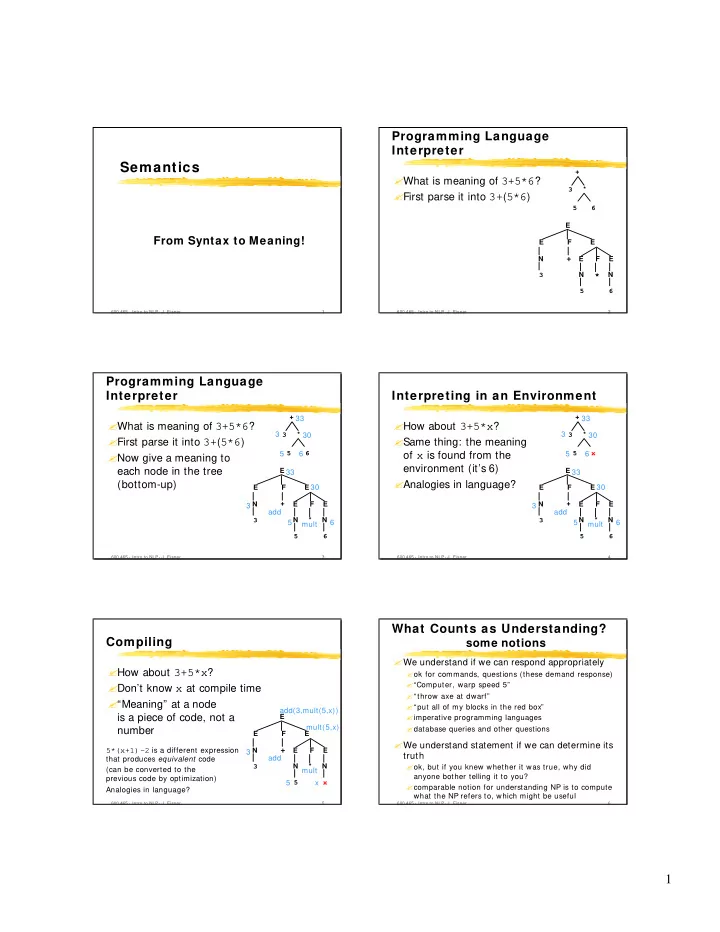
Programming Language Interpreter Semantics + What is meaning of 3+5*6 ? * 3 First parse it into 3+ ( 5*6 ) 5 6 E From Syntax to Meaning! E F E N + E F E 3 N N * 5 6 600.465 - Intro to NLP - J. Eisner 1 600.465 -


slide-1
SLIDE 1

1

600.465 - Intro to NLP

  • J. Eisner

1

Semantics

From Syntax to Meaning!

600.465 - Intro to NLP

  • J. Eisner

2

Programming Language Interpreter

What is meaning of 3+5*6? First parse it into 3+(5*6)

+ 3 * 5 6 E E F E E E 3 F N 5 N 6 N

* +

600.465 - Intro to NLP

  • J. Eisner

3

Programming Language Interpreter

What is meaning of 3+5*6? First parse it into 3+(5*6) Now give a meaning to

each node in the tree (bottom-up)

+ 3 * 5 6 E E F E E E 3 F N 5 N 6 N * + 3 5 6 30 33 3 5 6 30 33 add mult

600.465 - Intro to NLP

  • J. Eisner

4

Interpreting in an Environment

How about 3+5*x? Same thing: the meaning

  • f x is found from the

environment (it’s 6)

Analogies in language?

+ 3 * 5 x 3 5 6 30 33 E E F E E E 3 F N 5 N 6 N * + 3 5 6 30 33 add mult

600.465 - Intro to NLP

  • J. Eisner

5

Compiling

How about 3+5*x? Don’t know x at compile time “Meaning” at a node

is a piece of code, not a number

E E F E E E 3 F N 5 N x N *

+ 3 5 x mult(5,x) add(3,mult(5,x)) add mult 5*(x+1)-2 is a different expression that produces equivalent code (can be converted to the previous code by optimization) Analogies in language?

600.465 - Intro to NLP

  • J. Eisner

6

What Counts as Understanding?

some notions

We understand if we can respond appropriately

  • k for commands, questions (these demand response)

“Computer, warp speed 5” “throw axe at dwarf” “put all of my blocks in the red box” imperative programming languages database queries and other questions

We understand statement if we can determine its truth

  • k, but if you knew whether it was true, why did

anyone bother telling it to you? comparable notion for understanding NP is to compute what the NP refers to, which might be useful

slide-2
SLIDE 2

2

600.465 - Intro to NLP

  • J. Eisner

7

What Counts as Understanding?

some notions

We understand statement if we know how to determine its truth

What are exact conditions under which it would be true?

necessary + sufficient

Equivalently, derive all its consequences

what else must be true if we accept the statement?

Philosophers tend to use this definition

We understand statement if we can use it to answer questions [very similar to above – requires reasoning]

Easy: John ate pizza. What was eaten by John? Hard: White’s first move is P -Q4. Can Black checkmate? Constructing a procedure to get the answer is enough

600.465 - Intro to NLP

  • J. Eisner

8

What Counts as Understanding?

some notions Be able to translate

Depends on target language English to English?

bah humbug!

English to French?

reasonable

English to Chinese?

requires deeper understanding

English to logic?

deepest - the definition we’ll use! all humans are mortal = ? x [human(x) ? mortal(x)]

Assume we have logic- manipulating rules to tell us how to act, draw conclusions, answer questions …

600.465 - Intro to NLP

  • J. Eisner

9

Lecture Plan

Today:

Let’s look at some sentences and phrases What would be reasonable logical representations for them?

Tomorrow:

How can we build those representations?

Another course (AI):

How can we reason with those representations?

600.465 - Intro to NLP

  • J. Eisner

10

Logic: Some Preliminaries

Three major kinds of objects

  • 1. Booleans

Roughly, the semantic values of sentences

  • 2. Entities

Values of NPs, e.g., objects like this slide Maybe also other types of entities, like times

  • 3. Functions of various types

A function returning a boolean is called a “predicate” – e.g., frog(x), green(x) Functions might return other functions! Function might take other functions as arguments!

600.465 - Intro to NLP

  • J. Eisner

11

Logic: Lambda Terms

Lambda terms:

A way of writing “anonymous functions”

No function header or function name But defines the key thing: behavior of the function Just as we can talk about 3 without naming it “x”

Let square = ?p p* p Equivalent to int square(p) { return p* p; } But we can talk about ?p p* p without naming it Format of a lambda term: ? variable expression

600.465 - Intro to NLP

  • J. Eisner

12

Logic: Lambda Terms

Lambda terms:

Let square = ?p p* p Then square(3) = (?p p* p)(3) = 3* 3 Note: square(x) isn’t a function! It’s just the value x* x. But ?x square(x) = ?x x* x = ?p p* p = square

(proving that these functions are equal – and indeed they are, as they act the same on all arguments: what is (?x square(x))(y)? )

Let even = ?p (p mod 2 = = 0)

a predicate: returns true/false

even(x) is true if x is even How about even(square(x))? ?x even(square(x)) is true of numbers with even squares

Just apply rules to get ?x (even(x* x)) = ?x (x* x mod 2 = = 0) This happens to denote the same predicate as even does

slide-3
SLIDE 3

3

600.465 - Intro to NLP

  • J. Eisner

13

Logic: Multiple Arguments

All lambda terms have one argument But we can fake multiple arguments ... Suppose we want to write times(5,6) Remember: square can be written as ?x square(x) Similarly, times is equivalent to ?x ?y times(x,y) Claim that times(5)(6) means same as times(5,6)

times(5) = (?x ?y times(x,y )) (5) = ?y times(5,y)

If this function weren’t anonymous, what would we call it?

times(5)(6) = (?y times(5,y))(6) = times(5,6)

600.465 - Intro to NLP

  • J. Eisner

14

Logic: Multiple Arguments

All lambda terms have one argument But we can fake multiple arguments ... Claim that times(5)(6) means same as times(5,6)

times(5) = (?x ?y times(x,y )) (5) = ?y times(5,y)

If this function weren’t anonymous, what would we call it?

times(5)(6) = (?y times(5,y))(6) = times(5,6)

So we can always get away with 1-arg functions ...

... which might return a function to take the next

  • argument. Whoa.

We’ll still allow times(x,y ) as syntactic sugar, though

600.465 - Intro to NLP

  • J. Eisner

15

Grounding out

So what does times actually mean??? How do we get from times(5,6) to 30 ?

Whether times(5,6) = 30 depends on whether symbol times actually denotes the multiplication function!

Well, maybe times was defined as another lambda term, so substitute to get times(5,6) = (blah blah blah)(5)(6) But we can’t keep doing substitutions forever!

Eventually we have to ground out in a primitive term Primitive terms are bound to object code

Maybe times(5,6) just executes a multiplication function What is executed by loves(john, mary ) ?

600.465 - Intro to NLP

  • J. Eisner

16

Logic: Interesting Constants

Thus, have “constants” that name some of

the entities and functions (e.g., times):

GeorgeWBush - an entity red – a predicate on entities

holds of just the red entities: red(x) is true if x is red!

loves – a predicate on 2 entities

loves(GeorgeWBush, LauraBush) Question: What does loves(LauraBush ) denote?

Constants used to define meanings of words Meanings of phrases will be built from the

constants

600.465 - Intro to NLP

  • J. Eisner

17

Logic: Interesting Constants

most – a predicate on 2 predicates on

entities

most(pig, big) = “ most pigs are big”

Equivalently, most(?x pig(x), ?x big(x))

returns true if most of the things satisfying the first predicate also satisfy the second predicate

similarly for other quantifiers

all(pig,big)

(equivalent to ? x pig(x) ? big(x) )

exists(pig,big)

(equivalent to ?x pig(x) AND big(x) ) can even build complex quantifiers from English phrases: “between 12 and 75”; “a majority of ”; “all but the smallest 2”

600.465 - Intro to NLP

  • J. Eisner

18

A reasonable representation?

Gilly swallowed a goldfish First attempt: swallowed(Gilly, goldfish) Returns true or false. Analogous to

prime(17) equal(4,2+ 2) loves(GeorgeWBush, LauraBush) swallowed(Gilly, Jilly)

… or is it analogous?

slide-4
SLIDE 4

4

600.465 - Intro to NLP

  • J. Eisner

19

A reasonable representation?

Gilly swallowed a goldfish

First attempt: swallowed(Gilly , goldfish)

But we’re not paying attention to a! goldfish isn’t the name of a unique object the way Gilly is In particular, don’t want

Gilly swallowed a goldfish and Milly swallowed a goldfish

to translate as

swallowed(Gilly , goldfish) AND swallowed(Milly , goldfish)

since probably not the same goldfish …

600.465 - Intro to NLP

  • J. Eisner

20

Use a Quantifier

Gilly swallowed a goldfish First attempt: swallowed(Gilly , goldfish)

Better: ?g goldfish(g) AND swallowed(Gilly, g) Or using one of our quantifier predicates:

exists(?g goldfish(g), ?g swallowed(Gilly,g)) Equivalently: exists(goldfish, swallowed(Gilly ))

“In the set of goldfish there exists one swallowed by Gilly”

Here goldfish is a predicate on entities

This is the same semantic type as red But goldfish is noun and red is adjective .. # @!?

600.465 - Intro to NLP

  • J. Eisner

21

Tense

Gilly swallowed a goldfish Previous attempt: exists(goldfish, ?g swallowed(Gilly,g))

Improve to use tense:

Instead of the 2-arg predicate swallowed(Gilly,g) try a 3-arg version swallow(t,Gilly,g) where t is a time Now we can write: ?t past(t) AND exists(goldfish, ?g swallow(t,Gilly,g))

“There was some time in the past such that a goldfish was among the objects swallowed by Gilly at that time”

600.465 - Intro to NLP

  • J. Eisner

22

(Simplify Notation)

Gilly swallowed a goldfish Previous attempt: exists(goldfish, swallowed(Gilly ))

Improve to use tense:

Instead of the 2-arg predicate swallowed(Gilly,g) try a 3-arg version swallow(t,Gilly,g) Now we can write: ?t past(t) AND exists(goldfish, swallow(t,Gilly ))

“There was some time in the past such that a goldfish was among the objects swallowed by Gilly at that time”

600.465 - Intro to NLP

  • J. Eisner

23

Event Properties

Gilly swallowed a goldfish Previous: ?t past(t) AND exists(goldfish, swallow(t,Gilly ))

Why stop at time? An event has other properties:

[Gilly] swallowed [a goldfish] [on a dare] [in a telephone booth] [with 30 other freshmen] [after many bottles of vodka had been consumed]. Specifies who what why when …

Replace time variable t with an event variable e

?e past(e), act(e,swallowing), swallower(e,Gilly ), exists(goldfish, swallowee(e)), exists(booth, location(e)), …

As with probability notation, a comma represents AND Could define past as ?e ?t before(t,now), ended-at(e,t)

600.465 - Intro to NLP

  • J. Eisner

24

Quantifier Order

Gilly swallowed a goldfish in a booth ?e past(e), act(e,swallowing), swallower(e,Gilly ), exists(goldfish, swallowee(e)), exists(booth, location(e)), … Gilly swallowed a goldfish in every booth ?e past(e), act(e,swallowing), swallower(e,Gilly ), exists(goldfish, swallowee(e)), all(booth, location(e)), …

Does this mean what we’d expect??

?g goldfish(g), swallowee(e,g) ? b booth(b)? location(e,b) says that there’s only one event with a single goldfish getting swallowed that took place in a lot of booths ...

slide-5
SLIDE 5

5

600.465 - Intro to NLP

  • J. Eisner

25

Quantifier Order

Groucho Marx celebrates quantifier order ambiguity:

In this country a woman gives birth every 15 min. Our job is to find that woman and stop her.

?woman (? 15min gives-birth-during(woman, 15min)) ? 15min (?woman gives-birth-during(15min, woman)) Surprisingly, both are possible in natural language! Which is the joke meaning (where it’s always the same woman) and why?

600.465 - Intro to NLP

  • J. Eisner

26

Quantifier Order

Gilly swallowed a goldfish in a booth ?e past(e), act(e,swallowing), swallower(e,Gilly ), exists(goldfish, swallowee(e)), exists(booth, location(e)), … Gilly swallowed a goldfish in every booth ?e past(e), act(e,swallowing), swallower(e,Gilly ), exists(goldfish, swallowee(e)), all(booth, location(e)), … ?g goldfish(g), swallowee(e,g) ? b booth(b)? location(e,b)

Does this mean what we’d expect??

I t’s ?e ? b which means same event for every booth Probably false unless Gilly can be in every booth during her swallowing of a single goldfish

600.465 - Intro to NLP

  • J. Eisner

27

Gilly swallowed a goldfish in a booth ?e past(e), act(e,swallowing), swallower(e,Gilly ), exists(goldfish, swallowee(e)), exists(booth, location(e)), … Gilly swallowed a goldfish in every booth ?e past(e), act(e,swallowing), swallower(e,Gilly ), exists(goldfish, swallowee(e)), all(booth, ?b location(e,b))

Quantifier Order

Other reading (? b ?e) involves quantifier raising:

all(booth, ?b [ ?e past(e), act(e,swallowing), swallower (e,Gilly ), exists(goldfish, swallowee(e)), location(e,b)] ) “for all booths b, there was such an event in b”

600.465 - Intro to NLP

  • J. Eisner

28

Intensional Arguments

Willy wants a unicorn

?e act(e,wanting), wanter(e,Willy), exists(unicorn, ?u wantee(e,u)) “there is a unicorn u that Willy wants” here the wantee is an individual entity ?e act(e,wanting), wanter(e,Willy), wantee(e, ?u unicorn(u)) “Willy wants any entity u that satisfies the unicorn predicate” here the wantee is a type of entity

Willy wants Lilly to get married

?e present(e), act(e,wanting), wanter(e,Willy), wantee(e, ?e’ [act(e’,marriage), marrier(e’,Lilly)]) “Willy wants any event e ’ in which Lilly gets married” Here the wantee is a type of event Sentence doesn’t claim that such an event exists

Intensional verbs besides want: hope, doubt, believe,…

600.465 - Intro to NLP

  • J. Eisner

29

Intensional Arguments

Willy wants a unicorn

?e act(e,wanting), wanter(e,Willy), wantee(e, ?g unicorn(g)) “Willy wants anything that satisfies the unicorn predicate” here the wantee is a type of entity

Problem (a fine point I’ll gloss over):

?g unicorn(g) is defined by the actual set of unicorns (“extension”) But this set is empty: ?g unicorn(g) = ?g FALSE = ?g dodo(g) Then wants a unicorn = wants a dodo. Oops! So really the wantee should be criteria for unicornness (“intension”)

Traditional solution involves “possible-world semantics”

Can imagine other worlds where set of unicorn ? set of dodos Other worlds also useful for: You must pay the rent You can pay the rent If you hadn’t, you’d be homeless

600.465 - Intro to NLP

  • J. Eisner

30

Control

Willy wants Lilly to get married

?e present(e), act(e,wanting), wanter(e,Willy ), wantee(e, ?f [act(f,marriage), marrier(f,Lilly )])

Willy wants to get married

Same as Willy wants Willy to get married Just as easy to represent as Willy wants Lilly … The only trick is to construct the representation from the

  • syntax. The empty subject position of “to get married”

is said to be controlled by the subject of “wants.”

slide-6
SLIDE 6

6

600.465 - Intro to NLP

  • J. Eisner

31

Nouns and Their Modifiers

expert

?g expert(g)

big fat expert

?g big(g), fat(g), expert(g) But: bogus expert

Wrong: ?g bogus(g), expert(g) Right: ?g (bogus(expert))(g) … bogus maps to new concept

Baltimore expert

(white-collar expert, TV expert …)

?g Related(Baltimore, g), expert(g) – expert from Baltimore

Or with different intonation:

?g (Modified-by(Baltimore, expert))(g) – expert on Baltimore

Can’t use Related for that case: law expert and dog catcher = ?g Related(law,g), expert(g), Related(dog, g), catcher(g) = dog expert and law catcher

600.465 - Intro to NLP

  • J. Eisner

32

Nouns and Their Modifiers

the goldfish that Gilly swallowed every goldfish that Gilly swallowed three goldfish that Gilly swallowed

Or for real: ?g [goldfish(g), ?e [past(e), act(e,swallowing),

swallower(e,Gilly), swallowee(e,g) ]]

?g [ goldfish(g), swallowed(Gilly , g)]

three swallowed-by-Gilly goldfish

like an adjective!

600.465 - Intro to NLP

  • J. Eisner

33

Adverbs

Lili passionately wants Billy

Wrong?: passionately(want(Lili,Billy)) = passionately(true) Better: (passionately(want))(Lili,Billy) Best: ?e present(e), act(e,wanting), wanter(e,Lili),

wantee(e, Billy), manner(e, passionate)

Lili often stalks Billy

(often(stalk))(Lili,Billy) many(day, ?d ?e present(e), act(e,stalking), stalker(e,Lili), stalkee(e, Billy), during(e,d))

Lili obviously likes Billy

(obviously(like))(Lili,Billy) – one reading

  • bvious(likes(Lili, Billy)) – another reading

600.465 - Intro to NLP

  • J. Eisner

34

Speech Acts

What is the meaning of a full sentence?

Depends on the punctuation mark at the end. Billy likes Lili. assert(like(B,L)) Billy likes Lili? ask(like(B,L))

  • r more formally, “Does Billy like Lili?”

Billy, like Lili! command(like(B,L))

Let’s try to do this a little more precisely, using event variables etc.

600.465 - Intro to NLP

  • J. Eisner

35

Speech Acts

What did Gilly swallow?

ask(?x ?e past(e), act(e,swallowing), swallower(e,Gilly ), swallowee(e,x))

Argument is identical to the modifier “that Gilly swallowed” Is there any common syntax?

Eat your fish!

command(?f act(f,eating), eater(f,Hearer), eatee(… ))

I ate my fish.

assert(?e past(e), act(e,eating), eater(f,Speaker), eatee(…))

600.465 - Intro to NLP

  • J. Eisner

36

We’ve discussed what semantic representations should look like. But how do we get them from sentences??? First - parse to get a syntax tree. Second - look up the semantics for each word. Third - build the semantics for each constituent

Work from the bottom up The syntax tree is a “recipe” for how to do it

Compositional Semantics

slide-7
SLIDE 7

7

600.465 - Intro to NLP

  • J. Eisner

37

Compositional Semantics

NP Laura Vstem love VP

stem

VP

inf

T to S

inf

NP George VP

stem

Vstem want VP

fin

T

  • s

S

fin

NP N nation Det Every START Punc . G ?a a ?y ?x ?e act(e,loving), lover(e,x), lovee(e,y) L ?y ?x ?e act(e,wanting), wanter(e,x), wantee(e,y) ?v ?x ?e present(e),v(x)(e) every nation ?s assert(s) assert(every(nation, ?x ?e present(e), act(e,wanting), wanter(e,x), wantee(e, ?e’ act(e’,loving), lover(e’,G), lovee(e’,L))))

600.465 - Intro to NLP

  • J. Eisner

38

Add a “sem” feature to each context-free rule

S ?

NP loves NP

S[sem= loves(x,y)] ?

NP[sem= x] loves NP[sem= y]

Meaning of S depends on meaning of NPs TAG version:

Compositional Semantics

NP V loves VP S NP

x y

loves(x,y)

NP the bucket V kicked VP S NP

x

died(x) Template filling: S[ sem= showflights(x,y )] ? I want a flight from NP[ sem= x] to NP[ sem=y ]

600.465 - Intro to NLP

  • J. Eisner

39

Instead of S ?

NP loves NP S[sem= loves(x,y)] ? NP[sem= x] loves NP[sem= y]

might want general rules like S ?

NP VP: V[sem= loves] ? loves VP[sem=v(obj)] ? V[sem = v] NP[sem= obj] S[sem= vp(subj)] ? NP[sem=subj] VP[sem= vp]

Now George loves Laura has sem= loves(Laura)(George) In this manner we’ll sketch a version where

Still compute semantics bottom -up Grammar is in Chomsky Normal Form So each node has 2 children: 1 function & 1 argument To get its semantics, apply function to argument! (version on homework will be a little less pure)

Compositional Semantics

600.465 - Intro to NLP

  • J. Eisner

40

Compositional Semantics

AdjP Laura VP

fin

S

fin

START Punc . NP George Vpres loves ?s assert(s) loves = ?x ?y loves(x,y) L G ?y loves(L,y) loves(L,G) assert( loves(L,G)) Intended to mean G loves L Let ’s make this explicit …

600.465 - Intro to NLP

  • J. Eisner

41

Compositional Semantics

AdjP Laura VP

fin

S

fin

START Punc . NP George Vpres loves loves = ?x ?y loves(x,y) L G ?y loves(L,y) loves(L,G) ?e present(e), act(e,loving), lover(e,G), lovee(e,L) ?x ?y ?e present(e), act(e,loving), lover(e,y), lovee(e,x) ?y ?e present(e), act(e,loving), lover(e,y), lovee(e,L) NP Laura Vstem love VP

stem

VP

inf

T to S

inf

NP George VP

stem

Vstem want VP

fin

T

  • s

S

fin

NP N nation Det Every START Punc .

Now let’s try a more complex example, and really handle tense. Treat –s like yet another auxiliary verb

slide-8
SLIDE 8

8

NP Laura Vstem love VP

stem

VP

inf

T to S

inf

NP George VP

stem

Vstem want VP

fin

T

  • s

S

fin

NP N nation Det Every START Punc . ?e act(e,loving), lover(e,G), lovee(e,L)

the meaning that we want here: how can we arrange to get it?

NP Laura Vstem love VP

stem

VP

inf

T to S

inf

NP George VP

stem

Vstem want VP

fin

T

  • s

S

fin

NP N nation Det Every START Punc . ?e act(e,loving), lover(e,G), lovee(e,L) G

what function should apply to G to yield the desired blue result?

(this is like division!) NP Laura Vstem love VP

stem

VP

inf

T to S

inf

NP George VP

stem

Vstem want VP

fin

T

  • s

S

fin

NP N nation Det Every START Punc . ?e act(e,loving), lover(e,G), lovee(e,L) ?x ?e act(e,loving), lover(e,x), lovee(e,L) G NP Laura Vstem love VP

stem

VP

inf

T to S

inf

NP George VP

stem

Vstem want VP

fin

T

  • s

S

fin

NP N nation Det Every START Punc . ?e act(e,loving), lover(e,G), lovee(e,L) ?x ?e act(e,loving), lover(e,x), lovee(e,L) G ?a a ?x ?e act(e,loving), lover(e,x), lovee(e,L) We’ll say that “to” is just a bit of syntax that changes a VPstem to a VPinf with the same meaning. NP Laura Vstem love VP

stem

VP

inf

T to S

inf

NP George VP

stem

Vstem want VP

fin

T

  • s

S

fin

NP N nation Det Every START Punc . ?e act(e,loving), lover(e,G), lovee(e,L) ?x ?e act(e,loving), lover(e,x), lovee(e,L) G ?a a ?x ?e act(e,loving), lover(e,x), lovee(e,L) ?y ?x ?e act(e,loving), lover(e,x), lovee(e,y) L NP Laura Vstem love VP

stem

VP

inf

T to S

inf

NP George VP

stem

Vstem want VP

fin

T

  • s

S

fin

NP N nation Det Every START Punc . ?e act(e,loving), lover(e,G), lovee(e,L) ?x ?e act(e,loving), lover(e,x), lovee(e,L) G ?a a ?y ?x ?e act(e,loving), lover(e,x), lovee(e,y) L ?x ?e act(e,loving), lover(e,x), lovee(e,L) ?x ?e act(e,wanting), wanter(e,x), wantee(e, ?e’ act(e’,loving), lover(e’,G), lovee(e’,L))

by analogy

slide-9
SLIDE 9

9

NP Laura Vstem love VP

stem

VP

inf

T to S

inf

NP George VP

stem

Vstem want VP

fin

T

  • s

S

fin

NP N nation Det Every START Punc . ?e act(e,loving), lover(e,G), lovee(e,L) ?x ?e act(e,loving), lover(e,x), lovee(e,L) G ?a a ?y ?x ?e act(e,loving), lover(e,x), lovee(e,y) L ?x ?e act(e,loving), lover(e,x), lovee(e,L) ?x ?e act(e,wanting), wanter(e,x), wantee(e, ?e’ act(e’,loving), lover(e’,G), lovee(e’,L)) ?y ?x ?e act(e,wanting), wanter(e,x), wantee(e,y)

by analogy

Better analogy: How would you modify the secondobject on a stack (?x,?e,act…)? NP Laura Vstem love VP

stem

VP

inf

T to S

inf

VP

stem

Vstem want VP

fin

T

  • s

S

fin

NP N nation Det Every START Punc . ?x ?e act(e,wanting), wanter(e,x), wantee(e, ?e’ act(e’,loving), lover(e’,G), lovee(e’,L)) ?x ?e present(e), act(e,wanting), wanter(e,x), wantee(e, ?e’ act(e’,loving), lover(e’,G), lovee(e’,L)) NP George ?v ?x ?e present(e), v(x)(e) Your account v is overdrawn, so your rental application is rejected.. 1. Deposit some cash x to get v(x) 2. Now show you’ve got the money: ?e present(e), v(x)(e) 3. Now you can withdraw x again: ?x ?e present(e), v(x)(e) NP Laura Vstem love VP

stem

VP

inf

T to S

inf

VP

stem

Vstem want VP

fin

T

  • s

S

fin

NP N nation Det Every START Punc . ?x ?e present(e), act(e,wanting), wanter(e,x), wantee(e, ?e’ act(e’,loving), lover(e’,G), lovee(e’,L)) NP George every(nation, ?x ?e present(e), act(e,wanting), wanter(e,x), wantee(e, ?e’ act(e’,loving), lover(e’,G), lovee(e’,L))) ?p every(nation, p) NP Laura Vstem love VP

stem

VP

inf

T to S

inf

VP

stem

Vstem want VP

fin

T

  • s

S

fin

NP N nation Det Every START Punc . ?x ?e present(e), act(e,wanting), wanter(e,x), wantee(e, ?e’ act(e’,loving), lover(e’,G), lovee(e’,L)) NP George every(nation, ?x ?e present(e), act(e,wanting), wanter(e,x), wantee(e, ?e’ act(e’,loving), lover(e’,G), lovee(e’,L))) ?p every(nation, p) ?n ?p every(n, p) nation NP Laura Vstem love VP

stem

VP

inf

T to S

inf

VP

stem

Vstem want VP

fin

T

  • s

S

fin

NP N nation Det Every START Punc . NP George every(nation, ?x ?e present(e), act(e,wanting), wanter(e,x), wantee(e, ?e’ act(e’,loving), lover(e’,G), lovee(e’,L))) ?s assert(s)

600.465 - Intro to NLP

  • J. Eisner

54

In Summary: From the Words

NP Laura Vstem love VP

stem

VP

inf

T to S

inf

NP George VP

stem

Vstem want VP

fin

T

  • s

S

fin

NP N nation Det Every START Punc . G ?a a ?y ?x ?e act(e,loving), lover(e,x), lovee(e,y) L ?y ?x ?e act(e,wanting), wanter(e,x), wantee(e,y) ?v ?x ?e present(e),v(x)(e) every nation ?s assert(s) assert(every(nation, ?x ?e present(e), act(e,wanting), wanter(e,x), wantee(e, ?e’ act(e’,loving), lover(e’,G), lovee(e’,L))))

slide-10
SLIDE 10

10

600.465 - Intro to NLP

  • J. Eisner

55

Other Fun Semantic Stuff: A Few Much-Studied Miscellany

Temporal logic

Gilly had swallowed eight goldfish before Milly reached the bowl Billy said Jilly was pregnant Billy said, “Jilly is pregnant.”

Generics

Typhoons arise in the Pacific Children must be carried

Presuppositions

The king of France is bald. Have you stopped beating your wife?

Pronoun-Quantifier Interaction (“bound anaphora”)

Every farmer who owns a donkey beats it. If you have a dime, put it in the meter. The woman who every Englishman loves is his mother. I love my mother and so does Billy.