
SLIDE 1
Transactions of the Korean Nuclear Society Virtual Spring Meeting July 9-10, 2020
Sensitivity Analyses of Water Density in the Degraded Reactor Core on the Potential of Recriticality during Early Phase of Severe Accident
Yoonhee Lee* , Yong Jin Cho, and Kukhee Lim Korea Institute of Nuclear Safety 62 Gwahak-ro, Yuseong-gu, Daejeon, Korea 34142
*Corresponding author: yooney@kins.re.kr
- 1. Introduction
The temperature difference between eutectic formations of boron carbide (B4C) and cladding of the control rod material (~1150oC) and melting of the fuel (~2800oC) makes a configuration that shows high potential for recriticalty during early phase of the severe accidents. Numerous studies on such possibility of the recriticality have been performed by U. S. NRC [1], SKI [2], EPRI [3], Darnowski et al., [4] and etc. In the case
- f EPRI, they performed analyses on the possibility of
the recriticality for Fukushima Daiichi unit 1F2 using a surrogate model for 1/4 reactor core of BWR [3]. They concluded that borated water with concentrations higher than 2000 ppm should be injected to prevent the
- recriticality. The authors of Ref. 4 concluded that there
is recriticality during the progression of the accident if there is adequately large part of the reactor core without control materials and with intact fuel materials. The authors have performed the analyses on the pressurized water reactors (PWRs) using whole-core modeling on the degraded reactor core derived from MELCOR calculations and the configuration high power reactor core [5]. We also have provided boron concentrations to make the degraded reactor core sub- critical. There are competitive effects between excess reactivity and the aforementioned boron concentrations depending on the water density in the degraded reactor core, i.e., if the water density is reduced, the excess reactivity would be reduced, however, boron worth would also be competitively reduced. Hence such effects would require higher sub-critical boron concentrations. In this paper, we will perform sensitivity analyses of the water density on the criticality of the degraded reactor
- core. We will also analyze the sensitivity on the sub-
critical boron concentrations for the various water densities.
- 2. Configuration of the Degraded Reactor Core
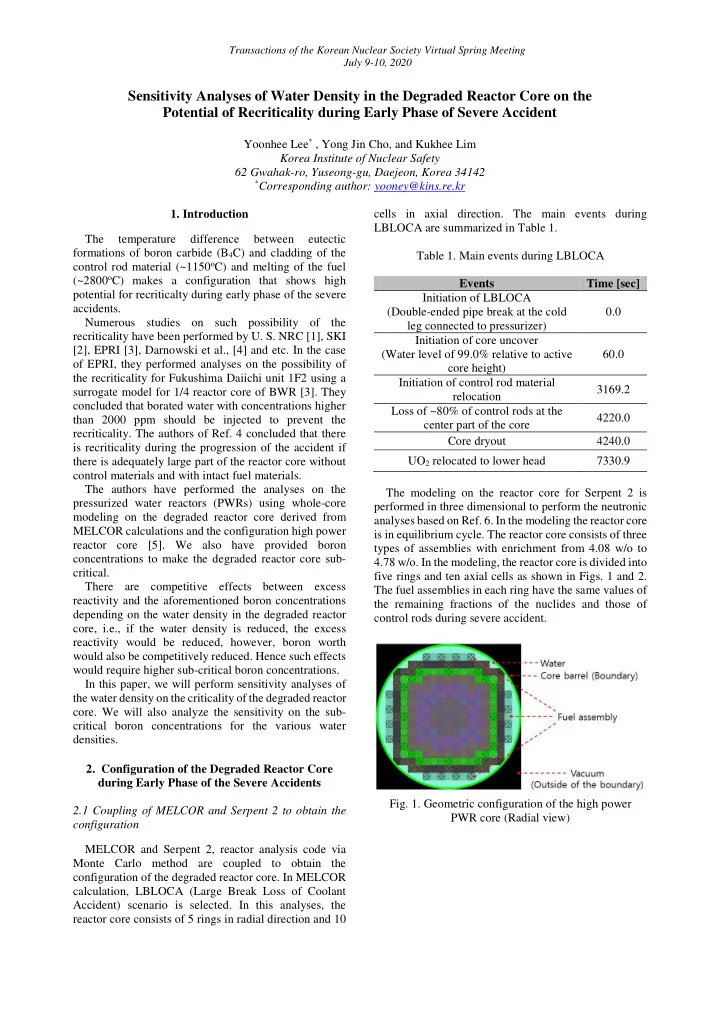
during Early Phase of the Severe Accidents 2.1 Coupling of MELCOR and Serpent 2 to obtain the configuration MELCOR and Serpent 2, reactor analysis code via Monte Carlo method are coupled to obtain the configuration of the degraded reactor core. In MELCOR calculation, LBLOCA (Large Break Loss of Coolant Accident) scenario is selected. In this analyses, the reactor core consists of 5 rings in radial direction and 10 cells in axial direction. The main events during LBLOCA are summarized in Table 1. Table 1. Main events during LBLOCA Events Time [sec] Initiation of LBLOCA (Double-ended pipe break at the cold leg connected to pressurizer) 0.0 Initiation of core uncover (Water level of 99.0% relative to active core height) 60.0 Initiation of control rod material relocation 3169.2 Loss of ~80% of control rods at the center part of the core 4220.0 Core dryout 4240.0 UO2 relocated to lower head 7330.9 The modeling on the reactor core for Serpent 2 is performed in three dimensional to perform the neutronic analyses based on Ref. 6. In the modeling the reactor core is in equilibrium cycle. The reactor core consists of three types of assemblies with enrichment from 4.08 w/o to 4.78 w/o. In the modeling, the reactor core is divided into five rings and ten axial cells as shown in Figs. 1 and 2. The fuel assemblies in each ring have the same values of the remaining fractions of the nuclides and those of control rods during severe accident.
- Fig. 1. Geometric configuration of the high power