Separation energies A = 21 isobaric chain one-nucleon separation - - PowerPoint PPT Presentation

separation energies
SMART_READER_LITE
LIVE PREVIEW

Separation energies A = 21 isobaric chain one-nucleon separation - - PowerPoint PPT Presentation

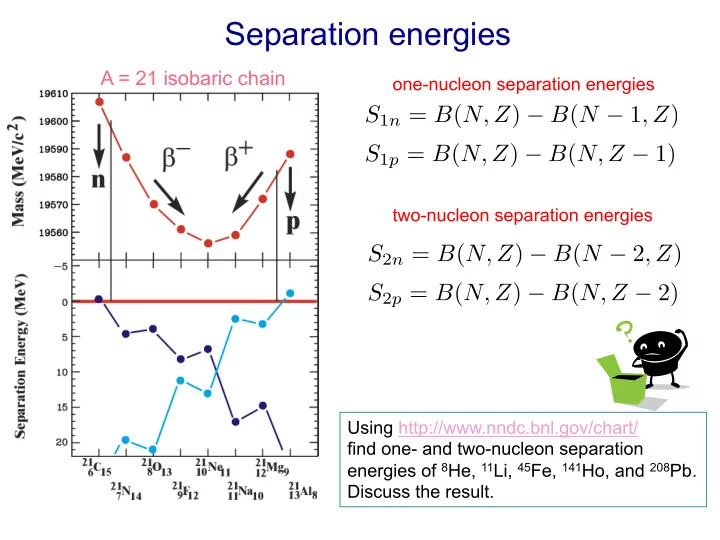
Separation energies A = 21 isobaric chain one-nucleon separation energies two-nucleon separation energies Using http://www.nndc.bnl.gov/chart/ find one- and two-nucleon separation energies of 8 He, 11 Li, 45 Fe, 141 Ho, and 208 Pb. Discuss the


slide-1
SLIDE 1

A = 21 isobaric chain

Separation energies

  • ne-nucleon separation energies

two-nucleon separation energies Using http://www.nndc.bnl.gov/chart/ find one- and two-nucleon separation energies of 8He, 11Li, 45Fe, 141Ho, and 208Pb. Discuss the result.

slide-2
SLIDE 2

Beta decay: energy relations

Mc2 = M 'c2 + Zmec2 − Bei

i=1 Z

atomic mass electron ¡binding ¡ energy ¡ nuclear ¡mass ¡ a) β- decay

Z AXN → Z+1 AXN−1 +e− +νe

Qβ− = Te− +T

νe = MP ' c2 − M D ' c2 − mec2

P(arent) D(aughter)

In the following, we assume that the neutrino mass is ~zero and that the very small differences in electron binding energy between the parent and daughter atoms can be neglected. This gives: Qβ− = MPc2 − M Dc2 Consequently, ¡the ¡β-­‑ ¡decay ¡process ¡is ¡possible ¡whenever ¡MP>MD ¡ b) β+ decay

Z AXN → Z−1 AXN+1 +e+ +νe

Qβ+ = Te+ +T

νe = MP ' c2 − M D ' c2 − mec2

= MPc2 − M Dc2 + 2mec2

( )

Consequently, ¡the ¡β+ ¡decay ¡process ¡has ¡a ¡threshold ¡2mec2

¡

Nuclear ¡recoil ¡is ¡very ¡small ¡ ¡

slide-3
SLIDE 3

c) Electron capture (inverse beta decay) Atomic ¡electron ¡is ¡captured ¡by ¡a ¡proton. ¡This ¡process ¡leaves ¡ the ¡atom ¡in ¡an ¡excited ¡state: ¡a ¡vacancy ¡has ¡been ¡created! ¡The ¡ vacancy ¡is ¡quickly ¡filled ¡by ¡producing ¡the ¡characteris:c ¡X-­‑ray ¡ cascade ¡

Z AXN +e− → Z−1 AXN+1 +νe

QEC = MPc2 − M Dc2 − Ben

( )

slide-4
SLIDE 4

mass relationship in electron capture between the parent and daughter atom energy relations in various beta decay processes

examples…

β+ ¡decay ¡can ¡occur ¡when ¡the ¡mass ¡of ¡parent ¡ atom ¡exceeds ¡that ¡of ¡daughter ¡atom ¡by ¡at ¡ least ¡twice ¡the ¡mass ¡of ¡the ¡electron ¡

slide-5
SLIDE 5

Radiocarbon dating

Radiocarbon ¡da:ng ¡is ¡a ¡radiometric ¡da:ng ¡method ¡that ¡uses ¡14C ¡to ¡determine ¡the ¡age ¡of ¡ carbonaceous ¡materials ¡up ¡to ¡about ¡60,000 ¡years ¡old. ¡The ¡technique ¡was ¡developed ¡by ¡ Libby ¡and ¡his ¡colleagues ¡in ¡1949. ¡In ¡1960, ¡Libby ¡was ¡awarded ¡the ¡Nobel ¡Prize ¡in ¡chemistry ¡ for ¡this ¡work. ¡The ¡level ¡of ¡14C ¡in ¡plants ¡and ¡animals ¡when ¡they ¡die ¡approximately ¡equals ¡ the ¡level ¡of ¡14C ¡in ¡the ¡atmosphere ¡at ¡that ¡:me. ¡However, ¡it ¡decreases ¡thereamer ¡from ¡ radioac:ve ¡decay. ¡ half-­‑life ¡of ¡5730 ¡years ¡

Atmospheric ¡nuclear ¡weapon ¡tests ¡ almost ¡doubled ¡the ¡concentra:on ¡of ¡14C ¡ in ¡the ¡Northern ¡Hemisphere. ¡The ¡date ¡ that ¡the ¡Par:al ¡Test ¡Ban ¡Treaty ¡(PTBT) ¡ went ¡into ¡effect ¡is ¡marked ¡on ¡the ¡graph. ¡