Seronegative Disease Arthur Bankhurst General Approach to Arthritis - - PDF document

seronegative disease
SMART_READER_LITE
LIVE PREVIEW

Seronegative Disease Arthur Bankhurst General Approach to Arthritis - - PDF document

4/8/13 Approach to Inflammatory Arthritis: Seropositive and Seronegative Disease Arthur Bankhurst General Approach to Arthritis 3 basic presentations of joint symptoms: Inflammatory Morning stiffness > 30 minutes Symptoms


slide-1
SLIDE 1

4/8/13 1

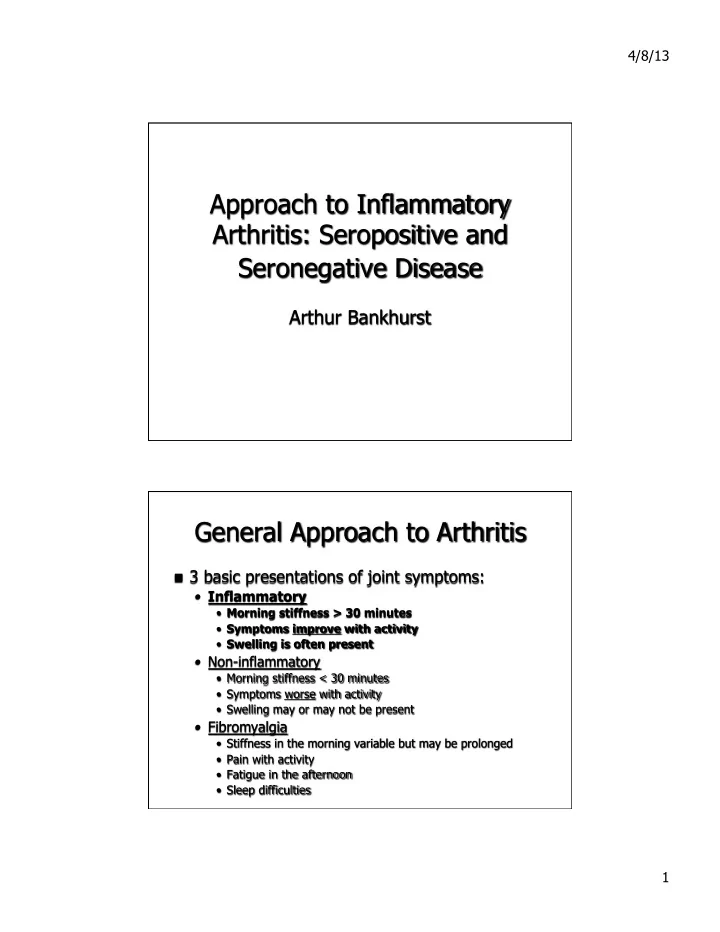
Approach to Inflammatory Arthritis: Seropositive and Seronegative Disease

Arthur Bankhurst

General Approach to Arthritis

 3 basic presentations of joint symptoms:

  • Inflammatory
  • Morning stiffness > 30 minutes
  • Symptoms improve with activity
  • Swelling is often present
  • Non-inflammatory
  • Morning stiffness < 30 minutes
  • Symptoms worse with activity
  • Swelling may or may not be present
  • Fibromyalgia
  • Stiffness in the morning variable but may be prolonged
  • Pain with activity
  • Fatigue in the afternoon
  • Sleep difficulties
slide-2
SLIDE 2

4/8/13 2

General Approach to Arthritis

  • 3 basic patterns for inflammatory arthritis
  • Monoarticular
  • Infection, crystal-induced arthritis, trauma, tumors,

AVN

  • Pauci-articular (oligo-articular) or involvement
  • f < 5 joints
  • Seronegative spondyloarthropathies, polyarticular

gout, sarcoidosis, bechet’s, bacterial endocarditis, lyme disease

  • Polyarticular or involvement of ≥ 5 joints
  • RA, viral arthritis, SLE, occasionally psoriatic arthritis

Seropositive Inflammatory Arthritis

  • What does seropositivity refer to?
  • Positive Rheumatoid factor (RF) and/or
  • Positive anti-CCP
slide-3
SLIDE 3

4/8/13 3

Seropositive Inflammatory Arthritis

  • What is a

rheumatoid factor?

  • An IgM (or IgG)

molecule directed against the Fc portion of your own IgG

  • Is rheumatoid

factor a specific test for rheumatoid arthritis?

Rheumatoid Factor Associations

  • Rheumatologic disease:
  • RA, SLE, Sjogren’s, MCTD, Myositis, Cryoglobulinemia
  • Infectious diseases:
  • Subacute bacterial endocarditis, TB, Syphilis,
  • Hepatitis C (40-70% of hepatitis C patients are Rf positive)
  • 5-10% of healthy older people
  • 2% of healthy young people
  • Idiopathic pulmonary fibrosis
  • Cirrhosis
  • Sarcoidosis
  • Waldenstrom’s macroglobulinemia
  • Take home message:
  • RF is NOT specific for rheumatoid arthritis!
slide-4
SLIDE 4

4/8/13 4

Seropositive Inflammatory Arthritis

  • Again, RF is NOT specific for

Rheumatoid arthritis!

  • Other key points about RF:
  • Sensitivity of RF is 70-80% so up to 30% of RA

patients will not have a positive RF

  • May not be present in early disease
  • Should be used in conjunction with a clinical

suspicion of RA, NOT as a screening test

  • Think about other disease entities, like

hepatitis C (40-70% will be positive)

Seropositive Inflammatory Arthritis

  • Anti-CCP Ab (Anti-cyclic citrullinated peptide)
  • Citrulline is a modified amino acid due to chemical

changes in arginine. Autoantibodies are formed in RA

  • Sensitivity of 78%, specificity of 96% for RA
  • 40% of “seronegative RA” are anti-CCP +
  • Level of CCP is predictive of disease severity
  • CCP is not typically present in Hepatitis C
  • May be present months prior to the onset of clinical

symptoms

  • When present, CCP is very reassuring that you

have RA

slide-5
SLIDE 5

4/8/13 5

Case #1

  • 30 year old female

with 10 days of polyarticular joint pain, swelling, 1-2 hours of morning stiffness

  • Rheumatoid factor

is mildly positive

  • CCP negative
  • What does

she have?

Parvovirus B19

  • Don’t forget infectious causes of arthritis!
  • Children: slapped cheek rash common, arthritis

uncommon

  • Adults rarely get “slapped cheek” rash and joint

symptoms occur in 60%

  • In human volunteers – viremia caused in 6 days,

anti-HPV IgM by second week. IgM Ab correlated with developing arthritis

  • Symptoms are self-limited but can persist for

months or even years

slide-6
SLIDE 6

4/8/13 6

Case #2

  • 35 year old female

with 7 weeks of arthritis, 3-4 hours of morning stiffness

  • Rheumatoid factor is

positive, CCP negative

  • IVDU
  • What does she have?

Hepatitis C

  • Can see polyarthralgias, but typically NOT

inflammatory

  • Other viral causes of arthritis:
  • Hepatitis B, Rubella, Cocksackie, echovirus,

HIV, mumps, alpha virus (Chickungunya,

  • thers)
  • Typically DO NOT cause arthritis: Hepatitis A,

HSV, VZV, EBV and CMV

slide-7
SLIDE 7

4/8/13 7

Case

  • 42 year old female

with 2 months of polyarticular arthritis, swelling in the MCPs/PIPs, and 1-2 hours of morning stiffness

  • Rheumatoid factor

is positive.

  • CCP is positive
  • What does she

have?

  • Target Population(Who should be tested?): Patients who:

1) have at least 1 joint with definite clinical synovitis (swelling)

2) with the synovitis not better explained by another disease

  • Classification criteria for RA (score-based algorithm: add score of criteria A-D;

a score of ≥ 6/10 is needed for classification of a patient having as having definite RA)

Score

  • A. Joint Involvement§

1 large joint 2-10 large joints 1 1-3 small joints (with or without involvement of large joints) 2 4-10 small joints (with or without involvement of large joints) 3 > 10 joints (at least 1 small joint) 5

  • B. Serology (at least 1 test result is needed for classification

Negative RF and negative ACPA Low-positive RF or low-positive ACPA 2 High-positive RG or high-positive ACPA 3

  • C. Acute-phase reactants (at least 1 test result is needed for classification

Normal CRP and normal ESR Abnormal CRP or normal ESR 1

  • D. Duration of symptoms§§

<6 weeks ≥6 weeks 1

Rheumatoid Arthritis The 2010 ACR / EULAR classification criteria for RA

slide-8
SLIDE 8

4/8/13 8

Rheumatoid Arthritis

  • What else can assist you in diagnosing RA?
  • Other lab abnormalities: ESR, CRP, HCT
  • Radiographic changes
  • Periarticular osteopenia
  • Marginal erosions
  • Periarticular soft tissue swelling
  • Uniform joint space narrowing
  • Sometimes subchondral cysts

Rheumatoid Arthritis

Periarticular osteopenia Joint space narrowing Marginal erosion Soft tissue swelling

slide-9
SLIDE 9

4/8/13 9

Advanced RA

MCP PIP DIP

Seropositive Inflammatory Arthritis

  • Summary
  • RA: symmetric inflammatory polyarthritis

affecting MCP/PIPs

  • RF positive, CCP positive: very likely RA
  • RF positive, CCP negative: possibly RA, look

for other possible causes

  • Other scenarios:
  • What about RF negative, CCP positive?
  • What about RF negative, CCP negative?
slide-10
SLIDE 10

4/8/13 10

Seronegative Inflammatory Arthritis

  • Refers to RF/CCP negative diseases with a

predilection for inflammation of the spine

  • The seronegative spondyloarthropathies:
  • Ankylosing Spondylitis (AS)
  • Psoriatic Arthritis (PsA)
  • Reactive Arthritis (ReA)
  • Enteropathic Arthritis (IBD)
  • Juvenile spondyloarthropathy
  • Undifferentiated Spondyloarthropathy

Seronegative Inflammatory Arthritis

Ankylosing Spondylitis IBD Arthritis Psoriatic Arthritis Reactive Arthritis Undifferentiated Spondyloarthropathy

Juvenile Spondyloarthritis

slide-11
SLIDE 11

4/8/13 11

Seronegative Inflammatory Arthritis

  • Common features
  • Absence of RF, CCP
  • Inflammatory arthritis of the spine (with

exceptions)

  • Radiographic evidence of sacroiliitis (with

exceptions)

  • Variable association with HLA-B27
  • Enthesitis, Osteitis, Synovitis

Seronegative Inflammatory Arthritis

  • HLA B27 association with Spondyloarthritis

(in Caucasians)

  • Ankylosing Spondylitis 90%
  • Reactive Arthritis 30-70%
  • IBD Spondyloarthropathy 30-70 %
  • Psoriatic Arthritis 10-25%
  • General population 8%
  • Haida Indians 50%, Japanese <1%
  • In other words, a positive B27 can help you,

but a negative B27 does not rule out a spondyloarthropathy

slide-12
SLIDE 12

4/8/13 12

Ankylosing Spondylitis

  • NY Criteria
  • Definite Ankylosing

Spondylitis If: Criterion 4 or 5 plus 1, 2,

  • r 3.
  • 1. Limited lumbar motion
  • 2. Low back pain for 3

months improved with exercise not relieved by rest

  • 3. Reduced chest expansion
  • 4. Bilateral, grade 2 to 4,

sacroiliitis on X-ray

  • 5. Unilateral, grade 3 to 4,

sacroiliitis on X-ray

Ankylosing Spondylitis

  • Inflammatory

disease of the spine

  • Typically affects

young men ages 15-30

  • Women affected but

less often (3:1 male:female)

slide-13
SLIDE 13

4/8/13 13

Ankylosing Spondylitis

  • Early

Sacroiliitis

Ankylosing Spondylitis

  • Late

Sacroiliitis

slide-14
SLIDE 14

4/8/13 14

Ankylosing Spondylitis

  • Spine involvement

Ankylosing Spondylitis

  • Common features
  • Enthesitis: Inflammation of

enthesis (attachment of tendon, ligaments or joint capsules)

  • Osteitis
  • Common sites
  • Heel – Most Common
  • Patella
  • Tibial Tubercle
  • Base of the 5th metatarsal
  • Plantar Fascia
  • Other sites include:
  • Anserine Bursa
  • Greater Trochanter
  • Iliac Crest
  • Rotator Cuff (Common in

Ankylosing Spondylitis)

  • Costochondral
slide-15
SLIDE 15

4/8/13 15

Ankylosing Spondylitis

  • Extraarticular features
  • Uveitis, most common

extraskeletal feature in SpA (40% in AS)

  • Lungs: Rigidity of the

chest wall and fibrosis in the upper lungs

  • Kidneys: IgA

nephropathy (rare)

  • Heart: Aortitis (dilation
  • f aortic root), aortic

regurgitation

Psoriatic Arthritis

 Quiz: which one of the following 5 cases is

psoriatic arthritis?

slide-16
SLIDE 16

4/8/13 16

Psoriatic Arthritis

  • Case #1:

50 yom with psoriasis presents with painful DIP joints

Psoriatic Arthritis

  • Case #2: 48 yof with

longstanding arthritis, psoriasis and the hand deformities shown on the right

  • Case #3: 52 yom

with psoriasis and progressive deformities shown on right

slide-17
SLIDE 17

4/8/13 17

Psoriatic Arthritis

  • Case #4: 24 yom with

psoriasis, intermittent pain in the wrists, knees and intermittent swelling

  • f the toes
  • Case#5: 37 yom with

psoriasis, low back pain and stiffness

Psoriatic Arthritis

  • All 5 cases are Psoriatic Arthitis. A

heterogenous disease which can present in many ways

  • 5 clinical subtypes and the relative

percentages at presentation

  • Sacroiliitis, Spondylitis (5%)
  • Oligoarthritis (40-50%)
  • DIP arthritis (5%)
  • Symmetrical polyarthritis (30-50%)
  • Arthritis mutilans (5%)
slide-18
SLIDE 18

4/8/13 18

Psoriatic Arthritis

  • Typical presentation is a peripheral inflammatory

joint disease – usually a mono- or oligo-arthritis

  • Most common age of onset is 30-50 years old
  • 6-42% of people with psoriasis get psoriatic

arthritis

  • May occasionally present with polyarthritis
  • Initial presentation of inflammatory spinal

disease is rare

  • Sacroiliitis develops in 1/3 of patients typically

asymmetric

  • Can have entheseal involvement, dactylitis,
  • cular involvement

Psoriatic Arthritis

slide-19
SLIDE 19

4/8/13 19

  • Radiographs
  • Fusiform soft-tissue swelling
  • Narrowing of all the

interphalangeal and MCP joints.

  • Resorption of the terminal tuft
  • f the index finger and

thumb.

  • Subchondral bone resorption
  • f the distal interphalangeal

joint of the thumb and middle fingers resulting in the "pencil-in-cup" appearance.

Psoriatic Arthritis Comparison of AS and PsA

slide-20
SLIDE 20

4/8/13 20

Reiter’s Syndrome/Reactive Arthritis

  • 1916 Hans Reiter described a

German Lieutenant with non- Gonococcal urethritis, arthritis, and uveitis

  • Unfortunately he was convicted
  • f war crimes during WWII
  • As a member of the SS, he

typhoid inoculation experiments that killed more than 250 prisoners at concentration camps

  • Wrote a book on "racial hygiene"
  • Was an enthusiastic supporter of

and participated in enforcing racial sterilization and euthanasia

Reactive Arthritis

  • Arthritis following an infection involving

the GI or GU tract

  • GI: Shigella, Salmonella, Campylobacter,

Yersinia

  • GU: Chlamydia, Mycoplasma

Episode of infection 1st episode of ReA Future episodes of infection and arthritis

slide-21
SLIDE 21

4/8/13 21

Reactive Arthritis

  • 75% will have waxing and waning course

with episodes lasting 6 weeks to 6 months

  • 25% will have a more persistent course

Reactive Arthritis

  • Clinical Features:
  • Joints: Arthritis, Dactylitis, Spondyloarthritis
  • Eyes: Uveitis, Conjunctivitis
  • Mucocutaneous: Oral ulcers, nail changes,

circinate balanitis, keratoderma blennorrhagicum

  • Enthesitis (heels, ribs)
  • Urogenital: urethritis, prostatitis
slide-22
SLIDE 22

4/8/13 22

Reactive Arthritis

  • Can’t see.. (conjunctivitis)

Reactive Arthritis

  • Can’t pee.. (circinate balanitis)
slide-23
SLIDE 23

4/8/13 23

Reactive Arthritis

  • Can’t climb a tree (arthritis)

Reactive Arthritis

  • Keratoderma

Blennorrhagica

  • Discrete, circinate,

scaly, and plaque-like lesions on the foot in reactive arthritis resemble secondary syphilis and psoriasis

slide-24
SLIDE 24

4/8/13 24

IBD associated Arthritis

  • Prevalence: 9% of patients with IBD.

50% experience migratory arthritis

  • Arthritis can affect SI joints (25%), spine and

peripheral joints

  • Peripheral arthritis
  • Acute and self-limiting, pauci-articular and associated

with IBD flares (90%) or

  • Chronic relapsing polyarticular, MCP involvement (5%)
  • r
  • Both (5%)
  • HLA-B27 positive in 30-75% with axial

involvement

IBD associated Arthritis

  • Extraarticular manifestations
  • Pyoderma gangrenosum

(<5%)

  • Aphthous stomatitis (<10%)
  • Acute anterior uveitis (5-15%)
  • Erythema nodosum (<10%)
slide-25
SLIDE 25

4/8/13 25

Comparison of Spondyloarthropathies

Ankylosing Spondylitis Psoriatic Arthritis Reactive Arthritis IBD Arthritis Sacroiliitis 100% symmetric 20% may be asymmetric 40% may be asymmetric 15% symmetric Peripheral Joints 25% 95% 90% 10-20% Eye 40% 20% 50% 5-15% Skin/Nail None 100% 30% <15% Cardiac 1-4% Rare 5-10% Rare

Seronegative Inflammatory Arthritis

  • Different pattern than seropositive arthritis:

Seropositive Seronegative Demographics ♀ > ♂ ♂ > ♀ Peripheral arthritis

Symmetrical small and large joints DIP spared Asymmetrical, usually large, lower extremity (PsA may be exception), dactylitis, enthesitis, DIP in PsA

Pelvic/axial disease Ø except c- spine Yes Enthesopathy No Yes Extra-articular Nodules, vasculitis,

sicca, Raynaud’s Iritis,uveitis,oral uclers, GI, GU,derm

slide-26
SLIDE 26

4/8/13 26

Summary

  • Seropositive arthritis
  • Usually symmetric polyarticular inflammatory

arthritis

  • ♀ > ♂
  • Positive RF and/or CCP
  • RF more sensitive, CCP more specific
  • Positive RF does not mean you have

Rheumatoid Arthritis

  • Rule out other causes of positive RF such as

hepatitis C, infection

Summary

  • Seronegative arthritis
  • RF and CCP negative
  • ♂ > ♀
  • Peripheral arthritis usually is pauciarticular

and asymmetric

  • Presence of axial disease (sometimes)
  • Enthesopathy
slide-27
SLIDE 27

4/8/13 27

Summary

  • Seronegative spondyloarthropathies
  • AS: inflammatory low back pain, bilateral sacroiliitis,

uveitis, axial > peripheral arthritis

  • PsA: psoriasis, dactylitis, DIP involvement, ‘pencil in

cup’ deformity, peripheral > axial arthritis. If sacroiliitis present – usually asymmetric

  • Reactive arthritis: infection, enthesitis, peripheral

> axial arthritis, If sacroiliitis present – usually asymmetric

  • IBD arthritis: Crohn’s, UC. Can be worse with

flares, peripheral > axial arthritis. If sacroiliitis present – can be asymmetric OR symmetric (indistinguishable from AS)

Diffuse Arthralgias and Myalgias

High Impact Rheumatology

slide-28
SLIDE 28

4/8/13 28

Case 1: History

  • A 48-year-old woman presents with

diffuse muscle pain, weakness, and significant fatigue. She reports

  • Symptoms for over 3 years that have become

slightly worse in past 6 months

  • Generalized pain and fatigue that limit her

ability to work

  • Increasing sleep difficulty due to the pain

Case 1: Objective Findings

 General physical examination is

unremarkable

 Diffuse muscle tenderness is noted  Some tenderness around the joints, but no

synovitis

 No objective muscle weakness  Normal neurologic examination  CBC, ESR, and chemistry profile are

normal

slide-29
SLIDE 29

4/8/13 29

How Should You Approach This Patient With Diffuse Musculoskeletal Complaints?

  • Ask yourself the following questions:
  • Is this a systemic inflammatory rheumatic

syndrome?

  • Does this represent rheumatic symptoms of

an endocrinopathy?

  • Is this a toxic/drug reaction?
  • Is this a generalized soft-tissue pain

syndrome? NOTE: Do not overlook regional rheumatic pain syndromes (physical examination is critical)

Characteristics of Inflammatory Disease

  • History
  • Associated with significant morning stiffness

(>45 min)

  • Pain often better with movement
  • Insidious onset of the pain
  • Physical exam
  • Objective findings of inflammation
  • Swelling, erythema, warmth, detectable joint fluid
  • Muscle weakness
  • Focal neurologic abnormalities
slide-30
SLIDE 30

4/8/13 30

Characteristics of Inflammatory Disease (cont’d)

  • Laboratory studies
  • ESR and C-reactive protein are indicators of

generalized inflammation

  • Autoantibodies can be helpful in selected

cases

  • Organ specific tests can suggest internal
  • rgan involvement
  • Liver function tests
  • Renal function tests
  • Muscle-specific enzymes

Inflammatory Causes of Musculoskeletal Pain: Specific Diagnoses

  • Rheumatoid arthritis
  • Systemic lupus erythematosus
  • Polymyositis
  • Scleroderma/eosinophilic fasciitis
  • Polymyalgia rheumatica
  • Duration of symptoms is important for

diagnosis

  • <6 months = may be early rheumatic disease
  • 1 year = diagnostic clinical signs and lab

abnormalities usually present

>2 years = abnormalities almost always

slide-31
SLIDE 31

4/8/13 31

Musculoskeletal Pain in Older Patients

  • Think polymyalgia rheumatica when
  • Age >60
  • Proximal muscle myalgias and stiffness

without specific muscle weakness

  • High ESR
  • Anemia

Think About the Musculoskeletal Pain

  • f Endocrine Diseases
  • Must consider
  • Thyroid disease
  • Parathyroid disease
  • Adrenal disease
  • Diabetes mellitus
  • Acromegaly
  • Diagnosis suggested by history and

appropriate screening lab studies

  • TSH, calcium, phosphorous, glucose, sodium/

potassium

slide-32
SLIDE 32

4/8/13 32

Don’t Forget

 Patients with hypothyroidism

can present with diffuse and nonspecific arthralgias and

  • myalgias. CKs may be elevated

Think About Toxic Drug Reactions That Can Cause Musculoskeletal Pain

 Hydroxymethylglutaryl coenzyme A (HMG-

CoA) reductase inhibitor

 Zidovudine (AZT)  Ethanol  Clofibrate  Cyclosporin A  Penicillamine

slide-33
SLIDE 33

4/8/13 33

 Hydroxymethylglutaryl

coenzyme A (HMG-CoA) reductase inhibitors can cause severe myalgias with or without evidence of objective myositis

Hsu I, et al. Ann Pharmacother. 1995;29:743–759.

Don’t Forget

Think About Generalized Soft- Tissue Pain Syndromes

 Fibromyalgia syndrome  Major depression associated with

musculoskeletal pain

 Somatoform pain disorders

slide-34
SLIDE 34

4/8/13 34

Soft-Tissue Pain Syndromes: Fibromyalgia

 Widespread musculoskeletal pain  Decreased pain threshold and tolerance  May have tenderness in specific regions

(tender points)

 Associated fatigue, sleep, somatic

complaints

 No objective inflammation seen on

physical examination

 Normal laboratory findings

2 4 6 8 10 12 14 Deltoid Forearm Calf Thigh MUSCLE GROUP Normal Fibromyalgia

Pain Response in Fibromyalgia

RELATIVE PAIN

slide-35
SLIDE 35

4/8/13 35

Syndromes That Overlap With Fibromyalgia

The neurologist sees chronic headache, the gastroenterologist sees IBS, the otolaryngologist sees TMJ syndrome, the cardiologist sees costochondritis, the rheumatologist sees fibromyalgia, and the gynecologist sees PMS.

Soft-Tissue Pain Syndromes: Major

Depression With Musculoskeletal Pain

  • Significant depression is seen in
  • 49% of patients with chronic soft-tissue pain
  • 37% of patients with rheumatoid arthritis
  • 33% of patients with osteoarthritis
  • Depression is associated with increased

pain levels in arthritis

  • Depression is more prevalent with loss of

valued activities

Bradley LA. Primer on Rheum Dis. 11th edition. 1997:413–415. Huyser BA, Parker JC. Rheum Dis Clin North Am. 1999;25:105–121.

slide-36
SLIDE 36

4/8/13 36

Soft-Tissue Pain Syndromes: Somatoform Pain Disorders

 Chronic pain that cannot be explained by a known

general medical condition

 These nonintentional symptoms cause significant

distress and impairment of social, occupational, and functional activities

 Psychological factors play a role in the onset,

severity, or maintenance of the pain

 Somatoform disorders are commonly seen (15%) and

nonrecognized (71%) in the primary-care setting

 Outpatient screening diagnostic tools are available

(PRIME-MD)

Kroenke K, et al. Psychosomatics. 1998;39:263–272. DSM-IV. 1994:458–462.

  • A patient probably has a generalized soft-tissue pain

syndrome when there is

  • Primarily nonarticular pain
  • Marked fatigue and/or functional impairment
  • No objective signs of inflammation or a general

medical disorder on examination or laboratory studies

  • Lack of specific neurologic abnormalities
  • Specific diagnostic testing and therapy exist for many

psychological causes of chronic pain

Don’t Ignore It

slide-37
SLIDE 37

4/8/13 37

73

ACR’s New Criteria for the Diagnosis of Fibromyalgia which does not Require Tender Points

slide-38
SLIDE 38

4/8/13 38

 Hyperalgesia and allodynia are still helpful

in the diagnosis of fibromyalgia

 The problem in the past has been the

diagnosis of fibromyalgia in the absence of significant tender points

 The two new criteria involve the

determination of the extent of pain (widespread pain index = WPI 0-19) and the severity of the somatic symptoms (ss 0-12)

CRITERIA

A patient satisfies diagnostic criteria for fibromyalgia if the following 3 conditions are met:

  • 1. Widespread pain index (WPI (WPI ≥7

and symptom severity (SS scale score ≥5

  • r WPI 3-6 and SS scale score ≥9.
  • 2. Symptoms have been present at a

similar level for at least 3 months.

  • 3. The patient does not have a disorder

that would otherwise explain the pain

slide-39
SLIDE 39

4/8/13 39

CRITERIA

#1

WPI: note the number areas in which the patient has had pain over the last week. In

how many areas has the patient had pain? Score will be between 1-19. Shoulder girdle, left Hip (buttock, trochanter), left Jaw, left Upper back Shoulder girdle, right Hip (buttock, trochanter), right Jaw, right Lower back Upper arm, left Upper leg, left Chest Neck Upper arm, right Upper leg, right Abdomen Lower arm, left Lower leg, left Lower arm, right Lower arm, right

CRITERIA

#2 SS scale score:

Fatigue Waking Unrefreshed Cognitive symptoms For the each of the 3 symptoms above, indicate the level of severity over the past week using the following scale: 0=no problem 1=slight or mild problems, generally mild or intermittent 2=moderate, considerable problems, often present and/or at a moderate level 3=severe, pervasive, continuous, life-disturbing problems Considering somatic symptoms in general, indicate whether the patient has: 0=no symptoms 1=few symptoms 2=a moderate number of symptoms 3=a great deal of symptoms The SS scale score is the sum of the severity of the 3 symptoms (fatigue, waking unrefreshed, cognitive symptoms) plus the extent (severity) of somatic symptoms in

  • general. The final score is between 0 and 12.
slide-40
SLIDE 40

4/8/13 40

Somatic Symptoms

Somatic symptoms that might be considered: Muscle Pain Irritable bowel syndrome Muscle Weakness Thinking / remembering problem Fatigue/Tiredness Headache Numbness/Tingling Pain/Cramps in the abdomen Weakness Insomnia Depression Constipation Nausea Pain in the upper abdomen Nervousness Chest Pain Blurred Vision Fever Diarrhea Dry Mouth Itching Wheezing Raynaud’s phenomenon Hives/welts Ringing in the ears Vomiting Oral ulcers Heartburn Loss of /change in taste Seizures Dry Eyes Shortness of Breath Loss of appetite Rash Sun Sensititivity Hearing difficulties Easy bruising Frequent urination Painful Urination Bladder spasms

Case 1: Follow-up

  • The laboratory studies were all normal
  • The patient’s symptoms were present for 3

years

  • Signs of focal, inflammatory, or organic

disease were not found on physical exam

  • PRIME-MD screening did not reveal

evidence of significant depression or somatization

  • Thus, the diagnosis of fibromyalgia was

made

  • Remember: Systemic rheumatic syndromes
slide-41
SLIDE 41

4/8/13 41

Case 2: History

  • A 48-year-old woman presents with

complaints of diffuse muscle pain, weakness, and fatigue. She reports

  • Gradual onset over past 6 months
  • Morning stiffness lasting 2 to 3 hours
  • Difficulty with getting up out of a chair and

combing her hair

  • No problems with holding a brush or standing
  • n her toes

Case 2: Objective Findings

 Minimal muscle

tenderness

 No joint tenderness

  • r swelling

 Significant proximal

muscle weakness in both upper and lower extremities

 No focal neurologic

abnormalities

slide-42
SLIDE 42

4/8/13 42

Case 2: Question

 Based on these findings, which of the

following diagnoses should be initially considered?

  • A. Fibromyalgia
  • B. Polymyalgia rheumatica
  • C. Inflammatory myositis
  • D. Noninflammatory myopathy

Case 2: Answer

  • C and D. Inflammatory myositis or

noninflammatory myopathy

  • The recent onset of symptoms (6 months)

makes consideration of an inflammatory process likely

  • Proximal muscle weakness suggests a

myopathy

  • PMR is characterized by muscle pain and

stiffness, not objective weakness

slide-43
SLIDE 43

4/8/13 43

Common Causes of Proximal Muscle Weakness With Elevated CK

  • Inflammatory myositis
  • Noninflammatory myopathies
  • Hypothyroidism
  • Hypokalemia
  • Alcoholism
  • Drugs
  • AZT
  • HMG-CoA reductase inhibitors

(the “statins”)

Polymyositis/Dermatomyositis: Key Points

  • Proximal muscle

weakness

  • May have

characteristic skin involvement

  • Heliotrope eyelids
  • Gottron’s sign
slide-44
SLIDE 44

4/8/13 44

Polymyositis/Dermatomyositis

  • Diagnosis

confirmed by

  • CK levels
  • EMG findings
  • Muscle biopsy

Polymyositis/Dermatomyositis (cont’d)

  • Therapy
  • Prednisone 1–2 mg/kg, as initial therapy
  • Methotrexate or azathioprine is often added
  • Intravenous immunoglobulin in rapidly

progressive or refractory cases

Olsen NJ. Primer on Rheum Dis. 11th edition. 1997:276–282.

slide-45
SLIDE 45

4/8/13 45

 Symptoms of muscle weakness

require a careful muscle strength and neurological examination

Don’t Forget

  • The diagnosis of inflammatory muscle

disease is difficult

  • Prednisone therapy can cause a steroid

myopathy with weakness

  • Cytotoxic therapy is hazardous
  • Failure to respond to therapy may suggest
  • Inclusion body myositis
  • Neoplasm-related myopathy

Don’t Hesitate to Refer

slide-46
SLIDE 46

4/8/13 46

Case 3: History

  • A 68-year-old man presents with

complaints of diffuse muscle pain, weakness, and total body fatigue. He reports:

  • Gradual onset over past 6 months
  • Morning stiffness lasting 2 to 3 hours
  • Difficulty with getting out of a chair and

combing his hair

  • Recent onset of right-sided headache
  • Recent onset of jaw pain when eating

Case 3: Objective Findings

 Proximal muscle

tenderness without

  • bjective weakness

 Tender right

temporal scalp region

 Normal visual

acuity

 Hgb 9.8; ESR 85;

CK 32

slide-47
SLIDE 47

4/8/13 47

Case 3: Question

 Based on the clinical findings, what is the

most important next step?

  • A. Treat now with prednisone 5 mg bid, and
  • bserve
  • B. Schedule a temporal artery biopsy for

tomorrow morning and use the results to determine whether prednisone will be used

  • C. Start an NSAID at maximal dose
  • D. Treat now with prednisone at 40 to 60 mg

per day and schedule temporal artery biopsy in the next few days

Case 3: Answer

  • D. Treat now with prednisone at 40 to 60

mg per day and schedule temporal artery biopsy for next week

  • Patients with symptoms of PMR may have

temporal arteritis

  • Sudden visual loss may occur in TA
  • The visual loss is usually not reversible

Nordberg E, et al. Rheum Dis Clin North Am. 1995;21:1013–1026.

slide-48
SLIDE 48

4/8/13 48

Temporal Arteritis and Polymyalgia Rheumatica

  • Patients with PMR should be evaluated for

symptoms of TA

  • Headache
  • Scalp tenderness
  • Visual changes
  • Jaw claudication
  • Treatment approaches
  • TA: prednisone 40 to 60 mg qd
  • PMR: prednisone 10 to 15 mg qd

 For probable temporal arteritis:

TREAT NOW! BIOPSY LATER!

 Biopsy as soon as possible

Hunder GC. Primer on Rheum Dis. 11th edition. 1997:294–300.

Don’t Hesitate

slide-49
SLIDE 49

4/8/13 49

Case 4: History

  • A 48-year-old woman presents with

complaints of diffuse muscle pain, weakness, and fatigue. She reports:

  • Gradual onset over past 12 months
  • Recent separation from her husband
  • Difficulty sleeping
  • A 10-lb weight loss
  • The physical exam and screening

laboratory tests are normal

Case 4: Question

 Based on this clinical information, which of

the following diagnostic studies are now indicated?

  • A. Abdominal CT to look for tumors
  • B. ACTH stimulation test
  • C. CPK, ANA, rheumatoid factor
  • D. PRIME-MD Patient Questionnaire
slide-50
SLIDE 50

4/8/13 50

Case 4: Answer

  • D. PRIME-MD Patient Questionnaire
  • A simple outpatient tool for the screening of

mental disorders in the primary care setting

  • Presence of core symptoms of depression on

this questionnaire correlates with DSM-IV diagnostic criteria

  • 97% sensitive
  • 94% specific

Brody, et al. Arch Intern Med. 1998;158:2469.

Screening for Depression in a Busy Clinic

  • Screening question
  • “During the past month, have you often been

bothered by the following?”

  • Little interest or pleasure in doing things

(anhedonia)

  • Feeling down, depressed, or hopeless (depressed

mood)

  • If one answer is “yes,” probe for core

symptoms of depression

Brody, et al. Arch Intern Med. 1998;158:2469.

slide-51
SLIDE 51

4/8/13 51

Screening for Depression in a Busy Clinic (cont’d)

  • Core symptoms of depression = SALSA
  • “Have you experienced any of the following

feelings nearly every day for the past 2 weeks?”

  • Sleep disturbance
  • Anhedonia
  • Low self-esteem
  • Appetite decrease
  • The presence of 2 or more core symptoms

correlates with a diagnosis for major depression

Common Presenting Complaints With Major Depression

  • Excessive worry over physical health
  • Complaints of pain
  • Joint pain
  • Headaches
  • Abdominal pain
  • Tearfulness and irritability
  • Brooding and anxiety

DSM-IV. 1994:323.

slide-52
SLIDE 52

4/8/13 52

Huyser BA, Parker JC. Rheum Dis North Am. 1999;25:115.

Musculoskeletal pain and the

presence of major depression may be interrelated

Increased Major Depression Increased Pain Levels

Don’t Forget

Case 5: Question

 40-year-old woman with diagnosis of

fibromyalgia has quit her job because of pain and fatigue. Which of the following therapies is most important?

  • A. NSAIDs
  • B. Low-dose tricyclic agents at night

(amitriptyline, cyclobenzaprine)

  • C. Instruction in general physical conditioning

exercises

  • D. Encourage her to return to work
slide-53
SLIDE 53

4/8/13 53

Case 5: Answer

  • C. Conditioning exercises
  • NSAIDs a little better than placebo
  • Amitriptyline a little better than NSAIDs
  • NSAIDs plus amitriptyline a little better than

amitriptyline alone

  • Duration of response to pharmacological

agents is usually limited

  • But exercise is BEST of all - to increase

function in spite of pain not to eliminate pain.

Therapy of Fibromyalgia Syndrome

  • Goal of therapy
  • Keep patient functional in spite of pain
  • Therapeutic techniques
  • Listen to the patient and reassure
  • Educate regarding the nondestructive nature
  • f the disease
  • Aggressively treat coexisting depression
  • Emphasize appropriate sleep hygiene
  • Instruct in a regular conditioning exercise

program

  • Encourage social interactions and employment
slide-54
SLIDE 54

4/8/13 54

 Use of corticosteroids or narcotic

agents is not indicated in fibromyalgia

Don’t Start It Things to Remember Tomorrow

  • In patients with diffuse arthralgias and

myalgias

  • Think about an inflammatory rheumatic

syndrome

  • Think about an endocrine abnormality
  • Think about drug or toxic reactions
  • Think about a soft-tissue pain syndrome
  • Fibromyalgia
  • Depression
  • Somatoform pain disorder
slide-55
SLIDE 55

4/8/13 55

Things to Remember Tomorrow (cont’d)

 Systemic rheumatic inflammatory

syndromes have objective abnormalities on examination

 Symptoms of muscle pain and/or weakness

require a careful examination of muscle strength and focal neurological abnormalities

 Screen for common, treatable mental

disorders (PRIME-MD)

slide-56
SLIDE 56

4/8/13 56

High Impact Rheumatology

Rheumatology at a Glance

Know It When You See It

*

Know It When You See It

˜ Hard boney

enlargements

˜ Heberden’s nodes at

the DIP joints

˜ Bouchard’s nodes at

the PIP joints

˜ Often have “squared”

first CMC joint due to

  • steophytes at that joint

Osteoarthritis: Typical hand

slide-57
SLIDE 57

4/8/13 57

Know It When You See It

Rheumatoid arthritis

˜ Soft synovial swelling ˜ Synovitis and volar

subluxation at the MCP joints

˜ Synovitis of the wrists ˜ Synovitis of the PIP

joints with early swan neck deformities

 Late-stage findings

indicating serious changes in the joints

 Swan neck (digits

2 to 4) PIP extension DIP flexion

 Boutonnière (digit

5) is the reverse; PIP flexion DIP

Rheumatoid Arthritis: Swan Neck and Boutonnière Deformities

slide-58
SLIDE 58

4/8/13 58

Tendon rupture in RA

˜ Inability to extend

fourth and fifth digits

˜ Due to deformity and

inflammation at the wrist causing excess wear of the extensor tendons

Know It When You See It Know It When You See It

Psoriatic arthritis

˜ Inflammation of the

DIP joints

˜ Sausage fingers ˜ Joint involvement

shows radial pattern

˜ Nail changes ˜ Psoriatic patches ˜ Arthritis may start

before the skin

slide-59
SLIDE 59

4/8/13 59

Know It When You See It

Psoriatic arthritis

˜ Sausage toes ˜ IP joint involvement of

a toe suggests a rheumatoid variant

˜ Psoriatic arthritis and

Reiter’s disease are the most common causes

Know It When You See It

Reiter’s syndrome

˜ Keratoderma

blennorrhagica

˜ May look like psoriasis

  • r syphilis

˜ Can occur in patches

  • r as sterile pustules
slide-60
SLIDE 60

4/8/13 60

  • Following:
  • Urethritis or cervicitis
  • Infectious diarrhea
  • Often associated with:
  • Inflammatory eye disease
  • Balanitis, oral ulceration,
  • r keratoderma
  • Enthesopathy
  • Sacroiliitis

Seronegative asymmetric arthritis

Reiter’s Syndrome (Reactive Arthritis)

 Ulcerative colitis  Regional enteritis

(Crohn’s disease)

 ? Whipple’s  ? Behçet’s

Inflammatory Bowel Disease

slide-61
SLIDE 61

4/8/13 61

Know It When You See It

˜ Butterfly rash ˜ Involves cheeks and

nose

˜ Patient also has rash

  • n chin and some

telangiectasia Systemic lupus erythematosus

Know It When You See It

˜ Interarticular

dermatitis

˜ Also has periungual

erythema

˜ This rash is distinct

from that seen in dermatomyositis that occurs over the joints Systemic lupus erythematosus

slide-62
SLIDE 62

4/8/13 62

Know It When You See It

Dermatomyositis

˜ Scaly rash over the

extensor surfaces of the interphalangeal joints

Know It When You See It

Periungual changes

˜ Seen in lupus

erythematosus, dermatomyositis, and scleroderma

˜ Thickening of capillary

loops

˜ Dropout of capillary

loops

˜ Hemorrhage in the nail fold

may also be present

slide-63
SLIDE 63

4/8/13 63 Close-up views of periungual changes

Upper right: Dilated loops Lower left: Dilated loops with dropout Upper left: Normal Lower right: Dilated loops with branching

View with ophthalmoscope and drop of oil

Know It When You See It Know It When You See It

Dermatomyositis

˜ Mantle or shawl

distribution of rash

slide-64
SLIDE 64

4/8/13 64

Know It When You See It

Linear scleroderma

˜ Not usually

associated with systemic disease

Know It When You See It

Livedo reticularis

˜ Appears in a broad-

based interrupted pattern in systemic vasculitis, including SLE

˜ May occur as a fine,

connected, lacy pattern in normals

slide-65
SLIDE 65

4/8/13 65

Know It When You See It

Palpable purpura

˜ Characteristic of

dermal vasculitis in Henoch-SchÖnlein purpura Saddle nose deformity

˜ Relapsing

polychondritis

˜ May also occur in

Wegener’s granulomatosis and syphilis

Know It When You See It

slide-66
SLIDE 66

4/8/13 66 Relapsing polychondritis

Left: Ear changes with inflammation in the cartilage and swelling Right: Loss of ear cartilage in late stages

Know It When You See It

Ochronosis

˜ Deposition of

homogentisic acid

˜ Gray discoloration

  • f the ear and

dense pigment on transillumination

Know It When You See It

slide-67
SLIDE 67

4/8/13 67

Know It When You See It

 Tophi appear rather

late in gout

 Prick the tophus

with a needle. Put the drop of material

  • n a slide

 Multiple birefringent

crystals will be seen

  • n polarized

Gout tophi in the ear a good tip-off if present

Know It When You See It

Urate crystal in a tophus

˜ Top: Seen with ordinary

light microscope with condenser racked down and light intensity adjusted

˜ Bottom: Seen with

compensated polarized light, the preferred method

slide-68
SLIDE 68

4/8/13 68

Gouty tophus on finger

˜ Note the yellow-

  • range color typical
  • f a tophus

˜ Patient also has

swelling of the PIP of the index and fifth digits

Know It When You See It

Skin pustule with disseminated gonorrhea

˜ Usually a few lesions ˜ Usually found on the

extremities

Know It When You See It

slide-69
SLIDE 69

4/8/13 69

Septic olecranon bursitis

˜ Swelling of the bursa ˜ Erythema and

tenderness

˜ If it looks ugly, tap it

Know It When You See It Know It When You See It

Septic prepatellar bursitis with cellulitis

˜ Rubor, calor, dolor over

the patella and adjacent tissue

˜ Lack of joint

involvement evident from nontender suprapatellar pouch and popliteal area

˜ Don’t tap a normal

knee through cellulitis

slide-70
SLIDE 70

4/8/13 70

  • Clubbing with loss of

nail angle

  • Full syndrome includes

periostitis of ends of long bones

  • Associated with
  • Chest malignancies
  • Chronic lung

infection

  • Other tumors

Hypertrophic osteoarthropathy

Know It When You See It

Amyloidosis

˜ Shoulder pad sign ˜ The worst case you

are likely to see

˜ Patient also has

macroglossia and purpura

Know It When You See It

slide-71
SLIDE 71

4/8/13 71

Hyperthyroidism

˜ Acropachy ˜ Right: Soft tissue

swelling between joints

˜ Left: Periosteal new

bone formation

Know It When You See It Know It When You See It

Ehlers-Danlos syndrome

˜ A true connective-

tissue disease

˜ Left: Hypermobility of

  • joints. Can touch

thumb to volar surface

  • f forearm

˜ Right: Hyperelasticity

  • f skin

˜ Associated with

vascular abnormalities

slide-72
SLIDE 72

4/8/13 72

Case Studies

  • A. Bankhurst

Case 1

 28 year old woman with pain in her arms and legs for past 7 years  Also has 7 year history of RA that has been well controlled on

methotroxate

 Has noted increased fatigue and wonders if RA is getting worse  No synovitis but pain in several joints as well as pain in soft tissue of

back, legs, shoulders, arms, and neck

 Lab: ESR, CT, TSH, CK, CRP, ESK were normal

Which of the following is the most likely diagnosis? a) Polymyositis b) Fibromyalgia c) RA d) SLE

slide-73
SLIDE 73

4/8/13 73

Case 2

  • 70 year-old woman in your office with a 2 day history of knee pain
  • She awoke this morning with warm, swollen knee with difficulty

walking

  • PMH: Type 2 DM, Chronic renal disease, hypertension
  • PE: T 37.9⁰ C, P=98, BMI=34, knee red and swollen
  • Lab: WBC=11000, CR=1.7, uric acid= 8.2
  • Which of the following is the most appropriate next step in this

patient’s management? a) Arthrocentesis b) Colchicine c) Ibuprofen d) Intravenous cerftriaxone e) Prednisone

Case 3

 56 year-old man is in your office for a two day history of right ankle

pain, no trauma or history of arthritis

 PMH: HTN on hydrochlorothiazide  PE: Right ankle warmness, swollen. Limited range of motion  Which is the most appropriate step for evaluation of this patient?

a) HLA-B27 Testing b) Arthocentesis c) Serum calcium d) Serum uric acid e) RF Testing

slide-74
SLIDE 74

4/8/13 74

Case 4

 64 year-old man with chronic gout, presents with swollen red elbow

for past 2 days.

 His last attack of gout was 4 months ago.  Rx: Metformin, atorvastatin, hydrochlorothiazide, and low dose asp.  PE: T 38.1 C, elbow warm with minimal erythema, fullness and

tenderness over right olecranon process. Passive motion of elbow painless.

 What is the most appropriate next step?

a) ESK b) X-Ray of elbow c) Right elbow aspiration d) Right olecranon bursa aspiration

Case 5

  • 43 year-old woman with 1 week of knee pain. Pain began as a

“pop” when she was going down a flight of stairs.

  • The knee became swollen over 4-6 hours. Continuous knee pain

relieved with ibuprofen. There is no “locking”.

  • PE: left knee minimal effusion without warmth and full ROM.

McMurray sign positive.

  • What is the likely diagnosis?

a) Anserine bursitus b) Ligamentous tear c) Meniscal tear d) Patellofemoral pain syndrome

slide-75
SLIDE 75

4/8/13 75

Case 6

 35 year-old woman with a 12 day history of bilateral anterior knee

  • pain. Worsens when descending stairs and requires her to stand up

from a sitting position occasionally to relieve stiffness and

  • discomfort. She is a moderate runner for exercise.

 PE: No swelling, warmth, tenderness, or instability of knee. Pressing

patella against femur and moving it inferiorly or superiorly reproduces the pain/

 What is the diagnosis?

a) OA b) Patella femoral pain syndrome c) Prepatellar bursitis d) Referred scaitic pain

Case 7

 48 year-old man developed left knee pain after slipping on ice. This

was followed by swelling and pain over the next several hours. He had no problems with his knee before the fall.

 PE: Mild effusion without erythema or warmth of the left knee. Full

ROM although with mild pain. No evidence of laxity of anterior cruciate ligaments.

 What is the most appropriate next step in management?

a) Crutches and a knee brace b) MRI of the knee c) Radiograph of the knee d) Symptomatic treatment

slide-76
SLIDE 76

4/8/13 76

Case 8

 47 year-old man with right lateral shoulder pain. He had been

pitching for last 2 months for his son’s baseball practice. He has pain with full abduction and when he lies on the right shoulder.

 PE: ROM normal and no deformity or swelling. Subacromial

tenderness, shoulder pain starts at 60⁰ abduction. No pain with elbow flexion or forarm suppination. Strength with abduction normal.

 What is the most likely diagnosis?

a) Adhesive capsulitis b) Bicipital tendinitis c) Glenohumeral arthritis d) Rotator cuff tear (complete) e) Rotator cuff tendinitis

Case 9

 74 year-old man with chromic hand stiffness and 20 year

history of OA of the hand. He presents with intermittent redness and swelling of several DIPs and PIPs. She had some relief with ibuprofen but stopped this because of gastric problems.

 What is the most likely diagnosis?

a) Psoriatic arthritis b) RA c) Gout d) Inflammatory OA

slide-77
SLIDE 77

4/8/13 77

Case 10

 49 year-old man with tophaceous gout and hypertension. His

last attack of gout was 6 months ago and resolved with

  • naproxen. Medications are: Colchicine, enalapril, and 100 mg

allopurinol.

 PE: Nontender moveable olecronon nodules and slightly

tender 1st MTP with an overlying nodule. Uric acid= 7.2, creatine=1.0

 What is the most appropriate next step?

a) Add probenecid b) Discontinue colchicine c) Increase allopurinol d) Obtain 24-hour urine urate excretion.

Case 11

 53 year-old woman with 3 month history of bilateral knee pain on

  • ambulation. Pain is worse in right knee with 15 minutes of AM
  • stiffness. She has swelling of DIPs and PIPs also.

 PE: no redness or swelling. Bilateral bony hypertrophy of the DIPs

and PIPs. Bilateral crepitus with passive knee ROM. Small right knee effusion.

 What studies would be most useful in the confirming of the

diagnosis? a) Anti-CCP b) ANA c) ESR d) RF e) No additional studies

slide-78
SLIDE 78

4/8/13 78

Case 12

 53 year-old woman with 3 day history of right knee swelling.

Pain is worse with weight bearing and initiation of movement after inactivity.

 PE: Knee has bony hypertrophy and medial joint-line

tenderness with a large effusion. Arthrocentesis: WBC=1000µL with 30% neutrophills

 What is the most likely diagnosis?

a) Septic arthritis b) Gout c) OA d) Calcium pyrophosphate deposition disease (Pseudo gout)

Case 13

 62 year-old woman with pain in left knee for 1 month and has

gradually become worse. Pain with exertion and at rest.

 PE: Obese, left knee effusion, slightly warm to touch. No bony

hypertrophy or crepitus.

 Arthrocentesis: WBC=1500/µL with 60% neutrophils, no crystals

What is the most likely cause of this problem? a) Septic arthristis b) RA c) OA d) Meniscal tear e) Gout

slide-79
SLIDE 79

4/8/13 79

Case 14

 51 year old woman with dermatomyositis. She has proximal

muscle weakness and a periorbital heliotrope rash.

 PE: confirms muscle weakness  Which is the following should be included in the patients

evaluation? a) Liver biopsy b) Cystoscopy c) Renal ultrasonography d) Colonoscopy, mammography, and papanicolaou smear

Case 15

  • 45 year-old man with 3 month history of increasing fatigue and
  • weakness. He has difficulty getting in and out of the bathtub and

taking no medications.

  • PE: difficulty rising from a chair without assistance. He has

weakness to shoulder abduction and does not have muscle tenderness on palpation.

  • CK= 5600, ESR= 52
  • Which of the following is the most likely diagnosis?

a) Fibromyalgia b) Myastenia gravis c) Polymyalgia rheumatica d) Polymytosis e) Syringomyelia

slide-80
SLIDE 80

4/8/13 80

Case 16

 62 year-old man with 1 year of progressive right knee

  • pain. He is unable to tolerate non steroidal anti-

inflammatory agents.

 PE: Obese, bilateral knee crepitus on ROM  In addition to weight loss and quad exercise, which is

the most appropriate treatment? a) Acetaminophen b) Arthroscopic debridement c) Diclofenac d) Indomethacin suppositories

Case 17

 27 year-old woman with 6 month history of pain and

swelling in wrists, knuckles, and fingers bilaterally. Prolonged stiffness and pain for 3 hours in the AM. The pain diminishes in the afternoon but she states she is exhausted.

 PE: Swelling/tenderness of PIPs, MCP, wrists, knees, and

ankles

 What is the most likely diagnosis?

a) Gonococcal arthritis b) Gout c) Osteoarthritis d) RA

slide-81
SLIDE 81

4/8/13 81

Case 18

 26 year-old woman who is 8 weeks pregnant developed pain/

swelling in left wrist 1 day ago and has had pain/swelling in right knee as well.

 PE: There is an effusion in the knee and scant mucoid cervical

discharge on pelvic exam. Arthrocentesis of the knee: WBC= 14,000/µL, 90% neutrophils, Gram stain negative.

 Which of the following is the most appropriate next step in this

patient’s management? a) Begin vanomycin b) Begin doxycycline c) Begin ceftriaxone d) Perform total hemolytic complement assay

Case 19

 65 year-old woman with RA has been well controlled on

  • methotrexate. During the last 3 days, she has developed severe

pain and swelling in the 3rd PIP of her right hand.

 PE: T= 39.2 C. PIP joint is exquisitely tender and warm.  Arthrocentesis: WBC= 85,000/µL and negative for crystals  What is the most likely organism causing this patient’s current

findings? a) Pseudomonas b) Salmonella c) Staphylococcus d) Streptococcus pyogenes

slide-82
SLIDE 82

4/8/13 82

Case 20

 62 year-old man with left anterior hip pain that began 3

days ago. He had a cystoscopic kidney stone extracted 4 days ago. He also has a fever and chills, a history of gout, and DJD in both hips.

 PE: T= 38.7 C, decrease ROM and pain of left hip. CT

scan= effusion

 Which of the following tests is more appropriate?

a) ANA, RF b) Bone scan c) Hip joint aspiration d) Urethral swab for Neisseria

Case 21

 40 year-old woman with 3 weeks history of right sternoclavicular

joint (SC) joint pain and swelling. No other medical problems but she does inject heroin and is sexually active.

 PE: T= 38.9 C, right SC joint is swollen and fluctuant. Needle tracks

are present. HCT 38, WBC= 14,400 /µL, ESR=72

 Which is the most appropriate next step?

a) X-Ray of SC joint b) MRI of the SC joint c) Empiric treatment with broad-spectrum antibiotics d) Throat, cervical, rectal, and blood cultures e) Aspiration of the SC joint

slide-83
SLIDE 83

4/8/13 83

Case 22

 24 year-old woman with 2 months history of fever, muscle/

joint is pain which is worse after a severe sunburn 4 days

  • ago. She states that her hands are swollen and painful. She is

sexually active.

 PE: T= 37.6 C, mild facial redness, painless mouth ulcer, and

throat is red.

 Which of the following is the most likely diagnosis?

a) Behçet’s disease b) Disseminated gonococcal arthritis c) Fibromyalgia d) Reactive arthritis e) SLE

Case 23

 32 year-old woman with 8 month history of joint pain, rash, fatigue,

and myalgias. She was diagnosed with pleurisy 3 months ago. She is not sexually active

 PE: T= 37.7 C, rash over the bridge of her nose and cheeks, sparing

the nasolabial folds. There is synovitis of wrists and MCP.

 Which of the following blood tests will be most helpful in confirming

the diagnosis? a) ESR, CRP b) RF, anti-CCP c) ANA, anti-double-stranded DNA d) Serum uric acid and HLA-B27

slide-84
SLIDE 84

4/8/13 84

Case 24

  • 82 year-old woman with a 2 week history of severe headache and

neck pain. Stiffness and aching in shoulder and neck.

  • PE: Scalp diffusely tender and carotids are tender. No weakness but

limited because of muscle pain.

  • Hb= 10, CK= 150, ESR= 50
  • Which is the most likely diagnosos?

a) Carotid artery dissection b) Polymyalgia rheumatica (PMR) c) PMR and giant cell arthritis d) Polymyositis

Case 25

 32 year-old woman with 2 weeks history of weakness of right

arm and left leg. The initial presentation was acute right wrist drop with sensory loss over the radical nerve distribution. One week ago, she had similar symptoms over left peroneal nerve

  • distribution. She as a diagnosis of SLE and is on

hydrochloroquine.

 Which is the most likely diagnosis?

a) Guillian-Barre syndrome b) Lyme disease c) Motor neuron disease d) Toxic neuropathy e) Vasculitic neuropathy

slide-85
SLIDE 85

4/8/13 85

Case 26

 65 year-old woman with 3 month history of “tiredness”. She has no

longer taken a daily walk because of fatigue and has pain in shoulder, neck, back, and hips. She sleeps poorly.

 PE: Full ROM of extremities without weakness. Her muscles are

tender.

 ESR= 222, CK=125  Which is the most likely diagnosis?

a) PMR b) Polymyositis c) RA d) Fibromyalgia