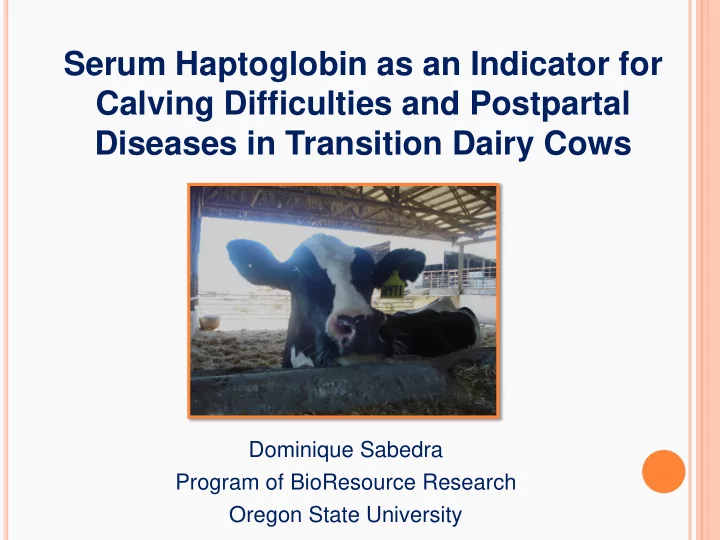
SLIDE 1
Dominique Sabedra Program of BioResource Research Oregon State University
Serum Haptoglobin as an Indicator for Calving Difficulties and Postpartal Diseases in Transition Dairy Cows
SLIDE 2
TRANSITION PERIOD
3 weeks from expected calving date to 3
weeks postpartum
Elevated incidence of metabolic and
infectious diseases
Increased exposure and susceptibility of the
mammary gland and uterine tract to bacteria
SLIDE 3
Cow Quality of Life decreased Profit and Milk Quality decreased Milk Loss and Treatment Costs
Transition Period
20 % older cows die 90% become ill
SLIDE 4 HAPTOGLOBIN
Acute Phase Protein Primary synthesis in the liver
Secondary synthesis in various body tissues
- Mammary gland
- White blood cells
- Adipose tissue
- Ovaries
SLIDE 5 Body’s response to infectious agents that
can cause stress, trauma, and inflammation
Innate immune system
Haptoglobin primarily serves to prevent
further tissue damage and promote repair
- Proportional to severity of challenge
ACUTE PHASE RESPONSE
SLIDE 6
Antioxidant
Anti- Inflammatory Agent Tissue- Regeneration Agent Bacteriostat
Immunomodulator
Functions of Haptoglobin
Prevents future tissue damage and promotes tissue generation
SLIDE 7 HAPTOGLOBIN IN BOVINE
Proposed as an indicator of acute and chronic
diseases
Limited sensitivity (percent of animals detected
as sick)
Delayed reaction (24 hr) to tissue damage or
infection
Decreases after an acute infection Does not always go up during disease
SLIDE 8 Hp Increase 2-3 g/L Baseline Concentration 25-35 mg/L Challenge
≤ 24 hours, >10-fold
Peaks between 60 & 80 hrs Up to 14 d
SLIDE 9 Objective 2 Objective 1
Evaluate whether peripartal [Hp] were associated with:
- Health status and severity
- Type and number of diseases
Objective 2
- Examine whether prepartal [Hp]
indicate birth complications
- Examine whether [Hp] were
elevated prior to clinical signs of diseases
SLIDE 10 Objective 2 Hypothesis 1
Haptoglobin concentrations will increase in the peripartal period:
- In relation to health status,
severity, type and number of diseases
Hypothesis 2
Haptoglobin concentrations will increase in the peripartal period:
- Prepartum in cows that had birth
complications
- Prior to the onset of clinical
signs of diseases
SLIDE 11
Van Beek Dairy in Monroe, Oregon, in
Spring and Summer of 2010
161 multiparous Holstein cows 4 weeks prior to expected calving date to 4
weeks post-calving
METHODS
SLIDE 12
METHODS: ANIMAL MANAGEMENT
Between days -28 and 100 postpartum, cows
were monitored daily for signs of diseases
Medical treatment was provided and recorded
by herd manager and recorded in Dairy Comp (Valley Ag. Software, Inc., Tulare, CA)
SLIDE 13 BLOOD COLLECTION
Blood samples were taken according to the
figure below (0 = day of calving)
- 21 -14 -7 -3 -1 0 1 3 7 14 21 28
SLIDE 14 BLOOD COLLECTION
5-8 mL of blood was taken from the coccygeal
vein or artery in a 10 mL serum vacutainer tube
Samples were placed on ice and transported to
lab
- Serum was separated by centrifugation at room
temperature for 20 minutes at 1600 x g
- Stored at -20 C until chemical analysis
SLIDE 15
SLIDE 16
SLIDE 17
BLOOD ANALYSIS
Samples were analyzed using a bovine
haptoglobin enzyme-linked immunosorbent assay (ELISA)
Life Diagnostics, Inc., Catalog number: 2410-7 Procedure was conducted according to
manufacturer's instructions
SLIDE 18
- No medical treatment
- SCC < 1,000,000 cells/mL
and
CLASSIFICATION OF GROUPS
Disease Status and Severity
Healthy (n=19) Mild Disease (n=49) Severe Disease (n=63) Died/Sold (n=30)
precursors or antibiotics,
- SCC>1,000,000 cells/mL
- r
- BHBA > 1.3 mmol/L
- Treated with antibiotics
with withdrawal period
precursors
- Died or sold in the first
100 days postpartum
SLIDE 19 Healthy (n=20)
No medical treatment
Mild Disease (n=17)
Treated without glucose precursors
Other Diseases (n=19) Ketosis(n=20)
BHBA > 1.3 mMol/L
Metritis(n=21)
Placental retention or purulent/putrid vaginal or cervical discharge
Mastitis (n=17)
Milk flakes, swelling, or SCC > 1,000,000 cells/mL
2+ Diseases (n=47)
Cows with more than 1 disease Diseases other than ketosis, metritis,
SLIDE 20 Healthy (n=63)
cows with mild diseases
Other Severe Disease (n=70)
without birth complications
Birth Complications (n=28)
- Twinning (n=16)
- Hard pull or
C-Section (n=8)
CLASSIFICATION OF GROUPS
SLIDE 21
First Treatment Time
CLASSIFICATION OF GROUPS
No Treatment (n=39) Treated D-21 to -1 (n=14) Treated D0 to 3 (n=50) Treated D4 to 7 (n=25) Treated D8 to 28 (n=28)
SLIDE 22
SUMMARY OF CLASSIFICATION GROUPS
Disease Status and Severity Disease Number and Type Birth Complications First Treatment Time
SLIDE 23 100 200 300 400 500
1 3 7 14 21 28
Haptoglobin (mg/L) Days Postpartum
Healthy (n = 20) Mild Disease (n = 41) Severe Disease (n = 70) Sold or Died (n = 30)
Figure 1: Elevated serum haptoglobin concentrations during the first week postpartum indicate disease status and severity of dairy cows during the peripartal period. Cows in the two severe groups had greater [Hp] than mild diseases (P <0.001).
SLIDE 24 100 200 300 400 500 600
Prepartum Postpartum Week 1 Postpartum Week 2-4 Haptoglobin Max. Peak (mg/L)
Healthy (n = 20) Mild Disease (n = 41) Severe Disease (n = 70) Sold or Died (n = 30)
Figure 2: Compared to healthy cows, sick cows had greater peak [Hp] in the first wk after calving (P < 0.001). Cows with severe diseases had greater peak [Hp] than the mild/healthy groups in the first wk after calving (P < 0.001). Cows that were sold or died had greater peak [Hp] than cows with severe disease in wk 2 to 4 postpartum (P = 0.04).
SLIDE 25 100 200 300 400
Prepartum Postpartum Week 1 Postpartum Week 2-4 Haptoglobin AUC (mg/L)
Healthy (n = 20) Mild Disease (n = 41) Severe Disease (n = 70) Sold or Died (n = 30)
Figure 3: Compared to healthy cows, sick cows had greater [Hp] AUC values in the first wk postpartum (P < 0.001). Cows with severe diseases had greater [Hp] AUC values than the mild/healthy groups in the first wk postpartum (P < 0.001). Cows that were sold or died had greater [Hp] AUC values than cows with severe disease in wk 2 to 4 postpartum (P = 0.02).
SLIDE 26 50 100 150 200 250 300 350 400
Prepartum Postpartum Week 1 Postpartum Week 2-4 Haptoglobin AUC (mg/L)
Mild Diseases (n = 17) Other Severe Diseases (n = 19) Ketosis (n = 20) Metritis (n = 21) Mastitis (n = 17) Two or More Diseases (n = 47)
Figure 4: Disease number and type affect [Hp] AUC values. Cows with ketosis, metritis, and 2
- r more diseases had the greatest [Hp] AUC values in wk 1 postpartum. Cows with mastitis
and 2 or more disease had the greatest [Hp] AUC values in wk 2 to 4 postpartum.
SLIDE 27 100 200 300 400 500 600 700 800
Prepartum Postpartum Week 1 Postpartum Week 2-4 Haptoglobin Max. Peak (mg/L)
Healthy (n = 20) Mild Diseases (n = 17) Other Severe Diseases (n = 19) Ketosis (n = 20) Metritis (n = 21) Mastitis (n = 17) Two or More Diseases (n = 47)
Figure 5: Disease number and type affect peak [Hp]. Cows with ketosis, metritis, and 2 or more diseases had the greatest peak [Hp] in wk 1 postpartum. Cows with mastitis and 2 or more disease had the greatest peak [Hp] in wk 2 to 4 postpartum. .
SLIDE 28 5 14 36 98 266
1 3 7 14 21 28
Haptoglobin (mg/L) Days Postpartum
Healthy/Mild Diseases (n = 63) Severe Diseases (n = 70) Birth Complications (n = 28)
Figure 6: Cows with versus without birth complications had greater [Hp] at days -14 prepartum (P < 0.001)
SLIDE 29 10 20 30 40 50 60 70 80
Area Under the Curve Peak Concentrations Prepartal Haptoglobin (mg/L)
Healthy/Mild Diseases (n = 63) Severe Diseases (n = 70) Birth Complications (n = 28)
Figure 7: Compared to cows without birth complications, cows with birth complications had greater [Hp] AUC values (P < 0.001) and peak concentrations (P = 0.004) in the last 3 wks prepartum
SLIDE 30 5 50 500
1 3 7 14 21 28 Haptoglobin (mg/L)
Days Postpartum
Not Treated (n = 39) Treated d0-3 (n = 50) First Treatment
Figure 8: Cows that were treated first within day 0 to 3 postpartum had greater [Hp] at days
- 7 (P = 0.05) and -3 (P = 0.01) postpartum.
SLIDE 31 5 50
1 3 7 14 21 28
Haptoglobin (mg/L)
Days Postpartum
Not Treated (n = 39) Treated d4-7 (n = 25)
Figure 9: Cows that were treated first between 4 and 7 days postpartum had greater [Hp] at days 1 (P = 0.04) and 3 postpartum (P < 0.001).
First Treatment
SLIDE 32 20 40 60 80 100 120 140 160 180 200
1 3 7 14 21 28
Haptoglobin (mg/L)
Days Postpartum
Not Treated (n = 39) Treated d8-28 (n = 33)
Figure 10: Cows that were treated first between 8 and 28 days postpartum had greater [Hp] at days 3 (P = 0.002) and 7 (P <0.001) postpartum.
First Treatment
SLIDE 33
Elevated serum haptoglobin concentrations
during first week postpartum indicate disease:
Incidence Severity Number Type
SUMMARY
SLIDE 34
Elevated serum haptoglobin concentrations
precede birth complications and clinical diagnosis and treatment of peripartal diseases
SUMMARY
SLIDE 35
Serum haptoglobin may assist in early
detection and treatment of diseases in early lactation
CONCLUSION
SLIDE 36
Increased profit Shorter time period between parturition and
resumption of estrus cycle
Consistent dairy products for consumers Happy cows!
IMPACT
SLIDE 37
FUTURE RESEARCH
Repeat the study on a larger scale and at
various farms that differ in management protocols
Include heifers Diseases to be diagnosed by a veterinarian
SLIDE 38 Thank you:
Dr. Gerd Bobe and my fellow laboratory peers Diamond V, ER Jackman Internship Support Program,
and USDA’s Multicultural Scholars Program
Van Beek Dairy Family and friends!
SLIDE 39
QUESTIONS?
SLIDE 40 FUNCTIONS OF HAPTOGLOBIN
Antioxidant
- Binds to free-floating hemoglobin to prevent
unwanted oxidation
- Transports complex to CD163 receptor on
monocytes, then degraded in the lysosomes
SLIDE 41 FUNCTIONS OF HAPTOGLOBIN
Anti-Inflammatory Agent
- Prevents oxidation damage of cells, hence,
the release of pro-inflammatory cytokines
- Inhibits the activity of cyclooxygenase (COX)
and lipoxygenase (LOX) in platelet cells
- COX and LOX promote inflammation and
- xidation of LDL
SLIDE 42 FUNCTIONS OF HAPTOGLOBIN
Tissue-Regeneration Agent
- Promotes the migration of fibroblasts needed
for tissue regeneration
- Inhibits the activities of matrix
metalloproteinases, which promote tissue breakdown
SLIDE 43 FUNCTIONS OF HAPTOGLOBIN
Bacteriostat
- Prevents the growth of pathogenic bacteria
that require the iron from hemoglobin
SLIDE 44 FUNCTIONS OF HAPTOGLOBIN
Immunomodulator
- Attracts monocytes and macrophages to site
- f infection
- Binds to decrease their production of pro-
inflammatory cytokines