
SLIDE 1
1
Database Usage (and Construction)
Transactions Authorization
Setting
- DBMS must allow concurrent access to
databases.
– Imagine a bank where account information is stored in a database not allowing concurrent
- access. Then only one person could do a
withdrawal in an ATM machine at the time – anywhere!
- Uncontrolled concurrent access may lead
to problems.
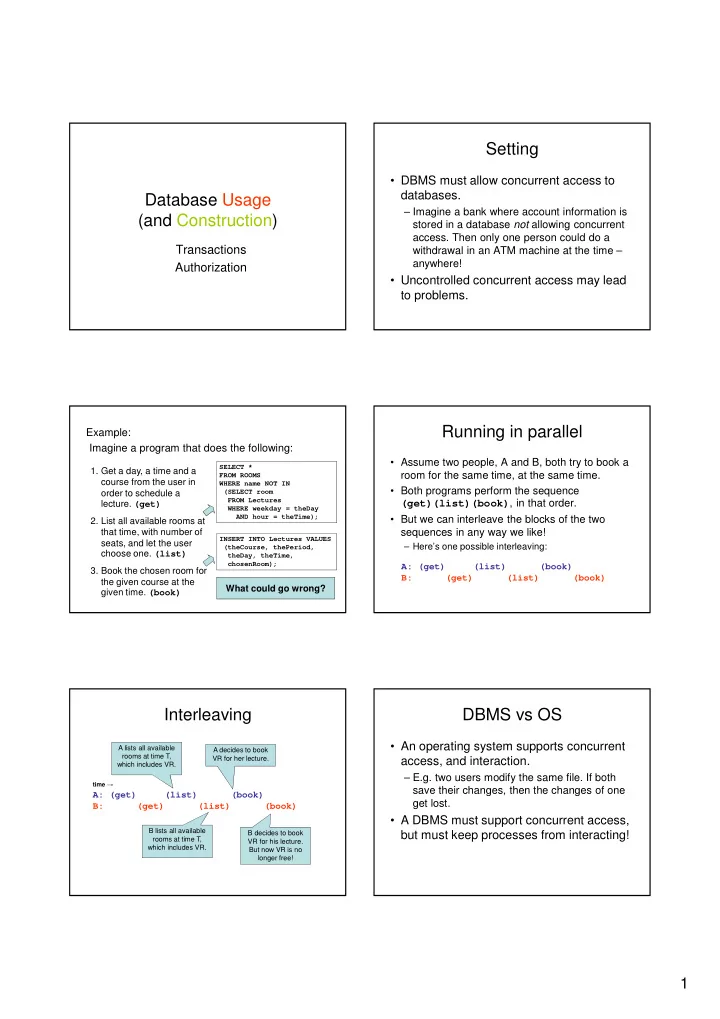
Example: Imagine a program that does the following:
- 1. Get a day, a time and a
course from the user in
- rder to schedule a
- lecture. (get)
- 2. List all available rooms at
that time, with number of seats, and let the user choose one. (list)
- 3. Book the chosen room for
the given course at the given time. (book)
SELECT * FROM ROOMS WHERE name NOT IN (SELECT room FROM Lectures WHERE weekday = theDay AND hour = theTime); INSERT INTO Lectures VALUES (theCourse, thePeriod, theDay, theTime, chosenRoom);
What could go wrong?
Running in parallel
- Assume two people, A and B, both try to book a
room for the same time, at the same time.
- Both programs perform the sequence
(get)(list)(book), in that order.
- But we can interleave the blocks of the two
sequences in any way we like!
– Here’s one possible interleaving: A: (get) (list) (book) B: (get) (list) (book)
Interleaving
A: (get) (list) (book) B: (get) (list) (book)
time
A lists all available rooms at time T, which includes VR. B lists all available rooms at time T, which includes VR. A decides to book VR for her lecture. B decides to book VR for his lecture. But now VR is no longer free!
DBMS vs OS
- An operating system supports concurrent
access, and interaction.
– E.g. two users modify the same file. If both save their changes, then the changes of one get lost.
- A DBMS must support concurrent access,