SHAMELESS ADVERTISING linguis5cgeography@okstate.edu NB: - - PowerPoint PPT Presentation

shameless advertising linguis5cgeography okstate edu nb
SMART_READER_LITE
LIVE PREVIEW

SHAMELESS ADVERTISING linguis5cgeography@okstate.edu NB: - - PowerPoint PPT Presentation

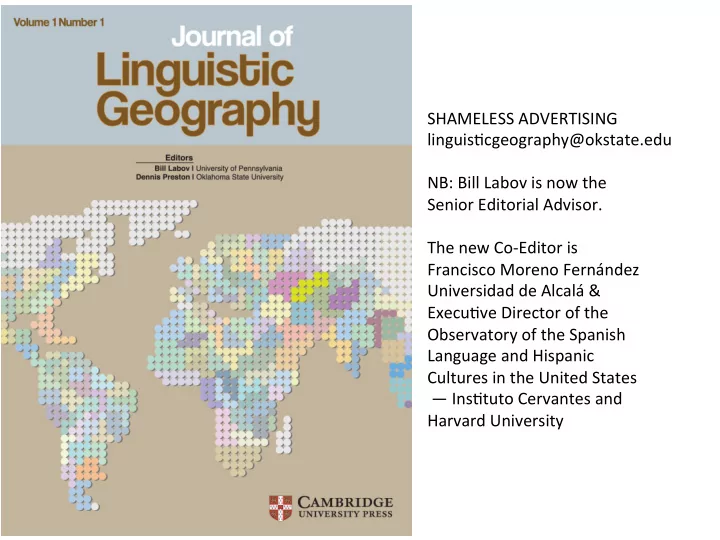
SHAMELESS ADVERTISING linguis5cgeography@okstate.edu NB: Bill Labov is now the Senior Editorial Advisor. The new Co-Editor is Francisco Moreno


slide-1
SLIDE 1

SHAMELESS ¡ADVERTISING ¡ linguis5cgeography@okstate.edu ¡ ¡ NB: ¡Bill ¡Labov ¡is ¡now ¡the ¡ ¡ Senior ¡Editorial ¡Advisor. ¡ ¡ ¡ The ¡new ¡Co-­‑Editor ¡is ¡ Francisco ¡Moreno ¡Fernández ¡ Universidad ¡de ¡Alcalá ¡& ¡ Execu5ve ¡Director ¡of ¡the ¡ ¡ Observatory ¡of ¡the ¡Spanish ¡ ¡ Language ¡and ¡Hispanic ¡ Cultures ¡in ¡the ¡United ¡States ¡ ¡— ¡Ins5tuto ¡Cervantes ¡and ¡ ¡ Harvard ¡University ¡ ¡ ¡

slide-2
SLIDE 2

Historical ¡ Sociolinguis/cs ¡ ¡ & ¡ ¡ Historical ¡Folk ¡ Linguis/cs ¡

¡ ¡

Dennis ¡R. ¡Preston ¡

Oklahoma ¡State ¡University ¡& ¡ ¡ Michigan ¡State ¡University ¡Emeritus ¡

¡

North ¡American ¡Research ¡Network ¡ ¡ in ¡Historical ¡Sociolinguis5cs ¡

July ¡21-­‑23 ¡ ¡

¡ LSA ¡InsAtute ¡ ¡ University ¡of ¡Kentucky ¡

¡ ¡ ¡

slide-3
SLIDE 3

1) What is “Folk Linguistics”? 2) How is it relevant to Sociolinguistics? 3) Historical Folk Linguistics and Historical Sociolinguistics 4) Data in, of, and from the discourse 5) Sample data and analyses

slide-4
SLIDE 4

WHAT IS IT? Research into folk linguistics, ideologies, and attitudes seeks to collect and analyze: What people believe about language, how they react to “instances” of it, and how they act on those beliefs and reactions. Traditionally,

  • Folk linguistics à beliefs
  • Language ideology à their organization and

repercussions in culture

  • Attitudes à evaluation
slide-5
SLIDE 5
slide-6
SLIDE 6

SOCIOLINGUISTICS

Analyses of variable and socially meaningful data

FOLK LINGUISTICS

Analyses of comments on, the cultural

  • rganization of, and reactions to language

IS IT RELEVANT?

slide-7
SLIDE 7

The Relevance of Folk Linguistics to Sociolinguistics I:

“Labovian” sociolinguistics (i.e., language variation and change) The Evaluation Problem. The theory of language change must establish empirically the subjective correlates of the several layers and variables in a heterogeneous structure. Such subjective correlates … cannot be deduced from the place

  • f the variables within linguistic structure.

(Weinreich, Labov, and Herzog 1968:186)

slide-8
SLIDE 8

The Relevance of Folk Linguistics to Sociolinguistics II:

“Hymesian” sociolinguistics (i.e., ethnographic approaches to variety) If the community’s own theory of linguistic repertoire and speech is considered (as it must be in any serious ethnographic account), matters become all the more complex and interesting. (Hymes 1972:39)

slide-9
SLIDE 9

HISTORICAL ¡SOCIOLINGUISTICS ¡

¡Analyses ¡of ¡variable ¡and ¡socially ¡ ¡ ¡meaningful ¡data ¡from ¡the ¡past ¡ ¡ ¡ ¡

HISTORICAL ¡FOLK ¡LINGUISTICS ¡

Analyses ¡of ¡comments ¡on, ¡the ¡cultural ¡

  • rganiza5on ¡of, ¡and ¡reac5ons ¡to ¡language ¡from ¡

the ¡past ¡

slide-10
SLIDE 10

X ¡ X ¡ X ¡ X ¡ X ¡

slide-11
SLIDE 11

THE DATA WE ARE INTERESTED IN: 1) In the discourse; “classic” historical sociolinguistic data 2) From the discourse; overt folk linguistic comment (“talk about talk”) 3) Of the discourse; historical sociolinguistic data with folk linguistic implications

slide-12
SLIDE 12

DATA FROM THE DISCOURSE HISTORICAL FOLK LINGUISTICS (NOT RELEVANT TO HISTORICAL SOCIOLINGUISTICS?)

If we turn back to what has been said, we have seen, on a narrow scientific question, how the people, in their utterances, have a definite and, I believe, decidedly true view in three respects. First, that not an accidental, but a necessary bond ties the name to the object which carries it. Second, that all that is can also be named, i.e., understood, and, conversely, what is not is also not entitled to a name. Third, that with the naming, i.e., the understanding of a thing, humankind subdues it, gaining power over it.

  • Polle. 1898. Wie denkt das Volk über die Sprache, 124
slide-13
SLIDE 13

AMERICAN ¡NOTES ¡

FOR ¡

GENERAL ¡CIRCULATION ¡

AND ¡ ¡

PICTURES ¡FROM ¡ITALY ¡ ¡

¡

BY ¡

CHARLES ¡DICKENS ¡ ¡

¡

WITH ¡8 ¡ILLUSTRATIONS ¡ ¡ BY ¡MARCUS ¡STONE, ¡R.A. ¡ ¡

¡

LONDON ¡

CHAPMAN ¡& ¡HALL, ¡Ltd. ¡

1913 ¡

¡

I ¡DEDICATE ¡THIS ¡BOOK ¡

TO ¡

THOSE ¡FRIENDS ¡OF ¡MINE ¡ IN ¡AMERICA ¡

WHO, ¡GIVING ¡ME ¡A ¡WELCOME ¡I ¡MUST ¡EVER ¡ GRATEFULLY ¡AND ¡PROUDLY ¡REMEMBER, ¡ LEFT ¡MY ¡JUDGEMENT ¡

FREE ¡

AND ¡WHO, ¡LOVING ¡THEIR ¡COUNTRY, ¡CAN ¡BEAR ¡ THE ¡TRUTH, ¡WHEN ¡IT ¡IS ¡TOLD ¡GOOD ¡ HUMOUREDLY, ¡AND ¡IN ¡A ¡ KIND ¡SPIRIT. ¡

slide-14
SLIDE 14

“Dinner, if you please,” said I to the waiter. “When?” said the waiter. “As quick as possible,” said I. “Right away?” said the waiter. After a moment’s hesitation, I answered “No,” at hazard. “NOT right away?” cried the waiter, with an amount of surprise that made me start. I looked at him doubtfully, and returned, “No; I would rather have it in this private room. I like it very much.” At this, I really thought the waiter must have gone out of his mind: as I believe he would have done, but for the interposition of another man, who whispered in his ear, “Directly.” “Well! and that’s a fact!” said the waiter, looking helplessly at me: “Right away.” I saw now that “Right away” and “Directly” were one and the same thing

DATA FROM (AND IN) THE DISCOURSE HISTORICAL FOLK SOCIOLINGUISTICS

slide-15
SLIDE 15

DATA ¡FROM ¡THE ¡DISCOURSE ¡ HISTORICAL ¡FOLK ¡LINGUISTICS ¡RELEVANT ¡TO ¡HISTORICAL ¡ SOCIOLINGUISTICS ¡

¡ The ¡first ¡men5on ¡of ¡a ¡sociolinguis5c ¡“fact” ¡ ¡ about ¡English? ¡

slide-16
SLIDE 16

Regional “purity” …in the southern parts of England […] the speech is nowadays purer than elsewhere. It may be that it retains more of the features of the original language and the old ways of speaking English, whereas the northern regions have been greatly corrupted by the Danish and Norwegian invasions. Gerald of Wales 1984 [1193] The Journey through Wales and the Description of Wales. Trans. by Lewis Thorpe. Harmondsworth: Penguin Books,

  • p. 231.
slide-17
SLIDE 17

Language & “character” Richard Verstegan (c.1550–1620) notes that the “special virtues of English were to be found in the Saxon monosyllables whose preservation reflected the steadfast and conservative character of the people who spoke the language.” Bailey, Richard W. 1991 Images of English. Ann Arbor: The University of Michigan Press, 39.

slide-18
SLIDE 18

Prescription

slide-19
SLIDE 19

Sociolinguistics (à la Trump) [T]he American of today is much more honestly English, in any sense that Shakespeare would have understood, than the so‐called Standard English of England. He believes, and on very plausible grounds, that American is better on all counts – clearer, more rational, and above all, more charming. Mencken, H. L. 1936 The American Language. 4th ed., Corrected enlarged and rewritten. New York: Knopf, 608-609.

slide-20
SLIDE 20

TWO ¡REMAINING ¡POINTS: ¡ ¡ 1) ¡Folk ¡linguis5c ¡data ¡that ¡allows ¡for ¡the ¡ considera5on ¡of ¡historical ¡sociolinguis5c ¡data ¡at ¡ levels ¡less ¡frequently ¡considered. ¡(In) ¡ ¡ 2) ¡The ¡possibility ¡of ¡retrieving ¡“implicit” ¡data ¡ from ¡the ¡historical ¡folk ¡linguis5c ¡record. ¡(Of) ¡ ¡ ¡

slide-21
SLIDE 21

Everybody ¡talks ¡to ¡you ¡or ¡to ¡anybody ¡else ¡who ¡hits ¡his ¡fancy. ¡If ¡you ¡are ¡an ¡ Englishman, ¡he ¡expects ¡that ¡that ¡railroad ¡is ¡preey ¡much ¡like ¡an ¡English ¡

  • railroad. ¡If ¡you ¡say ¡“No,” ¡he ¡says ¡“Yes?” ¡(interroga5vely), ¡and ¡asks ¡in ¡

what ¡respect ¡they ¡differ. ¡You ¡enumerate ¡the ¡heads ¡of ¡difference, ¡one ¡by ¡

  • ne, ¡and ¡he ¡says ¡“Yes?” ¡(s5ll ¡interroga5vely) ¡to ¡each. ¡Then ¡he ¡guesses ¡

that ¡you ¡don’t ¡travel ¡faster ¡in ¡England; ¡and ¡on ¡your ¡replying ¡that ¡you ¡do, ¡ says ¡“Yes?” ¡again ¡(s5ll ¡interroga5vely), ¡and ¡it ¡is ¡quite ¡evident, ¡don’t ¡ believe ¡it. ¡Aier ¡a ¡long ¡pause ¡he ¡remarks, ¡partly ¡to ¡you, ¡and ¡partly ¡to ¡the ¡ knob ¡on ¡the ¡top ¡of ¡his ¡s5ck, ¡that ¡“Yankees ¡are ¡reckoned ¡to ¡be ¡ considerable ¡of ¡a ¡go-­‑-­‑ahead ¡people ¡too;” ¡upon ¡which ¡you ¡say ¡“Yes,” ¡and ¡ then ¡he ¡says ¡“Yes” ¡again ¡(affirma5vely ¡this ¡5me); ¡and ¡upon ¡your ¡looking ¡

  • ut ¡of ¡window, ¡tells ¡you ¡that ¡behind ¡that ¡hill, ¡and ¡some ¡three ¡miles ¡from ¡

the ¡next ¡sta5on, ¡there ¡is ¡a ¡clever ¡town ¡in ¡a ¡smart ¡lo-­‑ca-­‑5on, ¡where ¡he ¡ expects ¡you ¡have ¡concluded ¡to ¡stop. ¡Your ¡answer ¡in ¡the ¡nega5ve ¡ naturally ¡leads ¡to ¡more ¡ques5ons ¡in ¡reference ¡to ¡your ¡intended ¡route ¡ (always ¡pronounced ¡rout); ¡and ¡wherever ¡you ¡are ¡going, ¡you ¡invariably ¡ learn ¡that ¡you ¡can’t ¡get ¡there ¡without ¡immense ¡difficulty ¡and ¡danger, ¡and ¡ that ¡all ¡the ¡great ¡sights ¡are ¡somewhere ¡else. ¡ ¡

slide-22
SLIDE 22

Takesi ¡Sibata: ¡“It ¡appears ¡to ¡be ¡natural ¡ for ¡forms ¡which ¡differ ¡from ¡those ¡ which ¡one ¡usually ¡uses ¡to ¡aeract ¡one’s ¡ aeen5on” ¡(1971:374). ¡ ¡

¡

…and ¡for ¡forms ¡which ¡differ ¡from ¡those ¡ which ¡one ¡expects ¡to ¡hear.… ¡(Preston ¡ 2005:148) ¡ ¡ ¡

slide-23
SLIDE 23

At ¡dinner, ¡there ¡is ¡nothing ¡to ¡drink ¡upon ¡the ¡table, ¡but ¡great ¡jugs ¡full ¡of ¡cold ¡

  • water. ¡Nobody ¡says ¡anything, ¡at ¡any ¡meal, ¡to ¡anybody. ¡All ¡the ¡passengers ¡

are ¡very ¡dismal, ¡and ¡seem ¡to ¡have ¡tremendous ¡secrets ¡weighing ¡on ¡their ¡

  • minds. ¡There ¡is ¡no ¡conversa5on, ¡no ¡laughter, ¡no ¡cheerfulness, ¡no ¡sociality, ¡

except ¡in ¡spiqng; ¡and ¡that ¡is ¡done ¡in ¡silent ¡fellowship ¡round ¡the ¡stove, ¡when ¡ the ¡meal ¡is ¡over. ¡Every ¡man ¡sits ¡down, ¡dull ¡and ¡languid; ¡swallows ¡his ¡fare ¡as ¡ if ¡breakfasts, ¡dinners, ¡and ¡suppers, ¡were ¡necessi5es ¡of ¡nature ¡never ¡to ¡be ¡ coupled ¡with ¡recrea5on ¡or ¡enjoyment; ¡and ¡having ¡bolted ¡his ¡food ¡in ¡a ¡ gloomy ¡silence, ¡bolts ¡himself, ¡in ¡the ¡same ¡state. ¡But ¡for ¡these ¡animal ¡

  • bservances, ¡you ¡might ¡suppose ¡the ¡whole ¡male ¡por5on ¡of ¡the ¡company ¡to ¡

be ¡the ¡melancholy ¡ghosts ¡of ¡departed ¡bookkeepers, ¡who ¡had ¡fallen ¡dead ¡at ¡ the ¡desk: ¡such ¡is ¡their ¡weary ¡air ¡of ¡business ¡and ¡calcula5on. ¡Undertakers ¡on ¡ duty ¡would ¡be ¡sprightly ¡beside ¡them; ¡and ¡a ¡colla5on ¡of ¡funeral-­‑baked ¡meats, ¡ in ¡comparison ¡with ¡these ¡meals, ¡would ¡be ¡a ¡sparkling ¡fes5vity. ¡ The ¡people ¡are ¡all ¡alike, ¡too. ¡There ¡is ¡no ¡diversity ¡of ¡character. ¡They ¡travel ¡ about ¡on ¡the ¡same ¡errands, ¡say ¡and ¡do ¡the ¡same ¡things ¡in ¡exactly ¡the ¡same ¡ manner, ¡and ¡follow ¡in ¡the ¡same ¡dull ¡cheerless ¡round. ¡
slide-24
SLIDE 24

“OF” ¡(Implicit ¡historical ¡folk ¡linguis5cs?) ¡

¡

I ¡Promise: ¡

(1) ¡that ¡I ¡will ¡not ¡dishonor ¡my ¡country’s ¡language ¡by ¡leaving ¡off ¡the ¡last ¡syllables ¡

  • f ¡words; ¡

Presupposes ¡that ¡leaving ¡off ¡the ¡last ¡syllables ¡of ¡words ¡“dishonors” ¡the ¡ language ¡(Levinson ¡1983; ¡note ¡the ¡“nega5on” ¡test) ¡

¡ ¡

(2) ¡that ¡I ¡will ¡say ¡a ¡good ¡American ¡“yes” ¡and ¡“no” ¡in ¡place ¡of ¡an ¡Indian ¡grunt ¡ “um-­‑hum” ¡and ¡“nup-­‑um” ¡or ¡a ¡foreign ¡“ya” ¡and ¡“yeh” ¡and ¡“nope”; ¡ Presupposes ¡that ¡“Indian ¡grunt” ¡and ¡foreign ¡ways ¡of ¡speaking ¡are ¡not ¡“good ¡ American.” ¡(See ¡Libert ¡2016 ¡for ¡a ¡discussion ¡of ¡the ¡presupposi5onal ¡character ¡

  • f ¡“instead ¡of.”) ¡ ¡

¡

(3) ¡That ¡I ¡will ¡do ¡my ¡best ¡to ¡improve ¡American ¡speech ¡by ¡avoiding ¡load ¡harsh ¡ tones, ¡by ¡enuncia5ng ¡dis5nctly ¡and ¡speaking ¡pleasantly, ¡etc…; ¡ Presupposes ¡that ¡enuncia5ng ¡dis5nctly ¡etc… ¡will ¡“improve” ¡American ¡speech ¡(& ¡ that ¡it ¡can ¡be ¡“improved”; ¡see ¡Fillmore ¡1971 ¡“verbs ¡of ¡judging”) ¡

…………… ¡

¡(5) ¡I ¡will ¡learn ¡to ¡ar5culate ¡correctly ¡one ¡word ¡a ¡day ¡for ¡a ¡year. ¡ Presupposes ¡a ¡correct ¡“ar5cula5on” ¡exists ¡

slide-25
SLIDE 25

More “Of”

  • 1 C: We uh - linguistics, in this field, uh - from the book I s- I

meant, I saw from the book that - many linguists quite interest in uh black English. So could you tell me - a little bit about - your dialect? 2 D: Dialects. 3 C: Heh yeah 5 D:Well, uh: - well - see the world’s getting smaller= 6 C: ((laughs)) I- I mea- do you have- 7D: =there’s not - even among all the ethnic groups we’re- we’re getting- getting less and less of dialectual in-

  • inFLUence. (.hhh) Uh I’m- happen - not to be - from the

South… ¡

slide-26
SLIDE 26

Presupposi5on ¡types ¡

¡

Your ¡dialects ¡ Definite ¡descrip5ons ¡= ¡dialects ¡exist ¡ Possessives ¡= ¡you ¡have ¡a ¡dialect ¡

¡

The ¡worlds ¡geGng ¡smaller ¡ Comparison ¡= ¡the ¡world ¡was ¡bigger ¡

¡

I ¡happen ¡not ¡to ¡be ¡from ¡the ¡South ¡ Implica5ves ¡= ¡This ¡is ¡an ¡“unplanned” ¡circumstance ¡

¡

¡

Implicatures ¡

¡

Less ¡and ¡less ¡dialectual ¡influence ¡ There ¡are ¡fewer ¡dialects ¡because ¡the ¡world ¡is ¡smaller. ¡

slide-27
SLIDE 27

Semantic And Pragmatic Approaches: Assertions Entailments Presuppositions Speech Acts Implications Argument structure Metaphor Discourse markers More of course…….

slide-28
SLIDE 28

Other ¡presupposi5on ¡triggers: ¡

Change-of-state verbs (I quit…) Iteratives (…again) Temporal clauses (… before) Cleft sentences (IT & WH) It wasn’t Bill who left. What Bill didn’t lose was his billfold. Stressed constituents (implicit clefts) Bill didn’t lose his BILLFOLD. Non-restrictive relatives Counterfactual conditionals (If I’d known…) Questions Yes-no (usually vacuous) Alternative (either-or, non-vacuous) WH (“Who left”) ¡

slide-29
SLIDE 29

SOME THINGS I’D LIKE FOR YOU TO REMEMBER: 1) Folk Linguistics (or “Language Regard”) is an important consideration in sociolinguistic investigation (historical or not). 2) That a text contains any linguistic representation of the “other” is often sufficient evidence that it is a folk fact. 3) That some representations are those of levels of language (e.g., interaction) that we often ignore. 4) That discourse, semantic, and pragmatic analytic tools at

  • ur disposal may allow us to see the implicit as well as

the explicit in historical data.

slide-30
SLIDE 30

Ic ¡þe ¡þancung ¡