Shape Analysis Syntax of the pointer language p | n | a 1 op a a 2 | - - PowerPoint PPT Presentation

shape analysis
SMART_READER_LITE
LIVE PREVIEW

Shape Analysis Syntax of the pointer language p | n | a 1 op a a 2 | - - PowerPoint PPT Presentation

Shape Analysis Syntax of the pointer language p | n | a 1 op a a 2 | nil a ::= Goal: to obtain a finite representation of the shape of the heap of a ::= x | x. sel p language with pointers. b ::= true | false | not b | b 1 op b b 2 | a 1 op


slide-1
SLIDE 1

Shape Analysis

Goal: to obtain a finite representation of the shape of the heap of a language with pointers. The analysis result can be used for

  • detection of pointer aliasing
  • detection of sharing between structures
  • software development tools

– detection of errors like dereferences of nil-pointers

  • program verification

– reverse transforms a non-cyclic list to a non-cyclic list

PPA Section 2.6

c F.Nielson & H.Riis Nielson & C.Hankin (May 2005)

110

Syntax of the pointer language

a ::= p | n | a1 opa a2 | nil p ::= x | x.sel b ::= true | false | not b | b1 opb b2 | a1 opr a2 | opp p S ::= [p:=a] | [skip] | S1; S2 | if [b] then S1 else S2 | while [b] do S | [malloc p]

Example

[y:=nil]1; while [not is-nil(x)]2 do ([z:=y]3; [y:=x]4; [x:=x.cdr]5; [y.cdr:=z]6); [z:=nil]7

PPA Section 2.6

c F.Nielson & H.Riis Nielson & C.Hankin (May 2005)

111

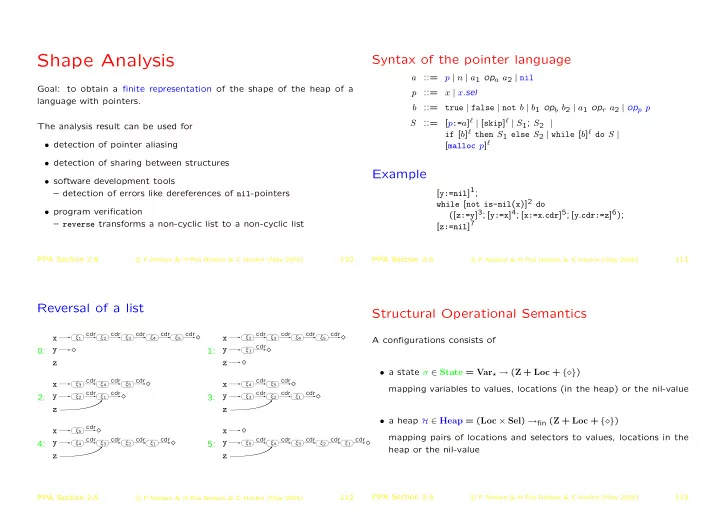
Reversal of a list

0: x

  • ξ1
  • cdr
  • ξ2
  • cdr
  • ξ3
  • cdr
  • ξ4
  • cdr
  • ξ5
  • cdr

y z 1: x

  • ξ2
  • cdr
  • ξ3
  • cdr
  • ξ4
  • cdr
  • ξ5
  • cdr

y

  • ξ1
  • cdr

z 2: x

  • ξ3
  • cdr
  • ξ4
  • cdr
  • ξ5
  • cdr

y

  • ξ2
  • cdr
  • ξ1
  • cdr

z

  • 3:

x

  • ξ4
  • cdr
  • ξ5
  • cdr

y

  • ξ3
  • cdr
  • ξ2
  • cdr
  • ξ1
  • cdr

z

  • 4:

x

  • ξ5
  • cdr

y

  • ξ4
  • cdr
  • ξ3
  • cdr
  • ξ2
  • cdr
  • ξ1
  • cdr

z

  • 5:

x y

  • ξ5
  • cdr
  • ξ4
  • cdr
  • ξ3
  • cdr
  • ξ2
  • cdr
  • ξ1
  • cdr

z

  • PPA Section 2.6

c F.Nielson & H.Riis Nielson & C.Hankin (May 2005)

112

Structural Operational Semantics

A configurations consists of

  • a state σ ∈ State = Var → (Z + Loc + {})

mapping variables to values, locations (in the heap) or the nil-value

  • a heap H ∈ Heap = (Loc × Sel) →fin (Z + Loc + {})

mapping pairs of locations and selectors to values, locations in the heap or the nil-value

PPA Section 2.6

c F.Nielson & H.Riis Nielson & C.Hankin (May 2005)

113

slide-2
SLIDE 2

Pointer expressions

℘ : PExp → (State × Heap) →fin (Z + {} + Loc) is defined by ℘[ [x] ](σ, H) = σ(x) ℘[ [x.sel] ](σ, H) =

       H(σ(x), sel)

if σ(x) ∈ Loc and H is defined on (σ(x), sel) undefined

  • therwise

Arithmetic and boolean expressions

A : AExp → (State × Heap) →fin (Z + Loc + {}) B : BExp → (State × Heap) →fin T

PPA Section 2.6

c F.Nielson & H.Riis Nielson & C.Hankin (May 2005)

114

Statements

Clauses for assignments: [x:=a], σ, H → σ[x → A[ [a] ](σ, H)], H if A[ [a] ](σ, H) is defined [x.sel:=a], σ, H → σ, H[(σ(x), sel) → A[ [a] ](σ, H)] if σ(x) ∈ Loc and A[ [a] ](σ, H) is defined Clauses for malloc: [malloc x], σ, H → σ[x → ξ], H where ξ does not occur in σ or H [malloc (x.sel)], σ, H → σ, H[(σ(x), sel) → ξ] where ξ does not occur in σ or H and σ(x) ∈ Loc

PPA Section 2.6

c F.Nielson & H.Riis Nielson & C.Hankin (May 2005)

115

Shape graphs

The analysis will operate on shape graphs (S, H, is) consisting of

  • an abstract state, S,
  • an abstract heap, H, and
  • sharing information, is, for the abstract locations.

The nodes of the shape graphs are abstract locations: ALoc = {nX | X ⊆ Var} Note: there will only be finitely many abstract locations

PPA Section 2.6

c F.Nielson & H.Riis Nielson & C.Hankin (May 2005)

116

Example

In the semantics: x

  • ξ3
  • cdr
  • ξ4
  • cdr
  • ξ5
  • cdr

y

  • ξ2
  • cdr
  • ξ1
  • cdr

z

  • In the analysis:

x

n{x}

  • cdr

n∅

  • cdr

y

n{y}

  • cdr

n{z}

z

  • Abstract Locations

The abstract location nX represents the location σ(x) if x ∈ X The abstract location n∅ is called the abstract summary location: n∅ rep- resents all the locations that cannot be reached directly from the state without consulting the heap Invariant 1 If two abstract locations nX and nY occur in the same shape graph then either X = Y or X∩Y = ∅

PPA Section 2.6

c F.Nielson & H.Riis Nielson & C.Hankin (May 2005)

117

slide-3
SLIDE 3

Abstract states and heaps

S ∈ AState = P(Var × ALoc) abstract states H ∈ AHeap = P(ALoc × Sel × ALoc) abstract heap x

n{x}

  • cdr

n∅

  • cdr

y

n{y}

  • cdr

n{z}

z

  • Invariant 2 If x is mapped to nX by

the abstract state S then x ∈ X Invariant 3 Whenever (nV , sel, nW) and (nV , sel, nW ) are in the abstract heap H then either V = ∅ or W = W

PPA Section 2.6

c F.Nielson & H.Riis Nielson & C.Hankin (May 2005)

118

Reversal of a list

0: x

n{x}

  • cdr

n∅

  • cdr

1: x

n{x}

  • cdr

n∅

  • cdr

y

n{y}

2: x

n{x}

  • cdr

n∅

  • cdr

y

n{y}

  • cdr

n{z}

z

  • 3:

x

n{x}

  • cdr

n∅

y

n{y}

  • cdr

n{z}

cdr

z

  • 4:

x

n{x}

y

n{y}

  • cdr

n{z}

cdr

n∅

  • cdr

z

  • 5:

y

n{y}

  • cdr

n{z}

cdr

n∅

  • cdr

z

  • PPA Section 2.6

c F.Nielson & H.Riis Nielson & C.Hankin (May 2005)

119

Sharing in the heap

x

  • ξ1
  • cdr
  • ξ2
  • cdr
  • ξ3

cdr

  • ξ4

cdr

  • cdr
  • ξ5

y

  • x
  • ξ1
  • cdr
  • ξ2
  • cdr
  • ξ3

cdr

  • ξ4
  • cdr
  • cdr
  • ξ5

y

  • Give rise to the same shape graph:

x

n{x}

  • cdr

n∅

  • cdr

y

n{y}

  • cdr

is: the abstract locations that might be shared due to pointers in the heap: nX is included in is if it might repre- sents a location that is the target of more than one pointer in the heap

PPA Section 2.6

c F.Nielson & H.Riis Nielson & C.Hankin (May 2005)

120

Examples: sharing in the heap

x

  • ξ1
  • cdr
  • ξ2
  • cdr
  • ξ3

cdr

  • ξ4

cdr

  • cdr
  • ξ5

y

  • x

n{x}

  • cdr

n∅

  • cdr

y

n{y}

  • cdr

x

  • ξ1
  • cdr
  • ξ2
  • cdr
  • ξ3

cdr

  • ξ4
  • cdr
  • cdr
  • ξ5

y

  • x

n{x}

  • cdr

n∅

  • cdr

y

n{y}

  • cdr

x

  • ξ1
  • ξ2

cdr

  • cdr
  • ξ3
  • cdr
  • ξ4

cdr

  • cdr
  • ξ5

y

  • x

n{x} cdr

n∅

  • cdr

y

n{y}

  • cdr

PPA Section 2.6

c F.Nielson & H.Riis Nielson & C.Hankin (May 2005)

121

slide-4
SLIDE 4

Sharing information

The implicit sharing information of the abstract heap must be consistent with the explicit sharing information: x

n{x} cdr

n∅

  • cdr

y

n{y}

  • cdr

Invariant 4 If nX ∈ is then either

  • (n∅, sel, nX) is in the abstract heap for

some sel, or

  • there are two distinct triples (nV , sel1, nX)

and (nW, sel2, nX) in the abstract heap Invariant 5 Whenever there are two distinct triples (nV , sel1, nX) and (nW, sel2, nX) in the abstract heap and X = ∅ then nX ∈ is

PPA Section 2.6

c F.Nielson & H.Riis Nielson & C.Hankin (May 2005)

122

The complete lattice of shape graphs

A shape graph is a triple (S,H,is) where S ∈ AState = P(Var × ALoc) H ∈ AHeap = P(ALoc × Sel × ALoc) is ∈ IsShared = P(ALoc) and ALoc = {nZ | Z ⊆ Var}. A shape graph (S, H, is) is compatible if it fulfils the five invariants. The analysis computes over sets of compatible shape graphs SG = {(S, H, is) | (S, H, is) is compatible}

PPA Section 2.6

c F.Nielson & H.Riis Nielson & C.Hankin (May 2005)

123

The analysis

An instance of a forward Monotone Framework with the complete lattice

  • f interest being P(SG)

A may analysis: each of the sets of shape graphs computed by the analysis may contain shape graphs that cannot really arrise Aspects of a must analysis: each of the individual shape graphs (in a set of shape graphs computed by the analysis) will be the best possible description of some (σ, H)

PPA Section 2.6

c F.Nielson & H.Riis Nielson & C.Hankin (May 2005)

124

The analysis

Equations: Shape◦() =

  • ι

if = init(S)

{Shape•() | (, ) ∈ flow(S)}

  • therwise

Shape•() = fSA

(Shape◦())

Example: The extremal value ι for the list reversal program x

n{x}

  • cdr

n∅

  • cdr

– x points to a non-cyclic list with at least three elements

PPA Section 2.6

c F.Nielson & H.Riis Nielson & C.Hankin (May 2005)

125

slide-5
SLIDE 5

Shape•(1) for [y:=nil]1

x

n{x}

  • cdr

n∅

  • cdr

Note: we do not record nil-values in the analysis

PPA Section 2.6

c F.Nielson & H.Riis Nielson & C.Hankin (May 2005)

126

Shape•(2) for [not is-nil(x)]2

x

n{x}

  • cdr

n∅

  • cdr

x

n{x}

  • cdr

n∅

  • cdr

y

n{y}

x

n{x}

  • cdr

n∅

y

n{y}

x

n{x}

  • cdr

n∅

  • cdr

y

n{y}

  • cdr

z

n{z}

x

n{x}

  • cdr

n∅

y

n{y}

  • cdr

z

n{z}

x

n{x}

n∅

y

n{y}

  • cdr

z

n{z}

x

n{x}

  • cdr

n∅

  • cdr

y

n{y}

  • cdr

z

n{z}

  • cdr

x

n{x}

  • cdr

n∅

y

n{y}

  • cdr

z

n{z}

  • cdr

x

n{x}

n∅

y

n{y}

  • cdr

z

n{z}

  • cdr

n∅

y

n{y}

  • cdr

z

n{z}

  • cdr

n∅

  • cdr

y

n{y}

  • cdr

z

n{z}

  • cdr

n∅

  • cdr

z

n{z}

  • cdr

n∅

  • cdr

PPA Section 2.6

c F.Nielson & H.Riis Nielson & C.Hankin (May 2005)

127

Shape•(3) for [z:=y]3

x

n{x}

  • cdr

n∅

  • cdr

x

n{x}

  • cdr

n∅

  • cdr

y

  • z

n{y,z}

x

n{x}

  • cdr

n∅

y

  • z

n{y,z}

x

n{x}

  • cdr

n∅

  • cdr

y

  • z

n{y,z}

  • cdr

x

n{x}

  • cdr

n∅

y

  • z

n{y,z}

  • cdr

x

n{x}

n∅

y

  • z

n{y,z}

  • cdr

x

n{x}

n∅

  • cdr

y

  • z

n{y,z}

  • cdr

n∅

  • cdr

y

  • z

n{y,z}

  • cdr

n∅

  • cdr

PPA Section 2.6

c F.Nielson & H.Riis Nielson & C.Hankin (May 2005)

128

Shape•(4) for [y:=x]4

x

n{x,y}

  • cdr

n∅

  • cdr

y

  • x

n{x,y}

  • cdr

n∅

  • cdr

y

  • z

n{z}

x

n{x,y}

  • cdr

n∅

y

  • z

n{z}

x

n{x,y}

  • cdr

n∅

  • cdr

y

  • z

n{z}

  • cdr

x

n{x,y}

  • cdr

n∅

y

  • z

n{z}

  • cdr

x

n{x,y}

n∅

y

  • z

n{z}

  • cdr

x

n{x,y}

n∅

  • cdr

y

  • z

n{z}

  • cdr

n∅

  • cdr

z

n{z}

  • cdr

n∅

  • cdr

PPA Section 2.6

c F.Nielson & H.Riis Nielson & C.Hankin (May 2005)

129

slide-6
SLIDE 6

Shape•(5) for [x:=x.cdr]5

x

n{x}

  • cdr

n∅

  • cdr

y

n{y}

  • cdr

x

n{x}

  • cdr

n∅

y

n{y}

  • cdr

x

n{x}

  • cdr

n∅

  • cdr

y

n{y}

  • cdr

z

n{z}

x

n{x}

  • cdr

n∅

y

n{y}

  • cdr

z

n{z}

x

n{x}

n∅

y

n{y}

  • cdr

z

n{z}

x

n{x}

  • cdr

n∅

  • cdr

y

n{y}

  • cdr

z

n{z}

  • cdr

x

n{x}

  • cdr

n∅

y

n{y}

  • cdr

z

n{z}

  • cdr

x

n{x}

n∅

y

n{y}

  • cdr

z

n{z}

  • cdr

n∅

y

n{y}

z

n{z}

  • cdr

n∅

  • cdr

y

n{y}

z

n{z}

  • cdr

n∅

  • cdr

z

n{z}

  • cdr

n∅

  • cdr

PPA Section 2.6

c F.Nielson & H.Riis Nielson & C.Hankin (May 2005)

130

Shape•(6) for [y.cdr:=z]6

x

n{x}

  • cdr

n∅

  • cdr

y

n{y}

x

n{x}

  • cdr

n∅

y

n{y}

x

n{x}

  • cdr

n∅

  • cdr

y

n{y}

  • cdr

z

n{z}

x

n{x}

  • cdr

n∅

y

n{y}

  • cdr

z

n{z}

x

n{x}

n∅

y

n{y}

  • cdr

z

n{z}

x

n{x}

  • cdr

n∅

  • cdr

y

n{y}

  • cdr

z

n{z}

  • cdr

x

n{x}

  • cdr

n∅

y

n{y}

  • cdr

z

n{z}

  • cdr

x

n{x}

n∅

y

n{y}

  • cdr

z

n{z}

  • cdr

n∅

y

n{y}

  • cdr

z

n{z}

  • cdr

n∅

  • cdr

y

n{y}

  • cdr

z

n{z}

  • cdr

n∅

  • cdr

z

n{z}

  • cdr

n∅

  • cdr

PPA Section 2.6

c F.Nielson & H.Riis Nielson & C.Hankin (May 2005)

131

Shape•(7) for [z:=nil]7

x

n{x}

  • cdr

n∅

  • cdr

x

n{x}

  • cdr

n∅

  • cdr

y

n{y}

x

n{x}

  • cdr

n∅

y

n{y}

x

n{x}

  • cdr

n∅

  • cdr

y

n{y}

  • cdr

x

n{x}

  • cdr

n∅

y

n{y}

  • cdr

x

n{x}

n∅

  • cdr

y

n{y}

  • cdr

x

n{x}

n∅

y

n{y}

  • cdr

n∅

  • cdr

y

n{y}

  • cdr

n∅

  • cdr

– upon termination y points to a non-circular list – a more precise analysis taking tests into account will know that x is nil upon termination

PPA Section 2.6

c F.Nielson & H.Riis Nielson & C.Hankin (May 2005)

132

Transfer functions

fSA

  • : P(SG) → P(SG)

has the form: fSA

(SG) =

  • {φSA

((S, H, is)) | (S, H, is) ∈ SG}

where φSA

  • : SG → P(SG)

specifies how a single shape graph (in Shape◦()) may be transformed into a set of shape graphs (in Shape•()) by the elementary block.

PPA Section 2.6

c F.Nielson & H.Riis Nielson & C.Hankin (May 2005)

133

slide-7
SLIDE 7

Transfer function for [b] and [skip]

We are only interested in the shape of the heap – and it is not changed by these elementary blocks: φSA

((S, H, is)) = {(S, H, is)} PPA Section 2.6

c F.Nielson & H.Riis Nielson & C.Hankin (May 2005)

134

Transfer function for [x:=a]

— where a is of the form n, a1 opa a2 or nil φSA

((S, H, is)) = {killx((S, H, is))}

where killx((S, H, is)) = (S, H, is) is S = {(z, kx(nZ)) | (z, nZ) ∈ S ∧ z = x} H = {(kx(nV ), sel, kx(nW)) | (nV , sel, nW) ∈ H} is = {kx(nX) | nX ∈ is} and kx(nZ) = nZ\{x} Idea: all abstract locations are renamed to not having x in their name set

PPA Section 2.6

c F.Nielson & H.Riis Nielson & C.Hankin (May 2005)

135

The effect of [x:=nil]

  • nV
  • sel1

n∅

  • x

n{x}

  • sel2

nW

(S, H, is)

  • nV
  • sel1

n∅

  • nW
  • sel2

(S, H, is)

PPA Section 2.6

c F.Nielson & H.Riis Nielson & C.Hankin (May 2005)

136

Transfer function for [x:=y] when x = y

φSA

((S, H, is)) = {(S, H, is)}

where (S, H, is) = killx((S, H, is)) and S = {(z, gy

x(nZ)) | (z, nZ) ∈ S}

∪ {(x, gy

x(nY )) | (y, nY ) ∈ S ∧ y = y}

H = {(gy

x(nV ), sel, gy x(nW)) | (nV , sel, nW) ∈ H}

is = {gy

x(nZ) | nZ ∈ is}

and gy

x(nZ) =

  • nZ∪{x}

if y ∈ Z nZ

  • therwise

Idea: all abstract locations are renamed to also have x in their name set if they already have y

PPA Section 2.6

c F.Nielson & H.Riis Nielson & C.Hankin (May 2005)

137

slide-8
SLIDE 8

The effect of [x:=y] when x=y

  • x
  • nX
  • y
  • nY
  • sel2

nW

  • sel1

nV

(S, H, is)

  • x
  • nX\{x}
  • y
  • nY ∪{x}
  • sel2

nW

  • sel1

nV

(S, H, is)

PPA Section 2.6

c F.Nielson & H.Riis Nielson & C.Hankin (May 2005)

138

Transfer function for [x:=y.sel] when x = y

Remove the old binding for x: strong nullification (S, H, is) = killx((S, H, is)) Establish the new binding for x:

  • 1. There is no abstract location nY such that (y, nY ) ∈ S – or there is

an abstract location nY such that (y, nY ) ∈ S but no nZ such that (nY , sel, nZ) ∈ H

  • 2. There is an abstract location nY such that (y, nY ) ∈ S and there is

an abstract location nU = n∅ such that (nY , sel, nU) ∈ H

  • 3. There is an abstract location nY such that (y, nY ) ∈ S and (nY , sel, n∅)

∈ H

PPA Section 2.6

c F.Nielson & H.Riis Nielson & C.Hankin (May 2005)

139

Case 1 for [x:=y.sel]

Assume there is no abstract location nY such that (y, nY ) ∈ S φSA

((S, H, is)) = {(S, H, is)}

OBS: dereference of a nil-pointer Assume there is an abstract location nY such that (y, nY ) ∈ S but there is no abstract location n such that (nY , sel, n) ∈ H φSA

((S, H, is)) = {(S, H, is)}

OBS: dereference of a non-existing sel-field

PPA Section 2.6

c F.Nielson & H.Riis Nielson & C.Hankin (May 2005)

140

Case 2 for [x:=y.sel]

Assume there is an abstract location nY such that (y, nY ) ∈ S and there is an abstract location nU = n∅ such that (nY , sel, nU) ∈ H. The abstract location nU will be renamed to include the variable x using the function: hU

x (nZ) =

  • nU∪{x}

if Z = U nZ

  • therwise

We take φSA

((S, H, is)) = {(S, H, is)}

where (S, H, is) = killx((S, H, is)) and S = {(z, hU

x (nZ)) | (z, nZ) ∈ S} ∪ {(x, hU x (nU))}

H = {(hU

x (nV ), sel, hU x (nW)) | (nV , sel, nW) ∈ H}

is = {hU

x (nZ) | nZ ∈ is} PPA Section 2.6

c F.Nielson & H.Riis Nielson & C.Hankin (May 2005)

141

slide-9
SLIDE 9

The effect of [x:=y.sel] in Case 2

  • x
  • nX
  • y
  • nY
  • sel

nU

  • sel2

nW nV

  • sel1

(S, H, is)

  • x

nX\{x}

  • y
  • nY
  • sel

nU∪{x}

  • sel2

nW nV

  • sel1

(S, H, is)

PPA Section 2.6

c F.Nielson & H.Riis Nielson & C.Hankin (May 2005)

142

Case 3 for [x:=y.sel] (1)

Assume that there is an abstract location nY such that (y, nY ) ∈ S and furthermore (nY , sel, n∅) ∈ H. We have to materialise a new abstract location n{x} from n∅. [x:=nil]···; [x:=y.sel]; [x:=nil]···

  • (S, H, is)

(S, H, is) (S, H, is) (S, H, is) Idea: (S, H, is) = (S, H, is) = killx((S, H, is))

PPA Section 2.6

c F.Nielson & H.Riis Nielson & C.Hankin (May 2005)

143

Case 3 for [x:=y.sel] (2)

Transfer function: φSA

((S, H, is)) = {(S, H, is) | (S, H, is) is compatible ∧

killx((S, H, is)) = (S, H, is) ∧ (x, n{x}) ∈ S ∧ (nY , sel, n{x}) ∈ H } where (S, H, is) = killx((S, H, is)).

PPA Section 2.6

c F.Nielson & H.Riis Nielson & C.Hankin (May 2005)

144

The effect of [x:=y.sel] in Case 3 (1)

  • x
  • nX
  • y
  • nY
  • sel

n∅

  • sel2

nW nV

  • sel1
  • sel3

(S, H, is)

PPA Section 2.6

c F.Nielson & H.Riis Nielson & C.Hankin (May 2005)

145

slide-10
SLIDE 10

The effect of [x:=y.sel] in Case 3 (2)

  • x

nX\{x}

  • y

nY

  • sel n{x}

nV

  • sel1 n∅
  • sel2 nW
  • sel3

(S

1, H 1, is 1)

  • x

nX\{x}

  • y

nY

  • sel n{x}

nV

  • sel1 n∅
  • sel2 nW
  • sel3

(S

3, H 3, is 3)

  • x

nX\{x}

  • y

nY

  • sel n{x}
  • sel3

nV

  • sel1 n∅
  • sel2 nW
  • sel3

(S

5, H 5, is 5)

  • x

nX\{x}

  • y

nY

  • sel n{x}

nV

  • sel3
  • sel1 n∅

nW

  • sel2

(S

2, H 2, is 2)

  • x

nX\{x}

  • y

nY

  • sel n{x}

nV

  • sel1 n∅
  • sel2

nW

  • sel3

(S

4, H 4, is 4)

  • x

nX\{x}

  • y

nY

  • sel

n∅ nW

  • sel2
  • sel1
  • sel3

n{x} nV

  • sel3

(S

6, H 6, is 6) PPA Section 2.6

c F.Nielson & H.Riis Nielson & C.Hankin (May 2005)

146

Transfer function for [x.sel:=a]

— where a is of the form n, a1 opa a2 or nil. If there is no nX such that (x, nX) ∈ S then fSA

  • is the identity.

If there is nX such that (x, nX) ∈ S but that there is no nU such that (nX, sel, nU) ∈ H then fSA

  • is the identity.

If there are abstract locations nX and nU such that (x, nX) ∈ S and (nX, sel, nU) ∈ H then φSA

((S, H, is)) = {killx.sel((S, H, is))}

where killx.sel((S, H, is)) = (S, H, is) is given by S = S H = {(nV , sel, nW) | (nV , sel, nW) ∈ H ∧ ¬(X = V ∧ sel = sel)} is =

  • is\{nU}

if nU ∈ is ∧ #into(nU, H) ≤ 1 ∧ ¬∃(n∅, sel, nU) ∈ H is

  • therwise

PPA Section 2.6

c F.Nielson & H.Riis Nielson & C.Hankin (May 2005)

147

The effect of [x.sel:=nil] when #into(nU, H) ≤1

x

  • nX
  • sel

nU

  • n∅
  • nV
  • sel1

(S, H, is) x

  • nX

nU

  • n∅

nV

  • sel1

(S, H, is)

PPA Section 2.6

c F.Nielson & H.Riis Nielson & C.Hankin (May 2005)

148

Transfer function for [x.sel:=y] when x = y

If there is no nX such that (x, nX) ∈ S then fSA

  • is the identity function.

If (x, nX) ∈ S but there is no nY such that (y, nY ) ∈ S then φSA

((S, H, is)) = {killx.sel((S, H, is))}

If there is (x, nX) ∈ S and (y, nY ) ∈ S then φSA

((S, H, is)) = {(S, H, is)}

where (S, H, is) = killx.sel((S, H, is)) and S = S (= S) H = H ∪ {(nX, sel, nY ) | (x, nX) ∈ S ∧ (y, nY ) ∈ S} is =

  • is ∪ {nY }

if #into(nY , H) ≥ 1 is

  • therwise

PPA Section 2.6

c F.Nielson & H.Riis Nielson & C.Hankin (May 2005)

149

slide-11
SLIDE 11

The effect of [x.sel:=y] when #into(nY , H) ≤1

x

  • nX
  • sel

nU

y

  • nY
  • (S, H, is)

x

  • nX
  • sel

nU

y

  • nY
  • (S, H, is)

PPA Section 2.6

c F.Nielson & H.Riis Nielson & C.Hankin (May 2005)

150

Transfer function for [malloc x]

φSA

((S, H, is)) = {(S ∪ {(x, n{x})}, H, is)}

where (S, H, is) = killx(S, H, is).

PPA Section 2.6

c F.Nielson & H.Riis Nielson & C.Hankin (May 2005)

151