Shared Access Networks Media Access Protocols More than two nodes - - PowerPoint PPT Presentation

▶
shared access networks media access protocols
SMART_READER_LITE
LIVE PREVIEW

Shared Access Networks Media Access Protocols More than two nodes - - PowerPoint PPT Presentation

Shared Access Networks Media Access Protocols More than two nodes are attached to the same physical medium Normally span a small geographical area Referred to as Local Area


slide-1
SLIDE 1

Media Access Protocols

Kameswari Chebrolu

  • Dept. of Electrical Engineering, IIT Kanpur

Shared Access Networks

  • More than two nodes are attached to the same

physical medium

  • Normally span a small geographical area
  • Referred to as Local Area networks
  • Examples: Ethernet, Token Ring, FDDI, 802.11
  • Problem: How to resolve contention for the

shared channel amongst several nodes?

  • Solution: Media Access Protocols

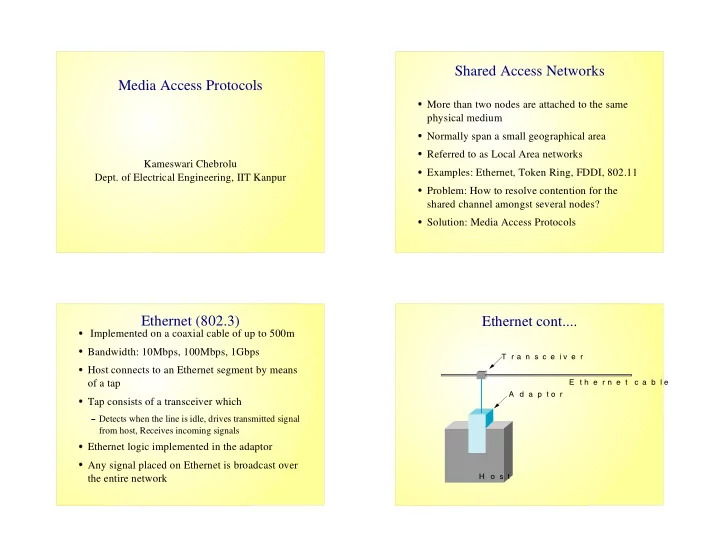
Ethernet (802.3)

  • Implemented on a coaxial cable of up to 500m
  • Bandwidth: 10Mbps, 100Mbps, 1Gbps
  • Host connects to an Ethernet segment by means
  • f a tap
  • Tap consists of a transceiver which
✁

Detects when the line is idle, drives transmitted signal from host, Receives incoming signals

  • Ethernet logic implemented in the adaptor
  • Any signal placed on Ethernet is broadcast over

the entire network

Ethernet cont....

T r a n s c e i v e r E t h e r n e t c a b l e A d a p t o r H o s t

slide-2
SLIDE 2

Ethernet Repeater

Repeater Host

Frame Format

  • Preamble: 64 bit sequence of alternating 0's and 1's
  • Destination/Source Address: 48 bit address used to

identify hosts

✁

Example: 00:0F:1F:D2:00:BB

  • Type: Identifies which of the higher layer protocols

this frame should be delivered

Dest addr 64 48 32 CRC Preamble Src addr Type Body 16 48

CSMA/CD Access Protocol

  • CSMA/CD: Carrier Sense Multiple Access with

Collision Detection

  • Carrier Sense means
✁

All nodes can distinguish between an idle and busy link

  • Collision Detect means
✁

A node listens as it transmits

✁

It can detect interference from other node transmissions

  • Under heavy loads, utilization is only 30%
✁

Maximum hosts limited to 1024

Receiver Side Algorithm

  • Each frame transmitted on the Ethernet is

received by every adaptor connected to it

  • An adaptors accepts only those frames
✁

addressed to its own address

✁

addressed to the broadcast address

✁

addressed to multicast address it belongs to

✁

all frames, if placed in promiscuous mode (special mode)

slide-3
SLIDE 3

Transmitter Side

  • If the line is idle, send immediately
  • If the line is busy, wait for it to become idle and

transmit immediately (1-persistent protocol)

  • If collision
✁

Jam for 32 bits and stop transmission

✁

To detect collisions, minimum frame size is set to 512 bits

✁

Wait some time and try again (exponential back off)

  • 1st time: 0, 51.2 us
  • 2nd time: 0, 51.2, 102.4 or 153.6 us
  • nth time: waits k * 51.2us, k random between 0 and 2n - 1
  • Report a transmission error after 16 attempts

Token Rings (802.5, FDDI)

  • A set of hosts connected in a ring
  • Data flows in a particular direction around the ring
✁

Each node receives from upstream neighbor and forward to downstream neighbor

  • Like in Ethernet, the ring is viewed as a single

shared medium

  • Bandwidths: 4Mbps, 16Mbps or 100Mbps
  • 250 stations per Ring

Token Ring Network Multistation Access Units

Host Host Host Host From previous MSAU

T To next

MSAU MSAU

slide-4
SLIDE 4

Basic Idea

  • A special bit pattern (24 bit token) rotates round the

ring

  • A host must capture token before transmitting a packet
  • As the packet flows past each node on the ring
✁

Only the intended receiver copies the packet into its buffer

✁

Only the sending host can remove the packet from the ring

  • After finishing transmission, sending host release token

back into the ring

✁

Immediate release

✁

Delayed release

  • Hosts get a Round-Robin service

Frame Format

  • Access control: Includes frame priority
  • Frame Control: Identifies higher layer protocol
  • Address fields: Similar to Ethernet, 48 bits long
  • Frame Status Byte: Provides reliability info.
✁

“A” bit is set if the intended recipient sees the frame

✁

“C” bit is set if the intended recipient copies the frame into its buffer successfully

Body Checksum Src addr Variable 48 Dest addr 48 32 End delimiter 8 Frame status 8 Frame control 8 Access control 8 Start delimiter 8

Token Ring Maintenance

  • A host acts as a “Monitor” to ensure the health of

the ring

  • A Monitor periodically transmits a special

control message

  • A Monitor is elected by transmitting a “claim”

token

✁

Contention is broken by some well defined rule like “highest address wins”

Role of the Monitor

  • Ensures that there is always a token in the ring
✁

A token can vanish due to bit errors, crash of a machine holding the token

✁

Monitor employs a Timer and watches for a passing token

✁

If timer expires before the token is seen, it creates a new one

✁

Timer: NumStations * TokenHoldingTime + RingLatency

  • Checks for corrupted or orphaned frames
✁

They are detected using the “monitor” bit in the header

✁

At transmission, this bit is set to 0, first time monitor sees the packet, this bit is set to 1

✁

Monitor drains off the ring any packet with monitor bit set to 1

slide-5
SLIDE 5

Summary

  • Looked at how to mediate access to a shared link
  • Two different protocols: Ethernet CSMA/CD

and token ring

✁

Protocols are distributed in nature

  • Moving on to “How to make two hosts talk

when they are not directly connected?”