Shellfish aquaculture in the Common Fisheries Policy DG for - PowerPoint PPT Presentation
Shellfish aquaculture in the Common Fisheries Policy DG for Maritime Affairs and Fisheries Aquaculture in the EU 1.3 million tonnes production Worth 3.6 billion 80.000 direct jobs Many different species and production systems
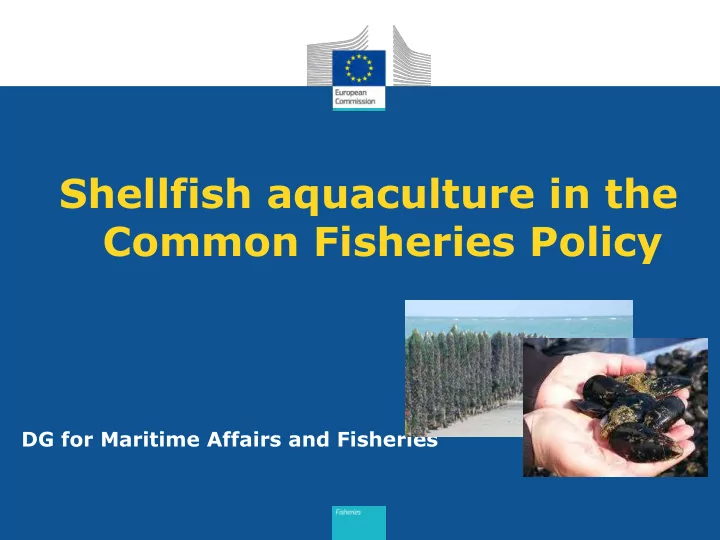
Shellfish aquaculture in the Common Fisheries Policy DG for Maritime Affairs and Fisheries
Aquaculture in the EU • 1.3 million tonnes production • Worth 3.6 billion € • 80.000 direct jobs • Many different species and production systems
EU aquaculture production by type (volume) Freshwater Marine finfish 22% 28% Shellfish 50%
The EU shellfish sector in figures • 0.68 million tonnes • 1.12 billion € • 55-65,000 jobs • Main species: • Mussel (492k t, 429k € ) • Oyster (99k t, 438k € ) • Clam (37k t, 172k € ) • Main producers: Spain, France, Italy
Filling the gap EU seafood consumption EU Captures 25% Net imports 65% EU Aquaculture 10%
Blue growth: job creation in coastal and inland areas • Blue Growth Communication 2012 (COM(2012)494 13,9,2012 • Five main focus areas: Aquaculture; Renewable energy, biotechnology; coastal & marine tourism and mineral resources • Action Plan for a Maritime Strategy in the Atlantic Area
Blue growth • With current labour productivity, every 1% of our seafood consumption produced by EU aquaculture could help creating 3-4.000 full- time jobs • Mostly in coastal and rural areas, important local impact • Shellfish: labour intensive, high job creation potential
Aquaculture in the CFP • "Basic Regulation": open method of coordination • "Common Market Organisation" Regulation: labelling, producers organisations • European Maritime and Fisheries Fund (EMFF) • Aquaculture Advisory Council • Aquaculture research: Horizon2020
The Open Method of Coordination • "Soft" approach – no change in EU legislation • Union strategic guidelines: common priorities and targets • Multiannual national strategic plans • Exchange of information and best practices
Union Strategic Guidelines COM(2013)229 1. Reduce administrative burdens 2. Facilitate access to water and space 3. Improve competitiveness 4. Exploit competitive advantages – "level playing field"
2. Facilitate access to space and water • "Lack of space" or "No access to space"? • Use of spatial planning to identify best location and make aquaculture development: • More sustainable • More socially acceptable • Less uncertain (and more interesting for investors) • Maritime Spatial Planning Directive
3. Increase competitiveness • Promote R&D, innovation, business differentiation • Exploit business opportunities (e.g. integration with angling and tourism, offshore wind farms) • Valorise environmental services (e.g. extensive ponds and habitat conservation) • Stronger producers organisations
4. Exploit competitive advantages – "Level playing field" • EU aquaculture offers high standards of: • Environmental protection • Health • Consumer protection • Inform consumers (food labels, information campaigns) • Exploit niche markets (certification schemes, organic aquaculture)
Multiannual national plans • Based on Strategic Guidelines and specific conditions in the Member States • Define Member States' objectives and the measures to achieve them • Cover the period 2014-2020 • Consistent with EMFF planning
Increasing competitiveness • Art. 47 (innovation) : new processes, products, species • Art. 48 (productive investment) • Art. 49 (advisory services) : provision of advisory services to farmers, covering: - environmental legislation - impact assessment - animal health and welfare - public health - health & safety - marketing and business strategies • Art. 50 (human capital) : - Professional training, lifelong learning - Improved working conditions - Networking
Support for aquaculture research under Horizon2020 "Societal Challenges" number 2: Food security, sustainable agriculture and forestry, marine and maritime and inland water research, and the bioeconomy Budget of € 3.8 Billion for the period 2014-2020 (twice the FP7 budget for the same thematic area in 2007-2013) Innovative, Sustainable Sustainable Blue Growth Food Security and Inclusive Bioeconomy
Examples of relevant calls 2014- 2015 Food security Tackling disease-related challenges and threats faced by European farmed aquatic animals Indicative budget: € 7 million for 2014 (fish parasites), € 4 million for 2015 (mollusc diseases) Sustainable food production systems Implementation of an Ecosystem-based approach for European aquaculture Indicative budget: € 3 million for 2014 (spatial planning), € 7,5 million for 2015 (aquaculture/environment)
Knowledge Gate • www.kg.eurocean.org
Thank you for your attention!
Recommend
More recommend
Explore More Topics
Stay informed with curated content and fresh updates.