
SLIDE 1
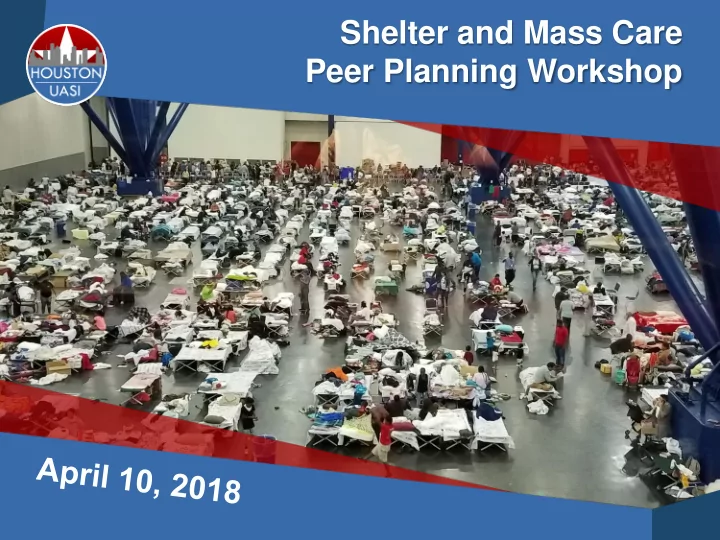
Shelter and Mass Care Peer Planning Workshop Welcome Brian Greene - - PowerPoint PPT Presentation
Shelter and Mass Care Peer Planning Workshop Welcome Brian Greene President and CEO Houston Food Bank bgreene@houstonfoodbank.org 2 Introduction Benzon John Homeland Security Planner Harris County Office of Homeland Security &
Brian Greene President and CEO Houston Food Bank bgreene@houstonfoodbank.org
2
Benzon John Homeland Security Planner Harris County Office of Homeland Security & Emergency Management benzon.john@oem.hctx.net 713-426-9554
3
4
9:00 – 9:30 Registration and Networking 9:30 – 10:00 Welcome and Introduction 10:00 – 10:30 Overview of Workshop Products 10:30 – 11:30 Local Planning Perspective 11:30 – 12:00 Break/Lunch 12:00 – 1:45 Panel of Experts (working lunch) 1:45 – 2:15 Whole Community Planning 2:15 – 2:30 Open Forum 2:30 Adjourn // Food Bank Tour
5
– Designed to meet the challenges of integrating planning efforts – Is not the end-all, be-all to the planning efforts
6
7
8
9
10
11
12
13
14
15
Caroline Egan Disaster Recovery Manager Fort Bend County Office of Emergency Management caroline.egan@fortbendcountytx.gov 281-342-6185
16
Plan Assessment Tool A resource to help you evaluate the degree to which you have planned and prepared for sheltering and mass care for general populations. Planning Resource List
and mass care specific
well as training information.
17
18
– Suggests strategies and considerations for concept of operations – Helps identify gaps in plans – Is not meant to be comprehensive
19
20
– Six Strategies
– Five Strategies
– Three Strategies
21
22
23
24
– Among sheltering and support agencies – With the EOC
25
services
shelter and EOC
needs
– Physical – Security – Health
– Behavioral Health – Transportation – Other services
26
27
28
29
30
– Mobile vs fixed
31
responsibilities
mass care provider and EOC
considerations
fixed site)
Distribution
services
32
33
34
35
36
37
38
39
Guidance
Templates, and Other Helpful Tools
40
Steve Rosa, Emergency Management Coordinator Bill Ray, Homeland Preparedness Project Brazoria County steverosa@brazoria-county.com bill@homelandpreparedness.org
41
Jack Colley, Chief of Governor’s Division of Emergency Management
» May 2005 – Walker County Shelter HUB » Tasked with housing 5000 displaced persons from the Gulf Coast and their pets. » First Shelter HUB on IH45 from the coast
Walker County
28 named storms 4 major storms impacted the United States 3 Category 5 storms November 30th ended hurricane season Hurricanes continued into 2006
23 Shelters were opened 7200 evacuees were in those
shelters
Total approximately 15,000
evacuees
Approximately 150,000
motorists on I-45 from South County Line to North County Line
Fuel shortage Walker County was supported
by State of Texas and FEMA
September 2005
Hurricane Rita Evacuation
Walker County with their pets and some livestock.
shelter was organized at the Walker County Fairgrounds.
included the opening of a shelter for evacuees at the fairgrounds.
Animals Housed during Rita: 27 Large Animals 377 Small Animals 404 TOTAL We learned the importance of a formal record keeping system with this incident. Our numbers above reflect only the animals which were placed on the “official count” following the first set
No pens, cages, pet
food, pet litter, feed, water bowls, leashes, water hoses
No paperwork or
documentation
Lack of volunteers to
animal shelter
Flea infestation during
clean up of Fairgrounds
The Walker County Fairgrounds Committeeman’s Room was adapted into a small animal shelter Goat pens were converted to dog kennels
Make shift paperwork during Hurricanes Katrina and Rita
HURRICANES
Katrina Rita Gustav Ike Harvey
Walker County is tasked
by TDEM to house 5000 displaced persons during a hurricane
Walker County has
agreements with two Point-To-Point Counties, 250 displaced persons from each county
These Counties are
Liberty and Hardin Counties
Planning meetings with
both Counties EMC’s took place to work out details for transporting displaced persons from the two counties to Walker County.
Planning
Good Staff Volunteers
CERT
Local Partners
Faith Based University School Districts
State Partners
TDEM
Pre-land fall STAR in Que
National Partners
American Red Cross The Salvation Army
Planning cont’d
Shelter Team Meetings
Monthly April – September
Plans Needs
Donations Management
Coordinator Warehouse Volunteers
Local Resources / Assets
County City Texas A&M Forest Service Texas Department of Criminal Justice Department of Public Safety Texas Department of Transportation
Butch Davis EMC 344 SH 75 N, Suite 200 Huntsville, TX 77320 936-435-2418 (office) 936-577-2846 (cell) bdavis@co.walker.tx.us Sherri Pegoda Deputy EMC 344 SH 75 N, Suite 200 Huntsville, TX 77320 936-435-8740 (office) 936-662-6109 (cell) walkercountyoem@co. walker.tx.us
Ammy Gierzak Homeland Security Planner Harris County Office of Homeland Security and Emergency Management ammy.Gierzak@oem.hctx.net 713-426-9570
65
66
67
68
69
70
71
72
73
Thanks to the Houston Food Bank for providing lunch and the Houston UASI Regional Planners Workgroup for providing snacks!
74
Tina Rose (Moderator) Regional Planner City of Houston Mayor’s Office of Public Safety and Homeland Security tina.rose@houstontx.gov
75
– To shelters – To the public
76
Tina Rose, Panel Moderator City of Houston Mayors Office of Public Safety and Homeland Security tina.rose@houstontx.gov Ethan Barton Conroe Independent School District ebarton@conroeisd.net
Texas A&M Veterinary Emergency Team wbissett@cvm.tamu.edu Sarah McIntire Houston Food Bank smcintire@houstonfoodbank.org Andy Meyer American Red Cross andy.meyer2@redcross.org Melissa Noriega BakerRipley mnoriega@bakerripley.org Tod Nutt Texas Health Resources todnutt@texashealth.org Ana Rausch Coalition for the Homeless arausch@homelesshouston.org Lori Upton SouthEast Texas Regional Advisory Council lori.upton@setrac.org
77
Disability Taskforce Toolkits Review
Will O’Neill Director Continuity of Operations and Emergency Management, Texas Health and Human Services Commission
May 18, 2017
➢ Explore best practices for communicating with members of the
disability community before and during emergencies through resources in the Effective Communications Toolkit.
➢ Understand how the FNSS Toolkit can provide planning guidance
to local emergency management and shelter planners to meet access and functional needs in general population shelters.
➢ Understand how resources in the FNSS toolkit enable children
and adults with or without disabilities who have access and functional needs maintain their health, safety, and independence in a general population shelter.
Including People with Disabilities in State-Level Emergency Management
Texas Disability Task Force on Emergency Management
Convened in 2011 Resource to Texas Division of Emergency Management (TDEM) Provides input to Texas emergency management community to assist in enhancing state and local emergency management planning and response Promotes preparedness efforts for Texans with disabilities Membership of state and local disability
Where can you find the Toolkits?
www.preparingtexas.org
Download: from the Preparing Texas Website under the preparedness link. Effective Communications Toolkit: Emergency Communications With People Who Have Disabilities Functional Needs Support Services Toolkit and resource tools
Who do the toolkits apply to?
This toolkit applies to professionals from local jurisdictions in the following fields: ➢ First responders; ➢ Emergency management professionals; ➢ Public information officers; ➢ Shelter managers; and ➢ State and local government
Communication Before & After a Disaster
The Effective Communications Toolkit helps you ensure that emergency communications services and equipment address the functional and access needs of people with disabilities as part of the “whole community” approach endorsed by FEMA
Chapter 2: General Guidance for All Communications
Check Your Documents and Website for Accessibility
Before disaster strikes, each agency and jurisdiction should develop a plan to:
spreadsheets, PDF documents, websites and any other documents are created in accessible formats;
and content development are properly trained;
page to provide a way for visitors to request accessible information or services.
Accessible Presentations & Meetings
Quick Reference:
http://accessibility.hhs.texas.gov/docs/guidelines/AccessiblePresentationsQuickReferenceGuide.pdf
Plain People First Language
Plain language is communication your audience can understand the first time they read or hear it. According to the Plain Language website, plain-language writing saves
Multi-Modal Warnings and Notification
Chapter 3: How to make the following methods of communications accessible
Plan Ahead with Local Media
Consult with local media, and in non-emergency times discuss the stations’ requirements from the FCC for accessibility of emergency broadcasts
Emergency Managers to the Public with real-time captioning
the camera frame
listeners who are blind or have low vision.
Face to Face Meetings – Just Ask
Anytime you are in an interaction with a person with a disability, you already have one expert to guide the interaction. Just “ask”.
Talkboards, Pictograms & Signage
Chapter 4: Auxiliary Aids and Services for Various Disabilities
Deaf or Hard of Hearing
Have Low Vision
Accessibility & Assistive Technology
“For most people technology makes things easier. For people with disabilities, technology makes things possible.” Assistive technology creates
disabilities to gain equal access to information, services, and employment . . . only when you do your part.
Chapter 5: Emergency Communications Tools for People with Disabilities
➢ General Etiquette ➢ People Who Are Older ➢ People Who Use a Service Animal ➢ People Who Have Mobility Impairments ➢ People Who Use Crutches, Canes or Other Mobility Devices ➢ People Who Have a Mental Illness ➢ People Who Have a Cognitive Disability ➢ High Tech and Low Tech Communication Tools ➢ People Who Are Blind or Have Low Vision
Access the mobile app at:
disabilitytips.tamu.ed u
Tips for First Responders
Chapter 6: Additional Resources and Training
This chapter contains links to all the resources you need to go from an effective communications novice to an effective communications expert!
Texas Functional Needs Support Services Tool Kit
To provide planning guidance to local emergency management and shelter planners, the State of Texas FNSS Integration Committee has created a tool kit that can be incorporated into existing shelter plans to meet access and functional needs in general population shelters. This tool kit is designed to provide first responders and emergency management professionals basic information about interacting with Texans with disabilities during a disaster and to identify disability leaders in the local communities.
Texas Functional Needs Support Services Tool Kit PART I: PLANNING TOOLS
Tab-A Emergency Management Planning Assessment Tab B- Planning for the Inclusion of People with Disabilities Tab D- Statewide Disability Stakeholders Tab E- Selected County Demographic, Functional and Medical Needs Data
Just Ask
Anytime you are in an interaction with a person with a disability, you already have one expert to guide the interaction. Just “ask”.
Planning Tools
Tab C- ADA Compliance Checklist Tab H - Medical Services Attachment 7- Public Health Shelter Checklist Tab- G- Attachment 3-Temporary Solutions for Emergency Sheltering Ramps Rapid Triage and Assessment
Facility Accessibility
➢ All shelters and facilities must meet ADA physical access requirements. ➢ If a shelter or facility that has inaccessible features is selected, it must be made accessible before use.
Tab E - Transportation Services
accessible transportation
must have access to the same benefits/ services as individuals without disabilities
Tab G-Rapid Assessment (Triage)
Attachment 1-Shelter Placement Guidance Attachment 2-Shelter Placement Form
Texas Functional Needs Support Services Tool Kit
Tab H - Medical Services Attachment 2-Durable Medical Equipment Attachment 3-Consumable Medical Supplies (CMS) Attachment 4- Oxygen Support (O2)
PART II: OPERATIONAL TOOLS
Personal Assistance Services
Personal Assistance Services (PAS) are formal and informal services that enable children and adults to maintain their usual level of independence in a shelter setting.
Tab H - Medical Services
Attachment 1-Disaster Behavioral Health Services Attachment-5 Pharmacy Support Attachment 6- Kidney Dialysis
Mental Health & Medical Services
local laws, rules and regulation related to mental health services
— Mental health services — Medical services — Emergency dental services — Medications
Attachment 1- Tips for Interacting with People with Disabilities, Functional and Access needs during a Disaster Attachment 2- Talk boards Attachment 3- Pictograms Attachment 4- Signage Attachment 5- Basic Emergency Sign Language & Deafblind Guidelines
Tab I - Effective Communications
Texas FNSS Tool Kit
PART III: Recovery
Tab K- Medical/Functional Needs Discharge Assessment Tab L- Support Capabilities for Repatriation of Evacuated Persons with Disabilities
Transition and Recovery
In order to transition out of the shelter environment and into the community plans must: Ensure local government has determined that the jurisdiction has been declared safe to inhabit Determine that the individuals house is safe to return to Ensure services have been restored to the area Ensure accessible transportation is available
Training Resources
Instructor Guide and Slides @ Preparing Texas
Rights, and FNSS Integration in Emergency Management Training Package DSHS TRAIN FNSS General Population Shelter Course CBT
number is 1070230.
FNSS Instructor Guide and Slides @ Preparing Texas
Overview of the Whole Community Approach, Disability Rights, and FNSS Integration in Emergency Management
FNSS General Population Shelter Computer Based Training
Functional Needs Support Services (FNSS) in General Population Shelters https://tx.train.org Course #: 1070230
Please take a moment and fill out a feedback form. Stick around if you plan to participate in the tour. Thank you for attending!
116