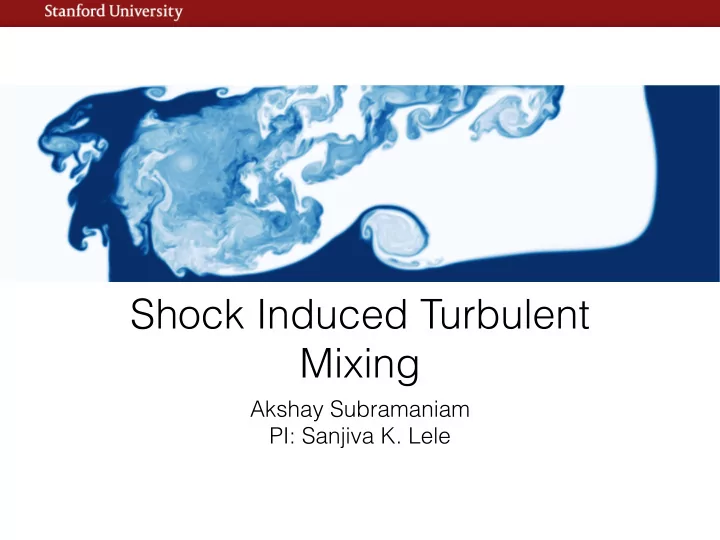
Shock Induced Turbulent Mixing Akshay Subramaniam PI: Sanjiva K. - - PowerPoint PPT Presentation
Shock Induced Turbulent Mixing Akshay Subramaniam PI: Sanjiva K. Lele Outline Introduction - Richtmyer-Meshkov Instability Classical RM problem Inclined interface vs. single mode interface Numerical technique Problem setup
Outline
- Introduction - Richtmyer-Meshkov Instability
- Classical RM problem
- Inclined interface vs. single mode interface
- Numerical technique
- Problem setup
- Results
- Effect of 3D perturbations
- Conclusions
Richtmyer-Meshkov (RM) Instability
- Interaction of a material interface with a
shockwave
- Predicted theoretically by Richtmyer
(1960) and shown experimentally by Meshkov (1969)
- Similar to Rayleigh-Taylor in mechanism
- Baroclinic vorticity generation causes
amplification of perturbations
- Linear models for small amplitude
sinusoidal perturbations
Dω Dt = ω · ru + νr2ω + ✓ 1 ρ2 rρ ⇥ rp ◆
Classical RM configuration Baroclinic vorticity generation
Applications
- Inertial Confinement Fusion (ICF)
- Critical to achieve energy break-
even
- Stellar evolution models to explain lack
- f stratification
- Mixing in supersonic and hypersonic
air-breathing engines
- Aim is to develop predictive capabilities
- Simulations key to bridging gap
between experiments, theory and modeling
The classical RM problem
- First model by Richtmyer for small
amplitude sinusoidal perturbations
- Many models that work well in the
linear regime
- Some extensions to early non-linear
times
- No net circulation deposition
From Brouillete (1990)
Inclined interface RM
- No existing model for interface evolution
- Intrinsically non-linear from early times for modest
interface angles
- Almost constant vorticity deposition along the interface
- Easier to study experimentally
From Zabusky (’99)
Governing Equations
- We solve the compressible multi-species Navier Stokes
equations
∂ρ ∂t + r · (ρu) = 0 ∂(ρu) ∂t + r · (ρuu + pδ τ) = 0 ∂E ∂t + r · [(E + p)u] r · (τ · u qc qd) = 0 ∂ρYi ∂t + r · (ρuYi) r · (ρDirYi) = 0 p(ρe, Y1, Y2, ..., YK) = (γ − 1) ρe
Numerical technique
- Miranda code developed at LLNL (Cook ’07)
- Compressible, multi-species solver
- 10th order compact finite differencing (Lele ’92) in space
- 4th order Runge Kutta time integrator
- LAD scheme for generalized curvilinear coordinates (Kawai
‘08) for shock and interface capturing
µ = µf + µ∗ β = βf + β∗ κ = κf + κ∗ Di = Df,i + D∗
i
The Miranda Code
- 10th order Pade scheme for derivative computation
- Need to solve pentadiagonal system
- Two approaches
- Direct block parallel pentadiagonal solves (BPP)
- Transpose algorithm with serial pentadiagonal solves
- Transpose algorithm shown to scale very well up to 65,536 processors
Af 0 = Bf
From Cook et. al. (2005)
The Miranda Code
Weak Scaling Strong Scaling
From Cook et. al. (2005)
Inclined interface RM
- No existing model for interface
evolution
- Intrinsically non-linear from early
times for modest interface angles
- Almost constant vorticity
deposition along the interface
- Easier to study experimentally
- Based on experimental setup in
the Inclined Shock Tube Facility at Texas A&M
- Slip walls in transverse (y)
direction
- Isotropic 3D cartesian grid
θ Shocked Air Unshocked Air D i r e c t i
- n
- f
S h
- c
k Heavygas: SF6 Inclined interface x y z Lyz Lyz Lx
Lyz = 11.4 cm θ = 30 Mshock = 1.5 A = ρSF6 − ρAir ρSF6 + ρAir = 0.67
Time epochs
- Before interaction (initial condition, t = 0 ms)
Density field
Time epochs
- First interaction of the shock and interface (t = 0.2 ms)
Time epochs
- Shock fully passes through the interface (t = 0.5 ms)
Time epochs
- Formation of a coherent wall vortex (t = 1.0 ms)
Time epochs
- Kelvin-Helmholtz rollers (t = 2.5 ms)
Time epochs
- Turbulent mixing (t = 5.0 ms)
Initial vorticity deposition Formation of wall vortex K-H rollers Effect of transverse modes Stratified mixing zone
y-z integrated vorticity
Total baroclinic vorticity generation Total wall torque
Effect of 3D perturbations
- Quite often, 2D RM simulations are performed since initial conditions are
2D
- Well correlated vortex rolls observed are unrealistic physically
- Want to quantify effects of 3D perturbations on top of the inclined interface
- 3D perturbations informed by more careful profiling of the initial condition
data from experiments
- Kelvin-Helmholtz rollers (t = 2.5 ms)
- Turbulent mixing (t = 5.0 ms)
Conclusions and Future Work
- The inclined interface RM problem was simulated for the set of
parameter values used in the experiment
- The qualitative physics of the problem are captured well and
match what is observed in experiments
- Higher mesh resolution calculations are required to get
convergence on higher order statistics
- 3D perturbations play an important role in the vortex breakdown
and mixing process
- Next step is to make quantitative comparisons with experiments
for validation
- Characterize turbulent mixing by looking at higher order moments
References
- Cook, A. W. (2007). Artificial fluid properties for large-eddy simulation of compressible turbulent
- mixing. Physics of Fluids (1994-present), 19(5), 055103.
- Lele, S. K. (1992). Compact finite difference schemes with spectral-like resolution. Journal of
computational physics, 103(1), 16-42.
- Kawai, S., & Lele, S. K. (2008). Localized artificial diffusivity scheme for discontinuity capturing on
curvilinear meshes. Journal of Computational Physics, 227(22), 9498-9526.
- McFarland, J. A., Greenough, J. A., & Ranjan, D. (2011). Computational parametric study of a
Richtmyer-Meshkov instability for an inclined interface. Physical Review E, 84(2), 026303.
- Zabusky, N. J. (1999). Vortex paradigm for accelerated inhomogeneous flows: Visiometrics for the
Rayleigh-Taylor and Richtmyer-Meshkov environments. Annual review of fluid mechanics, 31(1), 495-536.
- Brouillette, M. (2002). The richtmyer-meshkov instability. Annual Review of Fluid Mechanics, 34(1),
445-468.
- Richtmyer, R. D. (1960). Taylor instability in shock acceleration of compressible fluids.
Communications on Pure and Applied Mathematics, 13(2), 297-319.
- Cook, A. W., Cabot, W. H., Williams, P. L., Miller, B. J., Supinski, B. R. D., Yates, R. K., & Welcome, M.
- L. (2005, November). Tera-scalable algorithms for variable-density elliptic hydrodynamics with
spectral accuracy. In Proceedings of the 2005 ACM/IEEE conference on Supercomputing (p. 60). IEEE Computer Society.