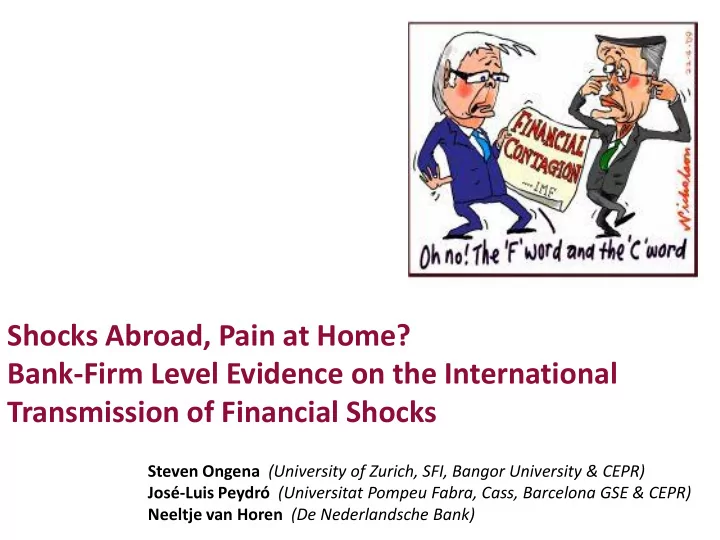
Shocks Abroad, Pain at Home? Bank-Firm Level Evidence on the - - PowerPoint PPT Presentation

shocks abroad pain at home bank firm level evidence on
SMART_READER_LITE
LIVE PREVIEW

Shocks Abroad, Pain at Home? Bank-Firm Level Evidence on the - - PowerPoint PPT Presentation

Shocks Abroad, Pain at Home? Bank-Firm Level Evidence on the International Transmission of Financial Shocks Steven Ongena (University of Zurich, SFI, Bangor University & CEPR) Jos-Luis Peydr (Universitat Pompeu Fabra, Cass, Barcelona GSE


slide-1
SLIDE 1

Shocks Abroad, Pain at Home? Bank-Firm Level Evidence on the International Transmission of Financial Shocks

Steven Ongena (University of Zurich, SFI, Bangor University & CEPR) José-Luis Peydró (Universitat Pompeu Fabra, Cass, Barcelona GSE & CEPR) Neeltje van Horen (De Nederlandsche Bank)

slide-2
SLIDE 2

Motivation & questions

  • Globalization of the financial system

– Banks borrowing on international wholesale market – Increased presence of foreign owned banks

  • Followed by a global financial crisis with international wholesale

liquidity evaporating and Western banks suffering important losses

  • Did the crisis spread through international bank linkages?

What are the real effects, notably for SMEs?

2

slide-3
SLIDE 3

This paper

  • Use matched bank-firm level data
  • Ask the following questions:

– Do banks that depend on international wholesale funding cut lending to firms when this market dries up? – Do financial problems at the parent bank negatively affect lending by their foreign subsidiaries? – Are there consequently real effects for the domestic borrowers? – Are there heterogeneous effects across types of firms?

3

slide-4
SLIDE 4

This paper

  • Use matched bank-firm level data
  • Ask the following questions:

– Do banks that depend on international wholesale funding cut lending to firms when this market dries up? – Do financial problems at the parent bank negatively affect lending by their foreign subsidiaries? – Are there consequently real effects for the domestic borrowers? – Are there heterogeneous effects across types of firms?

Is a globalized banking sector a shock propagator or shock absorber?

4

slide-5
SLIDE 5

Main take-away

  • Global financial crisis was transmitted via:

– Dependency on international wholesale funding – Foreign bank ownership

  • Substantial real consequences for firms dependent on bank credit

– But not for credit independent firms

  • Stronger negative effects for small firms, firms with limited tangible

assets and firms with single bank relationships

  • Transmission stronger in countries with lower pre-crisis growth or

financial development, more reliance on foreign funding or slower contract enforcement

5

slide-6
SLIDE 6

Contribution: Country- and bank-level data

  • Evidence based on country- and bank-level data on international

transmission of financial shocks

– Country: Kalemli-Ozcan, Papaioannou & Perri (JIE 2010); Cetorelli & Goldberg (IMFER 2011) – Bank: Peek and Rosengren (AER 1997, 2000); Claessens and Van Horen (JFP 2013); Cull & Martinez Peria (JBF 2013); De Haas & Van Lelyveld (JMCB 2014)

  • All focus on transmission of shocks through foreign ownership, not international wholesale

funding

  • But level of aggregation (country or bank) is problematic for identification

– Banks might lend to different types of firms  important to control for firm fundamentals (Mian, JF 2006; Giannetti & Ongena, RoF 2009; Jimenez, Ongena, Peydro & Saurina, AER 2012) – Aggregate volumes are driven by changes in lending to large firms  can hide credit crunch to small firms only (Gertler & Gilchrist, QJE 1994)

6

slide-7
SLIDE 7

Contribution: Loan-level data

  • Credit registry data allow for better identification. Transmission of:

– 1998 Russian default via international banks to Peru (Schnabl JF 2012) – US subprime exposure to German households (Puri, Rocholl & Steffen JFE 2011) – Lehman to foreign banks in Italy (Alberttazi & Bottero, 2013)

  • But no real effects, which is crucial as transmission only truly matters if

there are real effects

  • Also, data on only one country which limits external validity for

international studies

– Studies using syndicated loan data: multi-country and firm level, but no SMEs nor real effects (Giannetti & Laeven JFE 2012; De Haas & Van Horen AER 2012; RFS 2013)

7

slide-8
SLIDE 8

Our contribution

  • Study impact of international transmission of financial shocks on

firms in multi-country setting

– Special focus on SMEs – Examine both firm and country heterogeneity

  • Matched bank-firm data provide better identification than country

and bank data level papers

– Control for firm fundamentals – Firm fixed effects not very important once you control for firm observable fundamentals (Khwaja & Mian AER 2008)

  • Focus on two transmission channels:

– international wholesale liquidity and foreign ownership

8

slide-9
SLIDE 9

9

  • If international transmission of financial shocks took place, number of

conditions need to hold:

– Global financial crisis should affect “international” banks more  faced with an adverse capital shock these banks have to curtail lending

  • Important: Not necessarily picked up by (aggregate) bank-level data if only

affecting credit to e.g. small firms or if banks serve different clients

– If there are financial frictions this should affect the performance of firms that are dependent on loans from these banks

  • This should hold especially for firms that cannot switch to alternative sources of

funding

– Firms that are not dependent on bank loans should not be affected

Identification strategy

slide-10
SLIDE 10

10

  • Basic idea: differentiate between 6 types of bank-firm relationships

Identification strategy

slide-11
SLIDE 11

11

  • Basic idea: differentiate between 6 types of bank-firm relationships

Identification strategy

Local bank International bank Foreign bank

slide-12
SLIDE 12

12

  • Basic idea: differentiate between 6 types of bank-firm relationships

Identification strategy

Local bank International bank Foreign bank Firm 1a Firm 2a Firm 3a Firm 1b Firm 2b Firm 3b

slide-13
SLIDE 13

13

  • Basic idea: differentiate between 6 types of bank-firm relationships

Identification strategy

Local bank International bank Foreign bank Firm 1a Firm 2a Firm 3a Firm 1b Firm 2b Firm 3b

slide-14
SLIDE 14

14

  • Basic idea: differentiate between 6 types of bank-firm relationships

Identification strategy

Local bank International bank Foreign bank Firm 1a Firm 2a Firm 3a Firm 1b Firm 2b Firm 3b

slide-15
SLIDE 15

15

  • Basic idea: differentiate between 6 types of bank-firm relationships

Identification strategy

Local bank International bank Foreign bank Firm 1a Firm 2a Firm 3a Firm 1b Firm 2b Firm 3b

slide-16
SLIDE 16

16

  • Basic idea: differentiate between 6 types of bank-firm relationships

Identification strategy

Local bank International bank Foreign bank Firm 1a Firm 2a Firm 3a Firm 1b Firm 2b Firm 3b

slide-17
SLIDE 17

17

  • Basic idea: differentiate between 6 types of bank-firm relationships

Identification strategy

Local bank International bank Foreign bank Firm 1a Firm 2a Firm 3a Firm 1b Firm 2b Firm 3b

slide-18
SLIDE 18

18

  • Basic idea: differentiate between 6 types of bank-firm relationships

Identification strategy

Local bank International bank Foreign bank Firm 1a Firm 2a Firm 3a Firm 1b Firm 2b Firm 3b If there are financial frictions …

slide-19
SLIDE 19

19

  • Basic idea: differentiate between 6 types of bank-firm relationships

Identification strategy

Local bank International bank Foreign bank Firm 1a Firm 2a Firm 3a Firm 1b Firm 2b Firm 3b If there are financial frictions …

slide-20
SLIDE 20

Data

  • Banks and firms active in 14 countries in Eastern Europe and Central

Asia

  • Region especially suitable for identification

– Not directly affected by banking crisis in the West – Credit boom fuelled by international wholesale funding – Large presence of foreign banks

20

slide-21
SLIDE 21

Data

21

Bank ownership database

(Claessens & Van Horen)

+ Dealogic + Banksc Amadeus Kompass

Bank-Firm connections

slide-22
SLIDE 22

Bank-level data

– Identify three types of banks

  • Foreign bank: >50% shares held by foreigners in 2007 (Bank ownership

database)

  • International borrowing domestic bank: borrowed at least once from

syndicated loan or bond market between 2004 and 2007 (Dealogic)

  • Locally funded domestic bank: only funded locally

– Total 256 banks (130 foreign, 39 internationally borrowing and 87 locally funded)

  • In eight countries three types of banks present (160 banks); use as main sample

(better within-country interpretation of results)

– Balance sheet information from Bankscope

22

slide-23
SLIDE 23

23

  • Kompass: directories of over two million firms in 70 countries

Ongena & Şendeniz-Yüncü (JBF 2011); Giannetti & Ongena (JIE 2012)

  • Data collected from chambers of commerce, firm registries, phone

interviews and voluntary registering

  • Includes information on firm address, management, industry, date of

incorporation and bank-firm relationships but no balance sheet information

  • Use the directory from 2010:

– Bank-firm relationship often recorded prior to 2010 – Bank-firm relationships even during non-crisis times often last many years

Ongena & Smith, 2001; Degryse, Kim & Ongena, 2009

– Do not know whether banks switch, but:

  • If information pre-dates the crisis and well-performing firms managed to switch from

shocked to unaffected banks our estimates will be conservative

  • We exploit observable firm characteristics to proxy for probability of switching

Bank-firm connections

slide-24
SLIDE 24

Firm-level data

– Identify six types of firms

  • Credit dependent firm: total borrowing positive at least one year between

2004 and 2007 (Amadeus)

– Having a relationship with one of the three types of banks (Kompass)

  • Credit independent firm: no borrowing  rely only on bank for checking or

savings account (Amadeus)

– Having a relationship with one of the three types of banks (Kompass)

– Total 30,529 credit dependent and 14,364 credit independent firms (in three-bank type countries 15,454 and 10,639 firms)

24

slide-25
SLIDE 25

Credit dependency

– In Rajan and Zingales (AER 1998)

  • Industry specific
  • Technology determined (e.g. in US)

– In this paper

  • Firm-specific
  • Time-predetermined (i.e. measured during normal times, before the

financial crisis hits)

25

slide-26
SLIDE 26

26

Transparent firms Opaque firms Banks No financing Capital markets

Berger & Udell (1993), Greenbaum & Emmons (1998), Mannonen (2001)

Credit Dependency Bank Dependency

Santos & Winton (JF 2008), Chava & Purnanandam (JFE 2011)

slide-27
SLIDE 27

27

Characteristics of the firms

  • Large differences between groups (especially size, export activities and nr.

banks)

  • Differences within groups limited (except ownership and nr. banks)
slide-28
SLIDE 28

28

Econometric model

  • Evidence of international transmission implies:

– Negative interactions

  • Credit dependent firms that have relationship with internationally-borrowing

domestic or foreign banks should be more affected than firms that are credit dependent and have a relationship with a locally-funded domestic bank

– Insignificant bank relationship dummies

  • Credit supply shock should not affect firms that are linked to these banks but are

not credit dependent

,2009 1 2 3 4 ' ,2009

* *

i i i i i i i i j k i

Y International Foreign International Credit Dependent Foreign Credit Dependent X                 

slide-29
SLIDE 29

29

Econometric model

  • Dependent variables (2008-2009):

– Short-term debt growth – Change ROA – Asset growth – Operational revenue growth

  • Controls:

– Firm characteristics (export, foreign ownership, age, size, liquidity, solvency) – Lagged dependent variable – [country * firm is credit dependent] and [industry * firm is credit dependent] FEs

  • OLS, cluster by bank, winsorize 1st and 99th percentile
slide-30
SLIDE 30

Model (1) (2) (3) (4) Dependent Variable (Firm) D%Short- Term Debt DROA D%Operational Revenue D%Assets Sample Firm with Internationally-Borrowing Domestic Bank 0.057** 0.579 0.019* 0.013* (0.011) (0.123) (0.091) (0.095) Firm with Foreign Bank 0.021 0.382 0.005 0.003 (0.261) (0.314) (0.593) (0.707) Firm with Internationally-Borrowing Domestic Bank

  • 0.089***
  • 1.082**
  • 0.047***
  • 0.035***

* Firm Is Credit-Dependent (0.000) (0.018) (0.001) (0.000) Firm with Foreign Bank

  • 0.056***
  • 1.082**
  • 0.037***
  • 0.027***

* Firm Is Credit-Dependent (0.000) (0.015) (0.004) (0.003) Firm Characteristics Yes Yes Yes Yes Lagged Dependent Variable Yes Yes Yes Yes Industry * Firm Is Credit-Dependent Fixed Effects Yes Yes Yes Yes Country * Firm Is Credit-Dependent Fixed Effects Yes Yes Yes Yes R-squared 0.059 0.163 0.074 0.034 Number of Observations 21,406 21,129 21,359 21,446 3-Bank Type Countries

30

Credit dependent firms with a relationship with internationally- borrowing or foreign bank have lower growth short-term debt

Firm financing and performance between 2008 and 2009

slide-31
SLIDE 31

Model (1) (2) (3) (4) Dependent Variable (Firm) D%Short- Term Debt DROA D%Operational Revenue D%Assets Sample Firm with Internationally-Borrowing Domestic Bank 0.057** 0.579 0.019* 0.013* (0.011) (0.123) (0.091) (0.095) Firm with Foreign Bank 0.021 0.382 0.005 0.003 (0.261) (0.314) (0.593) (0.707) Firm with Internationally-Borrowing Domestic Bank

  • 0.089***
  • 1.082**
  • 0.047***
  • 0.035***

* Firm Is Credit-Dependent (0.000) (0.018) (0.001) (0.000) Firm with Foreign Bank

  • 0.056***
  • 1.082**
  • 0.037***
  • 0.027***

* Firm Is Credit-Dependent (0.000) (0.015) (0.004) (0.003) Firm Characteristics Yes Yes Yes Yes Lagged Dependent Variable Yes Yes Yes Yes Industry * Firm Is Credit-Dependent Fixed Effects Yes Yes Yes Yes Country * Firm Is Credit-Dependent Fixed Effects Yes Yes Yes Yes R-squared 0.059 0.163 0.074 0.034 Number of Observations 21,406 21,129 21,359 21,446 3-Bank Type Countries

31

No differential (or even opposite) effect for credit independent firms with a relationship with internationally-borrowing or foreign bank

Firm financing and performance between 2008 and 2009

slide-32
SLIDE 32

Model (1) (2) (3) (4) Dependent Variable (Firm) D%Short- Term Debt DROA D%Operational Revenue D%Assets Sample Firm with Internationally-Borrowing Domestic Bank 0.057** 0.579 0.019* 0.013* (0.011) (0.123) (0.091) (0.095) Firm with Foreign Bank 0.021 0.382 0.005 0.003 (0.261) (0.314) (0.593) (0.707) Firm with Internationally-Borrowing Domestic Bank

  • 0.089***
  • 1.082**
  • 0.047***
  • 0.035***

* Firm Is Credit-Dependent (0.000) (0.018) (0.001) (0.000) Firm with Foreign Bank

  • 0.056***
  • 1.082**
  • 0.037***
  • 0.027***

* Firm Is Credit-Dependent (0.000) (0.015) (0.004) (0.003) Firm Characteristics Yes Yes Yes Yes Lagged Dependent Variable Yes Yes Yes Yes Industry * Firm Is Credit-Dependent Fixed Effects Yes Yes Yes Yes Country * Firm Is Credit-Dependent Fixed Effects Yes Yes Yes Yes R-squared 0.059 0.163 0.074 0.034 Number of Observations 21,406 21,129 21,359 21,446 3-Bank Type Countries

32

Credit dependent firms with internationally-borrowing or foreign bank are more affected in profitability, operational revenue and asset growth

Firm financing and performance between 2008 and 2009

slide-33
SLIDE 33

Model (1) (2) (3) (4) Dependent Variable (Firm) D%Short- Term Debt DROA D%Operational Revenue D%Assets Sample Firm with Internationally-Borrowing Domestic Bank 0.057** 0.579 0.019* 0.013* (0.011) (0.123) (0.091) (0.095) Firm with Foreign Bank 0.021 0.382 0.005 0.003 (0.261) (0.314) (0.593) (0.707) Firm with Internationally-Borrowing Domestic Bank

  • 0.089***
  • 1.082**
  • 0.047***
  • 0.035***

* Firm Is Credit-Dependent (0.000) (0.018) (0.001) (0.000) Firm with Foreign Bank

  • 0.056***
  • 1.082**
  • 0.037***
  • 0.027***

* Firm Is Credit-Dependent (0.000) (0.015) (0.004) (0.003) Firm Characteristics Yes Yes Yes Yes Lagged Dependent Variable Yes Yes Yes Yes Industry * Firm Is Credit-Dependent Fixed Effects Yes Yes Yes Yes Country * Firm Is Credit-Dependent Fixed Effects Yes Yes Yes Yes R-squared 0.059 0.163 0.074 0.034 Number of Observations 21,406 21,129 21,359 21,446 3-Bank Type Countries

33

No differential (or even opposite) effect for credit independent firms with a relationship with internationally-borrowing or foreign bank

Firm financing and performance between 2008 and 2009

Similar results for All Countries

slide-34
SLIDE 34

34

  • Results consistent with the idea that the global financial crisis was

transmitted to firms via two international bank lending channels

  • With important consequences for the real economy

Key results

slide-35
SLIDE 35

35

  • Use observable characteristics that proxy for the ability of the firm to access

alternative sources of finance and/or switch banks

– Firms with single and with multiple bank relationships

  • Firms that have established relationships with multiple banks are more likely to be

able to switch when their main bank is curtailing credit

  • Expect impact larger for firms with single bank relationship

– Small versus large firms:

  • Ample evidence that large firms are more likely to have access to alternative

sources of funding

  • Expect impact to be larger for small firms

– Firms with and without tangible assets

  • In times of crises having collateral becomes more important
  • Expect impact larger for firms with limited tangible assets

Allowing for firm heterogeneity

slide-36
SLIDE 36

Dependent Variable (Firm) D%Short- Term Debt DROA D%Operatio nal Revenue D%Assets D%Short- Term Debt DROA D%Operatio nal Revenue D%Assets Panel A Firm with Internationally-Borrowing Domestic Bank 0.064** 0.109 0.012 0.003 0.048** 1.312** 0.029 0.036*** (0.012) (0.844) (0.369) (0.742) (0.040) (0.037) (0.279) (0.001) Firm with Foreign Bank 0.020 0.812 0.008

  • 0.004

0.019

  • 0.767
  • 0.009

0.015 (0.355) (0.114) (0.556) (0.636) (0.309) (0.240) (0.671) (0.193) Firm with Internationally-Borrowing

  • 0.107***
  • 0.932
  • 0.060***
  • 0.034***
  • 0.055**
  • 1.274**
  • 0.024
  • 0.042***

* Firm Is Credit-Dependent (0.000) (0.195) (0.001) (0.003) (0.049) (0.041) (0.423) (0.005) Firm with Foreign Bank

  • 0.081***
  • 1.580***
  • 0.060***
  • 0.034***
  • 0.003

0.268 0.014

  • 0.013

* Firm Is Credit-Dependent (0.000) (0.004) (0.001) (0.002) (0.895) (0.708) (0.560) (0.343) R-squared 0.062 0.175 0.082 0.030 0.072 0.147 0.077 0.067 Number of Observations 14,297 14,082 14,270 14,319 7,109 7,047 7,089 7,127 Single-Bank Firms Multiple-Bank Firms

Single vs multiple bank relationships

36

Impact in general stronger for firms with single bank relationship

slide-37
SLIDE 37

Dependent Variable (Firm) D%Short- Term Debt DROA D%Operatio nal Revenue D%Assets D%Short- Term Debt DROA D%Operatio nal Revenue D%Assets Panel B Firm with Internationally-Borrowing Domestic Bank 0.064** 0.625 0.028* 0.013 0.019 0.644

  • 0.012
  • 0.004

(0.018) (0.215) (0.085) (0.208) (0.477) (0.345) (0.705) (0.773) Firm with Foreign Bank 0.025 0.816* 0.008

  • 0.004

0.005

  • 0.708
  • 0.008

0.002 (0.265) (0.060) (0.545) (0.640) (0.815) (0.235) (0.578) (0.878) Firm with Internationally-Borrowing

  • 0.098***
  • 1.625**
  • 0.070***
  • 0.033***
  • 0.055**
  • 0.743
  • 0.004
  • 0.020

* Firm Is Credit-Dependent (0.000) (0.012) (0.000) (0.006) (0.047) (0.363) (0.899) (0.215) Firm with Foreign Bank

  • 0.041**
  • 2.165***
  • 0.040**
  • 0.022**
  • 0.059**

0.558

  • 0.022
  • 0.025

* Firm Is Credit-Dependent (0.047) (0.000) (0.021) (0.045) (0.011) (0.467) (0.353) (0.120) R-squared 0.072 0.155 0.067 0.039 0.060 0.177 0.093 0.047 Number of Observations 10,702 10,564 10,679 10,726 10,704 10,565 10,680 10,720 Small Firms Large Firms

Small vs large firms

37

Impact much more pronounced when firms are small

slide-38
SLIDE 38

Dependent Variable (Firm) D%Short- Term Debt DROA D%Operatio nal Revenue D%Assets D%Short- Term Debt DROA D%Operatio nal Revenue D%Assets Panel C Firm with Internationally-Borrowing Domestic Bank 0.098*** 0.749 0.012 0.010 0.009 0.469 0.024** 0.017* (0.000) (0.280) (0.569) (0.461) (0.802) (0.404) (0.034) (0.084) Firm with Foreign Bank 0.039 0.911**

  • 0.001

0.007 0.008 0.068 0.012 0.001 (0.114) (0.030) (0.951) (0.567) (0.693) (0.900) (0.151) (0.871) Firm with Internationally-Borrowing

  • 0.154***
  • 1.811**
  • 0.066***
  • 0.051***
  • 0.022
  • 0.409
  • 0.034*
  • 0.025**

* Firm Is Credit-Dependent (0.000) (0.019) (0.005) (0.000) (0.531) (0.554) (0.082) (0.049) Firm with Foreign Bank

  • 0.105***
  • 2.100***
  • 0.054**
  • 0.061***
  • 0.014
  • 0.163
  • 0.024
  • 0.002

* Firm Is Credit-Dependent (0.000) (0.000) (0.013) (0.000) (0.446) (0.793) (0.221) (0.875) R-squared 0.060 0.150 0.061 0.037 0.070 0.196 0.109 0.047 Number of Observations 10,658 10,524 10,637 10,676 10,748 10,605 10,722 10,770 Intangible Firms Tangible Firms

Firms with and without tangible assets

38

Impact only when firm has limited tangible assets

slide-39
SLIDE 39

39

  • Exploit cross-country dimension to examine what country characteristics

affect the strength of international transmission

– Real GDP growth

  • Low pre-crisis growth  lower profit margins firms  lower resilience firms 

stronger transmission

  • High pre-crisis growth  more excessive credit  more loans to unproductive firms

 weaker transmission

– Financial sector development

  • More developed  easier to find alternative sources of funding  weaker

transmission

– Reliance on foreign funding

  • More reliant  stronger transmission

– Speed contracts are enforced

  • Fast working legal system  easier to use collateral  weaker transmission

Allowing for country heterogeneity

slide-40
SLIDE 40

40

Allowing for country heterogeneity

slide-41
SLIDE 41

Conclusions

  • Global financial integration contributed to the international transmission of

financial shocks with important implications for the real economy

  • Policy implications

– For banks

  • Less reliance on international wholesale funding
  • More local funding of foreign subsidiaries

– For firms:

  • Reliance on bank credit (at the expense of informal financing) can increase firm

vulnerability to shocks

41