Sickle Cell and the Eye Adrienne W. Scott, MD Wilmer Eye Institute - PowerPoint PPT Presentation
Sickle Cell and the Eye Adrienne W. Scott, MD Wilmer Eye Institute Johns Hopkins University School of Medicine Disclosures Allergan, Inc. (Consultant) No financial interest in this subject matter Sickle Cell and the Eye- Take Home
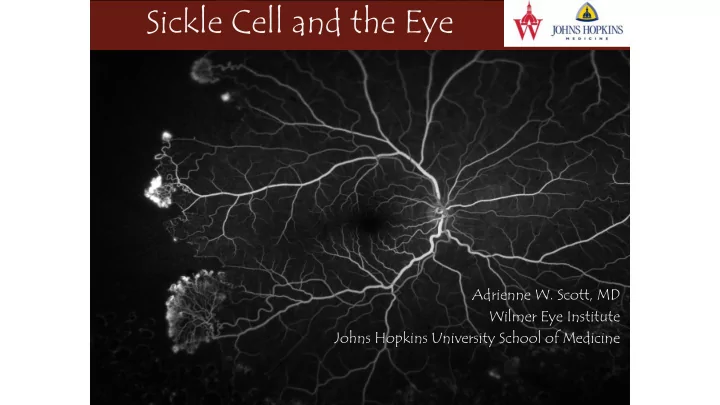
Sickle Cell and the Eye Adrienne W. Scott, MD Wilmer Eye Institute Johns Hopkins University School of Medicine
Disclosures • Allergan, Inc. (Consultant) • No financial interest in this subject matter
Sickle Cell and the Eye- Take Home Points • Sickle cell disease can affect any part of the eye • Retinopathy risk variable, depends on genotype • Male sex, older age, visual symptoms and floaters associated with retinopathy • Dilated fundus exam required at least annually beginning at age 10, younger if possible • Treatment can prevent vision loss
Orbital Involvement • Retro-orbital and Orbital Involvement – Orbital bone infarction – Orbital compression syndrome • Fever, lid edema, facial pain Schundeln et.al, Journal of Pediatrics, 2014.
Anterior Segment
Sickle Cell Retinopathy • Goldberg staging (AJO 1971) – Stage I: peripheral arteriolar occlusions – Stage II: peripheral arteriolar-venular anastomoses – Stage III: neovascular and fibrous proliferation – Stage IV: vitreous hemorrhage – Stage V: retinal detachment Top photo by Andrew R. Marks, M.D.
Non-Proliferative Sickle Cell Retinopathy
Stage 1: Peripheral arteriolar occlusions
Stage 2: Arteriolar-venular anastomoses
Stage 3: Neovascularization
Stage IV: vitreous hemorrhage
Stage IV: vitreous hemorrhage Seafans visible despite vitreous heme
Stage V: vitreous hemorrhage Combined TRD/RRD
Image Courtesy of the American Society of Retina Specialists (ASRS) image Bank
Sickle Cell Maculopathy • Numerous macular abnormalities possible • Hairpin venular loops • Microaneurysmal dots • Foveal avascular zone irregularities • Macular ischemia does not develop neovascularization • Many patients with abnormalities but no visual consequence
Multimodal Imaging in SCR
Treatments for Sickle Cell Retinopathy • Mostly observation, unless…. Stage 3 Stage 4 Stage 5
Treatments • Laser photocoagulation • Intravitreal injection of anti-vascular endothelial growth factor agents (anti-VEGF)
Post-treatment Pre-treatment Post-treatment Pre-treatment
Practical Questions • What about glasses? – Refractive error separate • Is all this retinal imaging testing necessary? – Not sure, a thorough dilated exam will pick up serious retinal pathology • So do all with SCD have retinopathy? – Probably, and will increase as they age • Is vision loss in SCD certain? – Probably not, risk is low, but subtle vision loss may be underdiagnosed • When are sickle cell retinopathy screening exams necessary? – At least annually, age 5 and older, NHLBI consensus suggests age 10 – Floaters, or vision loss, HbSC/Beta thal
Acknowledgements • Ian Han, M.D. • Sally Ong, M.D. • Marguerite Linz, B.A. • T.Y. Alvin Liu, M.D. • Morton F. Goldberg, M.D. • Hematology Department at JHU-SOM
Recommend
More recommend
Explore More Topics
Stay informed with curated content and fresh updates.