Signatures of Obscured Supermassive Black Hole Growth in High - - PowerPoint PPT Presentation

signatures of obscured supermassive black hole growth in
SMART_READER_LITE
LIVE PREVIEW

Signatures of Obscured Supermassive Black Hole Growth in High - - PowerPoint PPT Presentation

Signatures of Obscured Supermassive Black Hole Growth in High Redshift Dusty Galaxies (I ncluding SMGs ) Alexandra Pope (UMass Amherst) SMG20 Durham, UK August 2, 2017 Image credit: NASA/JPL-Caltech Why should we talk about AGN? Why


slide-1
SLIDE 1

Signatures of Obscured Supermassive Black Hole Growth in High Redshift Dusty Galaxies

Alexandra Pope (UMass Amherst) SMG20 – Durham, UK August 2, 2017

Image credit: NASA/JPL-Caltech
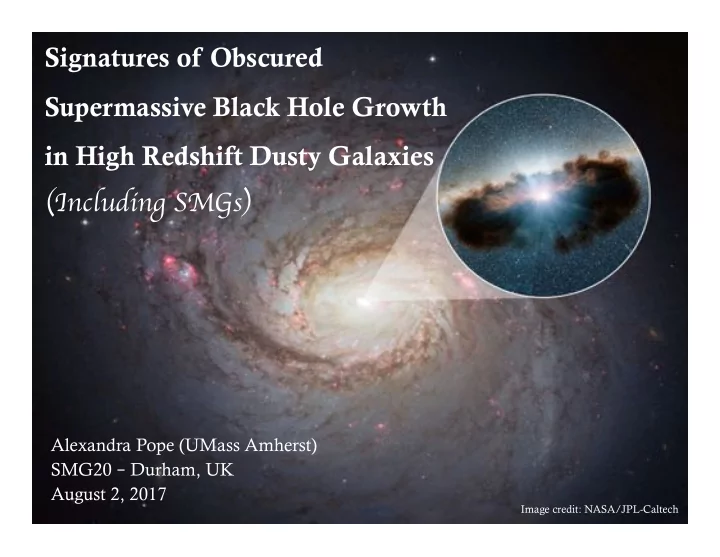
(Including SMGs)

slide-2
SLIDE 2

Why should we talk about AGN?

slide-3
SLIDE 3

Why should we talk about AGN?

Credit: K. Cordes & S. Brown (STScI)] Madau & Dickinson 2014

slide-4
SLIDE 4
  • 1. Looking for AGN in SMGs was an obvious idea

given the proposed merger scenario

Hopkins et al. 2007 Why should we talk about AGN at SMG20?

slide-5
SLIDE 5

Theories for triggering AGN

Cosmic time merger secular hot halo

Alexander & Hickox 2012

slide-6
SLIDE 6
  • 2. Looking for AGN in SMGs was an obvious idea

given the local ULIRGs

Tran et al. 2001

Log [LIR(L✺)] SB fraction

SMGs

Why should we talk about AGN at SMG20?

slide-7
SLIDE 7
  • 3. AGN were found in some of the first SMGs

A hyperluminous galaxy at z ¼ 2:8 found in a deep submillimetre survey

  • R. J. Ivison,

1 Ian Smail, 2 J.-F. Le Borgne, 3 A. W. Blain, 4 J.-P. Kneib, 3 J. Be

´zecourt,3

  • T. H. Kerr5 and J. K. Davies5
  • Mon. Not. R. Astron. Soc. 298, 583–593 (1998)

From the abstract: … The emission line widths, FWHM~1000–1500 km/s, and line ratios, along with the compact morphology and high luminosity of the galaxy, indicate that SMM 02399-0136 contains a rare dust-embedded, narrow-line

  • r type-2 active galactic nucleus (AGN) …

Why should we talk about AGN at SMG20?

slide-8
SLIDE 8

Why should we talk about AGN? Why are we not talking about AGN?

Credit: K. Cordes & S. Brown (STScI)] Madau & Dickinson 2014

slide-9
SLIDE 9

Why should we talk about AGN? Why are we not talking about AGN?

SMGs are dominated by intense star formation

(e.g. Fabian et al., 2000; Alexander et al., 2005a,b; Pope et al., 2006, 2008; Valiante et al. 2007; Menendez-Delmestre et al. 2009, Laird et al., 2010; Lutz et al., 2010; Georgantopoulos et al., 2011; Gilli et al., 2011; Hill & Shanks, 2011; Bielby et al., 2012; Johnson et al., 2013; Wang et al., 2013a,b)

Credit: K. Cordes & S. Brown (STScI)] Madau & Dickinson 2014

slide-10
SLIDE 10

SMGs may not be dominated by AGN … but AGN will still be crucial for their evolution

Image credit: NASA/MIT

Alexander & Hickox 2012

Feedback – Quenching – Triggering

slide-11
SLIDE 11

How do we observe AGN ?

Image credit: X-ray: NASA/CXC/Univ of Sydney/R.McElroy et al, Optical: ESO/CARS Survey.

  • S. Juneau et al. in prep.
  • X-ray spectra and imaging
  • Mid-IR spectra and imaging
  • Radio spectra and imaging
  • Optical spectroscopy
  • Submm/radio spectroscopy

Image credit: NASA/JPL-Caltech

slide-12
SLIDE 12

AGN in SMGs: X-ray insight

Alexander et al. 2005, 2008

slide-13
SLIDE 13

AGN in SMGs: X-ray insight

Laird et al. 2010

slide-14
SLIDE 14

Hollenbach & Tielens 1997

PAH H2 CO

Star formation heats the interstellar medium

slide-15
SLIDE 15

PAH H2 CO

Active Galactic Nuclei

Active Galactic Nuclei heat the interstellar medium

Warm dust [NeV] [OIV] Etc.

slide-16
SLIDE 16

Mid-infrared is a good tracer of AGN

Chen et al. 2017

slide-17
SLIDE 17

Mid-infrared spectral signature of AGN

10 Rest Wavelength (µm) 1 10 Normalized Flux

AGN Star-forming

[NeII] [NeV] PAHs

Local ULIRGs: Stierwalt et al. 2013

slide-18
SLIDE 18

Pope et al. 2008; Riechers et al. 2014

slide-19
SLIDE 19

Pope et al. 2008; Riechers et al. 2014

slide-20
SLIDE 20

Pope et al. 2008; Riechers et al. 2014

slide-21
SLIDE 21

Mid-IR picks up obscured AGN

Alexander et al. 2008

slide-22
SLIDE 22

Pope et al. 2008; Riechers et al. 2014

slide-23
SLIDE 23

AGN in SMGs: Mid-infrared color diagnostics

Coppin et al. 2010; see also Ivison et al. 2004; Pope et al. 2008

slide-24
SLIDE 24

What is the impact of the AGN on the full IR SED?

slide-25
SLIDE 25

Roebuck et al. (2016)

Simulations show AGN heating the ISM

The AGN can heat the ISM throughout the galaxy

slide-26
SLIDE 26

What is the impact of the AGN on the full IR SED?

Empirical SED templates based on Spitzer (IRS spectroscopy) and Herschel

  • bservations of 343 dusty

galaxies from z=0.5-4 Goal: Understand the impact

  • f the mid-IR diagnosed

AGN on the full IR SED

Kirkpatrick, Pope, et al. 2015

http://daisy.astro.umass.edu/~pope/Kirkpatrick2015/

slide-27
SLIDE 27

Kirkpatrick, Pope, et al. 2015

Observations of AGN heating the ISM

AGN fraction

slide-28
SLIDE 28

Are AGN an epidemic in dusty galaxies?

103 104 105 106 107 108 109 103 104 105 106 107 108 109 N > S (sr-2)

Papovich et al. (2004) Full counts z ~ 1 - 2 SFG Composite AGN

0.1 1.0 S24 (mJy) 0.0 0.2 0.4 0.6 0.8 Fraction > S

Kirkpatrick et al. 2017b, ApJ submitted

slide-29
SLIDE 29

What to do with AGN in dusty galaxies?

Step 1: Identify Step 2: Quantify AGN luminosity (-> Eddington ratio) Step 3: Determine impact of AGN on host galaxy ISM Step 4: Quantify black hole mass

slide-30
SLIDE 30

What to do with AGN in dusty galaxies?

Step 1: Identify Step 2: Quantify AGN luminosity (-> Eddington ratio) Step 3: Determine impact of AGN on host galaxy ISM Step 4: Quantify black hole mass

✔ ✔

Sort of Need resolved studies TBD

slide-31
SLIDE 31

Open questions

1. What is the sphere of influence of AGN within galaxies? How much does it contribute to heating the gas and dust on galaxy scales? How does this contribute to triggering or quenching the star formation? 2. How does the M-sigma relation evolve over cosmic time? How does it vary in individual galaxies over their lifetime?

SMGs/DSFGs are excellent laboratories for addressing these broad questions in galaxy evolution

slide-32
SLIDE 32

Black hole masses from mid-IR spectroscopy

Dasyra et al. 2008 Spinoglio et al. 2012

slide-33
SLIDE 33

JWST can see PAHs back to cosmic noon and AGN diagnostic lines (Ne lines) only out to z~1

slide-34
SLIDE 34

SPICA and Origins Space telescope can see the AGN diagnostic lines out to cosmic dawn

slide-35
SLIDE 35

NASA Mission concept: a Far-Infrared Surveyor for the 2020 Decadal review ~10 μm – 1000 μm, cold, large aperture ~8-15 m launch ~2030

slide-36
SLIDE 36
slide-37
SLIDE 37
slide-38
SLIDE 38
slide-39
SLIDE 39
slide-40
SLIDE 40

Summary

  • AGN may not dominate the

bolometric luminosity of dusty galaxies, but they are lurking in a significant fraction (~25%) of the population

  • We can exploit SMGs/DSFGs

to understand the coevolution

  • f star formation and

supermassive black hole growth at early times

  • JWST – SPICA – OST will be

crucial for weighing the black holes in these active systems

Image credit: NASA/JPL-Caltech