
SLIDE 1
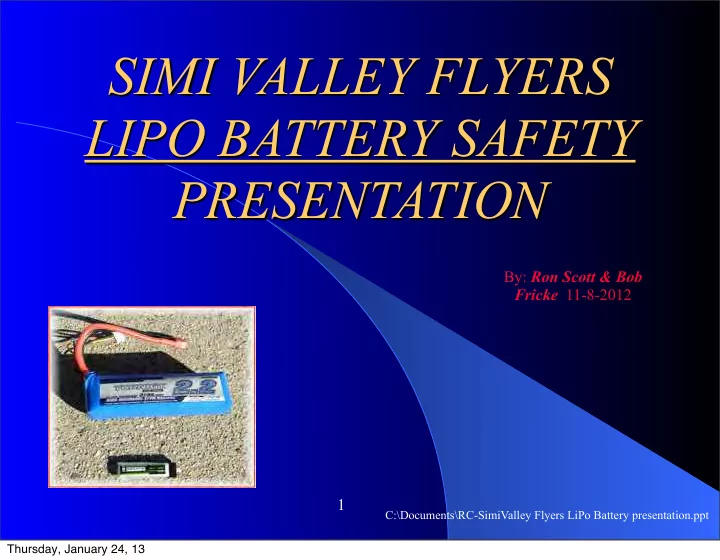
SIMI VALLEY FLYERS LIPO BATTERY SAFETY PRESENTATION
By: Ron Scott & Bob Fricke 11-8-2012
C:\Documents\RC-SimiValley Flyers LiPo Battery presentation.ppt
h
1
Thursday, January 24, 13
SIMI VALLEY FLYERS LIPO BATTERY SAFETY PRESENTATION By: Ron Scott - - PowerPoint PPT Presentation
SIMI VALLEY FLYERS LIPO BATTERY SAFETY PRESENTATION By: Ron Scott & Bob Fricke 11-8-2012 h 1 C:\Documents\RC-SimiValley Flyers LiPo Battery presentation.ppt Thursday, January 24, 13 INTRODUCTION This presentation was made to provide
By: Ron Scott & Bob Fricke 11-8-2012
C:\Documents\RC-SimiValley Flyers LiPo Battery presentation.ppt
1
Thursday, January 24, 13
2
Thursday, January 24, 13
l LiPo Batteries are being used extensively nowadays on all
kinds of models – primarily due to their energy density, compact size and relatively light weight.
l LiPo batteries are very different then NiCad and NiMh
batteries.
l LiPo batteries can cause explosions or fires if not used,
charged or stored correctly.
l Explosions or fires can cause injury to people, damage to
equipment, and environmental damage (landscape, etc).
l MOST IMPORTANT: Brush fires can spread rapidly and
cause massive damage to the hills around our field. This could result in the loss of our flying field.
3
Thursday, January 24, 13
l LiPo Battery design. l LiPo Battery characteristics. l What causes LiPo batteries to explode or catch fire. l How to properly charge LiPo batteries. l How to safely use LiPo batteries in your model. l What to do if your model catches fire on the ground before takeoff. l What to do if an aircraft crashes. l Field Safety regarding possible fires. l How to properly discard LiPo batteries l Storage of Lipo’s
4
Thursday, January 24, 13
Lithium-ion polymer batteries, polymer lithium ion, or more commonly lithium polymer batteries (abbreviated Li-poly, Li-Pol, LiPo, LIP, PLI or LiP) are rechargeable. LiPo batteries are usually composed of several identical cells in parallel to increase the discharge current capability, and are often available in series "packs" to increase the total available voltage. Each cell at full charge = 4.20 Volts. A typical 3 cell battery pack = 12.60 Volts.
Li-poly batteries are also gaining favor in the world of radio-controlled cars and large scale model trains, where the advantages of both lower weight and greatly increased run times and power delivery can be sufficient justification for the price. Radio-controlled car batteries are often protected by durable plastic cases to prevent puncture. Specially designed electronic motor speed controls are used to prevent excessive discharge and subsequent battery damage. This is achieved using a low voltage cutoff (LVC) setting that is designed to maintain cell voltage greater than 3 V (typically) per cell. 5
Typical 3 cell LiPo battery
Thursday, January 24, 13
l 4.2 V per cell (2cell=7.4 V, 3cell=12.6V, 4cell=16.8V, etc.) l Current rating is typically 1 amp (1,000 mah) to ~ 5 amp
(5,000mah) for a 1 to 5 lb. aircraft.
l “C” or Capacity is the amount of current a battery can
deliver over time.
l A standard battery pack with 3 cells and 2,200 mah at 20 C
can theoretically deliver 12.6 V at 2,200 ma (2.2 amps (1C)) for approximately 1 hour. Or 20 x 2.2 = 44 amps for a short time ~5-10 minutes depending on throttle setting.
l Always test the current draw in Amps (with a Watt/Ammeter)
combination) to assure that you are within safe limits.
6
Thursday, January 24, 13
l Being punctured as a result of a crash - i.e. the battery moves forward
and hits the motor or ESC (Electronic Speed Control).
l Overheated as a result of Hi discharge current draw. For example the
motor drawing 40 or more amps from a 30 amp capacity battery.
l Overcharged – for example, charging a 2,200 mah battery at a high
rate such as 5,000 ma and the battery is unable to handle the high
l Overheated in storage or in a car/truck at 110 degrees F or more.
7
Thursday, January 24, 13
l Don’t charge the battery in the aircraft. Charge in a safe and secure area. l Use the correct LiPo charger – with appropriate cell count and
current setting.
l Always charge in the “Balance” mode or use a Blinky balencer. l Use a protected enclosure such as a closed “non-flammable” canister,
l Charge at a 1 C (battery capacity) rate unless the battery Mfg states
8
Thursday, January 24, 13
secure and won’t be punctured if involved in a crash.
wire sizes and make good solder joints. Use shrink tubing
the maximum current draw.
if transmitter signal is lost.
9
Thursday, January 24, 13
l Move to a safe – nonflammable area if possible. l Get the fire extinguishers and put out the fire. l Disconnect and remove the battery ASAP. l If battery is bulged and hot, put in water or
10
Thursday, January 24, 13
1) Immediately throttle back to the lowest stick position and observe where the
plane went down.
2) Call out for help “AIRCRAFT DOWN - HELP” 3) Sound the Air Horn to alert all flyers to land and focus attention on the downed
aircraft.
4) Get to it as fast as possible. Bring fire extinguishers and shovels. Look for
fire or smoke.
5) Be ready to call 911and give directions to “Oak County Park” – off west Easy St. 6) If battery was ejected but not on fire, isolate it away from brush.
7) If 911 is called, someone needs to go to the front gate and give directions to the fire department. 8) Try to find out the “root cause” of the accident to prevent reoccurrence.
11
Thursday, January 24, 13
l Always put out fire extinguishers and shovels before
flying.
l Don’t fly alone. l Make sure someone has a cell phone in case of an
emergency and 911 is needed.
l Don’t fly on very windy dry days.
12
Thursday, January 24, 13
l See MIKE KANE’S PRESENTATION
titled “FIRE SAFETY 101”
l Be proactive and not complacent – we don’t want to
loose our flying field like some other fields such as the Channel Island Condors club did in July 2012.
13
Thursday, January 24, 13
l Discharge with a mild load ~ 500-600 Ma such as a 12 V
car tail light bulb(s) (#1157) shown below. This will take several hours. For more than 3 cells, use 2 bulbes in series.
l You can also immerse in salt water for several hours (~ 2
days). Mix ½ cup salt to 1 gallon water.
l After completely discharging, cut off connectors wrap
wires together and get rid of battery.
14
Thursday, January 24, 13
l
Always store cells or battery packs in a secure location where they cannot be shorted or handled by children. Use an ammunition box or fire proof container.
l
If batteries are to be stored for periods of greater than 4 weeks at a time, store in a 50% discharge state. This is irrespective of battery voltage.
l
How to get to a 50% discharge state?
and discharge to 50% of the pack capacity. For example, after you fully charge a pack, discharge the pack until 50% of the pack capacity is gone.
l
If you don't have a watt meter you can follow these general guidelines. With a fully charged pack, fly 1/2 the time you normally fly. For example, if you get 20 normal flight time, fly 10 minutes to get to "50%" discharge state.
15
Thursday, January 24, 13
l Don’t charge a hot battery pack - wait until it cools down. l Don’t use a puffed up battery - discharge and dispose of. l Don’t forget about batteries on charge – You no why. l Don’t charge batteries on a flammable surface. l Don’t discharge any cell below 3.0 V – it may not recover. l Don’t use an ESC with a current rating lower than the
maximum current draw - go 30-40% higher.
l Don’t store in a hot location - store in a safe and cool area.
16
Thursday, January 24, 13
l Aviation Incidents With Batteries - Involving Smoke, Fire, or Explosion
4 8 11 15 1994 1995 1996 1997 1998 1999 2000 2001 2002 2003 2004 2005 2006 2007 2008 2009 2010 2011 Lead Acid, Nmh, Nicd LiPo 3-D Column 3
Note: These are recent cargo and baggage incidents that the FAA is aware of . This should not be considered as a complete listing of all such incidents.
17
Thursday, January 24, 13
l “Safety Awareness” l “Links” to
18
Thursday, January 24, 13
l Have FUN and be safe
l We all hope you never have a “FIRE”. l This presentation will be posted on the
19
Thursday, January 24, 13