Simulating a New Hampshire River Ecosystem A Resource Guide - - PowerPoint PPT Presentation

simulating a new hampshire river ecosystem
SMART_READER_LITE
LIVE PREVIEW

Simulating a New Hampshire River Ecosystem A Resource Guide - - PowerPoint PPT Presentation

Simulating a New Hampshire River Ecosystem A Resource Guide Caitlin Julian Written by Caitlin Julian (2001) Revised by Judy Tumosa, NHF&G Watershed Specialist (2009) With assistance from: Dr. Joel Bader, former NHF&G Fish


slide-1
SLIDE 1

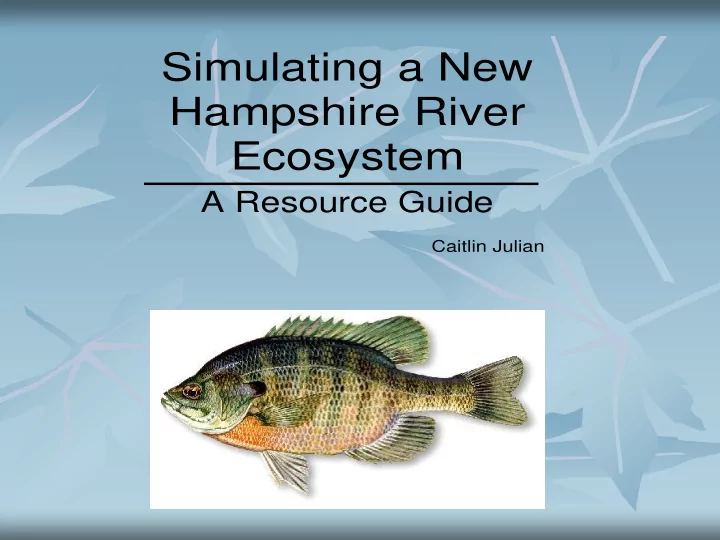
Simulating a New Hampshire River Ecosystem

A Resource Guide

Caitlin Julian
slide-2
SLIDE 2

Written by Caitlin Julian (2001) Revised by Judy Tumosa, NHF&G Watershed Specialist (2009) With assistance from:

 Dr. Joel Bader, former NHF&G Fish Pathologist  Angela Gospodarek, former Raymond Middle School  Gabe Gries, former NHF&G Fisheries Biologist  Howie Thurston, Let’s Go Fishing Instructor  Revised by Judy Tumosa, (2015)

slide-3
SLIDE 3

Purpose of a river ecosystem in the classroom

 Learn more about our warm water fish species

ecology and management in NH

 Learn how fish species interact & behave with

their surrounding environment

 Learn how fish species interact & behave with

each other

slide-4
SLIDE 4

Lotic or flowing environment for fluvial dependent species

 Water Circulation System for “natural” current

Ponded environment for macrohabitat generalist species

 Water Circulation System for “natural” current

not needed – design tank more like a pond

slide-5
SLIDE 5

Build a Water Circulation System

slide-6
SLIDE 6
slide-7
SLIDE 7
slide-8
SLIDE 8

Provide enough space – 50 gallons

minimum

slide-9
SLIDE 9

Provide “Natural” Substrate

slide-10
SLIDE 10
slide-11
SLIDE 11

Provide Cover

slide-12
SLIDE 12

Native or fake plants

slide-13
SLIDE 13

Provide Healthy Water

River water Well or town water – no chlorine

slide-14
SLIDE 14

Tank set up

Set up for 6-10 days before fish arrive Make the filter the correct size for tank

slide-15
SLIDE 15

Now we add the fish

slide-16
SLIDE 16

SCIENTIFIC LICENSE APPLICATION TO KEEP WARM WATER FISH IN THE CLASSROOM

Note: Only warm water fish species and minnows may be kept (no salmon or trout). Date School Year Teacher name Teacher email School name, address & telephone number Date of collection Collection sites, i.e. specific name of river or pond Method of collection Subpermittees Has attended/will attend training Return to: Judy Tumosa Watershed Education Specialist New Hampshire Fish and Game Department 11 Hazen Drive Concord, NH 03301 #603-271-0456 FAX #603-271-0465 judy.l.tumosa@wildlife.nh.gov

slide-17
SLIDE 17

The fish and its habitat needs http://www.wildlife.state.nh.us/fishing/species.html

slide-18
SLIDE 18

Current NH Warmwater Species

  • Largemouth bass
  • Smallmouth bass
  • Walleye
  • Northern Pike
  • Chain Pickerel
  • Black Crappie
  • Bluegill
  • Pumpkinseed
  • Yellow Perch
  • Brown Bullhead (hornpout)
slide-19
SLIDE 19

Native NH warmwater Species

  • Largemouth bass
  • Smallmouth bass
  • Walleye
  • Northern Pike
  • Chain Pickerel
  • Black Crappie
  • Bluegill
  • Pumpkinseed
  • Yellow Perch
  • Brown Bullhead (hornpout)
slide-20
SLIDE 20

Coexistence – i.e. Who Eats Whom

slide-21
SLIDE 21

How to Collect

 Electrofishing  Netting  Seining  Angling  Bait trap

slide-22
SLIDE 22

What do you Feed Them?

 Other Fish (such as goldfish)  Macroinvertebrates  Blood Worms  Worms  Brine Shrimp

slide-23
SLIDE 23

How to Maintain the Tank

slide-24
SLIDE 24

What do you do with your fish at the end of the year?

 If they are disease free, put them back where

you collected them

 If they show signs of disease, dispose of them

humanely

slide-25
SLIDE 25

Why Manage Warmwater Species?

slide-26
SLIDE 26

=

  • 0 vs. 1,000,000
  • Natural reproduction typically able to

replenish populations

  • Spawning habitat generally intact
  • Warmwater fish relatively prolific
  • Wise management important
slide-27
SLIDE 27

How Objectives Are Met

  • Boat electrofishing + angler surveys
  • Age and growth
  • Warmwater database
  • Habitat restoration/improvement
  • Bass tournaments: permitting, data

collection and data analysis

  • Special studies: Bass tagging on Winni
slide-28
SLIDE 28
slide-29
SLIDE 29

Habitat Restoration/Improvement

slide-30
SLIDE 30

Panfish. Fish fry!

slide-31
SLIDE 31

 Federally funded  State match = teachers and volunteers who

provide watershed education in their classrooms

 Watershed Education Program (WEP)  Watershed Ecology Institute (WEI)  Let’s go Fishing (LGF)

Aquatic Resources Education (ARE) Program

slide-32
SLIDE 32

Water Quality Monitoring

 Analyze Water quality

 Compare watershed-wide data

slide-33
SLIDE 33

Water Quality Monitoring cont.

 Identify macroinvertebrates

slide-34
SLIDE 34

Aquatic Resource Management

 Study in stream features  Conduct fisheries studies

slide-35
SLIDE 35

Warm and Cold Water Tanks

slide-36
SLIDE 36

Watershed Mapping

&

Land Use Assessment

 Obtain GIS watershed data

 Share data with local and state organizations  Identify resource concerns

slide-37
SLIDE 37
slide-38
SLIDE 38
slide-39
SLIDE 39

Citizen Science Definition

From: Cornell Laboratory of Ornithology Citizen Science Central “Projects in which volunteers partner with scientists to answer real world questions.”

slide-40
SLIDE 40

NGSS Connections

See Section 9 of the

“NH F&G Department Watershed Education Program Teacher Manual”

slide-41
SLIDE 41

Partners are essential to the mission:

 Schools, teachers, students statewide  Volunteers (TU, LGF, WEP, WEI)  UNH, PSU, Keene State, SNHU, EPSCoR, NHGA  Watershed Associations, River LAC’s, GMCG,

conservation commissions

 Fisheries biologists, hatchery staff, educators at

NHF&G

slide-42
SLIDE 42

Goal accomplished: A good day on the river…

slide-43
SLIDE 43

So if you are interested in a river ecosystem in your classroom:

 Contact Watershed Education Specialist Judy Tumosa

at NHF&G:

 judy.l.tumosa@wildlife.nh.gov, #603-271-0456  Fill out registration form to collect and keep fish  Attend warmwater fisheries workshop and obtain

“Simulating a NH River Ecosystem” manual

 Have lots of “FIN”