
SLIDE 1
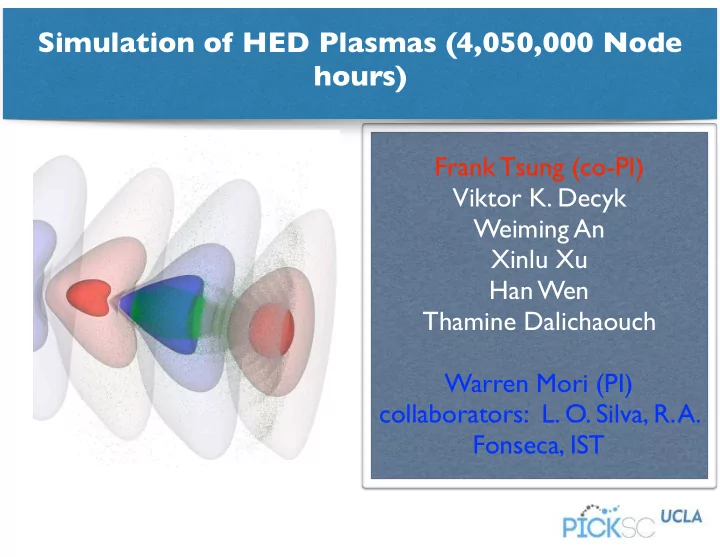
Frank Tsung (co-PI) Viktor K. Decyk Weiming An Xinlu Xu Han Wen Thamine Dalichaouch Warren Mori (PI) collaborators: L. O. Silva, R. A. Fonseca, IST
Simulation of HED Plasmas (4,050,000 Node hours)
Simulation of HED Plasmas (4,050,000 Node hours) Frank Tsung - - PowerPoint PPT Presentation
Simulation of HED Plasmas (4,050,000 Node hours) Frank Tsung (co-PI) Viktor K. Decyk Weiming An Xinlu Xu Han Wen Thamine Dalichaouch Warren Mori (PI) collaborators: L. O. Silva, R. A. Fonseca, IST Summary and Outline OUTLINE/SUMMARY
Frank Tsung (co-PI) Viktor K. Decyk Weiming An Xinlu Xu Han Wen Thamine Dalichaouch Warren Mori (PI) collaborators: L. O. Silva, R. A. Fonseca, IST
Simulation of HED Plasmas (4,050,000 Node hours)
OUTLINE/SUMMARY
· Overview of the project · HED plasmas and the importance of kinetic effects · Particle-in-cell method · Our main production code — OSIRIS · Application of OSIRIS to plasma based accelerators: · Producing high brightness x-ray using LWFA’s. · Performing high resolution LWFA simulations in quasi-3D. · QuickPIC Simulations of PWFA’s. · Higher (2 & 3) dimension simulations of LPI’s relevant to laser fusion · Importance of 2D and 3D effects in IFE. · Controlling LPI’s by temporal incoherence under IFE relevant conditions . · Code development — porting our codes to the Intel Phi (@ Cori supercomputer @ NERSC), and using deep learning for HED physics. · Summary/Conclusions
code features · Scalability to ~ 1.6 M cores (on sequoia). · SIMD hardware optimized · Parallel I/O · Dynamic Load Balancing · QED module · Particle merging · OpenMP/MPI/vector parallelism · CUDA branch/Intel Phi support
· Massivelly Parallel, Fully Relativistic Particle-in-Cell (PIC) Code · Visualization and Data Analysis Infrastructure · Developed by the osiris.consortium ⇒ UCLA + IST Ricardo Fonseca: ricardo.fonseca@tecnico.ulisboa.pt Frank Tsung: tsung@physics.ucla.edu http://epp.tecnico.ulisboa.pt/ http://plasmasim.physics.ucla.edu/
3.0
Laser Wake Field Accelerator(LWFA, SMLWFA) A single short-pulse of photons Plasma Wake Field Accelerator(PWFA) A high energy electron bunch
Livingston Curve for Accelerators --- Why plasmas?
Drive beam
Trailing beam
The Livingston curve traces the history
Lawrence’s cyclotron to present day technology. Currently plasma based accelerator can match conventional accelerators in terms of energy with much shorter
experiment at SLAC showed energy doubling using 1 meter of plasma. The goals of our research is no longer to match conventional accelerators in terms of energy, but in terms of quality as well.
X-ray FEL — Coherent light source at Angstrom scale — Can we make compact radiation sources for nuclear science? Using Plasmas?
One application of convention accelerator is a light source. The SLAC accelerator is now a light source called LCLS. In an X-ray FEL (XFEL), a “coherent” electron beam enters an undulator and a bright x-ray comes out, the electron beam can be diverted via an magnet (see right). The need for XFEL’s light sources can be justified by looking at the light sources in terms
coherence of the photon beam (or roughly the # of photons per volume). Improving the brilliance of the beam means the laser light is tightly focused in a small spot, with a very short time duration. This allows the light source to capture very fast phenomenon in a very focused region to study chemical or biological behaviors on a very short (usually femto-second) timescale. Compared to synchrotron sources, LCLS, which began in 2009, represents a 9 order of magnitude jump in brightness compared to synchrotrons. XFEL’s for the first time allow us to probe materials on the nuclear (Angstrom) length scale with femto-second
which cannot resolve effects on the the nuclear length scale Using PIC simulations, we are trying to study ways to generate high qualities electron beams with high energy and high quality to produce 20keV (0.62 Angstrom wavelength) lights comparable to those generated at LCLS. The beam parameters in LCLS is:
γbeam = 32, 000 = 16GeV
peak current density energy spread
Last year we demonstrated the possibility
the energy of the witness bunch and produce x-ray comparable to those @ LCLS. This year we use our numerical tools to study the possibility of generating coherent x-ray using LWFA’s in the self- injected regime, where the electrons resonates with the plasma wave near the speed of light. 3D simulations have demonstrated a technique to generate high quality electron beams without an external injector. (This means that these experiments can be performed without an accelerator) This work was published in late 2017.
witness beam
2017 2018
Introduction – Downramp Injection (X. Xu, PRSTAB, 20, 111303 (2017))
studied the injection process using 1D analysis.
Suk, et al., Phys. Rev. Lett. 86, 1011 (2001);
np,h [cm-3] np0 [cm-3] Lramp [mm] Lacc [mm] Initial T [eV] Plasma 1.5e18 1e18 1.33 (250 c/ωp0) 3.3 10
B~4e18 A/m2/rad2
Simulation Parameters:
this case)
Laser Plasma Interactions
NIF National Ignition Facility
IFE (inertial fusion energy) uses lasers to compress fusion pellets to fusion conditions. Inside the fusion chamber (hohlraum), the laser can excite plasma waves and undergo LPI (laser plasma interaction). In this case, the excitation of plasma waves via LPI is detrimental to the experiment in 2 ways. Laser light can be scattered backward toward the source and cannot reach the target LPI produces hot electrons which heats the target, making it harder to compress. The LPI problem is very challenging because it spans many orders of magnitude in lengthscale & lengthscale The spatial scale spans from < 1 micron (which is the laser wavelength) to milli-meters (which is the length of the plasma). The temporal scale spans from a femto- second(which is the laser period) to nano-seconds (which is the duration of the fusion pulse). A typical PIC simulation spans ~10ps. Lengthscales
speckle width 1μm Inner Beam Path (>1mm)
laser wavelength (350nm)10μm speckle length 100μm 1mm
Timescales
LPI growth time 1fs 1ps 1ns NIF pulse (20ns) Final laser spike (1ns)
non-linear interactions (wave/wave, wave particle, and multiple speckles) ~10psLaser period (1fs)
We have simulated stimulated Raman scattering in multi-speckle scenarios (in 2D)
NIF “Quad”
the direction of laser propagation). The SRS problem in IFE is not strictly 1D -- each “beam” (right) is made up of 4 lasers, called a NIF “quad,” and each laser is not a plane wave but contains “speckles,” each one a few microns in diameter. These hotspots are problematic because you can have situations where according to linear theory, the “averaged” laser is LPI unstable
by adding colors near the carrier frequency). And the LPI’s in these hotspots can trigger activities elsewhere. The multi-speckle problem are inherently 2D and even 3D.
in under-threshold speckles via: – “seeding” from backscatter light from neighboring speckles – “seeding” from plasma wave seeds from a neighboring speckle. – “inflation” where hot electrons from a neighboring speckle flatten the distribution function and reduce plasma wave damping.
speckles into the code OSIRIS. 2D OSIRIS simulations show, that given enough temporal bandwidth, LPI’s relevant to IFE (both SRS and HFHI) can be reduced.
Focusing without smoothing Focusing with phase scrambler Focusing with phase scrambler and smoothing by spectral dispersion (SSD) Smooth seed beam Laser amplifier chain Laser amplifier chain Laser amplifier chain SSD Phase corrector Distorted beam Distorted beam Distorted beam Smooth seed beam Smooth seed beam
11
Large scale 2D simulations of SRS with bandwidth (Dr. Han Wen, prepared for publication)
Linear background density Immobile ions Reflectivities
1D RPP (f=8) ISI (1THz) ISI (6THz)
I14 = 5 13% 15% 7% 3%
Over the past 2 years, we have performed a large number of 2D simulations, ranging from 120 microns to 750 microns long, which is roughly ½ of the total length of the NIF inner beam. In the past year, we have begun performing simulations with the largest 2D box to date. Typical width of the simulation box is 80 microns, which covers ~28 laser speckles and the typical length is 750 microns (which is > 1/2 of the inner beam path in NIF). Simulations of this scale takes 3-5 million core hours each.
Simulation Parameters:
OSIRIS Simulations of multi-speckle LPI with realistic beam smoothing:
ISI (1THz) RPP
longitudinal e-field transverse e-field slope fe(v) near the phase velocity
ISI (6THz)
Reflectivities
1D RPP (f=8) ISI (1THz) ISI (6THz)
I14 = 5 13% 15% 7% 3%
PIC simulations of 3D LPI’s is still a challenge, and requires exa-scale supercomputers, this will require code developments in both new numerical methods and new codes for new hardwares
2D multi- speckle along NIF beam path 3D, 1 speckles 3D, multi- speckle along NIF beam path Speckle scale 50 x 8 1 x 1 x 1 10 x 10 x 5 Size (microns) 150 x 1500 9 x 9 x 120 28 x 28 x 900 Grids 9,000 x 134,000 500 x 500 x 11,000 1,700 x 1,700 x 80,000 Particles 300 billion 300 billion 22 trillion Steps 470,000 (15 ps) 540,000 (5 ps) 540,000 (15 ps) Memory Usage* 7 TB 6 TB 1.6 PB CPU-Hours
5-10 million 10-15 million
1 billion (2 months on the full Blue Waters supercomputer)
(7 x 7 speckle pattern in 3D produced by OSIRIS)
On the GPU (and multi-cores), we apply a local domain decomposition scheme based on the concept of tiles. Particles ordered by tiles, varying from 2 x 2 to 16 x 16 grid points (typical tile size is 16 x 16 in 2D and 8 x 8 x 8 in 3D) On Fermi M2090:
and particles located in that tile We created a new data structure for particles, partitioned among threads blocks (i.e., particles are sorted according to its tile id, and there is a local domain decomposition within the GPU), within the tile the grid and the particle data are aligned and the loops can be easily parallelized. We created a new data structure for particles, partitioned among threads blocks: dimension part(npmax,idimp,num_blocks)
Designing New Particle-in-Cell (PIC) Algorithms on GPU’s
Evaluating New Particle-in-Cell (PIC) Algorithms on GPU: Electromagnetic Case 2-1/2D EM Benchmark with 2048x2048 grid, 150,994,944 particles, 36 particles/cell
GPU algorithm also implemented in OpenMP
Hot Plasma results with dt = 0.04, c/vth = 10, relativistic CPU:Intel i7 GPU:Fermi M2090 OpenMP(12 CPUs) Push 66.5 ns. 0.426 ns. 5.645 ns. Deposit 36.7 ns. 0.918 ns. 3.362 ns. Reorder 0.4 ns. 0.698 ns. 0.056 ns. Total Particle 103.6 ns. 2.042 ns. 9.062 ns (11.4x speedup). The time reported is per particle/time step. The total particle speedup on the Fermi M2090 was 51x compared to 1 Intel i7 core. The OpenMP version has been extended to take advantage of of the vector units on the Intel
depends on the particular version of Phi that you are running) and the particles are vectorized automatically by the Intel compiler.
Codes that are described here are available at the UCLA PICKSC web-site http://picksc.idre.ucla.edu/
OSIRIS on Intel Phi (Cori supercomputer @ NERSC)
process, particle tasks are vectorized using KNL vector intrinsics. On the Cori supercomputer @ NERSC (1 KNL unit per node, 68 cores per node and 512-bit vector units per core) OSIRIS achieved a speed of nearly 1 billion particles per second on a SINGLE Cori node. (A new version of OSIRIS that incorporates tiling (using OpenMP) is under developed.) Our skeleton code UPIC has 3 levels of parallelism using MPI + Tiles (OpenMP) + automatic vectorization (via Intel compiler) achieved similar numbers, and it is available on the PICKSC website (PICKSC -> Software -> Skeleton Codes -> OpenMP/Vectorization).
excellent (> 90%) strong scaling on nearly the entire machine (8,000 nodes, > 500,000 MPI processes).
500,000 nodes (roughly 50 times the size of Cori). We have applied to be one of 20 teams to use the Aurora supercomputer for 3 months in 2021. This allocation is equivalent to close to one full year of allocation on a current supercomputer and will allow us to model LPI in full 3D.
important and use ML to trigger kinetic simulations in 3D on future exa-scale supercomputers.
Processing # Strong Efficiency Weak Efficiency
1000 100% 100% 2744 95.3% >99% 4096 95.2% >99% 8000 90.3% >99%
longitudinal density-tailored plasma-based accelerator in the three-dimensional blowout regime”, Phys. Rev. Accel. Beams 20, 111303, 2017 "Kinetic Simulations of Reducing Stimulated Raman Scattering with Laser Bandwidth in Inertial Confinement Fusion", H. Wen, F. S. Tsung, B. J. Winjum, A. S. Joglekar, W. B. Mori, To be submitted.
Najafabadi, B. O’shea, Xinlu Xu, G. White and V. Yakimenko, "Plasma wakefield acceleration experiments at FACET II", Plasma Phys.
Weiming An, Wei Lu, Chengkun Huang, Mark Hogan, Chan Joshi, Warren Mori, "Ion motion induced emittance growth of matched electron beams in plasma wakefields", Phys. Rev. Lett. 118, 244801 (2017).
“Petascale kinetic simulations of laser plasma interactions relevant to inertial fusion — controlling laser plasma interactions with laser bandwidth”, The 3rd International Conference on Matter and Radiation at Extremes, Qingdao, China, May 2018
“Particle-in-Cell Simulations of Laser Plasma Interactions in Multiple Speckles with Temporal Bandwidth”, Wen, H., Winjum, B., Tsung, F., et al., 2017, APS Meeting Abstracts, BP11.131 “Recent progress in simulation and theory toward using nonlinear plasma wakefields to drive a compact X-FEL”, Xinlu Xu, Wei Lu, Chan Joshi, W. B. Mori, American Physical Society (APS), Division of Plasma Physics (DPP) conference, Milwaukee, WI, October 23 - 31st, 2017. (Talk) Thamine Dalichaouch, Xinlu Xu, Asher Davidson, Peicheng Yu, Weiming An, Chan Joshi, Chaojie Zhang, Warren Mori, "Generating high brightness electron beams using density downramp injection in nonlinear plasma wakefields," American Physical Society (APS), Division of Plasma Physics (DPP) conference, Milwaukee, WI, October 23 - 31st, 2017. (Talk) Thamine Dalichaouch, Asher Davidson, Xinlu Xu, Peicheng Yu, Weiming An, Chan Joshi, Chaojie Zhang, Warren B. Mori, "Generating high brightness electron beams using density downramp injection in nonlinear plasma wakefields," Anomalous Absorption (AA), Florence, OR, June 11th - 16th, 2017. (Poster)