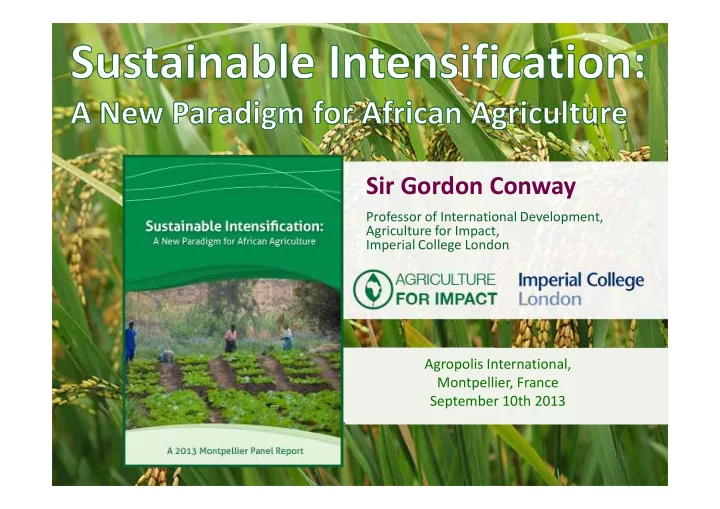
SLIDE 1 Sir Gordon Conway
Professor of International Development, Agriculture for Impact, Imperial College London
Agropolis International, Montpellier, France September 10th 2013
SLIDE 2
SLIDE 3 We Face 3 Interconnected Challenges
- Increasing food prices and recurring food
price spikes
- About 1 billion people (1 in 6 of the world’s
population) are chronically hungry population) are chronically hungry
- We have to increase food production by 60-
100% by 2050
SLIDE 4
IMF Food Prices
SLIDE 5 1 in 3 children under 5 are malnourished – 180 million children globally
- They are underheight and suffer from stunted
development and possible blindness and death
- Stunting linked to over 3.5 m deaths of under fives
SLIDE 6 Challenges to feeding the world by 2050 Demand
- Population Growth
- Changing Diets
Supply
fertiliser prices
- Changing Diets
- Biofuel Demand
- Climate change
- Land and water
scarcity
SLIDE 7 Rise in Meat Consumption
- Source: World Bank, 2010.
World Development Indicators
SLIDE 8
World Fertiliser Prices
SLIDE 9 Changing Climate in Africa
- More than 5% reduction in
length of growing period
Temp > 30 C
Source: Ericksen et al Mapping hotspots of climate change and food insecurity in the global tropics
SLIDE 10
Arable land is in short supply
SLIDE 11
We have to intensify
SLIDE 12
A single mother farming a hillside farming a hillside in western Kenya
SLIDE 13
2 3 Weeds Weeds Pests & Pests & Diseases Diseases Drought Drought Insecure Farm
Survival line
Months
1
2 3 1 4
SLIDE 14
2 3
Weeds Weeds Pests & Pests & diseases diseases Drought Drought
A Secure Farm
Soil Fertility >2 t/ha Resilient Crops
Survival line
Months
1
2 3 1 4 Actual harvest Resilient Crops
SLIDE 15 Sustainable Intensification
- There is not much more new arable land
available and water is scarce
- We have to intensify: “More with Less”
- Greater productivity but minimised
environmental footprint
SLIDE 16 Sustainable Intensification
- Increased production, income, nutrition
- On the same amount, or less, of land and water
- With efficient and prudent use of inputs
- Minimising emissions of Greenhouse Gases
- While increasing natural capital & environmental services
- Strengthening resilience
- Reducing environmental impact
SLIDE 17
A Model of Sustainable Intensification
SLIDE 18 Relevance of Sustainable Intensification
- Developed Countries
- Emerging Countries
- Least developed countries
- All technologies as appropriate:
- All technologies as appropriate:
- Traditional
- Intermediate
- Conventional
- New platform
SLIDE 19 Precision Farming (UK) GPS Soil Sampling Phosphorus Deficiency
http://www.willingtoncropservices.co.uk/
Harper Adams University
SLIDE 20
Precision Farming (Africa)
Microdosing in Niger
SLIDE 21
!""
SLIDE 22 Multiple Dimensions for Innovation
- Focussing on multiple benefits
- Engagement with multiple partners
- Utilisation of multiple approaches
- Working on multiple scales
SLIDE 23
Multiple Benefits
SLIDE 24 Key Partners in Agricultural Innovation
- International Agricultural Research Centres
- National Agricultural Research Systems
- Universities
- Universities
- Private sector
- NGOs
- Farmers
SLIDE 25 Multiple Approaches
- Agro-ecology
- Genetics
- Genetics
- Socio-economics
SLIDE 26 Ecological Intensification
- Use ecological principles
to design agricultural practices, such as:
- Agroforestry
- Agroforestry
- Integrated Pest
Management
SLIDE 27
2-4 tonnes C /ha
SLIDE 28 No-Till Agriculture in the UK (Thurlby Grange in Lincolnshire) Benefits:
- 8.75 to 10 ton/ha wheat
- Crop establishment cost
£245- £36/ ha
http://www.taa.org.uk/assets/pubs/Tony%20Reynolds%20v2%20Landwards%20Paper.pdf
£245- £36/ ha
- Fuel use 96 to 43 l/ha
- No wind erosion
- No moisture stress
- Elimination of black grass
SLIDE 29
Conservation Farming in Zambia
SLIDE 30 Genetic Intensification - Modern Plant Breeding
- Plants more nutritious:
- carbohydrate and protein
- micronutrients (Vit A, iron, zinc)
- Plants more resilient to:
- pests and diseases
- pests and diseases
- climate change
- Plants more efficient at:
- converting sunlight to food
- taking up nitrogen from the atmosphere
- using water
SLIDE 31 Nutritive Foods
#$ "
SLIDE 32
The New Rices for Africa (NERICAs)
'(
SLIDE 33
A Field in Uganda
SLIDE 34
Hybrid Maize in Ethiopia
SLIDE 35 Chaperone Genes for Drought Tolerance
- Genes from Bacterial RNA that
help to repair misfolded proteins resulting from stress
- Plants rapidly recover
- Plants rapidly recover
- No yield penalty when stress
free
SLIDE 36 Bananas Resistant to Wilt in Uganda
- $500 million losses a year in
Uganda
sweet pepper gene sweet pepper gene
- Successfully transferred to
bananas
- In Ugandan field trials
- Entirely government funded
SLIDE 37
Socio-economic intensification Markets
SLIDE 39
Input Markets
SLIDE 40 Certified Seed
+
SLIDE 41
Ethiopian Commodity Exchange
SLIDE 42 Multiple Scales
- Region – Intra-regional trade
- Country – Ethiopian Commodity Exchange
- Landscape – Watershed planning
- District – Farmer Field Schools
- Community – Cooperative marketing
- Farm – Zai
SLIDE 43 Zai pits in Burkina Faso
http://ffa.kenyafoodsecurity.org/index.php?option=com_content&view=article&id=92:soil-bund- fanya-chini-&catid=25:the-project&Itemid=154
SLIDE 44 Cooperative marketing
SLIDE 45
Farmer Field Schools
SLIDE 46
Sustainable Landscapes
Ethiopia Sussex, UK
SLIDE 47 Promoting Intraregional Food Trade
London Evening Post
SLIDE 48 Key Drivers of Going to Scale ?
- Farmer Associations
- Markets
- Markets
- ICT
SLIDE 49 An Agenda for Innovation
- We believe that Innovation for Sustainable Intensification
is going to be essential if food security is to be achieved in Africa.
- The culture and institutions for innovation in Africa -
what changes are needed?
- What policies do we need to support innovation?
SLIDE 50 An Agenda for Innovation
- Which sources of innovation are the most likely to deliver
multiple benefits including resilience and sustainability?
- Is building multiple benefits on the basis of an initial
innovation the best way to proceed?
- If we reduce costly and damaging inputs how do we
- If we reduce costly and damaging inputs how do we
increase yields?
- Can we build in resilience without having to wait for
innovations to break down?
- Some innovations may also increase natural capital or
reduce greenhouse gas emissions but often this is serendipitous.
SLIDE 51 An Agenda for Innovation
- Farmers are great innovators - how can their innovations
be brought to scale, to the community, district, nation and the world?
- Going to scale involves an appropriate enabling
environment and the participation of many stakeholders. environment and the participation of many stakeholders.
- Finally we need to engage in a participatory learning
agenda involving African and donor governments, the private sector , NGOs and farmers themselves.
SLIDE 52 """,-),
""","",
$%&""!