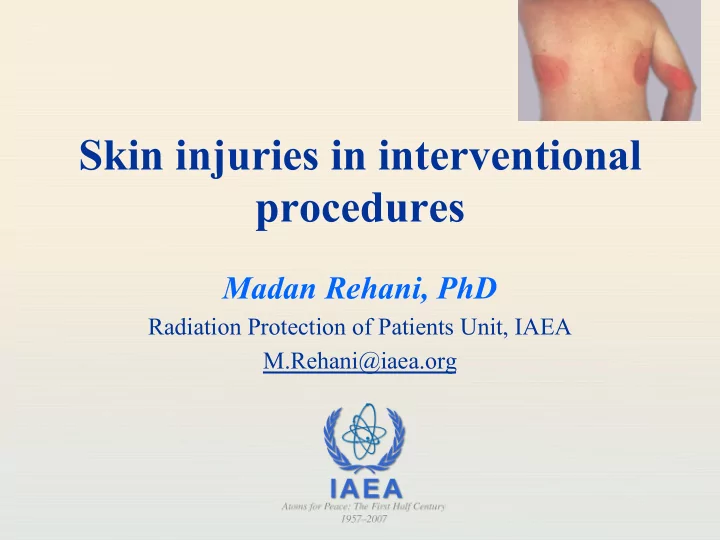
Skin injuries in interventional procedures Madan Rehani, PhD - - PowerPoint PPT Presentation

skin injuries in interventional procedures
SMART_READER_LITE
LIVE PREVIEW

Skin injuries in interventional procedures Madan Rehani, PhD - - PowerPoint PPT Presentation

Skin injuries in interventional procedures Madan Rehani, PhD Radiation Protection of Patients Unit, IAEA M.Rehani@iaea.org Skin injury Although called skin injury severe injuries can extend upto subcutaneous fat and muscle Epidermis


slide-1
SLIDE 1

Skin injuries in interventional procedures

Madan Rehani, PhD

Radiation Protection of Patients Unit, IAEA M.Rehani@iaea.org

slide-2
SLIDE 2

2

Skin injury

  • Although called skin injury

severe injuries can extend upto subcutaneous fat and muscle

  • Epidermis
  • Dermis
  • Subcutaneous tissue
slide-3
SLIDE 3

3

Radiology,Vol 254: Number 2.February 2010

slide-4
SLIDE 4

4

slide-5
SLIDE 5

5

Factors that affect skin injury

  • Radiation dose
  • Interval between irradiation (dose

fractionation)

  • Size of skin area irradiated
  • Biological factors
slide-6
SLIDE 6

6

Effect Single dose Threshold (Gy) Onset Early transient erythema 2 Hours Main Erythema 6 ~10 d Temporary hair loss 3 ~3 wk Permanent hair loss 7 ~3 wk Dry desquamation 14 ~4 wk Moist desquamation 18 ~4 wk Secondary ulceration 24 >6 wk Late erythema 15 ~6 – 10 wk Ischemic dermal necrosis 18 >10 wk Dermal atrophy (1st phase) 10 >14 wk Dermal atrophy (2nd phase) 10 >1 yr Induration (Invasive Fibrosis) 10 Telangiectasia 10 >1 yr Late dermal necrosis >12? >1 yr Skin cancer not known >5 yr

Recognizing radiation injury and effects

Characteristics of radiation injury

slide-7
SLIDE 7

7

slide-8
SLIDE 8

8

Single delivery radiation dose to skin of neck, torso, pelvic, buttocks or arms, NOT scalp Band Single-site acute skin-dose (Gy) NCI Skin reaction grade A1 0-2 NA A2 2-5 1 B 5-10 1-2 C 10-15 2-3 D >15 3-4

Doses are NOT rigid boundaries Skin dosimetry is unlikely to be more accurate than ±50%

slide-9
SLIDE 9

9

slide-10
SLIDE 10

10

slide-11
SLIDE 11

11

NCI Skin toxicity

  • Grade 1: faint to moderate erythema
  • Grade 2: moderate to brisk erythema; patchy

moist desquamation, mostly confined to skin folds and creases; and moderate edema

  • Grade 3: moist desquamation in areas other than

skin folds and creases

  • Grade 4: Skin necrosis or ulceration of full-

thickness dermis and spontaneous bleeding from involved site

slide-12
SLIDE 12

12

Factors that affect skin injury

  • Radiation dose
  • Interval between irradiation (dose

fractionation)

  • Size of skin area irradiated
  • Biological factors
slide-13
SLIDE 13

13

Exposure in multiple sessions

  • If there is no overlap of entrance beam from

different exposure, each session can be considered separate

  • A conservative approach to multiple radiation

exposure of the same portion is to assume that there is no repair of sublethal DNA damage

  • Resulting over estimate- safety margin
slide-14
SLIDE 14

14

Exposure in multiple sessions

  • If the second procedure is likely to irradiate

same part of the skin:

  • Increase time between two exposures
  • Examine skin before starting the procedure
  • Previously irradiated skin often looks normal,

but reacts abnormally when exposed to another insult

slide-15
SLIDE 15

15

Balter et al. Radiology2010, 254, 326-341

slide-16
SLIDE 16

16

Factors that affect skin injury

  • Radiation dose
  • Interval between irradiation (dose

fractionation)

  • Size of skin area irradiated
  • Biological factors
slide-17
SLIDE 17

17

Size of irradiated area

  • E.g. in RT mostly small

fields

  • If small area is irradiated:

Will heal quickly, cell migration from neighboring skin

  • Same reaction from same

dose in large field will not heal quickly

slide-18
SLIDE 18

18

Well-defined single dose clinical dose-response curves are not available for IR

Most data is from orthovoltage therapy and in pigs

slide-19
SLIDE 19

19

Factors that affect skin injury

  • Radiation dose
  • Interval between irradiation (dose

fractionation)

  • Size of skin area irradiated
  • Biological factors
slide-20
SLIDE 20

20

Biological Factors that influence skin reaction

  • Patient related factors: Smoking, poor nutritional

status, compromised skin integrity, obesity,

  • verlapping skin folds,
  • Location of irradiated skin (anterior neck most

sensitive, Less sensitive: flexor surface of extremities, trunk, back, nap of neck, scalp…in that

  • rder
  • Scalp is relatively resistant, but hair epilation in scalp
  • ccurs at lower doses as compared to hair at other

parts

  • Individual with light colored skin are most sensitive
slide-21
SLIDE 21

21

slide-22
SLIDE 22

22

  • Effective dose
  • Organ dose
  • Machine output- exposure rate: Not really
  • Fluoroscopy time

2 4 6 8 10 12 14 50 100 150 200 250 300 350 400 450 Fluoroscopy Time (min) Cumulative Dose (Gy)

Fluoroscopy Time (min) Cumulative Dose (Gy)

slide-23
SLIDE 23

23

Fluoroscopic Time (FT)

  • Tables: Column indicating FT needed to cause

radiation effect

  • This can be misleading & dangerous
  • FT is an extremely poor indicator of risk of

skin injury

  • FT should not be relied upon as sole dose

metric for complex procedures

  • It should be used with these understandings
slide-24
SLIDE 24

24

TLD grid

 80 LiF TLD’s  Attached to polyethylene carrier

n 8 x 10 chip matrix n 4 cm x 4 cm grid spacing

 Provide control TLD’s

slide-25
SLIDE 25

25

Methods using slow film

From MARTIR EC training programme (pub no. 199) www.europa.eu.int/comm/environment/radprot/#news

slide-26
SLIDE 26

26

Radiochromic detectors

RADIOCHROMIC FILMS:

  • Gafchromic XR Type R, usefull

dose range: 0.1-15 Gy

  • Minimal dependence on photon

energy (60 - 120 keV)

  • Acquisition: b/w, 12 bit/pixel

image (with a flatbed scanner)

slide-27
SLIDE 27

27

Peak skin dose

Example of dose distribution in a Coronary angiography procedure shown on a radiochromic film √

BUT

  • Expensive, each film ≈ $20
  • Not for routine use
slide-28
SLIDE 28

28

Alternative

Electronic methods- Machine can provide

  • Dose at interventional reference point
  • Cumulative air kerma

Upcoming

  • Computer estimated peak skin dose and

dose plots based on machine rotation (views) exposure factors

slide-29
SLIDE 29

29

Dosimetry features in modern angiography equipment

  • DAP/KAP: Gy.cm2 or equivalent units
  • Cumulative air kerma (Gy)- This can be related

to peak skin dose (work in progress).

slide-30
SLIDE 30

30

slide-31
SLIDE 31

31

Skin injury

  • Although called skin injury

severe injuries can extend upto subcutaneous fat and muscle

slide-32
SLIDE 32

32

  • Reactions below 5 Gy or so are not a clinical

problem as long as they are properly diagnosed.

  • Once this is done, the patient almost never has

any issues.

slide-33
SLIDE 33

33

Treatment of skin injury

  • Major injury- can be Very Complex
  • Combined skills of
  • Wound care specialist
  • Dermatologist
  • Plastic surgeon and others
  • Best guidance: Refer patients to experienced

providers with all information on radiogenic origin

  • Invariably experience may not be available, so take

foreign help. Email…. Makes things easier.

slide-34
SLIDE 34

34

Sequence

  • Dermatologist: Typically first to see
  • Dilemma:
  • He may not be aware
  • He is aware but patient does not know if the procedures he

has undergone involves radiation, because interventionalist did not guide him

  • Diagnosis delayed for months
slide-35
SLIDE 35

35

Cause of injury initially misidentified as pressure wound due to defibrillator pad. Injury ascribed to defibrillator pads- sued company Grounding electrodes used for electrocautery

Lesion required grafting.

slide-36
SLIDE 36

36

Consequences of misdiagnosis

  • Unnecessary dermatologic diagnostic procedures
  • Punch biopsy
  • Secondary complications
slide-37
SLIDE 37

37

Ideal Situation- Diagnosis

  • Patient undergoes complex procedure
  • Skin dose > 5 Gy
  • Patient asked to keep watch and get back
  • Patient is called by hospital staff after 30 days
  • No chance of missing case, it will lead to correct

diagnosis

slide-38
SLIDE 38

38

slide-39
SLIDE 39

39

Health Physics June 2010 (Vol.98, No.6)

slide-40
SLIDE 40

40