Slide 1 / 47 Slide 2 / 47 1 A fisherman noticed that a float makes - - PDF document

slide 1 47 slide 2 47
SMART_READER_LITE
LIVE PREVIEW

Slide 1 / 47 Slide 2 / 47 1 A fisherman noticed that a float makes - - PDF document

Slide 1 / 47 Slide 2 / 47 1 A fisherman noticed that a float makes 30 oscillations 2 What is the wave speed if the period is 4.0 seconds in 15 seconds. The distance between two and the wavelength is 1.8 m? consecutive crests is 2 m. What is


slide-1
SLIDE 1

Slide 1 / 47

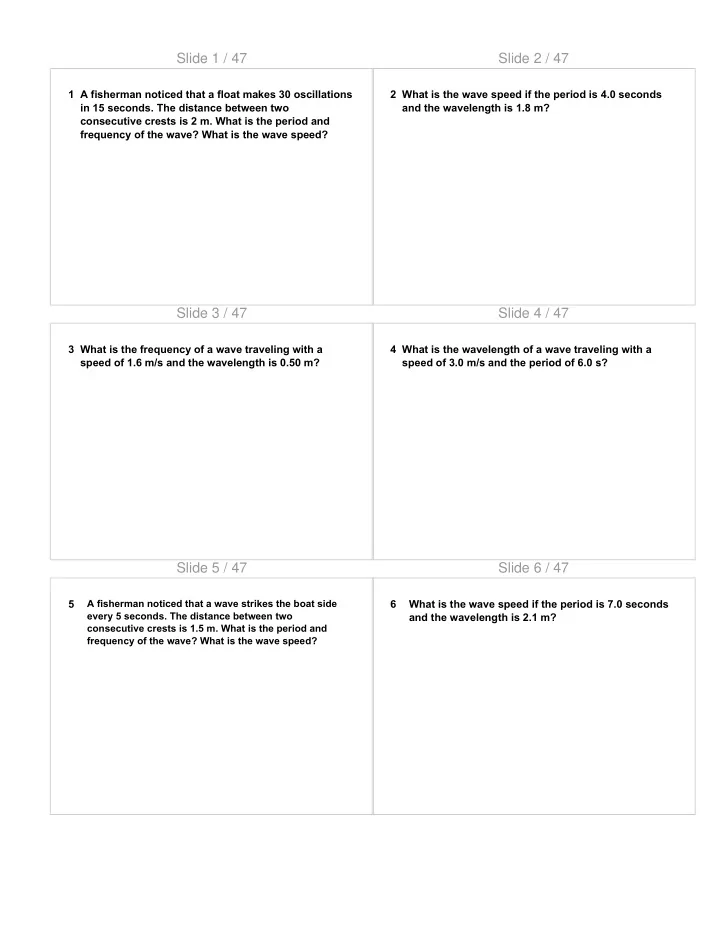
1 A fisherman noticed that a float makes 30 oscillations in 15 seconds. The distance between two consecutive crests is 2 m. What is the period and frequency of the wave? What is the wave speed?

Slide 2 / 47

2 What is the wave speed if the period is 4.0 seconds and the wavelength is 1.8 m?

Slide 3 / 47

3 What is the frequency of a wave traveling with a speed of 1.6 m/s and the wavelength is 0.50 m?

Slide 4 / 47

4 What is the wavelength of a wave traveling with a speed of 3.0 m/s and the period of 6.0 s?

Slide 5 / 47

5

A fisherman noticed that a wave strikes the boat side every 5 seconds. The distance between two consecutive crests is 1.5 m. What is the period and frequency of the wave? What is the wave speed?

Slide 6 / 47

6 What is the wave speed if the period is 7.0 seconds and the wavelength is 2.1 m?

slide-2
SLIDE 2

Slide 7 / 47

7 What is the period of a wave traveling with a speed

  • f 20 m/s and the wavelength is 4.0 m?

Slide 8 / 47

8 What is the wavelength of a wave traveling with a speed of 6.0 m/s and the frequency of 3.0 Hz?

Slide 9 / 47

9 A string with a linear density of 8.0 g/m (0.008 kg/m) is under tension of 200 N. What is the speed of the wave?

Slide 10 / 47

10 A wave speed in a piano string of linear density 5.0 g/m (0.005 kg/m) is 140 m/s. What is the tension in the string?

Slide 11 / 47

11 A wire with a linear density of 15 g/m (0.015 kg/m) undergoes a tension force of 250 N. A transverse wave with a wavelength of 0.40 m is produced in the

  • wire. What is the wave speed? What is the

frequency of oscillations?

Slide 12 / 47

12 A string with a linear density of 4.0 g/m (0.004 kg/m) is under tension of 150 N. What is the speed of the wave?

slide-3
SLIDE 3

Slide 13 / 47

13 A wave speed in a guitar string of linear density 9.0 g/m (0.009 kg/m) is 160 m/s. What is the tension in the string?

Slide 14 / 47

14 A guitar string with a linear density of 25 g/m (0.025 kg/m) undergoes a tension force of 400 N. A transverse wave with a wavelength of 0.80 m is produced in the wire. What is the wave speed? What is the frequency of oscillations?

Slide 15 / 47

15 A guitar string vibrates with a fundamental frequency of 330 Hz. What are the frequencies of first four harmonics?

Slide 16 / 47

16 A stretched wire resonates in three loops at a frequency of 180 Hz. What are the first four harmonics?

Slide 17 / 47

17 A stretched wire with a length of 2.0 m resonates in two loops. The wave speed is 120 m/s. What is the wavelength? What are the first three harmonics?

Slide 18 / 47

18 A violin string vibrates with a fundamental frequency of 450 Hz. What are the frequencies of first four harmonics?

slide-4
SLIDE 4

Slide 19 / 47

19 A piano string resonates in five loops at a frequency of 250 Hz. What are the first four harmonics?

Slide 20 / 47

20 A violin string with a length of 0.50 m resonates in five loops. The wave speed is 200 m/s. What is the wavelength? What are the first three harmonics?

Slide 21 / 47

21 A “snapshot” of a wave is given to the right. The frequency of oscillations is 240 Hz.

  • a. What is the

amplitude of the wave?

  • b. What is the

wavelength of the wave?

  • c. What is the wave

speed?

  • d. What is the wave

period?

Slide 22 / 47

22 A “snapshot” of a wave is given below. The frequency of oscillations is 120 Hz. a.

What is the amplitude of the

wave?

  • b. What is the wavelength of

the wave?

  • c. What is the wave speed?
  • d. What is the wave period?

Slide 23 / 47

23 A “snapshot” of a wave is given below. The frequency of oscillations is 160 Hz. a.

What is the

amplitude of the wave?

  • b. What is the

wavelength of the wave?

  • c. What is the wave

speed?

  • d. What is the wave

period?

Slide 24 / 47

24 A “snapshot” of a wave is given to the right. The frequency of oscillations is 100 Hz. a.

What is the amplitude of the

wave?

  • b. What is the wavelength of

the wave?

  • c. What is the wave speed?
  • d. What is the wave period?
slide-5
SLIDE 5

Slide 25 / 47

General problems

Slide 26 / 47

  • 1. A string with a length of 2.5 m resonates in five loops

as shown above. The string linear density is 0.05 kg/m and the suspended mass is 0.5 kg.

  • a. What is the wavelength?
  • b. What is the wave speed?
  • c. What is the frequency of oscillations?
  • d. What will happen to the number of loops if the

suspended mass is increased?

Slide 27 / 47

  • 1. A string with a length of 2.5 m resonates in five loops

as shown above. The string linear density is 0.05 kg/m and the suspended mass is 0.5 kg.

  • a. What is the wavelength?

Slide 28 / 47

  • 1. A string with a length of 2.5 m resonates in five loops

as shown above. The string linear density is 0.05 kg/m and the suspended mass is 0.5 kg.

  • b. What is the wave speed?

Slide 29 / 47

  • 1. A string with a length of 2.5 m resonates in five loops

as shown above. The string linear density is 0.05 kg/m and the suspended mass is 0.5 kg.

  • c. What is the frequency of oscillations?

Slide 30 / 47

  • 1. A string with a length of 2.5 m resonates in five loops

as shown above. The string linear density is 0.05 kg/m and the suspended mass is 0.5 kg.

  • d. What will happen to the number of loops if the

suspended mass is increased?

slide-6
SLIDE 6

Slide 31 / 47

  • 2. A string with a length of 2 m resonates in three loops

as shown above. The string linear density is 0.03 kg/m and the suspended mass is 1.2 kg.

  • a. What is the wavelength?
  • b. What is the wave speed?
  • c. What is the frequency of oscillations?
  • d. What will happen to the number of loops if the

suspended mass is increased?

Slide 32 / 47

  • 2. A string with a length of 2 m resonates in three loops

as shown above. The string linear density is 0.03 kg/m and the suspended mass is 1.2 kg.

  • a. What is the wavelength?

Slide 33 / 47

  • 2. A string with a length of 2 m resonates in three loops

as shown above. The string linear density is 0.03 kg/m and the suspended mass is 1.2 kg.

  • b. What is the wave speed?

Slide 34 / 47

  • 2. A string with a length of 2 m resonates in three loops

as shown above. The string linear density is 0.03 kg/m and the suspended mass is 1.2 kg.

  • c. What is the frequency of oscillations?

Slide 35 / 47

  • 2. A string with a length of 2 m resonates in three loops

as shown above. The string linear density is 0.03 kg/m and the suspended mass is 1.2 kg.

  • d. What will happen to the number of loops if the

suspended mass is increased?

Slide 36 / 47

  • 3. Two waves on the surface of water are generated by

two independent sources vibrating at the same frequency 1 Hz. The waves travel at a speed of 2.4 m/s. A point P is located 3.8 m from source 1 and 5.0 m from source 2.

  • a. What is the wavelength of the waves?
  • b. What is the extra distance traveled by the

second wave before it reaches point P?

  • c. What is the result of the interference at the

point P?

  • d. What will be the result of interference at the

point P if source 2 is moved 3.6 m further back?

  • e. What will be the result of interference at the

point P if source 2 is moved an additional 4.2 m further back?

slide-7
SLIDE 7

Slide 37 / 47

  • 3. Two waves on the surface of water are generated by

two independent sources vibrating at the same frequency 1 Hz. The waves travel at a speed of 2.4 m/s. A point P is located 3.8 m from source 1 and 5.0 m from source 2.

  • a. What is the wavelength of the waves?

Slide 38 / 47

  • 3. Two waves on the surface of water are generated by

two independent sources vibrating at the same frequency 1 Hz. The waves travel at a speed of 2.4 m/s. A point P is located 3.8 m from source 1 and 5.0 m from source 2.

  • b. What is the extra distance traveled by the

second wave before it reaches point P?

Slide 39 / 47

  • 3. Two waves on the surface of water are generated by

two independent sources vibrating at the same frequency 1 Hz. The waves travel at a speed of 2.4 m/s. A point P is located 3.8 m from source 1 and 5.0 m from source 2.

  • c. What is the result of the interference at the

point P?

Slide 40 / 47

  • 3. Two waves on the surface of water are generated by

two independent sources vibrating at the same frequency 1 Hz. The waves travel at a speed of 2.4 m/s. A point P is located 3.8 m from source 1 and 5.0 m from source 2.

  • d. What will be the result of interference at the

point P if source 2 is moved 3.6 m further back?

Slide 41 / 47

  • 3. Two waves on the surface of water are generated by

two independent sources vibrating at the same frequency 1 Hz. The waves travel at a speed of 2.4 m/s. A point P is located 3.8 m from source 1 and 5.0 m from source 2.

  • e. What will be the result of interference at the

point P if source 2 is moved an additional 4.2 m further back?

Slide 42 / 47

  • 4. Two waves on the surface of water are generated by

two independent sources vibrating at the same frequency 4.0 Hz. The waves travel at a speed of 3.2 m/

  • s. A point P is located 4.2 m from source 1 and 4.6 m

from source 2.

  • a. What is the wavelength of the waves?
  • b. What is the extra distance traveled by the

second wave before it reaches point P?

  • c. What is the result of the interference at the

point P?

  • d. What will be the result of interference at

the point P if source 2 is moved 1.2 m further back?

  • e. What will be the result of interference at

the point P if source 2 is moved an additional 1.6 m further back?

slide-8
SLIDE 8

Slide 43 / 47

  • 4. Two waves on the surface of water are generated by

two independent sources vibrating at the same frequency 4.0 Hz. The waves travel at a speed of 3.2 m/

  • s. A point P is located 4.2 m from source 1 and 4.6 m

from source 2.

  • a. What is the wavelength of the waves?

Slide 44 / 47

  • 4. Two waves on the surface of water are generated by

two independent sources vibrating at the same frequency 4.0 Hz. The waves travel at a speed of 3.2 m/

  • s. A point P is located 4.2 m from source 1 and 4.6 m

from source 2.

  • b. What is the extra distance traveled by the

second wave before it reaches point P?

Slide 45 / 47

  • 4. Two waves on the surface of water are generated by

two independent sources vibrating at the same frequency 4.0 Hz. The waves travel at a speed of 3.2 m/

  • s. A point P is located 4.2 m from source 1 and 4.6 m

from source 2.

  • c. What is the result of the interference at the

point P?

Slide 46 / 47

  • 4. Two waves on the surface of water are generated by

two independent sources vibrating at the same frequency 4.0 Hz. The waves travel at a speed of 3.2 m/

  • s. A point P is located 4.2 m from source 1 and 4.6 m

from source 2.

  • d. What will be the result of interference at

the point P if source 2 is moved 1.2 m further back?

Slide 47 / 47

  • 4. Two waves on the surface of water are generated by

two independent sources vibrating at the same frequency 4.0 Hz. The waves travel at a speed of 3.2 m/

  • s. A point P is located 4.2 m from source 1 and 4.6 m

from source 2.

  • e. What will be the result of interference at

the point P if source 2 is moved an additional 1.6 m further back?