SLIDE 1 Slide 1 / 39
Algebra I
Electric Potential and Capacitors
Multiple Choice www.njctl.org
Slide 2 / 39
1 A metal wire connects two charged conducting spheres. Sphere 1 has a greater radius than sphere 2. Which of the following statements accurately describes the electric potential of sphere 1 when compared to sphere 2? A It is smaller B It is greater C It is equal D Varies; depends on the charges that the spheres initially had
Slide 3 / 39
2 What is the SI unit for electric potential? A Joules B Coulombs C Farads D Volts
Slide 4 / 39
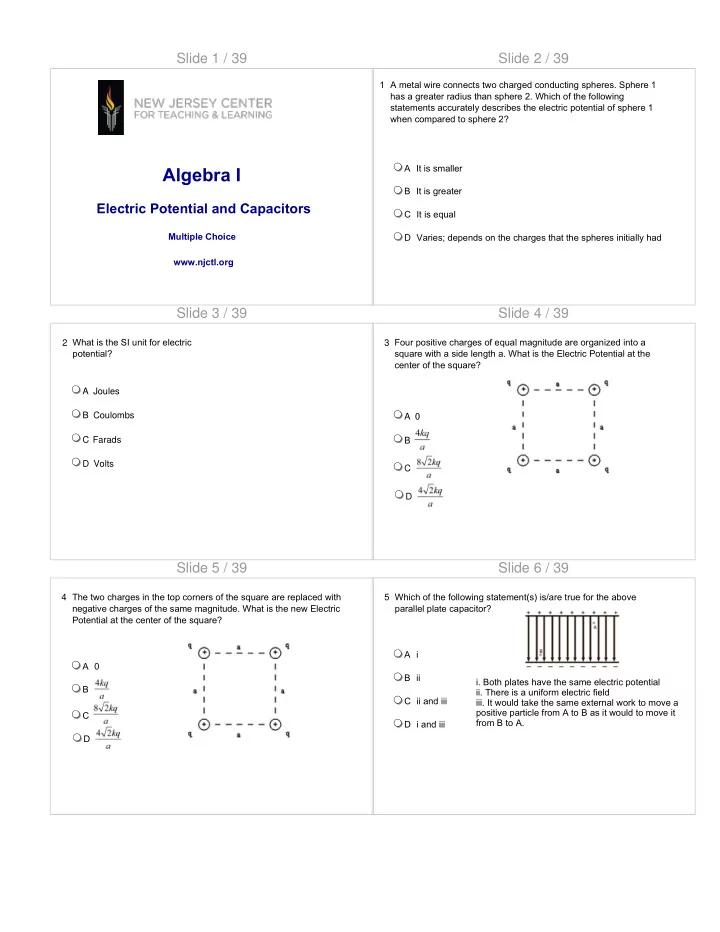
3 Four positive charges of equal magnitude are organized into a square with a side length a. What is the Electric Potential at the center of the square? A 0 B C D
Slide 5 / 39
4 The two charges in the top corners of the square are replaced with negative charges of the same magnitude. What is the new Electric Potential at the center of the square? A 0 B C D
Slide 6 / 39
5 Which of the following statement(s) is/are true for the above parallel plate capacitor? A i B ii C ii and iii D i and iii
- i. Both plates have the same electric potential
- ii. There is a uniform electric field
- iii. It would take the same external work to move a
positive particle from A to B as it would to move it from B to A.
SLIDE 2
Slide 7 / 39
6 What is the electric potential at point c if each side of the triangle has a length s? A 0 B C D
Slide 8 / 39 Slide 9 / 39
8 What is the electric potential at point C if the charge at point B is replaced with a new charge -Q? A 0 B C D
Slide 10 / 39
9 Given a plot of equipotential lines, how would you draw the electric field lines? A Perpendicular; towards lower potential B Parallel to all equipotential lines C Perpendicular; towards higher potential D Perpendicular; towards higher lines of higher energy
Slide 11 / 39
10 A parallel plate capacitor is connected to a battery. Which of the following diagrams most accurately portrays the electric field of a capacitor? A B C D
Slide 12 / 39
11 Two charges are separated by a distance d. If the distance between them is doubled, how does the electric potential energy change? A Potential energy is doubled B Potential energy is halved C Potential energy is quadrupled D Potential is energy quartered
SLIDE 3
Slide 13 / 39
12 A solid conducting metal sphere has a charge +Q. Where on the sphere is this charge located? A +Q at the center of the sphere B -Q at the center of the sphere and +2Q at the surface of the sphere C +Q evenly distributed throughout the entire sphere D +Q spread evenly on the surface of the sphere
Slide 14 / 39
13 How much external work is needed to move charge q from point A to point B along the designated path if the electric potential at point A is 100V and the electric potential at point B is 200V? A 0 B 100q C -100q D 300q
Slide 15 / 39
14 Two charges are plotted on the graph above. Each has a charge of +9 nC and each dash represents 1 m. What is the electric potential at the origin? A 114 V B 0 V C 413 V D 86.5 V
Slide 16 / 39
15 Two charges are plotted on the graph above. Each has a charge of +9 nC and each dash represents 1 m. How much work would it take to move a 4 nC test charge from infinity to the origin? A 0 J B 458 nJ C 1310 nJ D 612.12 nJ
Slide 17 / 39
16 What is the direction of the electric field at point A? A Up B Down C Right D Left
Slide 18 / 39
17 How much external work would it take to move a +8 μC charge from point A to point B at a constant velocity? A 320 μJ B -320 μJ C 160 μJ D -160 μJ
SLIDE 4 Slide 19 / 39
18 How much external work would it take to move a +8 μC charge from point B to A at a constant velocity? A 320 μJ B -320 μJ C 160 μJ D -160 μJ
Slide 20 / 39
19 How much external work would it take to move a +8 μC charge from point A to point B and back to point A? A 0 J B -320 μJ C 160 μJ D -160 μJ
Slide 21 / 39 Slide 22 / 39
21 A positive charge Q is a distance S from point P. The electric potential at P could be doubled by which of the following?
- i. Placing an identical charge Q at another point a distance S from
P
- ii. Placing charge 2Q at a distance 2S from P
- iii. Placing a charge 4Q at a distance 2S from P
A i only B ii only C ii and iii only D i and ii only
Slide 23 / 39
22 Which of the following variables can be affected if a dielectric, such as a sheet of insulating plastic material, is inserted into a parallel plate capacitor (charged and disconnected from the battery) when compared to a capacitor without the material?
- i. Capacitance
- ii. Electric Field between the plates
- iii. Electric Potential
A i and iii only B ii only C i and ii only D i, ii and iii
Slide 24 / 39
23 A parallel plate capacitor has an area of 1000cm2 and a distance of
- 1cm. A new dielectric material is inserted and its new capacitance
value is calculated to be 1.77 x 10⁻¹⁰ F. What must be the value of the dielectric constant κ? A 0.75 B 1.5 C 2 D 2.25
SLIDE 5 Slide 25 / 39
24 A parallel plate capacitor is charged to a maximum value of +Q and disconnected from the battery. The voltage between the plates is V, and the energy stored in the capacitor is U. If charge is halved and the capacitance is not changed, how are electric potential and potential energy affected? A Both potential and potential energy halved B Potential is halved and potential energy is quartered C Both potential and potential energy remain unchanged D Both potential and potential energy are both doubled
Slide 26 / 39
25 Why does the total electric field between the plates of an isolated capacitor decrease when a dielectric is inserted? A The dielectric material becomes polarized and creates a supporting electric field B The dielectric material becomes polarized and creates an
C The capacitance decreases D The voltage across the capacitor increases
Slide 27 / 39
26 The capacitance of a parallel-plate capacitor depends on which of the following? A II only B III only C I and II only D II and II only
- I. The plate area
- II. The plate separation
- III. The voltage of the capacitor
Slide 28 / 39
27 A parallel plate capacitor has a charge of Q. The voltage between the plates is V, and the energy stored in the capacitor is U. If C is halved and Q is not changed, how are V and U affected? A Both V and U are halved B V is halved and U is doubled C Neither V nor U change D Both V and U are doubled
Slide 29 / 39
28 The charge for a parallel plate capacitor is determined to be 450 x 10-6 C. It is charged with a source of V = 110V. What is the energy stored on the capacitor? A 0.02475 J B 0.0495 J C 0.2475 J D 0.495 J
Slide 30 / 39
29 A parallel-plate capacitor has a capacitance C. What is the new capacitance when a dielectric with κ = 4 is inserted between its plates? A 1/16 C B 1/4 C C C D 4 C
SLIDE 6
Slide 31 / 39
30 A parallel plate capacitor C has a plate separation of distance d and an area A. What is the new capacitance if the area of the plates is kept constant and the plate separation is halved? A 1/4 C B 1/2 C C 2 C D 4 C
Slide 32 / 39
31 A parallel plate capacitor C has area A and plate separation d. What is the new capacitance if the area is halved and the plate separation is doubled? A 1/4 C B 1/2 C C C D 2 C
Slide 33 / 39
32 A parallel plate capacitor C has a plate separation of distance d and an area A. What is the new capacitance if the area of the plates is doubled and the plate separation is halved? A 4 C B 2 C C C D 1/2 C
Slide 34 / 39
33 For a set of oppositely charged, infinite parallel plates, what is true about the electric field inside and outside the plates? A The electric field decreases as you move from the positive to the negative plate and is a non zero constant outside B The electric field decreases as you move from the positive to the negative plate and is non zero constant outside C The electric field is a non zero constant within the plates and zero outside D The electric field is zero within the plates and a non zero constant outside
Slide 35 / 39
34 The direction of the electric field in space is: A depends on the magnitude of the electric potential B in the direction of constant electric potential C in the direction of decreasing electric potential D in the direction of increasing electric potential
Slide 36 / 39
35 Which of the following will increase the capacitance of a capacitor? Select two answers A Closer plate spacing B Increasing charge C Decreased plate area D Adding a dielectric material with a greater dielectric constant
SLIDE 7
Slide 37 / 39
36 Which equations calculate for energy stored on a capacitor? Select two answers. A B 1/2 QV C 1/2 CV D
Slide 38 / 39
37 A Dielectric can do which of the following in capacitors? Select two answers. A Decrease capacitance B The electric field between plates is reduced. C Increase capacitance D The electric field between plates is increased
Slide 39 / 39
38 Identify the variables which determine the maximum capacitance a capacitor can store? Select two answers A Area dimensions/shape of the capacitor B Separation distance of parallel plates C Power source connected to the capacitor D How long a capacitor is connected to a power source