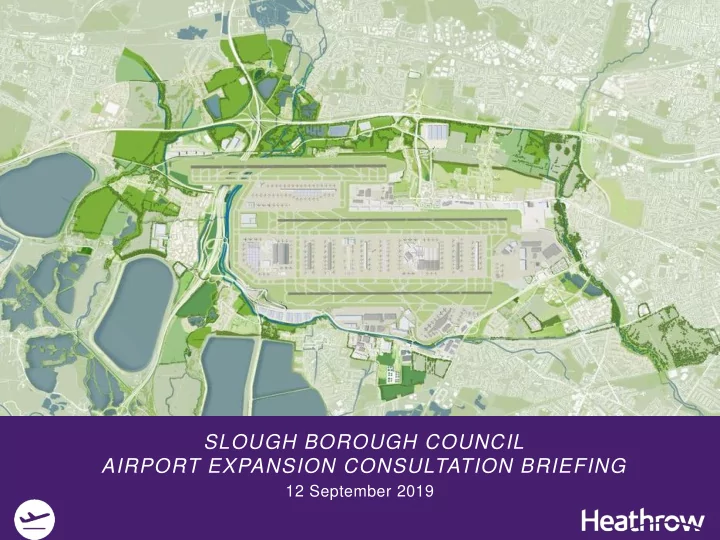
SLOUGH BOROUGH COUNCIL AIRPORT EXPANSION CONSULTATION BRIEFING 12 - - PowerPoint PPT Presentation

slough borough council airport expansion consultation
SMART_READER_LITE
LIVE PREVIEW

SLOUGH BOROUGH COUNCIL AIRPORT EXPANSION CONSULTATION BRIEFING 12 - - PowerPoint PPT Presentation

Classification: Public This document is commercially sensitive and confidential and not for onward circulation and without consent. This document contains information which is strictly private and confidential and commercially sensitive to


slide-1
SLIDE 1

Classification: Public

SLOUGH BOROUGH COUNCIL AIRPORT EXPANSION CONSULTATION BRIEFING

12 September 2019

This document is commercially sensitive and confidential and not for onward circulation and without consent. This document contains information which is strictly private and confidential and commercially sensitive to Heathrow Airport Limited. This draft document is being provided to the recipient on a strictly confidential basis and the recipient should not disclose, communicate or reproduce any part of this document unless expressly permitted by Heathrow Airport Limited to do so. Nothing in this document represents an intention or decision by Heathrow Airport Limited to proceed or not with an option for any component of the Heathrow Expansion Project.

slide-2
SLIDE 2

Classification: Public

AGENDA

Slough BC Heathrow Expansion Update

Economic Development Framework Rupert Waters Managing Aircraft Noise Andy Bird Surface Access Proposals Chris Casey AOB ALL

slide-3
SLIDE 3

Classification: Public

EXPANSION PROGRAMME – ECONOMIC DEVELOPMENT FRAMEWORK

slide-4
SLIDE 4

Classification: Public

slide-5
SLIDE 5

Classification: Public

HEATHROW EXPANSION: THE BENEFITS £46.2 billion to the

UK economy NPS enables at least

260,000

additional ATMs per annum

4

Logistics Hubs across the UK

26,000 more direct jobs

10,000

total apprenticeships by 2030

2x

current cargo capacity for British exporters

slide-6
SLIDE 6

Classification: Public

PURPOSE OF THE ECONOMIC DEVELOPMENT FRAMEWORK

Sets out our approach to maximise the

  • pportunity of Heathrow Expansion

Sets out our principles and objectives Highlights local, regional and national benefits, but with a focus on the sub-region Consultation which will inform the development of an Economic development Strategy

slide-7
SLIDE 7

Classification: Public

ECONOMIC IMPACTS

  • Between 89,000 and 98,000 construction job years
  • At peak around a quarter will be resident of core area
  • An increase of 26,800 direct jobs at Heathrow
  • ‘Catalytic’ effects will create 65,000 additional jobs nationally
  • Ability to capture inward investment locally will in part be

dependent on decisions made by policy makers

  • Further wider benefits through inward investment, local retention
  • f business rates, spending and supply chain effects
slide-8
SLIDE 8

Classification: Public

EDUCATION, EMPLOYMENT AND SKILLS

The Heath throw

  • w Skills

ls Taskfor kforce Employme

  • yment

t and Skills s Proposals: sals:

  • Enhanced recruitment and job brokerage
  • Address barriers for disadvantaged growth
  • Upskilling the workforce
  • Develop the skills infrastructure

Education tion: World of Work programme

slide-9
SLIDE 9

Classification: Public

BUSINESS AND INNOVATION

Supplier lier engage agement: t: A more coordinated approach to engaging SMEs and new entrants Business as usual and expansion Innovati ation

  • n:

Innovation partners initiative Centre of Excellence for sustainability Potential Sustainable Airport Research Centre Inward Inve vestm tmen ent

slide-10
SLIDE 10

Classification: Public

slide-11
SLIDE 11

Classification: Public

FROM FRAMEWORK TO AN ECONOMIC DEVELOPMENT STRATEGY Work with HSPG and other partners to develop the Economic Development ‘offer’ Taking into HSPG areas of focus and developing vision through the HSPG Business and Economy sub-group Task and finish Groups:

  • Job brokerage
  • SME engagement
  • Innovation
slide-12
SLIDE 12

Classification: Public

FUTURE ENGAGEMENT WITH STAKEHOLDERS

Other Forums

  • HSPG Busines and Economy Sub Group
  • Skills Partnership – local colleges and universities
  • Construction Strategic Skills Forum – delivery integrators, Tier 1s, expansion partners
  • Skills Implementation Steering Group – monitoring of Skills Taskforce delivery
  • Heathrow Community Engagement Board – local community and residents
slide-13
SLIDE 13

Classification: Public

MANAGING AIRCRAFT NOISE

Heathrow is quieter now than it was in the 1970s even though we have double the number of air traffic movements

Our committed goal is to expand Heathrow whilst affecting

fewer people

with noise than in 2013

Collaboration with airlines and NATS is

crucial to delivering a quieter Heathrow

Expansion means…

For eligible residents we have developed a draft Noise

Insulation Policy to

mitigate and manage effects for those most

  • affected. This will be

part of our consultation.

slide-14
SLIDE 14

Classification: Public

NOISE AND VIBRATION INFORMATION FOR AEC

  • Main consultation document:
  • Summarises noise information in AEC
  • Explains new noise policy language and the policy aims we have to

meet

  • In 2035 there will be fewer people effected by aircraft noise than in

2013

  • Key mitigation proposals
  • Operations Proposals (key noise mitigation)
  • Early growth
  • Package of new measures to reduce noise impact from night flights

(11pm t 7am)

  • Runway alternation proposals
  • Managed Preference
  • Noise Envelope
  • PEIR
  • Initial assessment:

i) Construction, Aircraft, Ground noise, Road noise, Rail noise, Combined noise ii) Early growth and expanded Heathrow iii) Inner area and Outer area

  • Mitigation and compensation
  • Noise Insulation Policy
  • Code of Construction Practice (CoCP)

What’s a LOAEL? SOAEL? UAEL? Noise Envelope

  • Enforceable limits
  • Will constrain airspace

change and future operation

  • Share benefits of

technology improvement between reduced noise impact and growth

slide-15
SLIDE 15

Classification: Public

NOISE AND VIBRATION SECTION 17 OF THE PEIR

  • Aircraft noise emissions (QC) are

getting quieter as technology improves. This trend is assumed to continue whilst the annual ATMs increase with 3R.

  • Year of highest aircraft noise emissions

is anticipated to be 2035 – as assessed in PEIR.

slide-16
SLIDE 16

Classification: Public

NOISE AND VIBRATION SECTION 17 OF THE PEIR

  • Aircraft noise assessment based on

indicative airspace test cases, as ACP and DCO are separate processes. As a result: a) inner area - not materially affected by airspace design so results are more representative of final outcomes. b) outer area - will be affected by airspace design so results are only indicative.

slide-17
SLIDE 17

Classification: Public

2013

* Likely average response

* * * *

THESE MAPS ARE IN THE CONSULTATION DOC AND AT EVENTS

Lowest Observed Adverse Effect Level Significant Observed Adverse Effect Level

Government noise policy language

Airspace change proposals have to consider noise where aircraft are below 7,000ft Noise effects have to be assessed where aircraft are below 4,000ft Unacceptable Adverse Effect Level

slide-18
SLIDE 18

Classification: Public

2035

LOAEL to SOAEL for one indicative airspace design Worst case area with within which LOAEL contour for different airspace designs could occur

* Likely average response

* * * * * Lowest Observed Adverse Effect Level Significant Observed Adverse Effect Level Unacceptable Adverse Effect Level

Government noise policy language

Airspace change proposals have to consider noise where aircraft are below 7,000ft Noise effects have to be assessed where aircraft are below 4,000ft

THESE MAPS ARE IN THE CONSULTATION DOC AND AT EVENTS

slide-19
SLIDE 19

Classification: Public

ADDITIONAL NOISE IMPACTS ASSESSED

  • Operational Noise impacts during the Early Growth Period
  • Ground noise impacts from the airfield
  • Construction noise impacts
  • Surface access noise impacts (e.g. road traffic noise)
slide-20
SLIDE 20

Classification: Public

NOISE ENVELOPE

  • As part of our DCO application we will be putting forward our proposals for

a Noise Envelope. This is a requirement of the Airports National Policy Statement (ANPS 5.60): “The applicant should put forward plans for a noise envelope. Such an envelope should be tailored to local priorities and include clear noise performance targets. As such, the design of the envelope should be defined in consultation with local communities and relevant stakeholders, and take account of any independent guidance such as from the Independent Commission on Civil Aviation Noise. The benefits of future technological improvements should be shared between the applicant and its local communities, hence helping to achieve a balance between growth and noise reduction. Suitable review periods should be set in consultation with the parties mentioned above to ensure the noise envelope’s framework remains relevant.”

  • A Noise Envelope Design Group was set up in March 2019 to provide a

forum for technical engagement on our development of proposed

slide-21
SLIDE 21

Classification: Public

NOISE ENVELOPE

  • Information regarding the Noise Envelope has been published in the following AEC documents; Consultation Document,

Environmentally Managed Growth, Future Runway Operations and Chapter 17 of the Preliminary Environmental Information Report. Definition:

Heathrow’s noise envelope is a set of legally binding and enforceable limits and controls to manage noise in the future while enabling growth.​ ​ It is a legally binding framework of limits and controls to manage noise. It will provide certainty both now and in the future. It will be reviewed after an agreed period. It will be designed to protect communities while enabling the airport to operate efficiently and allow it to grow within these limits. The Noise Envelope will deliver real benefits that can be shared between communities, consumers, and businesses during each stage of growth.​

slide-22
SLIDE 22

Classification: Public

NOISE ENVELOPE EXAMPLE PRESENTED IN THE PEIR

  • Based on ES worst case that includes all

mitigation measures

  • QC and/or LOAEL & SOAEL contours
  • This graphic indicates how following the

year of highest impact, QC limit values could progressively reduce with each periodic cycle, in a manner that would incentivise technology improvement and shares the associated benefits balancing Airport growth with reducing overall noise effects on communities.

slide-23
SLIDE 23

Classification: Public

NOISE INSULATION POLICY

slide-24
SLIDE 24

Classification: Public

PREFERRED MASTERPLAN – SURFACE ACCESS PROPOSALS

slide-25
SLIDE 25

Classification: Public

WHAT DO WE NEED TO ACHIEVE AND BY WHEN? OUR NATIONAL POLICY STATEMENT TARGETS

50% 55%

Increase passenger public transport mode share Reduction of colleague car trips No increase in Heathrow- related traffic

today 2030 2040

40%

today 2030 2040

  • 50%

from 2013 baseline

  • 25%

from 2013 baseline

Today 2030 2040

Passenger numbers increasing in line with expansion… …but no increases in Heathrow-related traffic

TAXI

Transport mitigation

Minimise and mitigate the effect of expansion on existing surface access arrangements

Air quality

Ensure that construction and

  • peration of expansion does not

affect UK’s ability to comply with legal air quality obligations

slide-26
SLIDE 26

Classification: Public

OUR SURFACE ACCESS PROPOSALS

slide-27
SLIDE 27

Classification: Public

Each surface access measure was either classified as a ‘pull’ measure, which aimed to encourage people to use public transport, cycle or use vehicles in a more sustainable way, or a ‘push’ measure, which looked to disincentivise car use. The graphic here sets out the push and pull measures considered as part of the SAS.

A balanced approach to achieve our targets

We know we will need both push and pull measures to achieve our mode share targets

PULL

The Elizabeth line HS2 + Old Oak Common Piccadilly line upgrade Western Rail Link Southern Rail Link Improve existing coach routes Enhanced coach bus and coach network Bus priority measures Southern Access Tunnel Discounted public transport Align public transport service with airport hours Integrating employment and public transport More efficient use of taxis and private hire Apply intelligent mobility Optimise freight vehicle management Vehicle charging (to control emissions) Vehicle charging (to control congestion) Reduce car parking availability

Infrastructure and new services Restraint measures Incentives to travel sustainably

PULL PUSH

slide-28
SLIDE 28

Classification: Public

TACKLING AIR QUALITY AND EMISSIONS

slide-29
SLIDE 29

Classification: Public

THANK YOU

slide-30
SLIDE 30