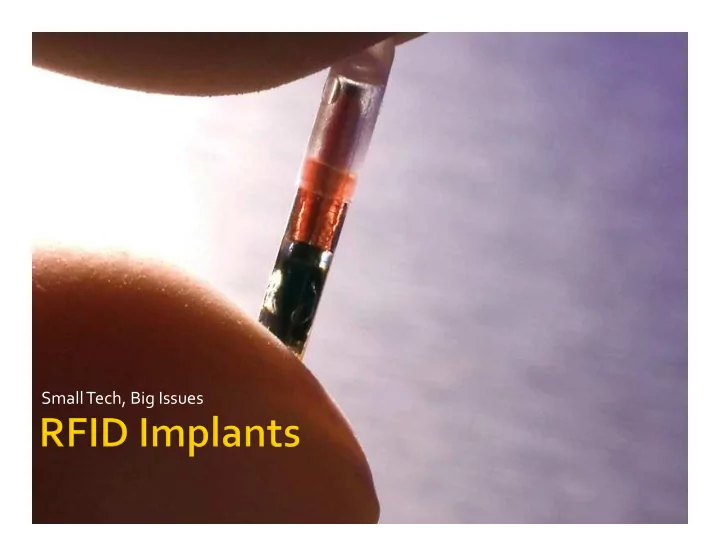
SmallTech,BigIssues HowItWorks AdvantagesofRFID - - PowerPoint PPT Presentation
SmallTech,BigIssues HowItWorks AdvantagesofRFID HistoryoftheRFID ProposedUses Identification MedicalRecords Immigration SecurityAuthentication
How It Works Advantages of RFID History of the RFID Proposed Uses
- Identification
- Medical Records
- Immigration
- Security Authentication
Ethical Issues
- Purchase tracking
- Lack of encryption
- Location tracking
- Unauthorized tag reading
- Requiring implant for job / immigration
1.
Controller initiates read
2.
Reader antenna sends short range radio‐ frequency signals
3.
Tag converts signal to energy
4.
Tag uses stored energy to transmit its memory contents back to reader
5.
Reader antenna collects sent data
http://www.rotil.nl/communications/products/rfid.en.php
Tags are:
- Cheap
- Resilient
- Long lived
- Don’t need power source
- Small
Operate under extreme conditions (cold / heat) Contactless recognition
- Through materials like plastic, glass, wood
- Can be made invisible to the user
In WW2, the Germans,
Japanese, Americans, and British were all using radar
No way to identify
planes
Germans discovered that
if pilots rolled their planes as they returned to base, it would change the radio signal reflected back
First passive RFID
system
http://apocalapsus.es/blog/category/cine/
EAS Systems Introduced
- Checkpoint
- Sensormatic
1‐bit tags: on or off Deactivated by partially
destroying capacitor by running tag over a strong electromagnetic field
Multi‐bit tags size of a
loaf of bread, size limited by circuitry
http://www.spychips.com/blog/2006/01/ eas_or_rfid_new_labels_prompt.html http://www.contractpharma.com/articles/2007/06/images/rfid.jpg
http://electronics.howstuffworks.com/gadgets/high‐tech‐gadgets/rfid.htm http://autoid.mit.edu/pickup/RFID_Papers/008.pdf
http://images.businessweek.com/ss/06/01/medtech/image/ verichip.jpg http://www.rfidjournal.com/imagecatalogue/imageview/5154/? RefererURL=/article/articleview/4055/
Received permission
from USFDA to market VeriChip in 2004
2000+ implants as of
2007
~$200 16‐digit code (128‐bits)
“Although currently PositiveID does not
actively market the VeriMed system, it continues to support existing patients and healthcare facilities.” ‐PositiveID website FAQ
Medical Records Immigration Security Authentication Kidnapping Prevention Tracking of criminals/parole….and sick
people?
# of record in secure
database
Focus market: Cancer
patients, people w/ pacemakers, or people who might be cognitively impaired
Detection:
- How does ER staff know you have a VeriChip?
▪ Bracelet? Tattoo? ▪ Big problems if not detected
- Does hospital have RFID reader?
Health Issues CAUSED by chip?
The potential risks to health associated with the device are: adverse tissue reaction; migration of implanted transponder; compromised information security; failure of implanted transponder; failure of inserter; failure of electronic scanner; electromagnetic interference; electrical hazards; magnetic resonance imaging incompatibility; and needle stick.
‐USFDA http://www.spychips.com/devices/verichip‐fda‐letter.pdf
CEO of VeriChip proposed implants in
immigrants and guest workers to assist the government in later identifying them
President of Columbia quoted telling a US
senator that he would agree to require Columbian citizens to be implanted before they could gain entry into the US for seasonal work
Who pays for it? Maintenance? Problems w/
chip? Cloning?
Dangerous Precedent Similar to branding cattle or tattoos the Nazis
forced on their victims in concentration camps?
Suggested use by
VeriChip
2004: Mexico’s
attorney general Carlos Altamirano and staff receive VeriChip implants for the purposes of “access, for security”.
http://msnbcmedia1.msn.com/j/msnbc/Components/Photos/ 040714/040714_mexicoChip_hmed_3p.hmedium.jpg
Lack of encryption
- Power/memory constraints prevent any security
measures, rolling code and challenge‐response authentication systems being worked on
Unauthorized reading
- Few laws preventing
- Hand held readers ~$250
- Make your own?
Cloning
2000+ Mexican citizens have had tags
implanted for the purpose of tracking in case they are kidnapped
No GPS capabilities in current RFID implants.. CEO of VeriChip’s parent company
“concedes that the company’s Mexican distributor may not have tried very hard to dispel the notion that VeriChips have GPS capabilities, which would be required for real remote tracking” [McHugh]
http://i34.photobucket.com/albums/d115/uniteduniverse/verichip1.jpg
life in the U.S. will become difficult for those
who do not want a chip inside them (in much the same way as it is currently difficult for anyone without a credit card, cellphone, email address or internet access
http://industry.bnet.com/pharma/10005641/
positiveid‐deal‐advances‐use‐of‐microchip‐ implants‐in‐florida‐health‐system/).
If there were a societal benefit, could a government require individuals to modify their bodies? For public health purposes, the answer is yes. In the United States, for example, students must have certain immunizations before attending public school. ‐Foster & Jaeger
Little legislation
- Washington (2008) – Unauthorized Reading
- California, Georgia, North Dakota, Virginia, Wisconsin –
Prohibits forced RFID implants
- 28(?) other states w/pending RFID legislation
Need a comprehensive set of regulations EPIC – Electronic Privacy Information Center
- “Public interest research center”
- “No clients, no customers, no shareholders”
Give notice of:
- Tag Presence
- Reader Presence
- Reading Activity
Removal Anonymity Priority Security Openness Accountability Rights
- Access
- Removal
- Accountability
RFID implants can be powerful tools if used while being conscious of their vulnerabilities or if sufficient advances in the technology are made. Even though RFID implants aren’t widely deployed at this time, legislation needs to be put in place to prevent potential issues from turning into real issues.
Bacheldor, Beth. “American Medical Association Issues Ethics Code for RFID Chip Implants” . RFID Journal. 17 July 2007. Accessed 11 May 2010. <http://www.rfidjournal.com/article/articleview/3487/1/1/>
Foster, Kenneth and Jaeger, Jan. “RFID Inside: The Murky Ethics of Implanted Chips”. University of Pennsylvania Department of Bioengineering. 2007. Reprinted from IEEE Spectrum, March 2007, 24‐29. < http://repository.upenn.edu/cgi/viewcontent.cgi?article=1098&context=be_papers>
“Guidelines on Commercial Use of RFID Technology”. Electronic Privacy Information Center. July 2004. http://epic.org/privacy/rfid/rfid_gdlnes‐070904.pdf
Landt, Jeremy. “The history of RFID”. IEEE Potentials. October/November 2005. http://autoid.mit.edu/pickup/RFID_Papers/008.pdf
McHugh, Josh. “A Chip in Your Shoulder”. Slate.com. 10 November 2004. http://www.slate.com/id/2109477
“Microchip implant (human)”. Wikipedia. < http://en.wikipedia.org/wiki/Microchip_implant_(human)>
Perakslis, Christine and Wolk, Robert. “Social Acceptance of RFID as a Biometric Security Method”. IEEE Technology and Society Magazine. Fall 2006. <http://autoid.mit.edu/pickup/RFID_Papers/079.pdf>
“Radio‐frequency identification”. Wikipedia. < http://en.wikipedia.org/wiki/Rfid>
Weissert, Will. “Mexican attorney general personally goes high‐tech for security”. USA Today. 14 July 2004. http://www.usatoday.com/tech/news/2004‐07‐14‐mex‐security‐implant_x.htm
Westhues, Jonathan. “Demo: Cloning a Verichip”. July 2006. < http://www.cq.cx/verichip.pl>
Witt, Sam. “Is human chip implant wave of the future?”. CNN.com. January 14, 1999. < http://www.cnn.com/TECH/computing/9901/14/chipman.idg/>