SML Modules and Abstract Data Types (ADTs) Hiding implementa-on - - PowerPoint PPT Presentation

sml modules and
SMART_READER_LITE
LIVE PREVIEW

SML Modules and Abstract Data Types (ADTs) Hiding implementa-on - - PowerPoint PPT Presentation

Overview of Modules and ADTs SML Modules and Abstract Data Types (ADTs) Hiding implementa-on details is the most important strategy for wriCng correct, robust, reusable soEware. Topics: These slides are lightly edited versions of Ben Woods


slide-1
SLIDE 1

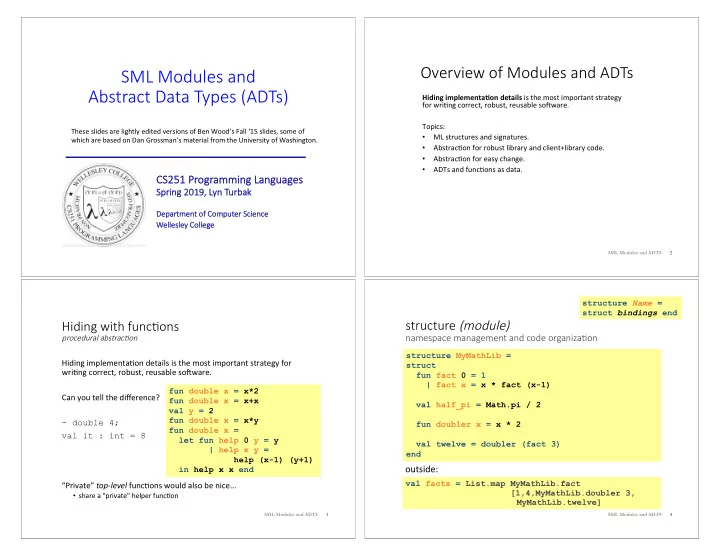
SML Modules and Abstract Data Types (ADTs)

CS251 Programmi mming Languages

Spring Spring 2019, 2019, Lyn yn Turbak urbak

Departme ment of Comp mputer Science We Wellesley College

These slides are lightly edited versions of Ben Wood’s Fall ‘15 slides, some of which are based on Dan Grossman’s material from the University of Washington.

Overview of Modules and ADTs

Hiding implementa-on details is the most important strategy for wriCng correct, robust, reusable soEware. Topics:

  • ML structures and signatures.
  • AbstracCon for robust library and client+library code.
  • AbstracCon for easy change.
  • ADTs and funcCons as data.

SML Modules and ADTS 2

Hiding with funcLons

procedural abstrac.on Hiding implementaCon details is the most important strategy for wriCng correct, robust, reusable soEware. Can you tell the difference?

  • double 4;

val it : int = 8 “Private” top-level funcCons would also be nice...

  • share a "private" helper funcCon

fun double x = x*2 fun double x = x+x val y = 2 fun double x = x*y fun double x = let fun help 0 y = y | help x y = help (x-1) (y+1) in help x x end

SML Modules and ADTS 3

structure (module)

namespace management and code organizaLon

structure MyMathLib = struct fun fact 0 = 1 | fact x = x * fact (x-1) val half_pi = Math.pi / 2 fun doubler x = x * 2 val twelve = doubler (fact 3) end

  • utside:

val facts = List.map MyMathLib.fact [1,4,MyMathLib.doubler 3, MyMathLib.twelve] structure Name = struct bindings end

SML Modules and ADTS 4

slide-2
SLIDE 2

signature

type for a structure (module) List of bindings and their types:

variables (incl. funcCons), type synonyms, datatypes, excepCons

Separate from specific structure.

signature MATHLIB = sig val fact : int -> int val half_pi : real val doubler : int -> int val twelve : int end signature NAME = sig binding-types end

SML Modules and ADTS 5

ascripLon

(opaque – will ignore other kinds)

Ascribing a signature to a structure

  • Structure must have all bindings with types as declared in signature.

structure Name :> NAME = struct bindings end signature MATHLIB = sig val fact : int -> int val half_pi : real val doubler : int -> int val twelve : int end structure MyMathLib :> MATHLIB = struct fun fact 0 = 1 | fact x = x * fact (x-1) val half_pi = Math.pi / 2 fun doubler x = x * 2 val twelve = doubler (fact 3) end

Real power: Abstrac-on and Hiding

SML Modules and ADTS 6

Hiding with signatures

MyMathLib.doubler unbound (not in environment) outside module. signature MATHLIB2 = sig val fact : int -> int val half_pi : real val twelve : int end structure MyMathLib2 :> MATHLIB2 = struct fun fact 0 = 1 | fact x = x * fact (x-1) val half_pi = Math.pi / 2.0 fun doubler x = x * 2 fun twelve = doubler (fact 3) end

SML Modules and ADTS 7

Abstract Data Type

type of data and operaLons on it

Example: raConal numbers supporCng add and toString structure Rational = struct datatype rational = Whole of int | Frac of int*int exception BadFrac (* see rationals.sml for full code *) fun make_frac (x,y) = ... fun add (r1,r2) = ... fun toString r = ... end

SML Modules and ADTS 8

slide-3
SLIDE 3

Library spec and invariants

External properCes [externally visible guarantees, up to library writer]

  • Disallow denominators of 0
  • Return strings in reduced form (“4” not “4/1”, “3/2” not “9/6”)
  • No infinite loops or excepCons

ImplementaCon invariants [not in external specifica9on]

  • All denominators > 0
  • All rational values returned from funcCons are reduced

Signatures help enforce internal invariants.

SML Modules and ADTS 9

More on invariants

Our code maintains (and relies) on invariants. Maintain:

  • make_frac disallows 0 denominator, removes negaCve denominator, and

reduces result

  • add assumes invariants on inputs, calls reduce if needed

Rely:

  • gcd assumes its arguments are non-negaCve
  • add uses math properCes to avoid calling reduce
  • toString assumes its argument is in reduced form

SML Modules and ADTS 10

A first signature

With what we know so far, this signature makes sense:

  • Helper funcCons gcd and reduce not visible outside the module.

signature RATIONAL_CONCRETE = sig datatype rational = Whole of int | Frac of int*int exception BadFrac val make_frac : int * int -> rational val add : rational * rational -> rational val toString : rational -> string end structure Rational :> RATIONAL_OPEN = ...

A7empt #1

SML Modules and ADTS 11

Problem: clients can violate invariants

Create values of type Rational.rational directly. Rational.Frac(1,0) Rational.Frac(3,~2) Rational.Frac(40,32) signature RATIONAL_CONCRETE = sig datatype rational = Whole of int | Frac of int*int ... end

SML Modules and ADTS 12

slide-4
SLIDE 4

SoluLon: hide more!

ADT must hide concrete type defini5on so clients cannot create invariant-viola5ng values of type directly.

This agempt goes too far: type rational is not known to exist signature RATIONAL_WRONG = sig exception BadFrac val make_frac : int * int -> rational val add : rational * rational -> rational val toString : rational -> string end structure Rational :> RATIONAL_WRONG = ...

A7empt #2

SML Modules and ADTS 13

Abstract the type! (R (Really Big Deal!) eally Big Deal!)

signature RATIONAL = sig type rational exception BadFrac val make_frac : int * int -> rational val add : rational * rational -> rational val toString : rational -> string end structure Rational :> RATIONAL = ... Only way to make 1st rational. Only opera-ons

  • n rational.

Type rational exists, but representa-on absolutely hidden. Client can pass them around, but can manipulate them only through module. Module controls all opera-ons with rational, so client cannot violate invariants.

Success! (#3)

SML Modules and ADTS 14

Abstract Data Type

Abstract type of data + operaLons on it

Outside of implementaCon:

  • Values of type rational can be

created and manipulated only through ADT opera-ons.

  • Concrete representa-on of values of type rational

is absolutely hidden. signature RATIONAL = sig type rational exception BadFrac val make_frac : int * int -> rational val add : rational * rational -> rational val toString : rational -> string end structure Rational :> RATIONAL = ...

SML Modules and ADTS 15

Abstract Data Types: two key tools

Powerful ways to use signatures for hiding:

  • 1. Deny bindings exist.

Especially val bindings, fun bindings, constructors.

  • 2. Make types abstract.

Clients cannot create or inspect values of the type directly.

SML Modules and ADTS 16

slide-5
SLIDE 5

A cute twist

In our example, exposing the Whole constructor is no problem In SML we can expose it as a funcCon since the datatype binding in the module does create such a funcCon

  • SCll hiding the rest of the datatype
  • SCll does not allow using Whole as a pagern

signature RATIONAL_WHOLE = sig type rational exception BadFrac val Whole : int -> rational val make_frac : int * int -> rational val add : rational * rational -> rational val toString : rational -> string end

SML Modules and ADTS 17

Signature matching rules

structure Struct :> SIG type-checks if and only if:

  • Every non-abstract type in SIG is provided in Struct, as specified
  • Every abstract type in SIG is provided in Struct in some way
  • Can be a datatype or a type synonym
  • Every val-binding in SIG is provided in Struct, possibly with a more

general and/or less abstract internal type

  • 'a list -> int more general than string list -> int
  • example soon
  • Every excepCon in SIG is provided in Struct.

Of course Struct can have more bindings (implicit in above rules)

SML Modules and ADTS 18

PairRaLonal (alternaLve concrete type)

structure PairRational = struct type rational = int * int exception BadFrac fun make_frac (x,y) = … fun Whole i = (i,1) (* for RATIONAL_WHOLE *) fun add ((a,b)(c,d)) = (a*d + b*c, b*d) fun toString r = ... (* reduce at last minute *) end

SML Modules and ADTS 19

Allow different implementa.ons to be equivalent

A key purpose of abstracCon:

  • No client can tell which you are using
  • Can improve/replace/choose implementaCons later
  • Easier with more abstract signatures (reveal only what you must)

UnreducedRational in adts.sml.

  • Same concrete datatype.
  • Different invariant: reduce fracCons only in toString.
  • Equivalent under RATIONAL and RATIONAL_WHOLE,

but not under RATIONAL_CONCRETE.

PairRational in adts.sml.

  • Different concrete datatype.
  • Equivalent under RATIONAL and RATIONAL_WHOLE,

but cannot ascribe RATIONAL_CONCRETE.

SML Modules and ADTS 20

slide-6
SLIDE 6

Some interesLng details

  • Internally make_frac has type int * int -> int * int,

externally int * int -> rational

  • Client cannot tell if we return argument unchanged
  • Internally Whole has type 'a -> 'a * int

externally int -> rational

  • specialize 'a to int
  • abstract int * int to rational
  • Type-checker just figures it out
  • Whole cannot have types 'a -> int * int
  • r 'a -> rational (must specialize all 'a uses)

SML Modules and ADTS 21

Cannot mix and match module bindings

Modules with the same signatures sCll define different types These do not type-check:

  • Rational.toString(UnreducedRational.make_frac(9,6))
  • PairRational.toString(UnreducedRational.make_frac(9,6))

Crucial for type system and module properLes:

  • Different modules have different internal invariants!
  • ... and different type definiLons:
  • UnreducedRational.rational looks like Rational.rational, but

clients and the type-checker do not know that

  • PairRational.rational is int*int not a datatype!

SML Modules and ADTS 22

signature SET = sig type ''a t val empty : ''a t val singleton : ''a -> ''a t val isEmpty : ''a t -> bool val size : ''a t -> int val member : ''a -> ''a t -> bool val insert : ''a -> ''a t -> ''a t val delete : ''a -> ''a t -> ''a t val union : ''a t -> ''a t -> ''a t val intersection : ''a t -> ''a t -> ''a t val difference : ''a t -> ''a t -> ''a t val fromList : ''a list -> ''a t val toList : ''a t -> 'a list val fromPred : (''a -> bool) -> ''a t val toPred : ''a t -> ''a -> bool val toString : (''a -> string) -> ''a t -> string end

Set ADT (set.sml)

Common idiom: if module provides

  • ne externally visible type, name it t.

Then outside references are Set.t. Double Ccks mean a Is an equality type (can compare elts with =)

SML Modules and ADTS 23

Side Note: Equality Types

Double-9ck types like ''a range over so-called equality types, which are types over which the polymorphic equality operator = is defined. Sadly, the semanCcs of IEEE 754 floaCng point arithmeCc standard prevents the real type from being an equality type. It includes Nan (not-a-number) values that represent the results of certain operaCons, such as subtracCng posiCve infinity from itself. According to the IEEE standard, tesCng two Nan values for equality must return false, but that would break the reflexivity property that is required for an equality type (i.e., for any value v in an equality type, v = v must be true). See the examples below.

- val myNan = Real.posInf - Real.posInf;

val myNan = nan : real

  • Real.isNan myNan;

val it = true : bool

  • Real.==(myNan,myNan);

val it = false : bool

  • Real.compareReal(myNan,myNan);

val it = UNORDERED : IEEEReal.real_order

- myNan = myNan;

Error: operator and operand don't agree [equality type required]

  • perator domain: ''Z * ''Z
  • perand: real * real
  • Real.compare(myNan,myNan)

uncaught exception Unordered

SML Modules and ADTS 24

slide-7
SLIDE 7

ImplemenLng the SET signature

ListSet structure (in class)

Represent sets as unordered list.

  • Invariant: no duplicates
  • What about ordering? Can’t use it, since not part
  • f signature!

ListSetDups structure (in class)

Represent sets as unordered list, *allowing* duplicates

FunSet structure (PS8)

Represent sets as predicate funcCons

Opera-onTreeSet structure (PS8)

Represent sets as trees of set operaCon

SML Modules and ADTS 25

ListSet (in class; soluLons in SML VM repo)

structure ListSet :> SET = struct type ''a t = ''a list val empty = [] fun singleton x = [x] fun insert x ys = if member x ys then ys else x :: ys ... flesh out the rest in class ... end

SML Modules and ADTS 26

  • Represent sets as unordered list without duplicates
  • Can’t use ordering, since not part of signature!
  • The following are helpful in implementaCon:

foldr, List.filter, List.exists, String.concatWith

Opening Modules

- ListSet.isEmpty (ListSet.empty);

val it = true : bool

  • ListSet.size (ListSet.singleton 17);

val it = 1 : int

  • open ListSet;
  • pening ListSet

type 'a t val empty : ''a t … lots of bindings omitted … val toString : (''a -> string) -> ''a t -> string

  • isEmpty (empty);

val it = true : bool

  • size (singleton 17);

val it = 1 : int

  • List.size (singleton 17);

val it = 1 : int

SML Modules and ADTS 27

TesLng ListSet

- val s1 = fromList [1,2,1,2,3,2,3,1,4];

val s1 = - : int t

  • toList s1;

val it = [4,3,2,1] : int list

  • toString Int.toString s1;

val it = "{4,3,2,1}" : string

  • val s2 = fromList [3,4,5,6];

val s2 = - : int t

  • toList (union s1 s2);

val it = [1,2,6,5,4,3] : int list

  • toList (intersection s1 s2);

val it = [4,3] : int list-

  • toList (difference s1 s2);

val it = [2,1] : int list

  • toList (difference s2 s1);

val it = [6,5] : int list

SML Modules and ADTS 28

slide-8
SLIDE 8

ListSetDups (soluLons in SML VM repo)

structure ListSetDups :> SET = struct type ''a t = ''a list val empty = [] fun singleton x = [x] fun insert x ys = x :: ys (* Allow dups *) ... flesh out the rest in class ... end

SML Modules and ADTS 29

  • Represent sets as unordered lists of elements, possibly

containing duplicates. This simplifies some operaCons and complicates others. Which?

  • When must duplicates be removed?
  • A removeDups helper funcCon is handy.

FunSet (PS8)

Specifying sets with predicates is fun!

Math: { x | x mod 3 = 0 } SML: fn x => x mod 3 = 0 structure FunSet :> SET = struct type ''a t = ''a -> bool val empty = fn _ => false fun singleton x = fn y => x=y fun member x pred = pred x fun fromPred pred = pred ... Flesh out the rest in PS7 ... end

  • Which set operaCons are unimplementable in FunSet?
  • Is fromPred implementable in ListSet?

SML Modules and ADTS 30

OperaLonTreeSet (PS8)

(delete 4 (difference (union (union (insert 1 empty) (insert 4 empty)) (union (insert 7 empty) (insert 4 empty))) (intersection (insert 1 empty) (union (insert 1 empty) (insert 6 empty)))))

SML Modules and ADTS 31