So Happy Together A Cooperative Relationship between Cyanobacteria - - PowerPoint PPT Presentation

so happy together
SMART_READER_LITE
LIVE PREVIEW

So Happy Together A Cooperative Relationship between Cyanobacteria - - PowerPoint PPT Presentation

So Happy Together A Cooperative Relationship between Cyanobacteria and Escherichia Coli for the production of biofuels University of Nevada, Reno - iGEM 2011 Introducing iGEM Team Nevada 2011 20 Undergraduates in Biochemisty, Biology,

slide-1
SLIDE 1

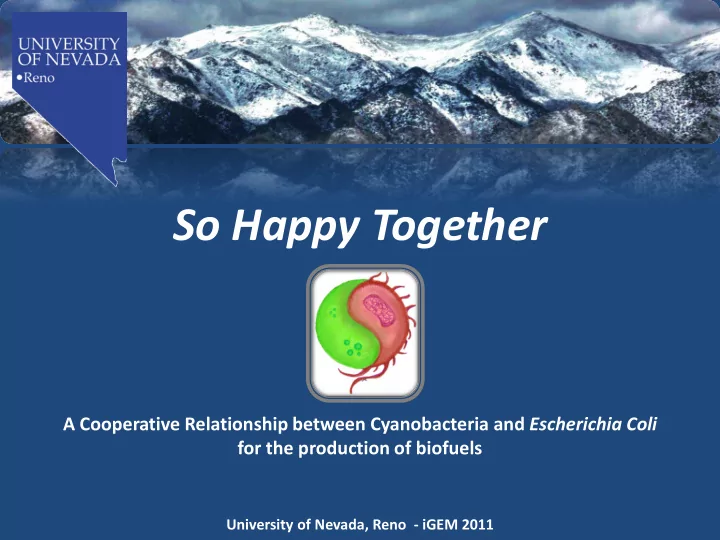
So Happy Together

A Cooperative Relationship between Cyanobacteria and Escherichia Coli for the production of biofuels

University of Nevada, Reno - iGEM 2011

slide-2
SLIDE 2

iGEM Team Nevada 2011

20 Undergraduates in Biochemisty, Biology, Biotechnology and Engineering

With Advisers

  • Dr. Howard
  • Dr. Shintani
  • Dr. Ellison

Introducing

slide-3
SLIDE 3

Concept from Crisis

  • Petroleum is a

disappearing resource

  • As resources diminish,

costs increase

slide-4
SLIDE 4

Biofuels are the Solution

slide-5
SLIDE 5

But at What Cost?

  • Ethanol increases demand for corn which increase corn prices
  • Ethanol profits shrink due to an increase in production cost
  • Fewer crops are planted and farmland prices increase
  • Large biomass requirements for production in corn
slide-6
SLIDE 6

Developing an Alternative Biofuel

  • While we have

manufactured several different types of biofuels, the cost in comparison to petroleum makes it an expensive alternative

  • An inexpensive and self

sustaining biofuel needs to be developed

slide-7
SLIDE 7
  • E. Coli has the potential to produce large quantities of fatty

acids but 30-40% of its production cost goes into supplying growth media How do we reduce this cost?

  • Cyanobacteria has the unique ability to sustain itself without

the cost requirements of E. coli

  • Cyanobacteria produces less than half the amount of biofuel

produced by E. coli How do we solve these problems?

Developing an Alternative Biofuel

slide-8
SLIDE 8

Our Project

Cyanobacteria

  • E. coli
slide-9
SLIDE 9

Electron micrograph of Synechocystis sp 6803

Cyanobacteria under the microscope

Cyanobacteria

  • Cyanobacteria are a phylum of bacteria that
  • btain their energy through photosynthesis
  • Cyanobacteria Synechocystis PCC 6803 is an

excellent research model, because its entire genome has been sequenced and it is easily transformed

  • Team Utah 2010 graciously supplied us with the

cyanobacteria tool kit that allowed us to develop new operons

slide-10
SLIDE 10

Developing an Auxotroph

Glycogen

  • ADP glucose pyrophosphorylase (AGP)
  • Invertase (INV)
  • Glucose Facilitator Transporter (GLF)
slide-11
SLIDE 11

Invertase Development

  • ADP glucose

pyrophosphorylase (AGP) is a naturally occurring gene in Cyanobacteria that converts ADP-glucose to glycogen

  • petBD

a promoter that has strong expression in log and stationary phase

  • Inverstase (INV)

converts ADP-glucose into glucose and fructose

Total Cyanobacteria Genome

slide-12
SLIDE 12

Glucose Facilitative Transporter Development

  • Thiamine monophosphate

pyrophosphorylase (ThiE) a naturally occurring gene in Cyanobacteria that produces thiamine (Vitamin B1)

  • Glucose Facilitator

Transporter (GLF) a transporter gene that moves glucose and fructose

  • utside of the cell

Total Cyanobacteria Genome

Thiamine monophosphate pyrophosphrylase (ThiE)

slide-13
SLIDE 13

Synechocystis Accomplishments

  • Chloramphenical resistance cassette needed to be

debugged before amplification pSB1C3 was used as a template for amplification of the coding region for Chloramphenical resistance

  • All Synechocystis construct parts are amplified and ready for

Gibson

slide-14
SLIDE 14

Our Project

Synechocystis

  • E. coli
slide-15
SLIDE 15

Ethanol Production

  • Pyruvate Decarboxylase

(PDC) converts pyruvate to acetaldehyde (Zymomonas mobilis)

  • Alcohol Dehydrogenase

(ADH) converts acetaldehyde into ethanol

  • σ 70 promoter

Constitutive promoter that is not affected by glucose

slide-16
SLIDE 16

Ethanol Production

  • Pyruvate

Decarboxylase Assay

  • Alcohol Dehydrogenase Assay
slide-17
SLIDE 17

Our Project

Synechocystis

  • E. coli
slide-18
SLIDE 18

Fatty Acid Production

  • Acyl-ACP is

intercepted by Bay Laurel Thioesterase (Umbellularia californica)

  • Bay Laurel Thioesterase will

turn Acyl-Co A in to C12 and C14 fatty acid derivatives.

Acyl-ACP

slide-19
SLIDE 19

Fatty Acid Production

Colorimetric assay results of free fatty acid production versus negative controls

slide-20
SLIDE 20

Fatty Acid Production

  • Gas chromatography results of Bay Laurel Thioesterase

controlled by the σ70 constitutive promoter

slide-21
SLIDE 21

Co-Cultivation

So Happy Together!

slide-22
SLIDE 22

0.2 0.4 0.6 0.8 1 1.2 1.4 1.6 1.8 2 5 10 15 20 25 30

OD (600 nm) Time (hours) 10-ß E. coli cells grown in BG-11 with glucose or BG-11, glucose, and NH4Cl.

LB BG-11 + 50 mM glucose BG-11 + 50 mM glucose + 1.0 mg/mL NH4Cl

  • Confirmed auxotrophies of E. coli

Co-Cultivation: Media

slide-23
SLIDE 23

Co-Cultivation: Media

  • No significant drop in effectiveness of glucose at 2.5 mM

0.2 0.4 0.6 0.8 1 1.2 1.4 1.6 1.8 2 5 10 15 20 25 30

OD (600 nm) Time (hours) Average growth (n=3) of Iq cells grown in BG-11, 0.20% casaminos, and decreasing concentrations of glucose

LB BG-11 BG-11 + .20% casaminos BG-11 + .20% casaminos + 10 mM glucose BG-11 + .20% casaminos + 2.5 mM glucose BG-11 + .20% casaminos + 1.0 mM glucose

slide-24
SLIDE 24

Co-Cultivation: Apparatus

  • Apparatus must run for

several days at a time

  • Stop contamination from

external environment

  • Prevent cross-

contamination as E. coli travels through dialysis tubing

slide-25
SLIDE 25

Co-Cultivation: Apparatus

0.2 0.4 0.6 0.8 1 1.2 21 29 41 48

OD (600 nm) Time (hours) Testing of cross-contamination between chambers (test done in BG-11 + 0.2% casamino acids + 50 mM glucose) Uninoculated Chamber

  • E. coli

Chamber

slide-26
SLIDE 26
  • Solved sequencing errors in

pSB1C3

  • Apparatus used to co-cultivate

different forms of bacteria

  • Developed an ethanol

generator

  • Developed a medium chain

fatty acid generator

Contributions to iGEM

slide-27
SLIDE 27
  • Production of high value compounds in engineered E. coli
  • Self sustaining possibilities for any fermentation system

Future Applications

slide-28
SLIDE 28

Human Practices

Sam and Megan presenting at the Rotary Club Marguerite teaching children about synthetic biology Student performance at UNR iGEM Concert

  • Thank you Elaine
slide-29
SLIDE 29

Submitted 8 parts to registry Demonstrated functionality of two parts Developed apparatus to co-culture E. coli and Synechocystis Collaborated with Utah State Collaborated with MIT in debugging pSB1C3

  • Thank you Austin Che and the Knight Lab at MIT

Developed a method for creating auxotrophies in Synechocystis for environmental control.

Checklist for Commemoration

slide-30
SLIDE 30

Thank You