So South Ca Carolina Department of Natural Reso sources Ma Mari - - PowerPoint PPT Presentation

so south ca carolina department of natural reso sources
SMART_READER_LITE
LIVE PREVIEW

So South Ca Carolina Department of Natural Reso sources Ma Mari - - PowerPoint PPT Presentation

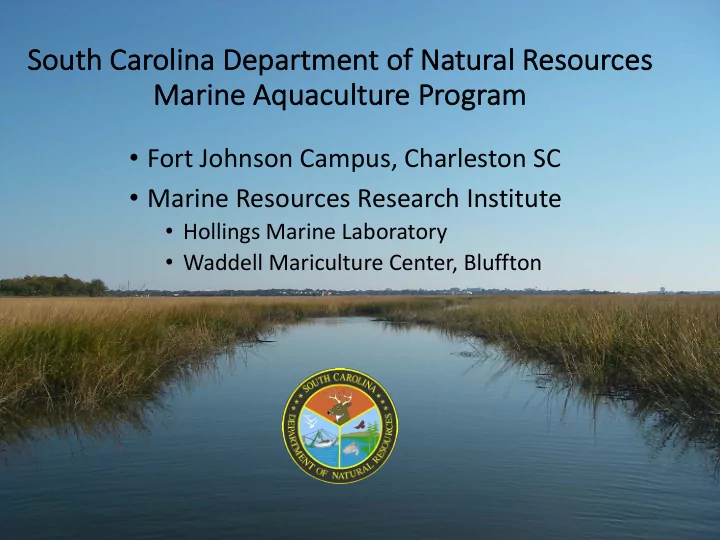
So South Ca Carolina Department of Natural Reso sources Ma Mari rine Aquacultu ture Program Fort Johnson Campus, Charleston SC Marine Resources Research Institute Hollings Marine Laboratory Waddell Mariculture Center, Bluffton


slide-1
SLIDE 1

So South Ca Carolina Department of Natural Reso sources Ma Mari rine Aquacultu ture Program

  • Fort Johnson Campus, Charleston SC
  • Marine Resources Research Institute
  • Hollings Marine Laboratory
  • Waddell Mariculture Center, Bluffton
slide-2
SLIDE 2

Fort Johnson Campus, Marine Resources Center

slide-3
SLIDE 3

Marine Resources Research Institute (MRRI)

slide-4
SLIDE 4

Aquaculture a and S Stoc

  • ck E

k Enhancement T Team

slide-5
SLIDE 5

Aquaculture a and S Stoc

  • ck E

k Enhancement T Team

  • Stock enhancement of marine species
  • Environmental tolerance testing
  • Fish nutrition/feed development
  • “omics” for diet formulation and testing
  • Demonstration-scale testing of diets and treatments
  • Genetic tools for aquaculture
  • Application of Nanobubble technology
  • Effects of parasites on performance and flesh quality
slide-6
SLIDE 6

WM WMC Facilities and nd Research

  • Dr. Aaron Watson and College of

Charleston student David Klett

South Carolina Department of Natural Resources – Mariculture Section - Aquaculture Nutrition Research

  • Develop and evaluate fishmeal and

fish oil replacement feeds and ingredients

  • Utilize traditional aquaculture

production metrics as well as advanced metabolic techniques

  • Increased utilization of more

sustainable and cost-effective ingredients to replace fishmeal and fish oil

  • Evaluate enzyme additions in plant-

based fish feeds to increase mineral utilization

  • Indigestible phytase-bond

phosphorus in plant-based feeds

  • Reduce effluent wastewater by

adding phytase enzymes allow fish to efficiently utilize phosphorus

  • Use of alternative feed ingredients
  • Brewers waste as feed additive
slide-7
SLIDE 7

Br Brood

  • odstoc
  • ck Con

Condition

  • ning Cu

g Culture a at M MRRI

slide-8
SLIDE 8
slide-9
SLIDE 9

WM WMC Facilities and nd Research

Hollings Marine Laboratory

slide-10
SLIDE 10

WM WMC Facilities and nd Research

slide-11
SLIDE 11

WM WMC Facilities and nd Research

  • Dr. Fabio Casu

South Carolina Department of Natural Resources – Mariculture Section - Aquaculture Nutrition NMR based Metabolomics research

  • Increase understanding of nutritional

requirements through metabolic profiling

  • Apply NMR-based metabolite profiling

and LCMS Orbitrap lipid profiling to identify nutritional needs in a variety of feeds, species, and life stages

  • Develop “-Omics” tools for aquaculture

research

  • Development of biomarker discovery

methods and novel metabolism and physiology evaluation techniques

  • Leverage cutting-edge technology to

identify and develop more rapid techniques to diagnose nutritional deficiencies

slide-12
SLIDE 12

WM WMC Facilities and nd Research

  • Dr. Tanya Darden

South Carolina Department of Natural Resources – Genetics Research

  • Using genetic tools to optimize hatchery

production and sourcing broodstock

  • Using Genetics and IBM to determine risk of

net pen escapement

  • Using Genetics and IBMs to optimize hatchery

production and determine stocking goals for stock enhancement

  • Genetic tools to track fish released into the

wild

  • Genetic tools for forensic evaluation of

seafood products

  • eDNA research to locate broodstock, invasive

species detection

slide-13
SLIDE 13

NIS NIST/NO NOAA/ AA/Co Colleg ege e of Ch Charles eston/Ci Citadel el M Military Co y Colleg ege

  • Dr. Peter Moeller
  • Dr. Jody Beers
  • Dr. Peter Lee
  • Dr. Eric McElroy
  • Dr. Mike Janech
  • Dr. Isaure De Buron
  • Dr. Clinton Moran
  • Dr. Tracey Schock
slide-14
SLIDE 14

WM WMC Facilities and nd Research

slide-15
SLIDE 15

WM WMC Facilities and nd Research

Erin Levesque and Dr. Jason Broach South Carolina Department of Natural Resources – Mariculture Section – Waddell Mariculture Center

  • Stock Enhancement Research
  • Improve spawning and larval and juvenile

grow-out techniques for red drum, spotted seatrout, and cobia

  • Evaluate aquaculture potential and ecology
  • f other species of recreational, commercial,

and conservation interest to South Carolina

  • Education and outreach to the public

regarding marine resources and mariculture efforts in South Carolina

slide-16
SLIDE 16

Intensive Aquaculture Research WMC

  • Growout systems
  • 4, 6-tank systems
  • 12, 1,250-L tanks
  • 12, 2,400-L tanks
  • Plumbing also adaptable for

single, interconnected 24-tank system that allows for increased replication with reduced background variation

  • Evaluation of stocking densities,

temperature effects, feed rates, diets, etc.

  • Plumbing adaptable to allow for

external egg collectors and replicated spawning experiments for small-bodied fishes

slide-17
SLIDE 17

Intensive Aquaculture Research WMC

  • Egg/Larval/Zooplankton

System

  • 20, 155-L Tanks
  • 5, 1,063-L Tanks
  • Egg incubation
  • Mass culture of fish larvae
  • Replicated evaluations of

environmental and nutrition effects on larvae

  • Plumbing allows for isolation
  • f individual tanks for

zooplankton culture (rotifers and Artemia)

slide-18
SLIDE 18

Extensive Culture

  • 12, 0.25-acre ponds
  • 9, 0.5-acre ponds
  • 3, 1.25-acre ponds
  • Growout of juveniles and sub-adults

for stock enhancement and tagging studies

  • Commercial, pilot-scale testing for

evaluating growout methods and feasibility

  • Demonstration scale research
slide-19
SLIDE 19

Future Research Projects Funded

  • Replacing Artemia Use in Larval Feeding Regimes of

Three Marine Baitfish- Spot, Pinfish, and Pigfish

  • Evaluating Shellfish Ponds to Produce a Compatible

Crop of Marine Fish, Tripletail Lobotes surinamensis

slide-20
SLIDE 20

Op Opport rtunities es

  • As a consequence of producing fish for stock enhancement

there is often excess fish

  • Key southeast species available
  • Demonstration-scale facilities
  • Access to tools and techniques to help the aquaculture

community

  • SBIR partnerships
  • Cooperative Extension projects
  • Training opportunities
  • Genetic sample processing
  • Consulting
slide-21
SLIDE 21
  • Key Partners
  • State/federal natural resource agencies (NC, GA, MD), Universities

(CofC, Clemson, USC, UGA, VCU, WVU)

  • Zeigler - Red Drum Digestibility (novel ingredients) and Growth Trial
  • Zeigler - Reduction in Fishmeal/effluent waste for Red Drum
  • Ichthus Unlimited – Novel Tuna Diet NMR-based Metabolomics
  • Ichthus Unlimited (pending) – Red Drum Digestibility (novel

ingredients)

  • Barron Algae-algae production as food/ animal feed additive
  • Nanopure Technology-Nanobubble ozonation
  • Hubbs Sea World Research Institute
  • Charleston Brewmasters
  • Swimming Rockfish and Shrimp Farm
  • Southland Fisheries
  • Hampton Roads Sanitation District

Co Collaborations (C (Contractual fu funding, , SBIR, , Joint competitive gr grants)

slide-22
SLIDE 22
  • Use of public resources for private profit
  • Easier for us to partner with organizations rather than companies
  • Non-Disclosure Agreements/ Intellectual Property
  • Cost (Collaborative grant-based model works best)
  • Space (hasn’t been too much of a problem)
  • Risk
  • Competition
  • Time to manage the relationship
  • Safety
  • IACUC

Ch Challenges t to P

  • Public-Pr

Private Partnerships

slide-23
SLIDE 23
  • Saltwater Recreational Saltwater License Funds
  • Sportfish Restoration Funds
  • Soy Aquaculture Alliance
  • Waddell Mariculture Center Fund
  • State of South Carolina
  • Hollings Marine Laboratory
  • Grice Marine Laboratory
  • SCDNR Aquaculture Team

Ackn knowledgements