So What If We Are All Getting Older? Legal and Policy Issues in - - PDF document

so what if we are all getting older legal and policy
SMART_READER_LITE
LIVE PREVIEW

So What If We Are All Getting Older? Legal and Policy Issues in - - PDF document

10/26/2017 So What If We Are All Getting Older? Legal and Policy Issues in Aging By: Roger Manus Director, Senior Law Clinic Campbell University, School of Law Demographic Context (aka Silver Tsunami) # of adults over 65 will increase


slide-1
SLIDE 1

10/26/2017 1

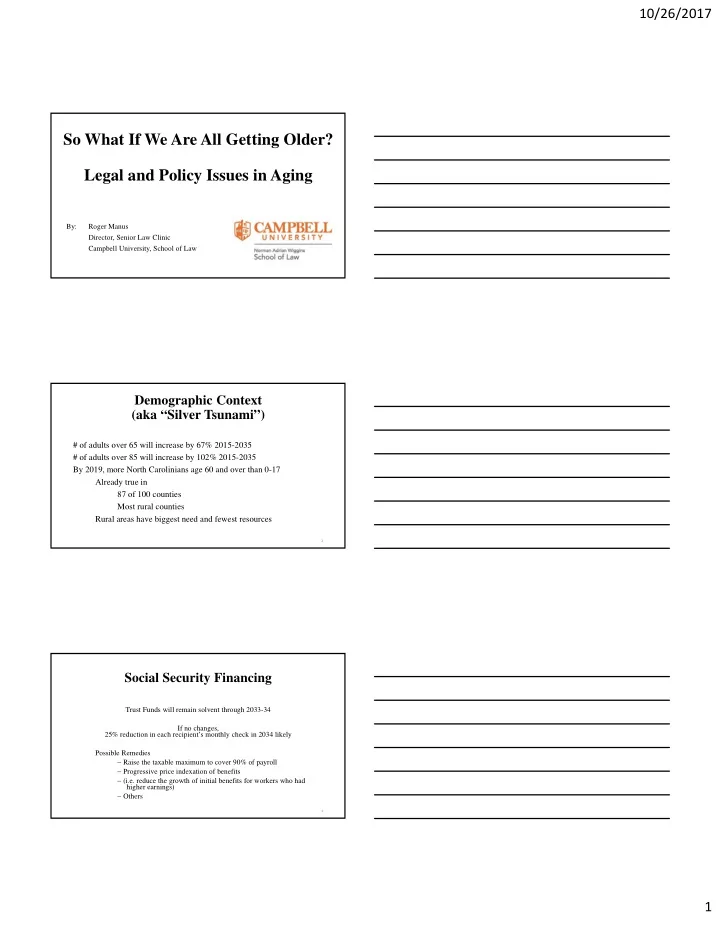
So What If We Are All Getting Older? Legal and Policy Issues in Aging

By: Roger Manus Director, Senior Law Clinic Campbell University, School of Law

Demographic Context (aka “Silver Tsunami”)

# of adults over 65 will increase by 67% 2015-2035 # of adults over 85 will increase by 102% 2015-2035 By 2019, more North Carolinians age 60 and over than 0-17 Already true in 87 of 100 counties Most rural counties Rural areas have biggest need and fewest resources

2

Social Security Financing

Trust Funds will remain solvent through 2033-34 If no changes, 25% reduction in each recipient’s monthly check in 2034 likely Possible Remedies  Raise the taxable maximum to cover 90% of payroll  Progressive price indexation of benefits  (i.e. reduce the growth of initial benefits for workers who had higher earnings)  Others

3

slide-2
SLIDE 2

10/26/2017 2

Government Supports for Health

Medicare Medicaid SHIIP ACA Other

4

Medicare Finances

Will remain solvent through 2029 (last year’s projection was 2028)

5

Medicaid Overview

Federal – State Partnership Most beneficiaries not elderly Most Medicaid funding goes for aged and disabled

6

slide-3
SLIDE 3

10/26/2017 3

N.C. Medicaid Changes

Session Law 2015 – 245 set in motion From fee-for-service to managed care Launch in 2019 Will affect health care of 2,000,000 North Carolinians

7

North Carolina recognized for exemplary Medicaid program but some weaknesses Changes will address weaknesses

8

Some Key Features

  • Integrated health care
  • Tie payment to value by
  • Using managed care approach with monthly capitated payments
  • Encourage Prepaid Health Plans (PHPs) to

 Quickly adopt Value Based Payment (VBP) arrangements with providers, and  Show measurable year to year health improvements from their baseline

  • Improve capacity in rural areas
  • Recognize social determinants of health
  • Acknowledges, but does not address except to

 Screen for  “leverage existing investments”  “identify gaps and opportunities”

  • An example of addressing social determinants:

deliver meals to beneficiaries discharged from hospital who need food assistance as part of their recovery

  • Encourage evidence-based strategies

9

slide-4
SLIDE 4

10/26/2017 4

Limited Exceptions to Mandatory Enrollment in New N.C. Medicaid Managed Care System

Excluded by legislation:

Beneficiaries dually eligible (for Medicaid and Medicare)  PACE beneficiaries  Medically needy beneficiaries  Others

10

Groups For Whom DHHS Proposes 4-Year Delay in Mandatory Enrollment:

  • Dually eligible – 245,000 (61% use institutional care)
  • Medicaid only beneficiaries with long stay (over 90 days)

in nursing homes – 2000

  • CAP/DA non-dual waiver beneficiaries – 1500
  • DHHS proposes shorter delays for 2 other groups
  • Will require legislation

11

Federal Medicaid Changes

If Medicaid gets significant funding reductions, and block granted as part of ACA repeal everything will change If not, Federal changes via administrative actions Section 1115 waivers Sub-Regulatory Guidance e.g. Letters to State Medicaid Directors

12

slide-5
SLIDE 5

10/26/2017 5

Workforce

Access to Geriatricians Access to Nurses Access to Paraprofessionals

13

Geriatrician Shortage

216 in practice in 2014 373 more needed in 2014

14

Nurse Shortage

By 2020, half of today’s nurses will be at traditional retirement age Nurse Licensure Compact (HB 550, 2017) allows nurses from any other compact state to practice in N.C. without additional licensing requirements Fewer than 1% of RNs are certified in gerontology

15

slide-6
SLIDE 6

10/26/2017 6

Access to Paraprofessionals

Personal Care Aides and Home Health Aides are among fastest-growing

  • ccupations. Demand expected to increase by 49% in 2010-2022

Looming severe shortage Population of older Americans is increasing much faster

  • Than the population of women aged 25-44 (the typical direct care worker), and
  • Than the population of potential family caregivers

Exacerbated by low compensation N.C. Medicaid reimbursement rate for aides reduced several years ago In 2017, was raised to $15.60/hr, effective 1/1/18

16

Long-Term Services and Supports

Location Choice “Aging in Place” 75% of older adults intend to live in their current home for the rest of their lives

17

N.C. Ranks 38th per LTCSS Score Card

18

slide-7
SLIDE 7

10/26/2017 7

Government Funded Long-Term Supports and Services

Current institutional long-term care programs Nursing Homes Adult Care Homes Emergency Preparedness

19

Adult Care Homes

1241 in N.C.* Average age of residents is 59* __________

*N.C. Public Press

20

Moving Away From Institutional Bias

Medicaid and Long-Term Supports and Services Role – Pays over half of cost History Katie Beckett Use of Medicaid in adult care homes in N.C.

21

slide-8
SLIDE 8

10/26/2017 8

HCBS* Waiver Programs Fund Various Types of Services

  • Adult day care
  • Personal care
  • Caregiver respite services
  • Other

for Medicaid beneficiaries who would otherwise be institutionalized at greater expense _________

*Home and Community Based Services

22

HCBS Medicaid Waiver Programs in N.C.

  • CAP/DA
  • CAP/Choice

Consumer driven – hire own workers directly

  • “Money follows the Person”

Helps person leave (instead of avoid) institution Cost effective Long wait lists

23

PACE Program for All-Inclusive Care for the Elderly

  • Managed care
  • Uses both Medicaid and Medicare Funds
  • Comprehensive services
  • 2017 Budget Bill requires efficacy study

24

slide-9
SLIDE 9

10/26/2017 9

Additional Federal Efforts to Minimize Institutional Bias in Medicaid

  • ACA increased flexibility in use of Medicaid
  • Incentive Programs
  • CMS Guidance Letters

e.g. re compliance with Omstead decision

25

Result of Efforts to Move Away From Medicaid Institutional Bias

  • Institutional services consume 70% of Medicaid’s LTSS spending,

BUT

  • Less in N.C.
  • Half recipients of Medicaid LTSS spending live in Community

(in U.S.)

26

Moving Away From Institutional Bias in State funding

State-County Special Assistance in Home 2017 Budget Bill allows DHHS to raise 15% cap

27

slide-10
SLIDE 10

10/26/2017 10

Home and Community Block Grant

  • Rooted in Older Americans Act
  • Targets “most needy”
  • Funds critical services to keep older adults healthy and independent
  • Meals
  • Job Training
  • Senior Centers
  • Caregiver Support
  • Transportation
  • Health Promotion
  • Benefits Enrollment

28

HCBG Funding and Wait List

1) Funding ($62 M) a) Federal (about half) b) State i. Flat since 2011 despite population growth and inflation

  • ii. Except cut 2014
  • iii. But cut restored thereafter through non-recurring

appropriations c) Counties and/or providers must add 10% match 2) Wait List – 10,000

29

United Way N.C. 211 Community Resource Line

  • Information and referral service
  • Single portal to access any government social or health service
  • Is contracted to include specialized information re LTSS – “No

Wrong Door Initiative”

  • State funding to:
  • Provide technical assistance (2016)
  • Boost capability in rural counties (2017)

30

slide-11
SLIDE 11

10/26/2017 11

Freedom from Abuse, Neglect and Exploitation

31

Current System of Adult Protective Services (APS)

73% APS service recipients over age 60 12% live in a facility 5% abuse 12% exploitation 69% neglect 66% of neglect is self-neglect 24% of neglect is caretaker neglect

32

Most Frequent Service Needs of APS Beneficiaries

Placement Medical or health care In-home aide services Legal / surrogate decision maker Money management Mental health

33

slide-12
SLIDE 12

10/26/2017 12

Challenges Faced by APS System

1) Increasing complexity of cases (esp. re financial exploitation) 2) Funding

a) 78% from counties b) Federal Funding Has not increased to fulfill the promise of Elder Justice Act Is currently threatened with elimination c) APS reports have increased by 69% in last 8 years, while funding has not

3) No mandated training or caseload limits for APS social workers 4) Limited resources to provide adequate services to victims 5) Severe underreporting

34

Appropriate Use of Guardianship

  • Uniform Adult Guardianship and Protective Proceedings

Jurisdiction Act

  • Establishes rules for:

Transferring guardianship from one state to another States to recognize other states’ guardianship orders A process for establishing guardianship jurisdiction

35

Guardians Ad Litem

Conflicting Duties

36

slide-13
SLIDE 13

10/26/2017 13

Mediations in Guardianship Proceedings

Need Seldom used Few qualified mediators Pilot project to remedy

37

Corporate Guardians

6 of 12 have recently gone out of business, so funding increased in 2017 budget bill Consider need for entities with focused expertise in

  • Mental Illness
  • Substance abuse

38

Monitoring Guardians

Mostly reactive instead of proactive

39

slide-14
SLIDE 14

10/26/2017 14

Rethinking Guardianship Task Force

40

Alternatives to Guardianship

  • Power of Attorney
  • Uniform Power of Attorney Act (SB 569:2017)

Addresses questions not addressed by current statute e.g. What if agents in disagreement? What if agent abuses power and steals from my bank account?

  • New Statutory Form

Effective January 1, 2018

41

Supported Decision-Making

42

slide-15
SLIDE 15

10/26/2017 15

Learning More

Joint subcommittee on aging may be appointed by Joint Legislative Oversight Committee on Health and Human Services To study and issue final report by November 1, 2018 re

  • Service needs
  • How to best address

43

Other Sources of Information

National Council on Aging (www.ncoa.org) Commission on Law and Aging (www.americanbar.org/groups/law_aging.html) Senior Citizens Handbook from N.C. Bar Association NCBA Elder and Special Needs Law Section

44