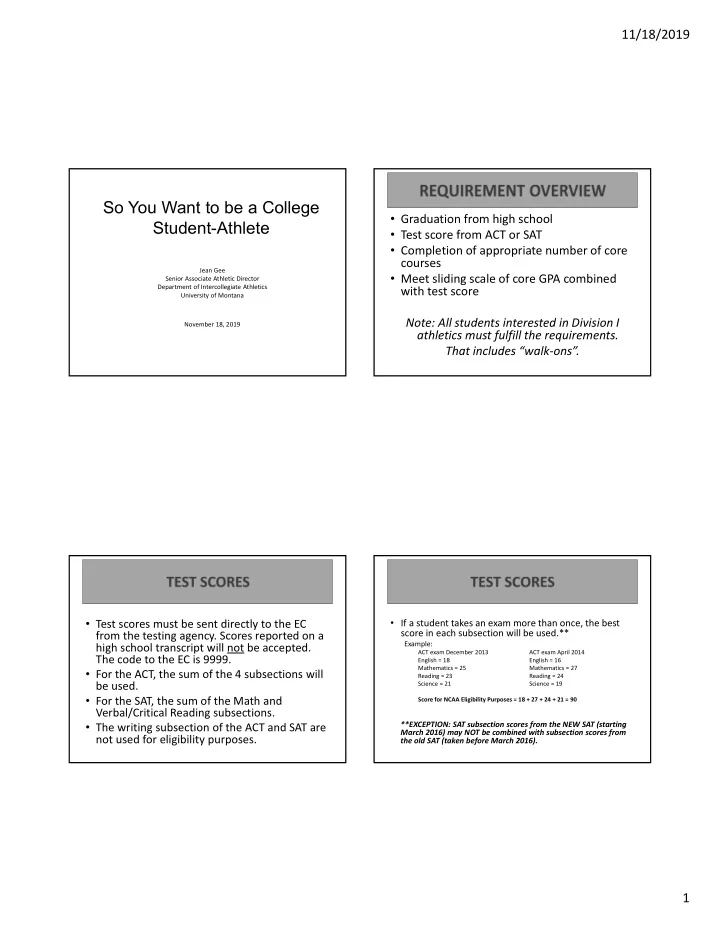
So You Want to be a College Graduation from high school - - PDF document

so you want to be a college
SMART_READER_LITE
LIVE PREVIEW

So You Want to be a College Graduation from high school - - PDF document

11/18/2019 So You Want to be a College Graduation from high school Student-Athlete Test score from ACT or SAT Completion of appropriate number of core courses Jean Gee Meet sliding scale of core GPA combined Senior Associate


slide-1
SLIDE 1

11/18/2019 1

So You Want to be a College Student-Athlete

Jean Gee Senior Associate Athletic Director Department of Intercollegiate Athletics University of Montana November 18, 2019

  • Graduation from high school
  • Test score from ACT or SAT
  • Completion of appropriate number of core

courses

  • Meet sliding scale of core GPA combined

with test score Note: All students interested in Division I athletics must fulfill the requirements. That includes “walk‐ons”.

  • Test scores must be sent directly to the EC

from the testing agency. Scores reported on a high school transcript will not be accepted. The code to the EC is 9999.

  • For the ACT, the sum of the 4 subsections will

be used.

  • For the SAT, the sum of the Math and

Verbal/Critical Reading subsections.

  • The writing subsection of the ACT and SAT are

not used for eligibility purposes.

  • If a student takes an exam more than once, the best

score in each subsection will be used.**

Example:

ACT exam December 2013 ACT exam April 2014 English = 18 English = 16 Mathematics = 25 Mathematics = 27 Reading = 23 Reading = 24 Science = 21 Science = 19 Score for NCAA Eligibility Purposes = 18 + 27 + 24 + 21 = 90

**EXCEPTION: SAT subsection scores from the NEW SAT (starting March 2016) may NOT be combined with subsection scores from the old SAT (taken before March 2016).

slide-2
SLIDE 2

11/18/2019 2

  • How do I know which courses fulfill core?

– Your high school has an approved core course list

  • n file with the NCAA Eligibility Center.

– The courses you take must match the course title

  • n the list exactly in order to use the course in

your core calculation. – If courses you have taken and/or plan to take are not on the list, your high school must submit those courses for approval and inclusion on the list. – High school core course lists can be downloaded from the Eligibility Center website.

  • Will a college course count in core?

– Yes as long as the high school accepts it, it is acceptable for any other student, meets the requirements for core and the high school puts the course on the high school transcript. – College courses do NOT need to be listed on the high school core course list. – Eligibility Center does need to receive an official transcript from the college.

  • Nontraditional courses = courses taught via the internet,

distance learning, independent study, individualized instruction, correspondence, or some variation of any of the above

– Must meet definition of core – The instructor and student must have ongoing access to one another for teaching, evaluating and providing assistance. – The instructor and student must have regular interaction throughout the course. – The student’s work must be available for evaluation and validation. – Grading of the student’s work must be conducted by appropriate academic authorities. – The course includes a defined time period for completion. – The course is acceptable for any student and is placed on the high school transcript.

  • Can I take core courses the summer after I

graduate?

– You must graduate with your class as determined by when you started 9th grade. – As long as you graduate with your class, you may use one (1) core course the summer after graduation.

  • If I don’t meet the test score requirement, can

I retake it while I am attending college?

– NO! You must receive the qualifying test score before you enroll full‐time at your college.

slide-3
SLIDE 3

11/18/2019 3

Establishes two separate standards

  • 1. Athletically related

financial aid and practice

  • 2. Competition

There will be 3 Possible Academic Outcomes

  • 1. Full qualifier = competition, athletics aid

(scholarship), and practice the first year.

  • 2. Academic redshirt = athletics aid the first year,

practice in first regular academic term (semester).

  • 3. Nonqualifier = no athletics aid, practice or

competition the first year. Sixteen (16) core courses required in the following areas:

  • 4 years English;
  • 3 years math at Algebra I level or higher;
  • 2 years natural or physical science (one lab if offered at any

high school attended);

  • 1 year additional English, math or natural/physical science;
  • 2 years social science; and
  • 4 years additional from areas above or foreign language,

philosophy or comparative religion.

slide-4
SLIDE 4

11/18/2019 4

Competition Sliding Scale

Minimum sum ACT or SAT (critical reading and math

  • nly) score that matches the 16 core‐course GPA.
  • Example: 2.3 core‐course GPA requires 980 SAT (new

SAT) or 75 sum ACT.

  • Example: 760 SAT (new SAT) or 55 sum ACT requires

core‐course GPA of 2.875.

Core‐course Progression

  • Must complete 10 core courses before seventh

semester of high school (senior year).

  • Of the 10 core courses completed by the end of

the junior year, seven must be in the area of English, math, or science.

  • These 10 core courses become “locked in” for the

purpose of GPA calculation.

  • A repeat of one of the “locked in” courses will not

be used if taken after the seventh semester begins.

An academic redshirt is created for those prospects that do not meet the “Qualifier” sliding scale requirement and/or the “10/7” requirement, but does meet the “Academic Redshirt” sliding scale and 16‐core course requirement.

Requirements for scholarship and practice

16 core courses in the following areas:

  • 4 years English,
  • 3 years math at Algebra I level or higher,
  • 2 years natural or physical science (one lab if offered by any school attended);
  • 1 year additional English, math or natural/physical science;
  • 2 years social science; and
  • 4 years additional from areas above or foreign language, philosophy or comparative

religion.

Minimum GPA of 2.0 in 16 core courses. Academic redshirt sliding scale:

Minimum sum ACT or SAT score (critical reading/math only) that matches the 16 core‐ course GPA.

Example: Core GPA of 2.00 requires SAT of 1100 (new SAT) or ACT sum of 86.

slide-5
SLIDE 5

11/18/2019 5

  • If these requirements are met an academic

redshirt can receive an athletics scholarship his/her first year and practice with the team during his/her first term (i.e., semester), but cannot participate in competition or team travel.

  • After the first semester is complete, in order to

continue to practice for the rest of the year, the student must have successfully passed 9 semester credits with at least a 2.0 cumulative GPA.

What If A Student Does Not Meet Either Set of Requirements?

He/she then becomes a Nonqualifier and… A. Cannot receive athletics aid during the first year. B. Cannot practice or compete during the first year.

Requirements for a NonQualifier to be eligible after the first year of collegiate enrollment

  • Must pass a minimum of 24 credits during the academic year,

which may include summer.

  • Of those 24 credits, 18 credits must be earned during the

regular two academic semesters (fall and spring) – CANNOT include summer.

  • Must successfully pass 6 credits during each semester.
  • Football Only: Must pass at least 9 credits during the fall term.
  • Must successfully achieve at least a 2.0 cumulative GPA.
  • Complete the registration process with the

NCAA Eligibility Center at the beginning of your junior year at www.eligibilitycenter.org

  • The Eligibility Center must receive official

transcripts from every high school attended.

  • SAT/ACT scores must be sent directly from

the testing agency to the Eligibility Center. The code for the EC is “9999”. Scores on a high school transcript will NOT be accepted.

slide-6
SLIDE 6

11/18/2019 6

  • During the registration process, you will answer a

series of questions. These questions are intended to evaluate your amateurism status.

  • Answer the questions honestly and as completely as

possible.

  • Use a valid and current email address. This is how

the EC will communicate with you if they have questions about any of your answers.

  • During your senior year (beginning April 1), you will

need to log back into your Eligibility Center account and request final amateurism certification.

  • This is your eligibility. Take responsibility!
  • Identify your interest in college athletics to your guidance counselor early.
  • Use the resources available to make sure you are meeting the

requirements:

– Guidance counselor – NCAA website – College compliance offices

  • NCAA requirements and college admissions requirements are different.

Fulfilling one does not mean you are OK with the other. Check with your potential colleges on admissions requirements.

  • The NCAA and your college do not share documents. Therefore, you must

always request two sets of documents be sent: one set to the NCAA and

  • ne set to your selected college.

DO WELL IN SCHOOL!!