SO2 and the air we breathe why flawed decision making puts our - - PowerPoint PPT Presentation

so2 and the air we breathe
SMART_READER_LITE
LIVE PREVIEW

SO2 and the air we breathe why flawed decision making puts our - - PowerPoint PPT Presentation

SO2 and the air we breathe why flawed decision making puts our health at risk The Global Economy The dominant (irrational) belief system of our time Trumps other paradigms. (the bottom line) Inherently wasteful and


slide-1
SLIDE 1

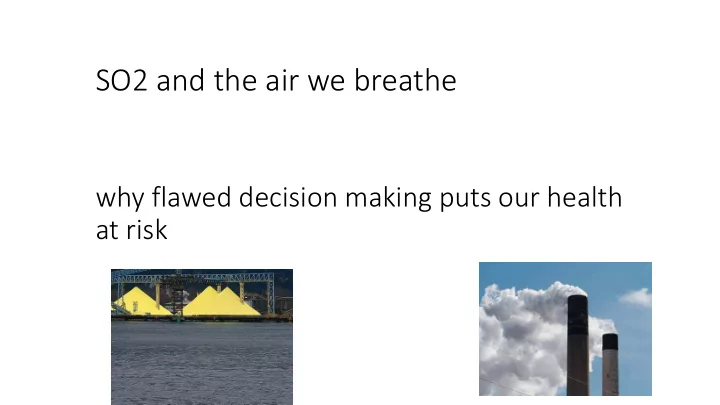
SO2 and the air we breathe

why flawed decision making puts our health at risk

slide-2
SLIDE 2
slide-3
SLIDE 3

The Global “Economy”

  • The dominant (irrational) belief system of our time
  • Trumps other paradigms. (the bottom line)
  • Inherently wasteful and unsustainable
  • Antithetical to ethics or moral considerations (eg. Arms manufacturing

and trade)

  • Exerts powerful ongoing negative pressure against the environment,

human health, and cultural diversity

slide-4
SLIDE 4

Click icon to add picture

Our Clean Air

slide-5
SLIDE 5

What does “world class” mean anyway?

slide-6
SLIDE 6

Our relationship with air is an intimate one

  • 23 000 breaths each day
  • 7 500 000 breaths per year
slide-7
SLIDE 7

Air pollution hits us where we live

slide-8
SLIDE 8

What we know about SO2

  • It is a respiratory irritant, acutely toxic at high levels while at “ambient

levels” it creates an inflammatory response in the respiratory tract causing cough, asthma, reduced exercise capacity, and an increase in emergency room visits. Like almost all respiratory toxins there is no known threshold below which no effects occur.

  • There are numerous observational studies suggesting that its effects

are significant over the long term leading to increased mortality from both respiratory and cardiovascular diseases. These studies are “nonconclusive” because SO2 never exists as the only air pollutant and it is statistically very difficult to tease out its independent effects. (The STAR Report has a reasonable list of these studies up to the date of its publication)

slide-9
SLIDE 9

The natural history of a air pollutants as a a c cause

  • f disease(

( cigarette smoke, particulates and man any y othe hers) s)

  • Initially known to create respiratory irritation
  • Further studies over time demonstrate damage to the respiratory tract

and association with chronic diseases like COPD

  • Eventually the systemic inflammatory damage is shown to profoundly

affect the cardiovascular system causing stress on the heart, blood vessels and vital organs. Cigarette smoke is now listed as a causal factor in a multitude of diseases while in the early 1950s it was dismissed as a respiratory irritant only.

slide-10
SLIDE 10

Prob

  • blem

ems with t the SO2 d decision

  • n m

making process in r relati tion t to i installing scr crubbers

  • Decision was based on out dated models which serve industry well

while allowing the public to assume the risk.

  • CALPUFF air dispersion model does not factor in climate change or the

interaction between multiple air pollutants from other sources…eg..forest fires. This is important!

  • Threshold assumptions about no effect levels are assumed in spite of

the scientific invalidity of this approach while guidelines continue to lag behind science.

  • The trends are not factored in: legally the question is limited to what

can we get away with at this point in time.

slide-11
SLIDE 11

Prob

  • blem

ems with t the SO2 d decision

  • n m

making process in r relati tion t to i installing scr crubbers

  • Public consultation and consideration was stage managed by

consultants for industry

  • Timelines were too short for meaningful input and critical evaluation of

documents

  • Input from Northern Health to MOE recommending that the

installation of scrubbers to reduce SO2 emissions to lowest achievable be a condition of the permit was ignored.

  • Lack of objective scientific review…MOE worked hand in hand with RTA. Industry

consultants brought “world class” expertise to the process of getting to “yes” and putting a spin on the data. (“if a cause cannot be proven that can be taken as proof

  • f no cause”)
slide-12
SLIDE 12

Prob

  • blem

ems with t the SO2 d decision

  • n m

making process in r relati tion t to i installing scr crubbers

  • Monitoring ambient levels of SO2 is interesting but linked to the old

“threshold” model and irrelevant to the concerns about chronic low level exposures adding respiratory and cardiovascular stress to the population

  • The idea of human health monitoring directly seems to have been set
  • aside. Monitoring of administrative data such as doctor visits,

medication use, or hospitalisation rates has no chance of demonstrating even real health effects. The population is too small, the baseline data, non existent or of poor quality and the potential for “proving” an outcome is the direct result of SO2 emissions is essentially zero.

slide-13
SLIDE 13

In C Conclusion:

  • 42 metric tonnes a day is a lot of SO2 !
  • Some of it will be present in and irritating our airways and lungs day in

and day out. The effects will be greater than predicted by the models especially when particulate levels in the air increase and SO2 is precipitated onto the particles and deposited in the alveoli along with the particulate matter

  • Our clean air is truly world class and its worth fighting for.
  • Scrubbers would largely alleviate the SO2 concern. We should ensure

that industry lives up to its “world class” self image and that our politicians and regulators put our health ahead of corporate interests.

slide-14
SLIDE 14

Thank you!

David Bowering MD. MHSc.