Social History of Ideas Social History of Ideas Historians have a - - PDF document

social history of ideas social history of ideas
SMART_READER_LITE
LIVE PREVIEW

Social History of Ideas Social History of Ideas Historians have a - - PDF document

12/10/2009 Social History of Ideas Social History of Ideas Historians have a rich appreciation of ideas like Historians have a rich appreciation of ideas like Democracy Democracy How the Computer Became How the Computer Became


slide-1
SLIDE 1

12/10/2009 1

How the Computer Became How the Computer Became Information Technology Information Technology

Thomas Haigh Thomas Haigh The Haigh Group & The Haigh Group & University of Wisconsin University of Wisconsin – – Milwaukee Milwaukee thaigh@computer.org thaigh@computer.org www.tomandmaria.com/tom www.tomandmaria.com/tom

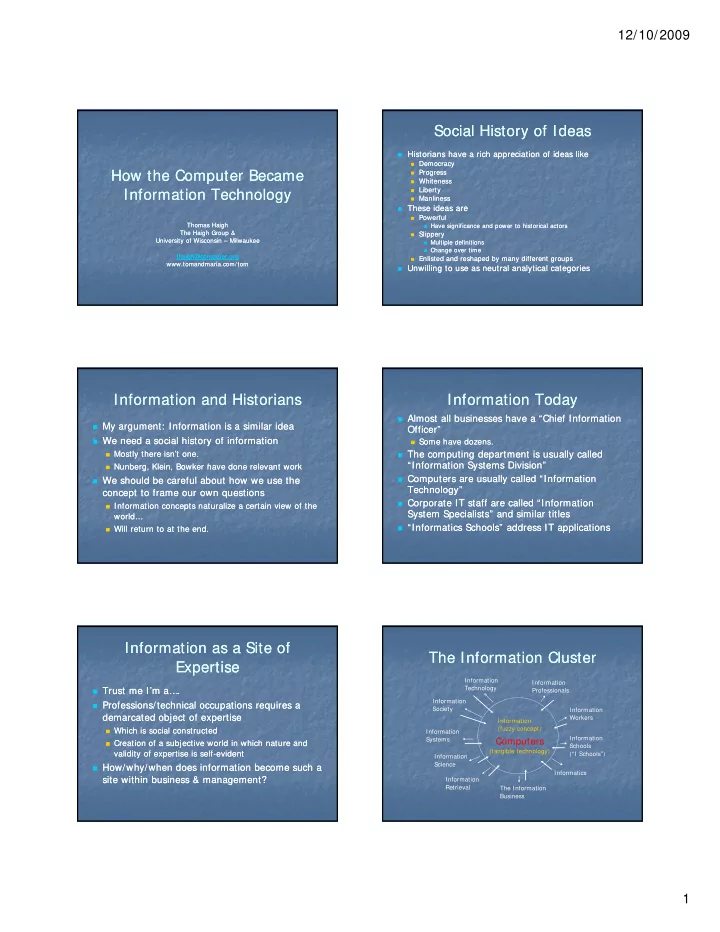
Social History of Ideas Social History of Ideas

 Historians have a rich appreciation of ideas like

Historians have a rich appreciation of ideas like

 Democracy

Democracy

 Progress

Progress

 Whiteness

Whiteness

 Liberty

Liberty

 Manliness

Manliness

 These ideas are

These ideas are

 These ideas are

These ideas are

 Powerful

Powerful

 Have significance and power to historical actors

Have significance and power to historical actors

 Slippery

Slippery

 Multiple definitions

Multiple definitions

 Change over time

Change over time

 Enlisted and reshaped by many different groups

Enlisted and reshaped by many different groups

 Unwilling to use as neutral analytical categories

Unwilling to use as neutral analytical categories

Information and Historians Information and Historians

 My argument: Information is a similar idea

My argument: Information is a similar idea

 We need a social history of information

We need a social history of information

 Mostly there isn’t one.

Mostly there isn’t one.

 Nunberg Klein Bowker have done relevant work

Nunberg Klein Bowker have done relevant work

 Nunberg, Klein, Bowker have done relevant work

Nunberg, Klein, Bowker have done relevant work

 We should be careful about how we use the

We should be careful about how we use the concept to frame our own questions concept to frame our own questions

 Information concepts naturalize a certain view of the

Information concepts naturalize a certain view of the world… world…

 Will return to at the end.

Will return to at the end.

Information Today Information Today

 Almost all businesses have a “Chief Information

Almost all businesses have a “Chief Information Officer” Officer”

 Some have dozens.

Some have dozens.

 The computing department is usually called

The computing department is usually called “Information Systems Division” “Information Systems Division” Information Systems Division Information Systems Division

 Computers are usually called “Information

Computers are usually called “Information Technology” Technology”

 Corporate IT staff are called “Information

Corporate IT staff are called “Information System Specialists” and similar titles System Specialists” and similar titles

 “Informatics Schools” address IT applications

“Informatics Schools” address IT applications

Information as a Site of Information as a Site of Expertise Expertise

 Trust me I’m a….

Trust me I’m a….

 Professions/technical occupations requires a

Professions/technical occupations requires a demarcated object of expertise demarcated object of expertise

 Which is social constructed

Which is social constructed

 Creation of a subjective world in which nature and

Creation of a subjective world in which nature and validity of expertise is self validity of expertise is self-

  • evident

evident

 How/why/when does information become such a

How/why/when does information become such a site within business & management? site within business & management?

The Information Cluster The Information Cluster

Information Technology Information Professionals Information Workers Information Society Information Information Systems Information Retrieval The Information Business Information Schools (“I Schools”) (fuzzy concept)

Computers

(tangible technology) Informatics Information Science

slide-2
SLIDE 2

12/10/2009 2 Information Was About Informing Information Was About Informing

 OED shows word “Information” used back

OED shows word “Information” used back to 1450 to 1450

 Root is in act of “Informing”

Root is in act of “Informing”

“For your information” on a memo “For your information” on a memo

 For your information on a memo

For your information on a memo

 Tourist information office

Tourist information office

 US Constitution: President “give Congress

US Constitution: President “give Congress information of the state of the Union” information of the state of the Union”

 (Analyzed by Geoff Nunberg

(Analyzed by Geoff Nunberg – – “Farewell to “Farewell to the Information Age”) the Information Age”)

“Information as a Thing” “Information as a Thing”

 Title of a paper by information scientist Michael

Title of a paper by information scientist Michael Buckland, distinguishing Buckland, distinguishing

 Information as process (informing)

Information as process (informing)

 Information as knowledge (known by someone)

Information as knowledge (known by someone) g ( y ) g ( y )

 Information as a thing (synonym for fact/data)

Information as a thing (synonym for fact/data)

 My claim is that 3

My claim is that 3rd

rd meaning is

meaning is

 New

New

 Now dominant

Now dominant

 Inseparable from computer technology

Inseparable from computer technology

 First popularized as a site of expertise

First popularized as a site of expertise

1910-1950 2: No discussion of information as concept or site of expertise. 1950s (1st generation computers) 3: Information Theory appears in Computer Engineering. 4: Management Information Systems concept spreads (1959-68) 1960s (2nd & 3rd generation computers) 5: Data Base Concept Spreads (early 1960s & 1970s) Business Computer use called "Electronic Data Processing" 1970s MIS as new name 6: Information Society 7: Information 1970s (online applications) MIS as new name for computer dept 1980s (Networks, PCs) 6: Information Society Concept Spreads 7: Information Technology Concept Spreads 1990s 8: Chief Information Officer & Information Systems or IT Dept

2: The Absence of “Information” 2: The Absence of “Information” In Business Prior to 1950 In Business Prior to 1950

W.H. Leffingwell W.H. Leffingwell

 Leader of Scientific Office

Leader of Scientific Office Management Movement Management Movement

 1910s

1910s-

  • 1930s

1930s

 Influenced by Taylor

Influenced by Taylor

 Expert on office systems and

Expert on office systems and

 Expert on office systems and

Expert on office systems and technologies technologies

 Tried to create new profession

Tried to create new profession

  • f Office Manager
  • f Office Manager

 Broad authority over

Broad authority over administrative systems and administrative systems and procedures procedures

 Supervision of all clerical workers

Supervision of all clerical workers

Leffingwell, from 1925 textbook Leffingwell, from 1925 textbook

slide-3
SLIDE 3

12/10/2009 3

Advertisement from System Magazine, mid-1910s

The Power of File Cards The Power of File Cards

“… Acme visible records force their owners “… Acme visible records force their owners to use the facts to use the facts -

  • profit by them, save

profit by them, save money by them, stop losses before they money by them, stop losses before they y y , p y y y , p y get started…. Its successful operation in get started…. Its successful operation in your business will be automatic…” your business will be automatic…” (Advertisement for Acme file cards, System (Advertisement for Acme file cards, System magazine 1932) magazine 1932)

Systems, Facts Systems, Facts – – NOT “information”, IT, information systems, etc NOT “information”, IT, information systems, etc

3: Information Theory and 3: Information Theory and Computer Engineering Computer Engineering in the 1950s in the 1950s

1910-1950 2: No discussion of information as concept or site of expertise. 1950s (1st generation computers) 3: Information Theory appears in Computer Engineering. 4: Management Information Systems concept spreads (1959-68) 1960s (2nd & 3rd generation computers) 5: Data Base Concept Spreads (early 1960s & 1970s) Business Computer use called "Electronic Data Processing" 1970s ( li MIS as new name f t d t 6: Information Society C t S d 7: Information T h l (online applications) for computer dept 1980s (Networks, PCs) Concept Spreads Technology Concept Spreads 1990s 8: Chief Information Officer & Information Systems or IT Dept

Information in the 50s Information in the 50s

  “Information Theory”

“Information Theory” – – fashionable & novel fashionable & novel during late 1940s, early 1950s during late 1940s, early 1950s

slide-4
SLIDE 4

12/10/2009 4

Shannon’s Information Theory Shannon’s Information Theory

 Generalized representation of digital

Generalized representation of digital communication communication

 Message from Sender

Message from Sender  Receiver Receiver

 i.e. a process of INFORMING

i.e. a process of INFORMING p

 But rapidly taken up within computing

But rapidly taken up within computing engineering engineering

 Signals constantly flowing between parts of the

Signals constantly flowing between parts of the machine machine

 E.g. Tape drive

E.g. Tape drive  Memory Memory  Register Register

 No human is involved in the process

No human is involved in the process

 Blurs line between transmission & storage

Blurs line between transmission & storage

Giant Brains, 1949 Giant Brains, 1949

 Computer as the

Computer as the latest and most latest and most powerful “physical powerful “physical equipment for equipment for handling information” handling information”

 Like nerve cells,

Like nerve cells, writing, human writing, human gestures gestures

 Earliest statement of

Earliest statement of this concept? this concept?

Information Information Theory Arrives Theory Arrives in Business in Business

  • Fashionable
  • Scientific

Fortune, 1953 Sc e t c

  • Powerful
  • Ill-defined

4: Management Information 4: Management Information Systems Systems

1910-1950 2: No discussion of information as concept or site of expertise. 1950s (1st generation computers) 3: Information Theory appears in Computer Engineering. 4: Management Information Systems concept spreads (1959-68) 1960s (2nd & 3rd generation computers) 5: Data Base Concept Spreads (early 1960s & 1970s) Business Computer use called "Electronic Data Processing" 1970s MIS as new name 6: Information Society 7: Information (online applications) for computer dept 1980s (Networks, PCs) Concept Spreads Technology Concept Spreads 1990s 8: Chief Information Officer & Information Systems or IT Dept

The Computer Enters Business The Computer Enters Business

slide-5
SLIDE 5

12/10/2009 5 Early corporate Early corporate computer use as computer use as Data Processing Data Processing

Haigh, Thomas. "The Chromium- Plated Tabulator: Institutionalizing an Electronic Revolution, 1954-1958." IEEE Annals of the History of Computing 23, no. 4 (2001): 75-104.

Social History of Data Processing Social History of Data Processing

 Strong ties to Punched Card work

Strong ties to Punched Card work

 Fairly low status work

Fairly low status work

 Data Processing Management Association

Data Processing Management Association

G f DP i G f DP i

 Group for DP supervisors

Group for DP supervisors

 Seek collective mobility

Seek collective mobility

 Tied to position of corporate DP departments

Tied to position of corporate DP departments

 Computing staff rise with the computer up the

Computing staff rise with the computer up the corporate ladder corporate ladder

 Seek new identities, claims to expertise to accomplish

Seek new identities, claims to expertise to accomplish this this

A Manifesto in Org Charts, 1969 A Manifesto in Org Charts, 1969

Closeups: above is endpoint Below is startpoint

Management Information Systems Management Information Systems

 Coined in 1959 by American Management

Coined in 1959 by American Management Association group Association group

 “The Continuing Seminar on Management Information

“The Continuing Seminar on Management Information Systems” Systems”

 Elites of the “systems”, management consulting and

Elites of the “systems”, management consulting and computer vending communities computer vending communities computer vending communities computer vending communities

 “Totally Integrated Management Information

“Totally Integrated Management Information System” System”

 INFORMS each manager of what he/she needs to

INFORMS each manager of what he/she needs to know to make decisions know to make decisions

 System include models, forecasts, projections

System include models, forecasts, projections

 Used directly by top executives

Used directly by top executives

Haigh, Thomas. "Inventing Information Systems: The Systems Men and the Computer, 1950-1968." Business History Review 75, no. 1 (2001): 15- 61.

Very Influential in 1960s Very Influential in 1960s

  Endorsed by

Endorsed by

 Management writers

Management writers

 Computer consultants

Computer consultants

 Computer companies

Computer companies

  • pu
  • pa
  • pu
  • pa

  Impossible to realize

Impossible to realize with technologies of the with technologies of the day day

 Backlash begins around

Backlash begins around 1968 1968

slide-6
SLIDE 6

12/10/2009 6

Power of Information Power of Information

“When complete information is available, the “When complete information is available, the policy or decision may already have been made. policy or decision may already have been made. Another way to say this is the facts speak for Another way to say this is the facts speak for th l d i l f l th l d i l f l themselves and require only a formal themselves and require only a formal acceptance and stamp of approval by the line acceptance and stamp of approval by the line executive rather than a decision.” executive rather than a decision.”

(McDonough, Adian. "The Scope of Management Systems: Past, (McDonough, Adian. "The Scope of Management Systems: Past, Present and Future." In Total Systems, edited by Alan D. Meacham Present and Future." In Total Systems, edited by Alan D. Meacham and Van B. Thompson, 20 and Van B. Thompson, 20-

  • 24. Detroit, MI: American Data
  • 24. Detroit, MI: American Data

Processing, Inc., 1962.) Processing, Inc., 1962.)

MIS Will Realize Potential of computer… MIS Will Realize Potential of computer…

Harvard Business Review Harvard Business Review -

  • 1964

1964

Univac Advertisement, Business Week 1965 Univac Advertisement, Business Week 1965

Utopian Promises for MIS Utopian Promises for MIS

“a more relaxed, leisurely management environment. The uneasiness will be replaced by a feeling of confidence in the completeness and timeliness of information and in the decisions based on that information….”

5: Database Management 5: Database Management System & Databanks System & Databanks

1910-1950 2: No discussion of information as concept or site of expertise. 1950s (1st generation computers) 3: Information Theory appears in Computer Engineering. 4: Management Information Systems concept spreads (1959-68) 1960s (2nd & 3rd generation computers) 5: Data Base Concept Spreads (early 1960s & 1970s) Business Computer use called "Electronic Data Processing" 1970s MIS as new name 6: Information Society 7: Information (online applications) for computer dept 1980s (Networks, PCs) Concept Spreads Technology Concept Spreads 1990s 8: Chief Information Officer & Information Systems or IT Dept

slide-7
SLIDE 7

12/10/2009 7 The Data Base The Data Base

 “A veritable

“A veritable bucket of facts… bucket of facts… into which into which information information seeking ladles of seeking ladles of seeking ladles of seeking ladles of various sizes and various sizes and shapes are shapes are thrust…” thrust…”

 Milton D. Stone,

Milton D. Stone, 1962 1962

Business Conception Rather Vague Business Conception Rather Vague

 Shared pool of data between applications

Shared pool of data between applications

 Data Base as technological foundation for MIS

Data Base as technological foundation for MIS

Extension of MIS? Extension of MIS?

 “Writings on MIS have waned recently and have

“Writings on MIS have waned recently and have largely been replaced by writings on the Data largely been replaced by writings on the Data Base… the titles [of articles] are remarkably Base… the titles [of articles] are remarkably similar….” Richard L. Nolan, 1974 similar….” Richard L. Nolan, 1974

 SIMILAR: both about integrating corporate

SIMILAR: both about integrating corporate systems and providing managers with systems and providing managers with information information

 DIFFERENT:

DIFFERENT:

 MIS

MIS – – start by identifying all information needs start by identifying all information needs

 Data Base

Data Base – – build data repository to support querying build data repository to support querying and analysis as needed and analysis as needed

“Data” not Information “Data” not Information

  Data Base Management System

Data Base Management System

 Specific kind of systems software sold from

Specific kind of systems software sold from 1970s onward as data store 1970s onward as data store

  NOT an “information base”

NOT an “information base”

 Information is still associated more with

Information is still associated more with communication, not facts to be stored communication, not facts to be stored

6: The Information Society 6: The Information Society and the Information Age and the Information Age

1910-1950 2: No discussion of information as concept or site of expertise. 1950s (1st generation computers) 3: Information Theory appears in Computer Engineering. 4: Management Information Systems concept spreads (1959-68) 1960s (2nd & 3rd generation computers) 5: Data Base Concept Spreads (early 1960s & 1970s) Business Computer use called "Electronic Data Processing" 1970s MIS as new name 6: Information Society 7: Information (online applications) for computer dept 1980s (Networks, PCs) Concept Spreads Technology Concept Spreads 1990s 8: Chief Information Officer & Information Systems or IT Dept

slide-8
SLIDE 8

12/10/2009 8 1970s: Spread of Info 1970s: Spread of Info Terms Inside Business Computing Terms Inside Business Computing

 1972: Data Processing Management Association

1972: Data Processing Management Association renames its show “Info/Expo” renames its show “Info/Expo”

 1972: Business Automation magazine becomes

1972: Business Automation magazine becomes Infosystems Infosystems

 Management Information Systems becomes

Management Information Systems becomes

 New name for computer department

New name for computer department

 (as VP, MIS) New name for computer manager

(as VP, MIS) New name for computer manager

 Blanket name for computer education/research in

Blanket name for computer education/research in business schools business schools

Resurgence of Interest in Resurgence of Interest in Computers in 1970s Computers in 1970s

  First microprocessors and mass market

First microprocessors and mass market chip 1970s chip 1970s

  Late 1970s also saw popularization of

Late 1970s also saw popularization of ideas of ideas of

 Information technology

Information technology

 Information society/Post Industrial Society

Information society/Post Industrial Society

 Computer literacy

Computer literacy

 Microcomputer revolution

Microcomputer revolution

The Third Wave The Third Wave

 Futurist Alvin Toffler

Futurist Alvin Toffler

 1980, influential example of

1980, influential example of “information age” thinking “information age” thinking

 The Third Wave will

The Third Wave will

 “sweep across history

“sweep across history and complete itself in a and complete itself in a few decades Tearing few decades Tearing few decades… Tearing few decades… Tearing

  • ur families apart,
  • ur families apart,

rocking our economy, rocking our economy, paralyzing our political paralyzing our political systems, shattering our systems, shattering our values.” values.”

 “Telecottages” &

“Telecottages” & “Virtual organizations” “Virtual organizations”

 Everyone works from

Everyone works from home home

Micro Millennium Micro Millennium

 Utopian best seller

Utopian best seller

 Computer replace doctors

Computer replace doctors and lawyers in 1980s and lawyers in 1980s

 Human race largely retires

Human race largely retires g y g y

 Ultra Intelligent machines

Ultra Intelligent machines by early 1990s by early 1990s

 Basic for a TV series

Basic for a TV series

 “Could be the most

“Could be the most important book of the important book of the next two decades” next two decades” – – Playboy Playboy

The Information Business (1980) The Information Business (1980)

7: Information Technology 7: Information Technology

slide-9
SLIDE 9

12/10/2009 9

1910-1950 2: No discussion of information as concept or site of expertise. 1950s (1st generation computers) 3: Information Theory appears in Computer Engineering. 4: Management Information Systems concept spreads (1959-68) 1960s (2nd & 3rd generation computers) 5: Data Base Concept Spreads (early 1960s & 1970s) Business Computer use called "Electronic Data Processing" 1970s MIS as new name 6: Information Society 7: Information (online applications) for computer dept 1980s (Networks, PCs) Concept Spreads Technology Concept Spreads 1990s 8: Chief Information Officer & Information Systems or IT Dept

Information Technology Information Technology

 1958

1958 – – Harvard Business Harvard Business Review Review – – “Management “Management in the 1980s”. in the 1980s”.

 First use of phrase

First use of phrase “Information Technology”? “Information Technology”?

 IT =

IT =

 Computers +

Computers +

 Mathematical simulation +

Mathematical simulation +

 Operations Research

Operations Research

Revived in 1970s Revived in 1970s

 IT receives few mentions during 1960s

IT receives few mentions during 1960s

 Revives in late 1970s

Revives in late 1970s

 Along side Information Society, Computer Revolution,

Along side Information Society, Computer Revolution, etc. etc.

 Originally means

Originally means

 Computers + Telecoms

Computers + Telecoms

 Soon becomes a pretentious synonym for

Soon becomes a pretentious synonym for computers computers

 Particularly in policy circles

Particularly in policy circles

 (Today people talk about ICTs)

(Today people talk about ICTs)

LEXIS-NEXIS Count of Incidence Of Selected Terms in Business Week, US News & The Economist

1500 2000 2500 Information Technology/Processing Data processing Computer 500 1000 1 9 7 5 1 9 7 7 1 9 7 9 1 9 8 1 1 9 8 3 1 9 8 5 1 9 8 7 1 9 8 9 1 9 9 1 1 9 9 3 1 9 9 5 1 9 9 7 1 9 9 9 2 1

8: The Chief Information 8: The Chief Information Officer Officer

1910-1950 2: No discussion of information as concept or site of expertise. 1950s (1st generation computers) 3: Information Theory appears in Computer Engineering. 4: Management Information Systems concept spreads (1959-68) 1960s (2nd & 3rd generation computers) 5: Data Base Concept Spreads (early 1960s & 1970s) Business Computer use called "Electronic Data Processing" 1970s MIS as new name 6: Information Society 7: Information (online applications) for computer dept 1980s (Networks, PCs) Concept Spreads Technology Concept Spreads 1990s 8: Chief Information Officer & Information Systems or IT Dept

slide-10
SLIDE 10

12/10/2009 10

Chief Information Officer Chief Information Officer

 Phrased coined circa 1980

Phrased coined circa 1980

 William R Synnott, head of Info Systems & Services

William R Synnott, head of Info Systems & Services for First National Bank of Boston for First National Bank of Boston

 Promoted in 1981 book “Information Resource

Promoted in 1981 book “Information Resource M t” M t” Management” Management”

 CIO heads “Information Resource Management”

CIO heads “Information Resource Management” department department

 Prescriptive: the “CIO role does not exist except

Prescriptive: the “CIO role does not exist except in the minds of imaginative leaders today.” in the minds of imaginative leaders today.”

The CIO Concept The CIO Concept

 Information is the new money

Information is the new money

 The key resource of 1980s business

The key resource of 1980s business

 But nobody is in charge of it

But nobody is in charge of it

 CIO is the CFO of information

CIO is the CFO of information

 Information, not data processing or computers as site of

Information, not data processing or computers as site of i i expertise expertise

 Accounting

Accounting – – just one kind of information just one kind of information

 Sees as claim to corporate power

Sees as claim to corporate power

 “Data processing connotes a technical limitation… it is important

“Data processing connotes a technical limitation… it is important the right identification be established” the right identification be established”

 Information gives powerful corporate mandate

Information gives powerful corporate mandate

 “issuance of corporate policy and instructions is, in fact, an

“issuance of corporate policy and instructions is, in fact, an information service.” information service.”

Spread from 1986 Onward Spread from 1986 Onward

 CIO concept widely featured in business

CIO concept widely featured in business press press

 Badge of status among computer

Badge of status among computer managers managers managers managers

 Often as new title for old job

Often as new title for old job

 Synnott says “There are a lot of fake CIOs….

Synnott says “There are a lot of fake CIOs…. It’s like Santa Claus. They’re on every street It’s like Santa Claus. They’re on every street corner, but you know they’re not all real.” corner, but you know they’re not all real.”

 Big firms create many CIOs!

Big firms create many CIOs!

The CIO Role The CIO Role

 Higher status, more managerial

Higher status, more managerial

 “Technicians need not apply… Unlike their

“Technicians need not apply… Unlike their predecessors predecessors— —the chief data the chief data-

  • processing operating

processing operating

  • fficers
  • fficers—

—CIOs are business managers first.” (1983 CIOs are business managers first.” (1983 article) article)

 Tied into tech transition to PCs, networks

Tied into tech transition to PCs, networks

 No central monopoly on computer hardware or

No central monopoly on computer hardware or systems systems

 More policy and standards setting

More policy and standards setting

 Debate over background

Debate over background

 IT or general business best?

IT or general business best?

Information as Area of Authority Information as Area of Authority

 Still focused on technology & systems

Still focused on technology & systems

 Narrow reading of information, excludes

Narrow reading of information, excludes

 Brand management & advertising

Brand management & advertising

 Technical writing etc

Technical writing etc

 Technical writing, etc.

Technical writing, etc.

 Not just computers, networks and

Not just computers, networks and databases (ie Information technology) but databases (ie Information technology) but also their also their

 Contents

Contents

 Uses

Uses

Fuzziness of “Information” Fuzziness of “Information”

 

Is crucial Is crucial – – CIO responsible for CIO responsible for

1. 1.

“Information systems” to inform managers “Information systems” to inform managers

2

Responsibility for defining and managing Responsibility for defining and managing

2. 2.

Responsibility for defining and managing Responsibility for defining and managing corporate databases corporate databases

3. 3.

“Information technology” standards and “Information technology” standards and infrastructure infrastructure – – ie computers & networks ie computers & networks

 

“Information” unites these three formerly “Information” unites these three formerly distinct areas distinct areas

slide-11
SLIDE 11

12/10/2009 11

Some Skeptics Some Skeptics

“Information is no more than a linguistic “Information is no more than a linguistic convenience that saves you the trouble of convenience that saves you the trouble of thinking what you are talking about.” thinking what you are talking about.” g y g g y g

 Robert A Fairthorne, 1965

Robert A Fairthorne, 1965

“Are We There Yet” “Are We There Yet”

  Annual suvey in CIO

Annual suvey in CIO magazine charts magazine charts progress progress

 % reporting to CEO or

% reporting to CEO or board (51% by 2002) board (51% by 2002)

 % involved in strategy

% involved in strategy formation, etc formation, etc

  Progress is slow but real

Progress is slow but real

9: Beyond Information 9: Beyond Information The Information Pyramid The Information Pyramid

 New, higher status realms above information

New, higher status realms above information

 Knowledge

Knowledge

 Data

Data

 Reaction against association of information with

Reaction against association of information with computer achieved though IT, CIO computer achieved though IT, CIO

Chief Knowledge Officer Chief Knowledge Officer

 Popular idea from late

Popular idea from late-

  • 90s onward

90s onward

 Intended to be broader than CIO

Intended to be broader than CIO

 Push beyond computerized systems

Push beyond computerized systems y p y y p y

 More focused on business

More focused on business

 (Both originally promised for CIO & DBA)

(Both originally promised for CIO & DBA)

 Like CIO

Like CIO

 Well publicized movement to create position

Well publicized movement to create position

 Big variation between firms in adoption, role

Big variation between firms in adoption, role

Conclusions Conclusions

slide-12
SLIDE 12

12/10/2009 12

We Have Seen We Have Seen

 The recent (post

The recent (post-

  • 1950) origins of

1950) origins of

 Information as a synonym for facts or data

Information as a synonym for facts or data

 IT, information systems & other info terms

IT, information systems & other info terms

 Information as a commodity or fix for

Information as a commodity or fix for

 These developments were

These developments were

 Pushed by social groups seeking a broad and

Pushed by social groups seeking a broad and attractive domains for claimed expertise & attractive domains for claimed expertise & products products

 Intimately bound up with the spread of

Intimately bound up with the spread of computers into business computers into business

Identity Inflation Identity Inflation

 1950s: “Data Processing” is narrowly technical

1950s: “Data Processing” is narrowly technical

 Management Information Systems seems more

Management Information Systems seems more managerial managerial

 1970s: MIS seems too narrowly technical

1970s: MIS seems too narrowly technical

 Chief Information Officer seems more managerial

Chief Information Officer seems more managerial

 2000s: CIO seems too narrowly technical

2000s: CIO seems too narrowly technical

 Chief Knowledge Officer seems more managerial

Chief Knowledge Officer seems more managerial

 Difficulty of blending technical & managerial

Difficulty of blending technical & managerial roles, cultures, mandates roles, cultures, mandates

 Parallel:

Parallel:

 Negro

Negro  Colored Colored  Black Black  African American African American

Implications for Historians Implications for Historians

 Spate of books and exhibitions in 1990s on

Spate of books and exhibitions in 1990s on

  • rigins of the information revolution in
  • rigins of the information revolution in

 Telegraph

Telegraph

 Printing press

Printing press

 Encyclopedias

Encyclopedias

 Good: Challenge “rupture talk” of Internet boom

Good: Challenge “rupture talk” of Internet boom

 Bad: Project current understandings of

Bad: Project current understandings of information into past information into past

Example: Headrick Example: Headrick

IT revolution: 18 IT revolution: 18th

th century

century

Defines information as“data organized in a Defines information as“data organized in a systematic fashion” systematic fashion”

Suggests a taxonomy of Suggests a taxonomy of

information gathering systems (such as information gathering systems (such as censuses), censuses),

information classification systems (such as information classification systems (such as taxonomies), taxonomies), i f ti t f ti t ( h i f ti t f ti t ( h

information transformation systems (such information transformation systems (such as statistics and cartography), as statistics and cartography),

information storage and retrieval systems information storage and retrieval systems (such as dictionaries or museums) (such as dictionaries or museums)

information communication systems (such information communication systems (such as messengers). as messengers).

No discussion of No discussion of

Meaning of information to historical actors Meaning of information to historical actors

Change in information concepts over time Change in information concepts over time

  • D. R. Headrick,
  • D. R. Headrick, When Information Came of Age: Technologies

When Information Came of Age: Technologies

  • f Knowledge in the Age of Reason and Revolution, 1700
  • f Knowledge in the Age of Reason and Revolution, 1700–

– 1850

  • 1850. Oxford: Oxford University Press, 2000.

. Oxford: Oxford University Press, 2000.

Why Is This Bad? Why Is This Bad?

 Erases work of historical actors

Erases work of historical actors

 Information system concepts discovered, not invented

Information system concepts discovered, not invented

 And anyway, had been there all along

And anyway, had been there all along

 Remove possibility of understanding what

Remove possibility of understanding what p y g p y g historical actors through they were doing historical actors through they were doing

 E.g. recasts the history of accounting in terms of

E.g. recasts the history of accounting in terms of information information

 Accepts concept of information as a thing to be

Accepts concept of information as a thing to be stockpiled, manipulated, transmitted, etc stockpiled, manipulated, transmitted, etc

 Endorses information as a domain of expert

Endorses information as a domain of expert knowledge knowledge

Visit My Website Visit My Website

  www.tomandmaria.com/tom

www.tomandmaria.com/tom

 Computer history resource list

Computer history resource list

 All my published papers

All my published papers

 All my published papers

All my published papers

 Draft of this paper (“How the Computer

Draft of this paper (“How the Computer Became Information Technology…” Became Information Technology…”