Social Workers and LMHCs : How to Obtain Your Continuing Education - - PowerPoint PPT Presentation

social workers and lmhcs how to obtain your continuing
SMART_READER_LITE
LIVE PREVIEW

Social Workers and LMHCs : How to Obtain Your Continuing Education - - PowerPoint PPT Presentation

Social Workers and LMHCs : How to Obtain Your Continuing Education Contact Hour for this Webinar Create a Username & Password at the NYU Silver CE Online Portal : https://sswforms.es.its.nyu.edu/ Log on to the Continuing


slide-1
SLIDE 1

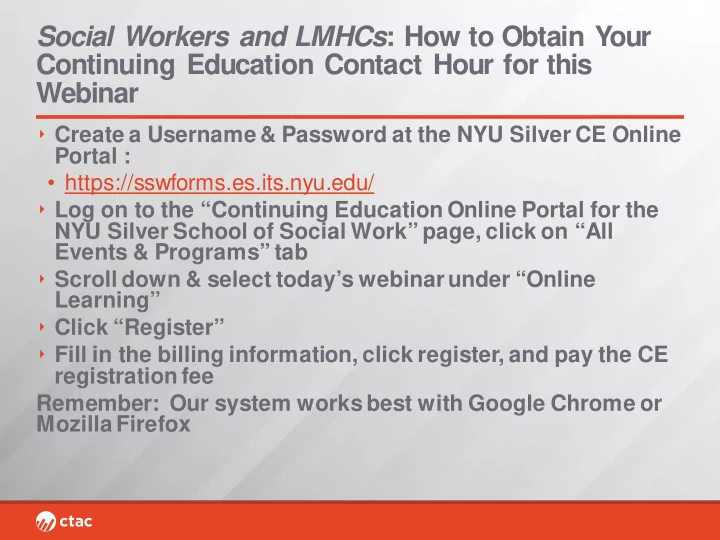
Social Workers and LMHCs: How to Obtain Your Continuing Education Contact Hour for this Webinar

  • Create a Username & Password at the NYU Silver CE Online

Portal :

  • https://sswforms.es.its.nyu.edu/
  • Log on to the “Continuing Education Online Portal for the

NYU Silver School of Social Work” page, click on “All Events & Programs” tab

  • Scroll down & select today’s webinar under “Online

Learning”

  • Click “Register”
  • Fill in the billing information, click register, and pay the CE

registration fee Remember: Our system works best with Google Chrome or Mozilla Firefox

slide-2
SLIDE 2

Social Workers and LMHCs: How to Obtain Your Continuing Education Contact Hour for this Webinar, cont.

  • After registering, you will receive a confirmation email

with a link to complete an evaluation

  • Once the evaluation is submitted, within 24 - 48 hours,

log back on to NYU Silver CE Online Portal, go to “Your Registrations” and you will see “Take Assessment” in red next to the name of the program

  • Complete assessment
  • Once done, you will be directed how to download your

CE certificate

  • For Questions: Call us at 212-998-5973 or email us at

silver.continuingeducation@nyu.edu

slide-3
SLIDE 3

Resilience Informed Service Environments (RISE)

ANTHONY SALERNO, PHD JAMES RODRIGUEZ, LCSW, PHD JANUARY 17, 2018

slide-4
SLIDE 4

Agenda

  • Understanding resilience
  • The neurobiology of resilience
  • Research on resilience
  • Building Resilience
slide-5
SLIDE 5

Poll Questions

  • Please tell us who you are?
  • A. Adult Mental Health Providers
  • B. Child/Adolescent MH Providers
  • C. Adult Care Manager
  • D. Child/Adolescent Care Manager
  • E. Substance Use Provider
  • F. Supervisor
  • G. Administrator
  • H. Other
slide-6
SLIDE 6

Understanding Resilience

THE OTHER SIDE OF THE COIN FROM TRAUMA

slide-7
SLIDE 7

Resilience

“What’s predictable is preventable.”

Robert Anda – Co-Investigator, ACEs Study

slide-8
SLIDE 8

History

  • Early worked focused on the individual – internal

strengths that protect people against the negative effects of exposure to toxic stress (e.g. the resilient child – invulnerable, invincible)

  • Picked up by MH researchers interested in the social

determinants of health

slide-9
SLIDE 9

Definition

  • Resilience. A dynamic process reflecting positive

adjustment despite significant risk or adversity (Luthar

& Zigler, 1991; Garmezy, 1971; Rutter, 1987)

  • Resilience is…
  • Context-based/Situational
  • Domain Specific
  • Fluctuates over time (fluid)
slide-10
SLIDE 10

Resilience is not…?

  • Competence
  • Ego resiliency
  • Grit
slide-11
SLIDE 11

When has someone demonstrated resilience?

  • 1. Resiliency - No signs of unhealthy coping response

(disorder), despite exposure to Potentially Traumatizing Event (PTE)

  • 2. Recovery – Improving coping response after

unhealthy coping in response to PTE.

  • 3. Prosperity – exceeds expectations and doing better

than before exposure to PTE.

Bonanno and Mancini, 2012

slide-12
SLIDE 12

Three Levels of Protection

Resilience

Individual Strengths (Assets)

Significant

  • thers

(Resources)

Systems and Culture (Resources)

slide-13
SLIDE 13

Individual characteristics (Assets)

  • Temperament
  • Personality traits
  • Ego resiliency
  • Competence
  • Grit
  • Intelligence
  • Future orientation
  • Self-efficacy
  • Self-esteem
slide-14
SLIDE 14

Significant others (Resources)

  • Family/Parenting
  • Attachment,
  • Parental/Caregiver monitoring/supervision, support
  • Peers
  • Mentors
  • Extended family
  • Social support
slide-15
SLIDE 15

Systems support (Resources)

  • Quality Systems
  • Schools –
  • Engaging services
  • Quality care
  • Evidence-based practice
  • Practice-based evidence
  • Trauma Informed Systems
  • Safety
  • Connections
  • Emotional regulation
slide-16
SLIDE 16

Cultural/Context Example

  • Religion/Spirituality
  • Ethnic/Racial Identity (Zimmerman et al., 1995)
  • 5 Categories of Resilience in African American males

impacted by poverty (Teti, et al., 2012):

  • 1. Perseverance and refusing to quit despite challenges
  • 2. A commitment to learning/growing from hardship
  • 3. Using reflection and refocusing
  • 4. Creating a positive and supportive environment
  • 5. Drawing on religion/spirituality for strength
slide-17
SLIDE 17

Cultural and Community Resilience

  • First Nations research (Chandler and Lalonde, 1998)
  • Self government
  • Land claims
  • Education
  • Health services
  • Cultural facilities
  • Police and fire departments
  • Native Language
  • Increases suicide rates by cumulative bands
  • 0 = 137.5/100,000
  • 6 = 0.0/100,000
slide-18
SLIDE 18

Recent Research and the Brain

slide-19
SLIDE 19

Sinha et al., 2016

slide-20
SLIDE 20

Neurobiology of Resilience

Genetics Epigenetics Neurochemicals

slide-21
SLIDE 21

Genetics

slide-22
SLIDE 22

Epigenetics

  • Biological mechanisms that will switch genes on and
  • ff (What happens around the gene):
  • Epigenetics control genes
  • Epigenetics is everywhere
  • Epigenetics makes us unique
  • Epigenetics is reversible or plastic
slide-23
SLIDE 23

Epigenetic Factors

  • Exposure to stress
  • Environmental toxins
  • Prenatal environment
  • Diet
  • Exercise
  • Developmental (critical) periods
  • Aging
  • Virus/infection
slide-24
SLIDE 24

Epigenetics and Stress

2 4 6 8 10 12 14 16 18 20 1 2 3 4-5 6 or more

ACE Score

slide-25
SLIDE 25

Neurochemicals

Norepinephrine Neuropeptide Y Galanin

CRH Cortisol DHEA Others Dopamine Serotonin BDNF ALLO

Sympathetic NS HPA Axis Others

slide-26
SLIDE 26
slide-27
SLIDE 27

Basic Research on Resilience

  • Resilience is a significant predictor of decrease in self-

reported fatigue after MTBI (Losoi et al., 2014).

  • Associated with healthy lifestyles, wellness:
  • Healthy eating, Exercise, Tobacco use (Wagnild 2015)
  • Fatigue (Losoi et al., 2014)
  • Depression, Anxiety (Alena et al., 2014; Wagnild, 2015)
  • Life satisfaction (Alena et al., 2014)
  • Religiosity (Mosquito, 2015)
slide-28
SLIDE 28

Outcomes of Resilience Based Intervention

  • Self efficacy and personal functioning in people with

severe mental Illness (Maxan et al., 2013)

  • Decreased adolescent substance use (Hodder, et al., 2011)
  • PTSD Symptoms and positive emotional health (Kent et al.,

2011)

  • Quality of life and self-concept for people with TIC D/O

(Storch et al., 2012)

  • Psychological, physiological and self-management for

African Americans with Type II Diabetes (Steinhardt et al. 2015)

slide-29
SLIDE 29

Components of RB Interventions

  • All provide psycho-education on resilience
  • Finding positive meaning in the context of disease –

reframing disease (Steinhardt et al., 2015)

  • Emotion regulation and social connectedness (Kent et

al., 2011; Maxan et al., 2013).

  • Storch et al., (2012): typical CBT components with

focus on: (1) talking to others about tics, (2) responding to bullies, and (3) not limiting activities because of tics.

slide-30
SLIDE 30

Research on Resilience in Children

  • Therapeutic Foster Care can affect cortisol levels in

children and adults (Fisher, 2016)

  • Social Emotional Learning increases resilience:

emotional control, goal setting, perspective taking, problem solving (Durlak et al., 2011)

  • Treating maternal mental health and improving

parenting helps (Goodman and Garber 2017)

  • Individual characteristics (e.g. self-efficacy) at least
  • ne supportive adult relationship help overcome

adversity (Werner and Smith, 2005)

slide-31
SLIDE 31

What You Can Do

slide-32
SLIDE 32

Ways of Building Resilience

  • 1. Build on strengths – whether assets or resources
  • 2. Increase protective factors
  • 3. Reduce exposure to risk
  • 4. Prevention: Primary, Secondary, Tertiary
slide-33
SLIDE 33

Implications for the work in behavioral health services

The bifocal lens of trauma and resilience

  • Assessing the severity and chronicity of a person’s risk

exposure

  • Assessing comprehensive resiliency promoting personal

and environmental factors

slide-34
SLIDE 34

A practical and immediate clinical focus that aligns with building resilience

  • Maintaining a very comprehensive and continual

focus on personal strengths and opportunities to utilize the people, places and things in the person’s life that are reliable and helpful resources.

  • Assisting clients to identify, engage and develop

strong social bonds is critical.

slide-35
SLIDE 35

What practitioners need to know

  • Practitioners and service systems can strengthen a

persons resilience (ability to more effectively manage the impact of highly stressful events in the past, present and future)

  • In contexts of higher exposure to adversity,

environmental factors may be more important to resilience than individual factors.

  • Even maladaptive patterns of coping may be signs of

resilience in challenging contexts.

slide-36
SLIDE 36

Assessing Risk

  • Age of initial exposure and duration of adversity
  • Severity and duration of adverse events and conditions
  • Number of adverse events experienced
  • Current challenges and difficulties associated with

adversity

  • Cultural/familial/religious beliefs and values about:
  • What constitutes an adverse event- what the term trauma means
  • Why bad things happen to good people ( role of sin, punishment, forgiveness)
  • How people are expected to deal with highly stressful life events (prayer, penance)
  • Self disclosure to strangers, keeping or disclosing secrets
  • Gender related expectations
slide-37
SLIDE 37

Measuring Resilience

Connor Davidson Scale: 4 Resiliency Factors

  • Factor 1: Flexibility to Cope with Changes/Challenges
  • I can handle unpleasant feelings
  • I tend to bounce back after illness or hardship
  • I can make unpopular or difficult decisions
  • Factor 2: Social and Familial Support
  • My family is willing to help me make decisions and listen

to me

  • My friends are willing to help me make decisions and

listen to me

  • I have close and secure relationships
slide-38
SLIDE 38

Connor Davidson (continued)

  • Factor 3: Spiritual Support
  • Sometimes fate or god can help
  • Things happen for a reason
  • Factor 4: Being Goal-Oriented
  • I like challenges
  • I work to attain my goals
  • I have pride in my achievements
  • I have a strong sense of purpose
  • I have few regrets in life i can achieve my goals

Connor KM, Davidson JR. Development of a new resilience scale: The Connor Davidson Resilience Scale (CD-RISC). Depress Anxiety 2003; 18(2):76-82. PMID: 12964174.

slide-39
SLIDE 39

Resiliency Scale for Adults: Two Major Factors

  • Factor I: Personal Competence
  • Follow through with plans
  • Manage one way or other
  • Able to depend on self more than anyone
  • Factor Il. Acceptance of Self and Life
  • I usually take things in stride
  • I seldom wonder what the point of it all is
  • I take things one day at a time
  • I can usually find something to laugh about

Wagnild, G. and Young, H.M.,(1993) Development and Psychometric Evaluation of the Resilience

  • Scale. Journal of Nursing Measurement, Vol. 1, No. 2
slide-40
SLIDE 40

Brief Resiliency Scale: Single Resiliency Factor

  • 1. I tend to bounce back quickly after hard times
  • 2. I have a hard time making it through stressful events
  • 3. It does not take me long to recover from a stressful event
  • 4. It is hard for me to snap back when something bad happens
  • 5. I usually come through difficult times with little trouble
  • 6. I tend to take a long time to get over set-backs in my life

Smith, B. W., Dalen, J., Wiggins, K., Tooley, E., Christopher, P., & Bernard, J. (2008). The Brief Resilience Scale: Assessing the Ability to Bounce Back. International Journal of Behavioral Medicine, 15, 194-200. http://dx.doi.org/10.1080/10705500802222972

slide-41
SLIDE 41

Questions we need to answer

  • Are there clinical cutoffs or specific dosages of protective

factors (individual and environmental) that mitigate the impact

  • f stressors and prevent psychological and behavioral

problems?

  • How do different levels of exposure to adversity, different

contexts, and different cultures, affect these cutoffs?

  • In which contexts and under what conditions are children

likely to develop maladaptive coping strategies as a pathway to resilience?

  • What is the relationship between higher levels of resilience

and a child’s recovery from a mental disorder?

  • Which resilience-promoting interventions are the most

effective with which specific populations of children?

slide-42
SLIDE 42

Systemic Pillars of Healing

slide-43
SLIDE 43

Creating Safety (Individual)

  • Discuss safety
  • People, places and things that make someone feel safe or

not.

  • Creating a Safe (Enough) Place
  • Thinking of a safe place (i.e. present or past, person,

religious/spiritual)

  • Make it as vivid
  • Deep experience (i.e. thoughts, feelings, sensations)
  • Readjust if necessary
  • SUDS Ratings (1-10)
  • Repeated checks
slide-44
SLIDE 44

Creating Safety (Provider System)

  • Changing environment
  • Waiting areas
  • Staff training
  • Privacy/Confidentiality
  • Survey people, providers
slide-45
SLIDE 45

Connections (Individual)

  • 1. Motivational Interviewing
  • 2. Processing transference
  • 3. DBT Chain Analysis (e.g. Chain Analysis)
  • 4. Interpersonal Psychotherapy - Resolving

Interpersonal Role Disputes

slide-46
SLIDE 46

Connections (Provider System)

  • Groups
  • Opportunities to make connections
  • Development communication skills
  • Peer/social support
  • Social events
  • Play/Physical Activity
slide-47
SLIDE 47

Connections (Community)

  • Identify extent and quality of social networks
  • Explore involvement of social supports in treatment
  • Design service planning to strengthen connections to

community resources (e.g. religious, cultural, social)

slide-48
SLIDE 48

Managing Emotions (Individual)

  • Stress Inoculation Training:
  • Breathing/Breathing retraining
  • Muscle relaxation
  • Cognitive coping
  • Self-dialogue/Self-talk
  • Thought-stopping
  • Role playing
  • Exposure
  • In-vivo
  • Imaginal
  • Narration
slide-49
SLIDE 49

Managing Emotions (System)

  • Adjunctive group:
  • Yoga,
  • Meditation,
  • Other stress reduction opportunities,
  • Mindfulness based group interventions
  • Psychological First Aid training (Community)
slide-50
SLIDE 50

Twelve Ways to Build Resilience (APA)

  • 1. Making Connections
  • 2. Avoid seeing crisis as insurmountable
  • 3. Accept that change is a part of living
  • 4. Move towards a goal
  • 5. Take decisive action
  • 6. Look for opportunities for self-discovery
  • 7. Nurture a positive view of self
  • 8. Keep things in perspective
  • 9. Maintain a hopeful outlook
  • 10. Take care of self
  • 11. Learn from past
  • 12. Stay flexible

APA (2017) Road to Resilience available at: http://www.apa.org/helpcenter/road- resilience.aspx

slide-51
SLIDE 51

Accepting Reality

  • Teaching Radical Acceptance
  • Accepting reality as it is
  • Pain is a reality of life
  • The past can’t be changed
  • Turning the mind – a Half Smile activity
  • ACT metaphors
  • The Person on a Bus metaphor
  • The Book metaphor
slide-52
SLIDE 52

Finding Meaning

  • When you have a great sense that life has meaning,

what are you doing? What are you aware of?

  • What leaves you without much of a sense of meaning
  • r a sense that life has no meaning?
  • What could you do to gain or regain a sense of

meaning?

slide-53
SLIDE 53
slide-54
SLIDE 54

Poll Question

What topics would you be interested in hearing more about regarding the topic of resilience? Check top 3

  • A. Understanding resilience
  • B. Interventions to build resilience (children/youth)
  • C. Interventions to build resilience (adults)
  • D. Organizational resilience
  • E. Neurobiology of resilience
  • F. Service provider resilience
  • G. Resilience and culture
  • H. Resilience building strategies

I. Others (please chat in)

slide-55
SLIDE 55

Poll Question

  • What resilience related activities would you be

interested in attending if offered by the CTAC? Check all that apply

  • A. Webinars
  • B. In-Person training
  • C. Learning Community
  • D. Consultation
  • E. Other (please chat in response)
slide-56
SLIDE 56

Q & A

slide-57
SLIDE 57

Social Workers and LMHCs: How to Obtain Your Continuing Education Contact Hour for this Webinar

  • Create a Username & Password at the NYU Silver CE Online

Portal :

  • https://sswforms.es.its.nyu.edu/
  • Log on to the “Continuing Education Online Portal for the

NYU Silver School of Social Work” page, click on “All Events & Programs” tab

  • Scroll down & select today’s webinar under “Online

Learning”

  • Click “Register”
  • Fill in the billing information, click register, and pay the CE

registration fee Remember: Our system works best with Google Chrome or Mozilla Firefox

slide-58
SLIDE 58

Social Workers and LMHCs: How to Obtain Your Continuing Education Contact Hour for this Webinar, cont.

  • After registering, you will receive a confirmation email

with a link to complete an evaluation

  • Once the evaluation is submitted, within 24 - 48 hours,

log back on to NYU Silver CE Online Portal, go to “Your Registrations” and you will see “Take Assessment” in red next to the name of the program

  • Complete assessment
  • Once done, you will be directed how to download your

CE certificate

  • For Questions: Call us at 212-998-5973 or email us at

silver.continuingeducation@nyu.edu