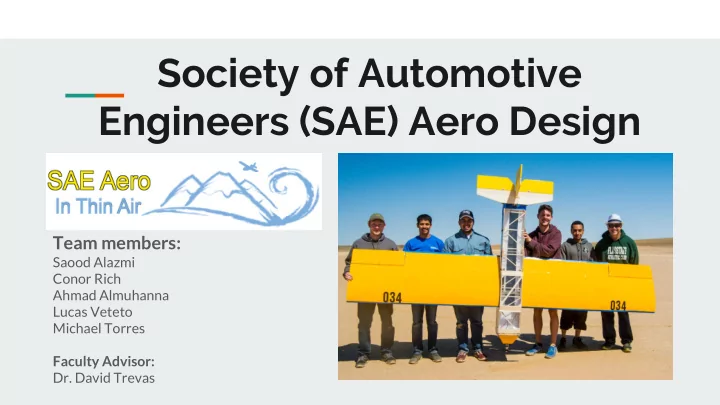
Society of Automotive Engineers (SAE) Aero Design Team members: - - PowerPoint PPT Presentation

society of automotive engineers sae aero design
SMART_READER_LITE
LIVE PREVIEW

Society of Automotive Engineers (SAE) Aero Design Team members: - - PowerPoint PPT Presentation

Society of Automotive Engineers (SAE) Aero Design Team members: Saood Alazmi Conor Rich Ahmad Almuhanna Lucas Veteto Michael Torres Faculty Advisor: Dr. David Trevas Acknowledgements Our Sponsors Special thanks to: Dr. David Trevas


slide-1
SLIDE 1

Society of Automotive Engineers (SAE) Aero Design

Team members:

Saood Alazmi Conor Rich Ahmad Almuhanna Lucas Veteto Michael Torres Faculty Advisor:

  • Dr. David Trevas
slide-2
SLIDE 2

Acknowledgements

Special thanks to: Our Sponsors

  • Dr. David Trevas

Alex Klausenstock

slide-3
SLIDE 3
  • The SAE Aero Design competition is designed to provide exposure to real-world challenges professional

engineers encounter in the industry.

  • High percentage of competition points awarded to design report and presentation to emphasize written

and oral skills.

  • The purpose of this competition is to design and construct a remote control (RC) airplane following the

strict requirements of SAE.

  • The R/C airplane has to carry the largest payload while keeping the empty weight low. It will use tennis

balls as “passengers” and half pound weights to represent the “luggage”.

Project Description

slide-4
SLIDE 4

Competition Objectives

  • Design and construct an R/C airplane following the requirements given by the competition.
  • Provide a technical report and 2-D drawing of the final airplane design.
  • Give an oral presentation to the judges.
  • Load the airplane with a ½ pound weight for each tennis ball.
  • Demonstrate the plane’s ability to takeoff, fly in a loop, and land.
slide-5
SLIDE 5

Project Goals and SAE Requirements

  • Project goals:

○ Successfully take off and maintain flight while carrying passenger (tennis balls). ○ Limitations on electric motor power output, battery size, wing construction, etc. ○ Aircraft before loading must be less than 55 lbs.

slide-6
SLIDE 6
  • High coefficient of lift airfoil.

○ Sokolov-il

  • Wing shape changed from tapered to square.
  • Boxed main spar, with bass wood ribs, followed by balsa

paneling, followed by monokote.

○ Basswood vs. Balsa wood vs Plywood

Design Approach: Wings

slide-7
SLIDE 7

Design Approach: Fuselage

  • Solid plywood sides for strength
  • Clear top for competition requirement.
  • A magnetic door on top of the fuselage

○ For wings bolting to the fuselage ○ For access to the aileron servo wiring.

slide-8
SLIDE 8

Design Approach: Nose/Tail

  • Hinged firewall (top)

○ Loading/unloading of passengers and luggage. ○ Attachment point for front landing gear.

  • Removable nose-cone (bottom right)

○ Allows access to electrical component ○ Motor and propellor

  • Tail constructed out of Balsa panels.

○ Control surfaces attached by CA hinges ○ (Bottom Left)

slide-9
SLIDE 9

Design Approach: Payload

  • Separate compartments for passengers and luggage.

○ Tennis balls in upper compartment, luggage in lower. ○ All wiring kept away from passengers and luggage.

  • Tennis balls inserted by sliding tray.
  • Luggage inserted into bottom compartment and bolted in place.
slide-10
SLIDE 10

CAD Design

  • Required for competition
  • Important for design

○ Total weight ○ Center of Gravity (CG)

slide-11
SLIDE 11
  • RISA-2D was used to test the reaction force in the aluminum spar.
  • ~24 lbs of lift generated in each wing. Averaging 4.8 lb/ft of lift along the main spar.
  • Experiences a bending stress of 12,700 psi.

Rod will yield at 35,000 psi.

Factor of Safety = 2.75.

Loading

slide-12
SLIDE 12

Payload Prediction Curve

  • Predicting 21.4 lbs of payload.

○ 4.4 lb tennis balls ○ 17 lb luggage

  • Predicted weight of unloaded plane: 28.8 lb
  • Actual weight of unloaded plane: 31.6 lb
  • Predicted Flight Weight: 50.2 lb
  • Actual total weight: 53 lb
slide-13
SLIDE 13
  • 1st flight attempt

○ Did not fly. ■ Rear wheels were too soft. ■ Loading failure of front landing gear.

Unable to attend competition.

  • 2nd flight attempt

○ Redesign of front and rear landing gear and wheels. ○ Increased the propeller size and pitch. ○ Decreased the wing’s angle of attack. ■ Increased takeoff speed. ■ Crashed on fourth flight.

Results

slide-14
SLIDE 14

Results: Video

slide-15
SLIDE 15

Takeaway

  • Challenges

○ First time group competing against teams with many years of experience ○ Students and Faculty advisor with no aerodynamics experience ○ Limited budget

  • What we learned

○ Calculating the Lift and Drag of a wing ○ Dynamic wing loading ○ Takeoff and landing distances ○ Electronic wiring of remote control aircrafts ○ Practical experience with designing/building

slide-16
SLIDE 16