Sodium Reactor Experiment Accident Sodium Reactor Experiment - - PowerPoint PPT Presentation

sodium reactor experiment accident sodium reactor
SMART_READER_LITE
LIVE PREVIEW

Sodium Reactor Experiment Accident Sodium Reactor Experiment - - PowerPoint PPT Presentation

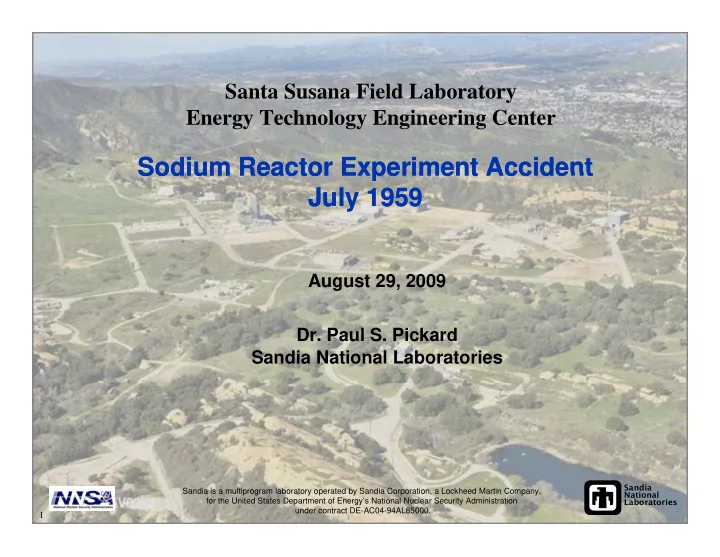
Santa Susana Field Laboratory y Energy Technology Engineering Center Sodium Reactor Experiment Accident Sodium Reactor Experiment Accident Sodium Reactor Experiment Accident Sodium Reactor Experiment Accident July 1959 July 1959 August 29,


slide-1
SLIDE 1

Santa Susana Field Laboratory y Energy Technology Engineering Center

Sodium Reactor Experiment Accident Sodium Reactor Experiment Accident Sodium Reactor Experiment Accident July 1959 Sodium Reactor Experiment Accident July 1959

August 29, 2009

  • Dr. Paul S. Pickard

Sandia National Laboratories

Sandia is a multiprogram laboratory operated by Sandia Corporation, a Lockheed Martin Company, for the United States Department of Energy’s National Nuclear Security Administration under contract DE-AC04-94AL85000.

1

Sandia National Laboratories

slide-2
SLIDE 2

SANDIA NATIONAL LABORATORIES

Sandia's Primary Mission Ar Sandia's Primary Mission Areas: eas:

  • Energy, Resources and Nonproliferation
  • Defense Systems & Assessments

H l d S it & D f

Albuquerque, New Mexico Livermore, California

  • Homeland Security & Defense
  • Nuclear Weapons

Sandia Labs

Other Locations Kauai (HI), Carlsbad (NM), Tonopah (NV)

Radiation Effects Research Renewable Energy Research Space Systems 2 Basic Sciences Large-Scale Tests Nuclear Energy Safety Research Inertial Confinement Fusion

slide-3
SLIDE 3

Presentation Purpose and Approach Presentation Purpose and Approach

  • Purpose:

Purpose: – Overview of nuclear reactor technology relevant to the Sodium Reactor Experiment (SRE) D i ti f th d – Description of the cause and progression of the accident and fuel damage that occurred in July 1959

SRE Facility (1957)

  • Approach:

– Reviewed available information on SRE design and July 1959 reactor accident Review focused on accident causes and resulting fuel damage – Review focused on accident causes and resulting fuel damage – Review covered only 2 weeks of operations at the site and did not include subsequent recovery activities or other Area IV

  • perations

3

slide-4
SLIDE 4

Presentation Outline Presentation Outline

  • Background – early nuclear

reactor technology

  • Description of SRE reactor
  • July 1959 sequence of
  • July 1959 sequence of

events

  • Reactor fuel damage
  • Fission products* release

mechanisms

  • Comments and observations

S ( ) SRE Facility (1958)

4

* Fission products are the atomic fragments left after a large nucleus fissions

slide-5
SLIDE 5

Early Nuclear Power Reactor Development

  • Early nuclear power reactor development focused

Water and Sodium Cooled Systems

Early nuclear power reactor development focused primarily on Light Water cooled Reactors (LWR)

  • Water cooled reactors were selected for Naval

applications Water cooled reactors were already being

  • Water cooled reactors were already being

commercialized

  • LWRs have limited efficiency (~33%) due to low

temperature operation (~350º C, 660º F)

  • LWRs operate at high pressures (~2200 psi)
  • Sodium (liquid metal) cooled reactors with

graphite moderators were considered promising ti f hi i hi h ffi i i

ETEC 1985

Shippingport Pressure Vessel Operational – 1957

  • ptions for achieving higher efficiencies
  • Sodium cooled reactors could operate at
  • Higher temperatures, higher efficiencies

B t till t t l

ETEC 1985

p (60 megawatt-electric)

  • But still operate at lower pressures

5

slide-6
SLIDE 6

Overview of Area IV Reactor Operations Overview of Area IV Reactor Operations

Reactors Operated within Area IV (1956 – 1980)

  • Area IV – research focused on

development of new types of nuclear power reactors

Facility Name Power, kWt Operating Period Kinetics Experiment Water Boiler 1 07/56 -11/66 L-85 Nuclear Experiment Reactor 3 11/56 - 02/80 Sodium Reactor Experiment 20 000 04/57 - 02/64

p ( )

  • SRE was the largest of the 10

reactors operated in Area IV

Sodium Reactor Experiment 20,000 04/57 02/64 S8ER Test Facility 50 09/59 - 12/60 SNAP Environmental Test Facility 65 04/61 - 12/62 Shield Test Irradiation Facility 50 12/61 - 07/64 S8ER Test Facility 600 05/63 - 04/65 Shield Test Irradiation Facility 1 08/64 - 06/73 SNAP Environmental Test Facility 37 01/65 03/66

ETEC 1985

SNAP Environmental Test Facility 37 01/65 - 03/66 SNAP Ground Prototype Test Facility 619 05/68 - 12/69

kWt = kilowatt-thermal SNAP = Systems Nuclear Auxiliary Power

Sodium as a Coolant

ETEC 1985

  • Low pressure operation (boiling point of 883º C, 1621º F )
  • Excellent heat removal
  • Flammable in air
  • Can become radioactive

6

  • Melting point of 98º C, 208º F
slide-7
SLIDE 7

Sodium Reactor Experiment Description

7

slide-8
SLIDE 8

Overview of S di R t E i t (SRE) Sodium Reactor Experiment (SRE)

Design Rendition of

  • The SRE was a 20 megawatt-thermal (MWt), low

SRE Facility (1957)

g (

t)

pressure sodium cooled nuclear reactor

  • Purpose of the SRE was to investigate different

nuclear fuel materials and the use of sodium as a coolant a coolant

  • SRE was operational from 1957 to 1964
  • SRE did not operate on a continuous basis -

each experiment (or run) lasted up to a few each experiment (or run) lasted up to a few weeks

  • Experiments were conducted under varying
  • perating conditions in order to test designs

and components, which required frequent startups and shutdowns, and refueling

  • perations
  • During Core I operations involving uranium

Below Ground

8

During Core I operations involving uranium metal fuel; 14 experimental runs were conducted between 1957 and July 1959

SRE Core and Vessel

slide-9
SLIDE 9

SRE Core and Vessels SRE Core and Vessels

Control Rod Drive Concrete Concrete Plug Below Ground

Handling of Upper Concrete Plug

Main Sodium Inlet Main Sodium Outlet Sodium Tank Auxiliary Sodium Outlet

6 ft

Cover Gas

C t Handling of Upper Concrete Plug

Fuel Bundle 19 ft Core Tank Auxiliary Sodium Inlet Thermal Shield

6 ft

Concrete Stainless Steel

Graphite Moderator Thermal Shield (5.5 inches steel) Grid Plate

9

SRE Upper Concrete Plug Vertical Section of SRE Reactor

11 ft

slide-10
SLIDE 10

SRE Fuel Bundle and Moderator Can

11 inches 11 inches Hanger Vent Tube ft.

Cross-section

  • f moderator

can containing fuel bundle comprised of 7 f l d

  • Approx. 6

Zirconium (Metal) Can

fuel rods

Other Nonfuel Tubes Control Rod Safety Rod Fuel Bundle Neutron Source

Graphite Moderator 10

Hexagonal Moderator Cans Containing Fuel Bundles (Top View) Fuel Bundle Moderator Can Assembly

slide-11
SLIDE 11

SRE Fuel Bundle SRE Fuel Bundle

0 090 inch

0.75 inch Diameter Fuel Slugs Hanger Rod Helium Filled

  • Uranium metal fuel
  • 2.7% U-235 enrichment

(natural uranium is 0 7%

0.090 inch 0.010 inch Stainless Steel Tube

  • prox. 6 ft.

Fuel Rod Jacket (NaK filled) 6 inch Fuel Slugs Expansion Space

(natural uranium is 0.7% U-235)

  • Fuel slugs are 0.75 inch

diameter and 6 inches in length

0.010 in NaK Bond

App

length

  • Clad in stainless steel tubes
  • Sodium-potassium (NaK)

bonding between fuel and

6 inches Stainless Steel cladding NaK Bond 6 inches

bonding between fuel and cladding

  • Wire wrap around fuel

bundles

0.75”

Fuel Slugs (12 total per rod) 6 inches

11

7-Rod Fuel Bundle Fuel Rod

slide-12
SLIDE 12

SRE Fuel Bundle Cooling SRE Fuel Bundle Cooling

Control Rod Drive

Stainless Steel Cladding

Concrete Concrete Plug Below Ground

NaK Bond 6 inch Sodium Coolant Flow

Main Sodium Outlet Sodium Tank Auxiliary Sodium Outlet

6 ft

Cover Gas

0.75” 6-inch Fuel Slugs (12 per rod, 84 per bundle)

Fuel Bundle 19 ft Core Tank Auxiliary Sodium Inlet

6 ft

Thermal Shield Graphite Moderator Grid Plate (5.5 inches steel)

12

11 ft

slide-13
SLIDE 13

SRE Cover Gas and Venting S t U d N l O ti System Under Normal Operations

  • Gaseous activation products*

Gaseous activation products produced during normal

  • perations would collect in

the cover gas

  • Cover gas was pumped to

storage tanks to allow activation products to decay

  • After decay to acceptable

release levels, storage tanks t d t t h were vented to atmosphere through a HEPA filter and stack

  • Stack was monitored with

radiation alarms and radiation alarms and automatic shut-off valves to prevent release of activation products exceeding acceptable levels

13

* Activation products are materials made radioactive by neutron activation

slide-14
SLIDE 14

SRE Cooling Systems SRE Cooling Systems

SRE Cooling System Features

  • SRE core could produce up to 20

MWt of power P i di li l

SRE Cooling System Features

  • Primary sodium cooling loop

removed heat to an intermediate heat exchanger Secondary sodium loop isolated

  • Secondary sodium loop isolated

core and radioactive coolant from power generation system

  • Numerous other pumps and valves
  • Numerous other pumps and valves

existed to startup and control system operations

14

slide-15
SLIDE 15

Barriers to Release of Fission Products d A id t C diti under Accident Conditions

M lti l b i d t

  • Multiple barriers were used to

minimize release of radioactive materials

  • fuel

Cover Gas SODIUM

SOLID FUEL – retains most fission

  • cladding
  • coolant
  • vessels

SOLID FUEL METAL CLADDING – fission products release if cladding is breached SO U products in matrix unless melted

  • r vaporized
  • Physical and chemical

characteristics of different fission products affected the probability

SODIUM – reacts with some fission products

  • f release from fuel or coolant in

an accident

15

slide-16
SLIDE 16

General Types of Fission Products yp

– Inert gaseous species (Xe, Kr) are non-reactive; readily released from the fuel

Leak or Breach

– Volatile species (I, Cs, …) have higher vapor pressures; generally reactive; released at higher temperatures

SOLID FUEL L CLADDING ODIUM EL

Breached Cladding

Heated Gases

temperatures – Non-volatile species (Mo, Zr …) have low vapor pressure elements that generally remain with the fuel;

S METAL SO VESSE

Liquid Fuel Cladding

that generally remain with the fuel; less likely to be released

Barriers to Fission Products Release

16

slide-17
SLIDE 17

Nuclear Fission of U-235

U-235 Fission

  • U-235 “fissions” into two lighter nuclei (fission

d t )

neutron

products)

  • Fission products include most elements in varying

percentages

  • Radioactive with a range of half lives:

fission product neutron

I-131 (~8 days) Xe-133 (~5 days) Sr-90 (~29 years)

neutron fission product neutron Uranium 235 nucleus neutron neutron

Fission Chain Reaction

  • On average, the fission of U-235 also produces about 2.4 neutrons
  • One neutron is recaptured in U-235 to sustain the fission process

17

  • Remaining neutrons escape out of system (or are absorbed into other materials)
slide-18
SLIDE 18

SRE Accident Description SRE Accident Description

18

slide-19
SLIDE 19

Status of SRE Operations Prior to Run 14 Fuel Damage Event

Runs 9-12 Run 8 Run 13 Run 14

1958 1959

NOV DEC JAN FEB MAR APR MAY JUN JUL

OWER LEVEL Mwt

5 10 15 20

  • Run 8 Oxygen contamination observed in sodium; higher than

expected temperatures observed in some channels

PO

Fuel bundles and black residue removed, resulting in improved reliability of temperature measurements

  • Run 9 High power run – fuel channel exit temperatures higher than

expected

  • Run 11 20 MWt power; fuel channel exit temperatures still higher than

expected; fluctuations in primary sodium flow observed; several reactor scrams (shutdowns) experienced

  • Run 13 Various temperatures measured across the core were
  • bserved to increase steadily with time
  • bserved to increase steadily with time

19

slide-20
SLIDE 20

Observed Temperature and Power Variations Caused by Coolant Flow Blockages

  • Leak in primary pump seal allowed organic

pump coolant (Tetralin C10H12) to leak into pump coolant (Tetralin, C10H12) to leak into primary cooling system

  • Tetralin decomposed at high temperature

leaving an insoluble “carbon” material, which coated reactor internal components d f d ti l bl k and formed partial blockages

  • Blockages restricted coolant flow to fuel

bundles, resulting in significantly higher fuel temperatures E ti b d d t

  • Erratic power response observed due to

sodium voiding and re-flooding

  • Leakage of Tetralin and associated

temperature anomalies were recognized during these earlier runs during these earlier runs

  • Potential consequences of coolant

blockages were not recognized

Tetralin (C10H12) coolant formed carbon blockages Higher fuel temperatures in partially blocked

20

formed carbon blockages in inlet channels in partially blocked channels

slide-21
SLIDE 21

SRE Accident Run 14 Summary SRE Accident Run 14 Summary

July 12 1959 Start up

  • July 12 – Initial operation – higher than expected fuel temperatures in some channels; high

July 12, 1959 Start up July 26, 1959 Shutdown radiation levels (~0.5R/hr) recorded in reactor building due to shield plug leakage

  • July 13 – Startup after shield plug replaced; observed power changes were not consistent

with control rod movements; reactor was shut down after a rapid power rise (excursion); power anomalies were caused by sodium boiling and re-flooding

  • July 14-26 – continued operations at various power levels were conducted to investigate

reasons for temperature and flow readings; highest fuel temperatures were recorded in the July 22-24 period

  • Operations resulted in damage to 13 of 43 of the reactor’s fuel bundles – cladding

Operations resulted in damage to 13 of 43 of the reactor s fuel bundles cladding failures and partial melting

  • Fission products were released from the fuel into the reactor’s primary sodium coolant
  • Primary reactor vessel did not fail, but some gaseous radionuclides escaped into reactor

21

building from the cover gas

  • During Run 14 and the subsequent fuel recovery processes, fission products in the

cover gas were periodically vented to the environment

slide-22
SLIDE 22

Continued Operations During Run 14 p g

1. Core and sodium exit temperatures continued to

Temperature History for the 2-Week Period

temperatures continued to increase 2. Highest fuel temperatures

  • ccurred July 22-24; most fuel

damage probably occurred during thi ti

1400 1600 Core Temperature Channel 67

Eutectic Temperature

Core Temperature Channel 55

this time 3. High fuel temperatures in blocked coolant channels allowed a low melting point alloy to form between cladding and fuel

mperature (F)

800 1000 1200 Exit Temperature Channel 55 Core Temperature Channel 55 Relative Reactor Power Level Core Temperature Channel 67 Exit Temperature Channel 54 Exit Temperature Channel 55 Core Temperature Channel 55 Relative Reactor Power Level Core Temperature Channel 67 Exit Temperature Channel 54

between cladding and fuel, causing local melting and cladding failure 4. Cladding was also breached as a result of fuel expansion and

Tem

er Level (MW) 5 10 15 20 200 400 600

p formation of the fuel/cladding alloy 5. Breached cladding allowed gaseous and some volatile fission products to be released to sodium coolant

7/27/09 7/17/09 7/19/09 7/23/09 7/11/09 7/13/09 7/15/09 7/25/09 7/21/09 Powe 5

coolant 6. Reactor shutdown on July 26th

22

slide-23
SLIDE 23

SRE Damaged Fuel Description SRE Damaged Fuel Description

  • 13 out of 43 total fuel bundles

damaged damaged

  • Damaged fuel bundles showed

evidence of local melting and cladding failure

  • Additional fuel bundles may have

Additional fuel bundles may have been damaged during removal

  • Most fuel slugs were still intact

(i.e., had not melted)

B tt ti Mid ti f I t t f l l t f

Fuel Bundles Not Damaged Fuel Bundles Damaged

Bottom section

  • f damaged fuel

bundle Mid-section of damaged fuel bundle

Mechanisms Fuel/cladding melting

Intact fuel slugs on top of core during damaged fuel bundle removal 23

  • Fuel/cladding melting
  • Thermal cycling, cladding failure
slide-24
SLIDE 24

Observations Relevant to Releases from Damaged Fuel*

Cover Gas: Primarily noble gases observed in E ti t d t b l th 1% f cover gas. Estimated to be less than ~1% of

  • inventory. Radiation levels in cover gas much

higher during and after Run 14. Iodine was not detected. Sodium Coolant: Levels observed for different fission products varied but were generally less than 1% of inventory. Iodine Le els in sodi m ere less than Iodine: Levels in sodium were less than

  • expected. Iodine adsorbtion on internal

structures was small. Carbonaceous Material: Was an effective fission products collector (concentrations were ~1000 times higher than sodium). Review of accident included: Sandia calculation of inventory at end of Run 14

24

* NAA-SR-6890, “Distribution of Fission Product Contamination in the SRE”, R.S. Hart, March 1, 1962

  • Sandia calculation of inventory at end of Run 14
  • Review of retention and release mechanisms for the key fission products
slide-25
SLIDE 25

Comparison of Core Radionuclide Inventory with Original SRE Analysis Inventory with Original SRE Analysis

  • Sandia recalculated the SRE inventory after

Total SRE Reactor Inventory, Curies

Isotope Half Life Hart Sandia

  • Sandia recalculated the SRE inventory after

Run 14 using current methods (ORIGEN) – Based on best estimate of power history from early reports

Isotope Half Life Inventory Inventory Cs-134 2.062 y 200 80 Cs-137 30.0 y 8,700 7,754 Sr-89 50.5 d 160,000 148,100

  • Sandia total inventory results were about

10% lower than original analysis – Noble gases (Xe, Kr) – essentially the same as original (1959) analysis

Sr-90 29.12 y 8,150 7,512 I-131 8.04 d 16,800 21,390 Ce-141 32.50 d 127,000 136,200 Ce-144 284.3 d 169,000 159,800

g ( ) y – Non-volatiles (Zr, Ba, Ru, Ce) – specific radionuclides differ, but totals slightly lower Volatiles (I Cs ) Cs 137 Sr 90

Ru-103 39.28 d 75,200 83,620 Ba(La)-140 12.74 d 56,100 62,640 Zr(Nb)- 95 63.98 d 553,000 295,800 Kr-85 10.72 y 1,100 934

– Volatiles (I, Cs...) – Cs-137, Sr-90 lower, but I-131 about 20% higher

  • Original estimates were generally

consistent with current Sandia inventory anal sis

Xe-133 5.245 d 50,800 48,930 Xe-131M 11.9 d

  • 408

I-133 20.8 h

  • 62,420

I-135 6.61 h 58 350

analysis

25

Hart, R.S., Distribution of Fission Product Contamination in the SRE NAA-SR-6890 Atomics International, March 1, 1962.

I 135 6.61 h

  • 58,350

Totals: 1,226,050 1,093,937

slide-26
SLIDE 26

Fission Products Release Mechanisms Fission Products Release Mechanisms

  • Noble gas radionuclides (Xe Kr

) are inert can Noble gas radionuclides (Xe, Kr…) are inert, can be released from liquefied fuel, are not retained in sodium, and reside in the cover gas

  • Less than 1/3 of fuel bundles were damaged

( / )

L G

Heated Gases Leak or Breach

(13/43)

  • Cladding breached in all 13 damaged bundles
  • High levels of noble gases were observed in

cover gas during accident, which were b l d h h h k

SOLID FUEL METAL CLADDING SODIUM VESSEL

Liquid Fuel Breached Cladding

subsequently vented through the stack

  • Liquefied fuel (uranium-iron alloy formation)
  • ccurred only at highest temperature locations

N l til di lid (Z B R C )

M

G N V G V G V

  • Non-volatile radionuclides (Zr, Ba, Ru, Ce...) are

low vapor pressure elements that tend to remain in fuel and will remain in the sodium

Radionuclides G – Nobel gas N N l til

G V G

26

N – Non-volatile V - Volatile

slide-27
SLIDE 27

Fission Products Release Mechanisms (cont’d) Fission Products Release Mechanisms (cont’d)

  • Volatile radionuclides (I, Cs…) can be released from

fuel, but will react with sodium ,

  • Iodine reacts with sodium to form a soluble iodide (NaI

melting point 651º C, 1204º F); most remains in the sodium

L

Heated Gases Leak or Breach

G

  • Some release of volatiles can occur with high

temperatures or sodium boiling at local fuel damage locations; these volatile fission products would then likely react with cooler bulk sodium

SOLID FUEL SODIUM VESSEL

Liquid Fuel Breached Cladding

METAL CLADDING

  • Uranium metal fuel chemistry may explain low iodine

readings in sodium

  • Iodine reacts with metal fuel to form non-volatile

uranium triiodide (UI melting point 766º C 1411º F)

G N V

M

G V G V

uranium triiodide (UI3, melting point 766º C, 1411º F)

  • Unlike uranium oxide fuel (UO2), a significant fraction
  • f iodine is trapped in solid metal fuel as UI3
  • Results from cladding breach experiments in EBR II

Radionuclides G – Nobel gas N N l til

G G V

27

(Idaho), and other tests indicated no elemental iodine released to sodium coolant – almost all retained in fuel as an iodide

N – Non-volatile V - Volatile

slide-28
SLIDE 28

SRE C l i SRE Conclusions

28

slide-29
SLIDE 29

Observations and Comments

  • Existing documentation from 1959 provides a reasonable description of

the SRE accident and causes the SRE accident and causes

  • Fuel and cladding damage causes and mechanisms are consistent with

current understanding

  • The inventory was re-calculated using current tools and data, which

confirmed original inventory estimates for important fission products

  • Conclusions:
  • Absence of iodine radionuclides in the cover gas is consistent with

known chemical mechanisms

  • Metal fuel and sodium form nonvolatile iodides

Similar observations from EBR II and other experiments

  • Similar observations from EBR-II and other experiments
  • From this review, primary release should have been noble gases
  • The July accident itself should not have resulted in major releases of

volatile fission products volatile fission products

29