Software Engineering http:// Summer 2009 www.st.cs.uni- - - PDF document

software engineering
SMART_READER_LITE
LIVE PREVIEW

Software Engineering http:// Summer 2009 www.st.cs.uni- - - PDF document

Everything on these slides can also be found on the Web site: Software Engineering http:// Summer 2009 www.st.cs.uni- sb.de/edu/se/ 2009/ 1 Denver A Software Crisis International Airport (DIA) Construction started in 1989 53 sq


slide-1
SLIDE 1

Software Engineering

Summer 2009

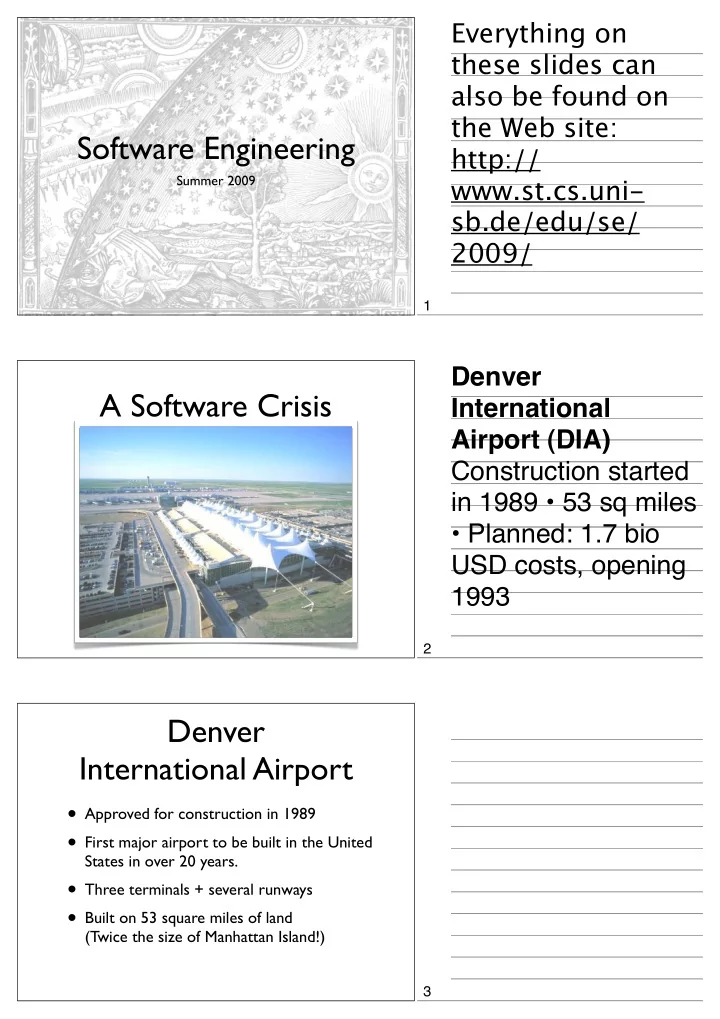
A Software Crisis Denver International Airport

  • Approved for construction in 1989
  • First major airport to be built in the United

States in over 20 years.

  • Three terminals + several runways
  • Built on 53 square miles of land

(Twice the size of Manhattan Island!)

Everything on these slides can also be found on the Web site: http:// www.st.cs.uni- sb.de/edu/se/ 2009/

1

Denver International Airport (DIA) Construction started in 1989 • 53 sq miles

  • Planned: 1.7 bio

USD costs, opening 1993

2 3

slide-2
SLIDE 2

BAE Contract

  • Original assumption: Every company builds

its own baggage transport system

  • United (70% Denver traffic) was the only

to begin planning; contract with BAE

  • First fully automated baggage system
  • Later, Denver airport extended contract to

entire airport – three times original size

The Scope

  • 20 miles of track
  • 6 miles of conveyor belts
  • 56 laser arrays that read bar coded tags
  • 400 frequency readers
  • 3,100 standard size baggage ‘Telecars’
  • 450 6.5 ft by 4 ft oversize cars
  • 55 separate computers

The System

4 5 6

slide-3
SLIDE 3

The System The System The Timeframe

  • BAE started work 17 months before

scheduled opening October 31, 2003

  • In Munich (similar system), engineers had

spent two years just testing the system (with 24/7 operation six months before the airport opened)

7 8 9

slide-4
SLIDE 4

More Risks

  • Most of buildings were already done, so

BAE had to accommodate system (sharp turns, narrow corridors…)

  • BAE paid little attention to German sister

project and devised system from scratch

  • Little communication within BAE

Final Blunder

  • The decision to broadcast the preliminary

test of the “revolutionary” new baggage system on national television

10

While all of the previous blunders contributed to the failure of the system, the worst mistake was still yet to come. It was a decision so terrible, so foolish, so absolutely

11

What camera crews depicted was truly a disaster; carts jammed together, damaged luggage everywhere, some bags literally split in half, and the tattered remains of clothing strewn

12

slide-5
SLIDE 5

A Disaster

  • Carts jammed together
  • Damaged luggage everywhere, some bags

literally split in half

  • Tattered remains of clothing strewn about

caused subsequent carts to derail

  • Half the luggage that survived the ordeal

ended up at the wrong terminal

More Issues

  • Carts got stuck in narrow corridors
  • Wind blew light baggage from carts
  • 5% of the labels were read correctly
  • Normal network load was 95%

Complexity: Empty Carts

  • Empty carts need to go where they are

needed

  • Cart has to be at its “cannon” at the right

moment

  • Lanes have limited length ➔ traffic jam
  • All controlled by single central system

13 14 15

slide-6
SLIDE 6

Consequences

  • Airport opening delayed four times –
  • verall, sixteen months late
  • New engineering firm
  • split system in three (one per terminal)
  • implemented manual backup system
  • BAE got bankrupt
  • Overall damage: 1.3 bln USD

Glass’ Law

Requirement deficiencies are the prime source

  • f project failures.

Chaos Report

  • 31% of projects were aborted prior to

completion

  • in small (large) development companies,
  • nly 16% (9%) of all projects were

completed within projected budget and time limits

Survey by the Standish Group, 1994 – 350 companies with >8000 software projects

16

This and other laws are found in Endres/Rombach: Handbook of Software and Systems Engineering. Evidence: Denver airport case study and two more

17

http:// www.standishgrou p.com

18

slide-7
SLIDE 7

Project Success

Survey by PC week, 1995: 365 information systems professionals on success of software development projects

31% 53% 16%

successful

  • perational

cancelled

More Examples

Toll Collect (2003) Airbus A 380 (2006) Airbags (1999) AT&T outage (1990)

16% of all projects successful 53% operational, but less than successful 31% cancelled

19

Airbags: RISKS 20.28, March 29, 1999: a baby sitting in a rear facing car seat mounted to the front seat in a Volkswagen Golf was killed by the impact of the deploying air bag in an

  • ncoming traffic
  • collision. The car owners

and parents of the killed baby had previously had

20 21

slide-8
SLIDE 8

Challenges

  • Why does it take so long to get software

finished?

  • Why are the development costs so high?
  • Why can’t we find all errors?
  • Why do we spend so much time and effort

maintaining existing programs?

  • Why is it difficult to measure progress?

Topics

  • Requirements Engineering
  • Software Specification
  • Software Design and Architecture
  • Advanced Programming Techniques
  • Software Quality Assurance
  • Software Maintenance and Evolution
  • Software Project Management

Your Lecturers

  • Andreas Zeller
  • Frank Padberg
  • Some Guests
  • Lecture Tue+Thu 8:30–10:00 HS2

22 23 24

slide-9
SLIDE 9

Your Tutors

  • Kim Herzig (coordinator)
  • Yulya Patenko
  • David Nemer

KIM HERZIG

Exercise Dates

25 26 27

slide-10
SLIDE 10

Exercise Sheets

  • Every Thursday morning
  • To be completed until next Thursday
  • Discussed in exercise groups

Mini Tests

  • Every Thursday morning at 08:30
  • 10-minute questionnaire

about last week’s exercise sheet

  • Be there on time!

Your Grades

  • Log on to the Web site to see your grades
  • You get a password by the end of this week

28 29 30

slide-11
SLIDE 11

Schedule Schedule Books

31 32 33

slide-12
SLIDE 12

Exams

  • Final Exam end of term (last week of July)
  • Extra Exam beginning of term (October)
  • Requirement: 50% of mini tests grades

Grading

10% 90%

Exam Mini tests

Web Site

34 35 36

slide-13
SLIDE 13

Sign up! Summary

37 38