SLIDE 1
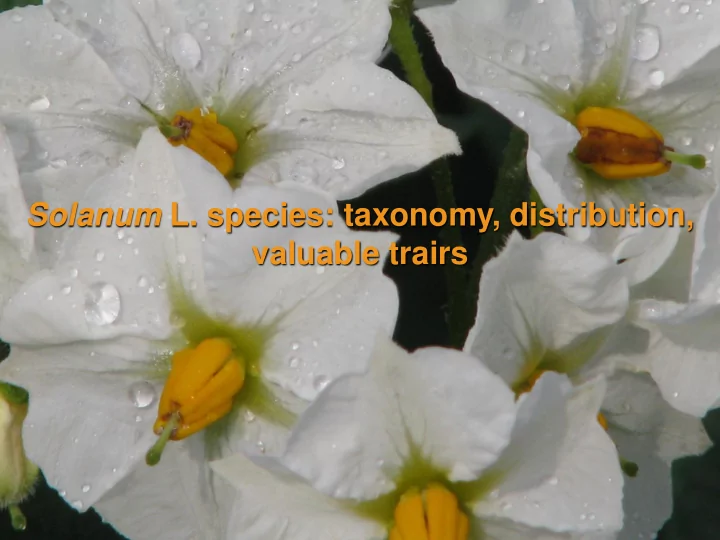
Solanum L. species: taxonomy, distribution, valuable trairs
SLIDE 2 The cultivated potato Solanum tuberosum L.
- riginated from the Andean Region of South
America.
Potato was first domesticated and eaten by man in South America particularly in the region of the Andes about 8000 years ago. Potato is one of the most important food crops in the world and is ranked at the fourth place in world food production after wheat, corn and rice.
SLIDE 3
SLIDE 4
Nutritional value per 100 g (row with peel)
Energy 321 kJ (77 kcal) Iron 1.8 mg (14%) Carbohydrates 19 g Magnesium 23 mg (6%) Starch 15 g Phosphorus 57 mg (8%) Dietary fiber 2.2 g Potassium 421 mg (9%) Fat 0.1 g Sodium 6 mg (0%) Protein 2 g Calcium 12 mg (1%) Water 75 g
SLIDE 5
Thiamine (Vit. B1) 0.08 mg (6%) Riboflavin (Vit. B2) 0.03 mg (2%) Niacin (Vit. B3) 1.1 mg (7%) Vitamin B6 0.25 mg (19%) Vitamin C 20 mg (33%)
Vitamins (per 100 g):
SLIDE 6
Potato can be grown widely under various climatic conditions at various altitudes because its high adaptation ability.
SLIDE 7
Species richness is highest between 8° and 20° S and around 20° N. Wild potatoes typically occur between 2000 and 4000 m altitude. Wild potatoes occur between 38° N and 41° S, with more species in the southern hemisphere.
SLIDE 8
- Wild potatoes occur in 16 countries., but
88% of the observations are from Argentina, Bolivia, Mexico, and Peru. High species richness
in northern Argentina, central Bolivia, central Ecuador, central Mexico, and south and north-central Peru. Peru has the highest number of species (93), followed by Bolivia (39).
SLIDE 9
Corolla shapes
SLIDE 10
SLIDE 11
Variation in Solanum andigenum tuber morphology
SLIDE 12 Botanical series of Central American species
- Series Morelliformia Hawkes
- Series Bulbocastana Rydb.
- Series Conicibaccata Bitter
- Series Longipedicellata Bukasov
- Series Demissa Bukasov
- Series Pinnatisecta (Rydb.) Hawkes
- Series Tuberosa (Rydb.) Hawkes
SLIDE 13
- Hawkes (1990) and Gorbatenko (1989)
recognize 15 and 20 series,respectively, for the South American species, and
- Hawkes (1990) and Bukasov (1978)
recognize 21and 36 series, respectively.
SLIDE 14
- Series Commersoniana Buk.
- Series Circaeifolia Hawkes
- Series Conicibaccata Bitter
- Series Cuneoalata Hawkes
- Series Acaulia Juz.
- Series Megitstacroloba Cardenas & Hawke
- Series Tuberosa (Rydb .) Hawkes
Botanical series of South American species
SLIDE 15
In a nature there are several ploidy levels, varying from diploid (2n = x = 24) to hexaploid (2n = 6x = 72). Commonly cultivated potato varieties are being a tetraploids (2n=4x=48).
SLIDE 16
Differences in ploidy lead to difficulties to use wild species in cross with S. tuberosum. There are the barriers in cross ability in species with different ploidy levels.
SLIDE 17
Crosses
SLIDE 18
SLIDE 19
SLIDE 20
SLIDE 21
Triple diploid interspecific potato hybrid
SLIDE 22 Potato breeding is aimed at improving resistance to many potato diseases. Wild species of the genus Solanum are widely distributed from Central America to South America. Utilization of wild Solanum germplasm could broaden the genetic resistance base
SLIDE 23
Evaluation of potato breeding lines for resistance to Early Blight caused by Alternaria solani
SLIDE 24 Wild potato species are being to be the valuable source
genes for resistance to harmful
To
late blight resistance, breeders are focused on the introgression of dominant resistance genes from wild potato species originated from Mexico.
A potato tuber ruined by late blight
SLIDE 25 Late Blight Caused by Phytophthora infestans is the causal agent of late blight, which is the most devastating disease in potato worldwide. It caused the great Irish famine in the 1840s resulting in famine- related diseases, which caused the death of over 1 million people and lead to the emigration of over 1.5 million people. The economic value of loss caused by late blight costs
- f crop protection have been estimated at 5 billion
US$ annually.
SLIDE 26 The pathogen P. infestans belongs taxonomically to the
SLIDE 27 The necessity of developing varieties with durable resistance increases because sexual reproduction of pathogen leads to more virulent and fungicide-resistant strains of P. infestans
A1 x and A2 mating types
SLIDE 28
SLIDE 29
Black ‘ s differential set (r, R1-R11)
SLIDE 30 The genetic spectrum of resistance genes in S. guerreroense was not yet studied. It is very probably that S. guerreroense is also reach with major genes for resistance to P. infestans because it is phylogenetically close to
Both species are hexaploid (2n = 6x = 72) . During the first half of the 20th century, eleven dominant R genes (R1-R11) from the wild species S. demissum were discovered
SLIDE 31
Hybrid progeny from S. guerreroense Corr.
SLIDE 32
Evaluation in glasshouse and in field experiments
SLIDE 33
Inoculation of yang seedlings with Phytophthora infestans
SLIDE 34
Inoculation with P. infestans detached leaflets
SLIDE 35
Leaflet tests
SLIDE 36 Reaction of hypersensitivity on leaves of plants possessing R-genes after inoculation with
SLIDE 39 Tubers of S. guerreroense hybrid progenies with necrotic reaction to inoculation with
SLIDE 40
Hybrid cv. Aurora x (S. tuberosum x S. phureja). Source of gene for resistance to P. infestans R3a.
SLIDE 41
Hybrid S. guerreroense x Black differential line R5. Source of genes for resistance to P. infestas R1 and R3a
SLIDE 42
Hybrid S. guerreroense x S. andigenum. Source of gene for resistance to nematod Ro1.
SLIDE 43 Genes for resistance to Globodera rostochiensis and Phytophthora infestans detected in five interspecific potato hybrids
Number of plants with detected resistance genes Globodera rostochiensis Phytophthora infestans No. In 2011 Number
plants Ro1 Gro1 R1 R3a 1 24 24 1 2 28 28
18 5 20 20
6 6 6
7 7
SLIDE 44 The weight of tubers at a third part of S. guerreroense hybrid progenies exceeded those formed in plants of
- S. guerreroense in 3- 7 times.
SLIDE 45
Tubers of parental wild accession (to left) and its hybrid progeny from cross with cultivated Solanum phureja
SLIDE 46
Materials used in these lection have been co- funded by EU Structural Funds (project: “Development, improvement and implementation
- f environmentally friendly and sustainable crop
breeding technologies”, 2009/0218/1DP/1.1.1.2.0/09/APIA/VIAA/099 ), Latvian Council of Science, Latvian National Programme in Agrobiotechnology