Solid State Physics 460- Lecture 2 Structure of Crystals (Kittel - - PowerPoint PPT Presentation

solid state physics 460 lecture 2 structure of crystals
SMART_READER_LITE
LIVE PREVIEW

Solid State Physics 460- Lecture 2 Structure of Crystals (Kittel - - PowerPoint PPT Presentation

Solid State Physics 460- Lecture 2 Structure of Crystals (Kittel Ch. 1) See many great sites like Bobs rock shop with pictures and crystallography information on the web at www.rockhounds.com/rockshop/xtal/index.html Physics 460 F


slide-1
SLIDE 1

Physics 460 F 2006 Lect 2 1

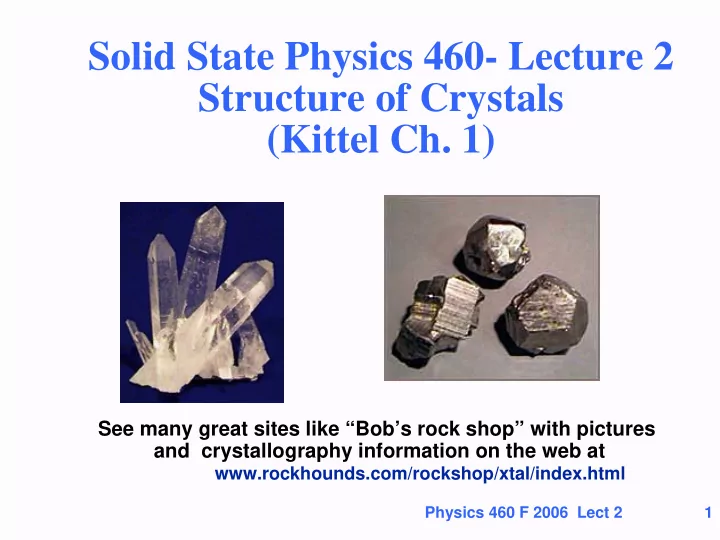
Solid State Physics 460- Lecture 2 Structure of Crystals (Kittel Ch. 1)

See many great sites like “Bob’s rock shop” with pictures and crystallography information on the web at

www.rockhounds.com/rockshop/xtal/index.html

slide-2
SLIDE 2

Physics 460 F 2006 Lect 2 2

Ideal crystals are simple and relevant!

  • Many solids are made of crystallites that

are microscopic - but contain ~ 1020 atoms! Ideal Crystalline Solid Real poly- crystalline Solid

slide-3
SLIDE 3

Physics 460 F 2006 Lect 2 3

Crystals

  • A crystal is a repeated array of atoms
  • Examples

Array of atoms Each atom is identical Array of atoms Two types of atoms

slide-4
SLIDE 4

Physics 460 F 2006 Lect 2 4

Two Dimensional Crystals

(Easier to draw in 2 dimensions – 3 dimensions later)

slide-5
SLIDE 5

Physics 460 F 2006 Lect 2 5

Two Dimensional Crystals

a1 a2

φ

Lattice

slide-6
SLIDE 6

Physics 460 F 2006 Lect 2 6

Two Dimensional Crystals

a1 a2

φ

Basis Lattice

  • Infinite number of possible crystals
  • Finite number of possible crystal types
slide-7
SLIDE 7

Physics 460 F 2006 Lect 2 7

Lattices and Translations

a1 a2

φ

a1 a2*

φ∗

  • The entire infinite lattice is specified by 2 primitive

vectors a1 and a2 (also a3 in 3-d)

  • T(n1,n2,…) = n1 a1 + n2 a2 (+ n3 a3 in 3-d),

where the n’s are integers

  • Note: the primitive vectors are not unique different

vectors a1 and a2 can define the same lattice

slide-8
SLIDE 8

Physics 460 F 2006 Lect 2 8

Primitive Cell

  • A representative cell
  • Translation of a primitive cell fills space
  • T(n1,n2,…) = n1 a1 + n2 a2 where the n’s are integers
  • Note: the primitive cells are not unique different

cells can fill all space

  • All primitive cells have the same are (volume)

a1 a2

φ

a1 a2

φ

slide-9
SLIDE 9

Physics 460 F 2006 Lect 2 9

Two Dimensional Lattices Primitive Cell and Wigner-Seitz Cell

Wigner-Seitz Cell -- Unique a1 a2 a1 a2 One possible Primitive Cell

  • All primitive cells have same area (volume)
  • Wigner Seitz Cell is most compact, highest

symmetry cell possible

  • Also same rules in 3 dimensions
slide-10
SLIDE 10

Physics 460 F 2006 Lect 2 10

Possible Two Dimensional Lattices

a1 a2

φ

  • Special angles φ = 90 and 60 degrees lead to special

crystal types

  • In addition to translations, the lattice is invariant

under rotations and/or reflections

slide-11
SLIDE 11

Physics 460 F 2006 Lect 2 11

Possible Two Dimensional Lattices

a1 a2

φ General oblique

a1 a2

Hexagonal Φ = 60, a1 = a2 6-fold rotation , reflections

a1 a2

Square 4-fold rot., reflect.

a1 a2

Rectangular 2-fold rot., reflect. Centered Rectangular 2-fold rot., reflect.

a1 a2

  • These are the only possible special crystal

types in two dimensions

slide-12
SLIDE 12

Physics 460 F 2006 Lect 2 12

More on Two Dimensional Lattices

a1 a2

φ

  • Why is it imposible to have a crystal with a

five-fold rotation symmetry?

  • Why is the centered square not a special

type?

slide-13
SLIDE 13

Physics 460 F 2006 Lect 2 13

Classification of Crystal Structures

  • Crystal structures classified by:
  • Translation symmetry
  • Only the Bravais lattice
  • Limited number of possible Bravais lattice types
  • Rotation, Inversion, reflection symmetry
  • Depends upon basis
  • Limited number of possible crystal types
  • Examples in 2 dimensions
  • (3 dimensions later)
  • See Kittel for lists of possible translation types.
  • See other crystallography references for lists of all possible

crystal types

slide-14
SLIDE 14

Physics 460 F 2006 Lect 2 14

Summary at this point

  • A crystal is a repeated array of atoms
  • Crystal

¤ Lattice + Basis Crystal Lattice of points (Bravais Lattice) Basis of atoms

  • Crystals can be classified into a small number of

types – See text for more details

slide-15
SLIDE 15

Physics 460 F 2006 Lect 2 15

Examples of Crystals Close packing of spheres in a 2-d crystal

  • Each sphere has 6 equal neighbors
  • Close packing for spheres
  • Hexagonal symmetry (rotation by 60 degrees)
  • Actually occurs for rare gas atoms (spherical) on a

flat surface

slide-16
SLIDE 16

Physics 460 F 2006 Lect 2 16

Crystalline layers with >1 atom basis

a1 a2 τ2 τ3

CuO2 Square Lattice Cu O O Square Lattice

a1 a2

CuO2 Basis

τ2 τ3

Cu O O

  • One CuO2 layer in the High Tc superconductors
  • Square lattice
  • One basis unit on each site
slide-17
SLIDE 17

Physics 460 F 2006 Lect 2 17

Crystalline layers with >1 atom basis

Honeycomb Lattice (graphene or BN layer)

a1 a2 τ2

Hexagonal Lattice

a1 a2

Basis 2 C atoms

  • r BN pair
  • A single layer of graphitic carbon (graphene)
  • The two atoms in the cell are both Carbon
  • A single layer of hexagonal boron nitride (BN)
  • The two atoms in the cell are B and N
slide-18
SLIDE 18

Physics 460 F 2006 Lect 2 18

Next Time

  • More on Crystal Lattices - Continue Kittel, Ch. 1
  • 3 Dimensions
  • Lattice planes
  • Examples of crystals