1
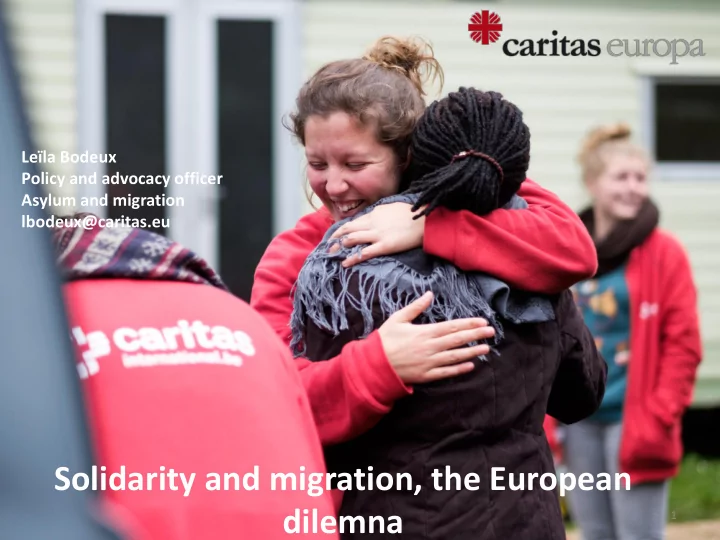
Solidarity and migration, the European dilemna 1 European context: - - PowerPoint PPT Presentation
Lela Bodeux Policy and advocacy officer Asylum and migration lbodeux@caritas.eu Solidarity and migration, the European dilemna 1 European context: A long way from 2015 So-called European refugee crisis due to increase of arrivals
European context: A long way from 2015
- So-called «European refugee crisis » due to increase of arrivals to Europe
in 2015 (1,3 million refugees)
- More an EU solidarity crisis than a refugee crisis
- Developing regions host 84 % of
the world’s refugees
- In Lebanon, 1 in 6 people is a
refugee and in Jordan 1 in 11
- Turkey hosts the largest number
- f refugees worldwide (2.9
million people)
- About 0.4% of the total EU
population is a refugee (around 0.5% in 1992-1995)
European context: A long way from 2015
- Initial welcoming Germany migrants transit through the Balkan route. Huge
solidarity wave in many countries but also fear and challenges.
3
- EU core values of solidarity and
responsibility sharing challenged
- Relocation mechansim:
- 160 000 people to be relocated from Italy
and Greece to EU countries
- But some Member states refused to
participate and challenged the scheme to the EU Court of Justice.
European context: A long way from 2015
- EU-Turkey deal and « closure of the Balkan route » :
- Germany and Austria behind both ideas
- Political tension led to this externalisation approach
- Some EU Member states pushing for offshore processing centers
- Inhumane condition in several Balkan countries (Serbia, Croatia, Hungary)
- New Hotpost approach in Greece and Italy:
- Reception facilities put in place in strategic zone of arrivals to swiftly identify, register
and process asylum application to support state’s authorities.
- Challenge to ensure the respect of procedural safeguards, fundamental rights and
transparent asylum procedure. Problem of discrimination against some groups, detenion, lack of facilities for vulnerable groups and children.
- Libya as EU priority to « close » the central Mediterranean Sea
4
European context: A long way from 2015
- Crisis of solidarity:
- Internal: lack of solidarity and responsibility sharing among Member states. EU asylum
legislation not implemented by some countries.
- External: EU further externalising migration managemlent policies to third countries that
already host most refugees.
- Migration is an election topic in most EU countries:
- Extremist political candidates on the rise
- Anti-migrant parties seize power or mainstream parties adopt a toughter stance
- Stricter laws implemented, intergration undermined (eg. Family reunification restricted
in Germany and Sweden for subsidiary protection, return to conflict countries such as Irak or Afghanistan)
- Human rights and Geneva refugee convention challenged
- Complicated political context to promote a positive approach to migration
- But positive initiatives ongoing: humanitarian admission programme in Germany,
humanitarian corridor in Italy, France, community sponsorship in UK.
European agenda on migration (13/05/15)
- Reducing the incentives for irregular migration: addressing the root causes
behind irregular migration in non-EU countries, dismantling smuggling and trafficking networks, better application of return policies Externalisation of migration policies
- Saving lives and securing the external borders: better management of EU’s
borders Frontex and border protection, hotspot approach, returns
- Strengthening the common asylum policy: solidarity towards refugees and
frontline Member states (ex: Italy) reform of the common European asylum system
- Developing a new policy on legal migration: aims at attracting qualified
workers Blue card directive
6
Common European asylum system (CEAS)
- Reform of the Common European asylum system ongoing:
- Aims at harmonizing asylum procedure and protection standards
- Seeks to avoid secondary movement and “abuses”
- “Package” of several directives and regulations:
- Aims to clarify the grounds for granting international protection (eg. Refugee
status and subsidiary protection, safe country of origin) Qualification regulation
- Aims to fasten the asylum decisions Procedure directive
- Aims to ensure minimum material reception conditions (eg. housing) Reception
Conditions Directive
- Dublin regulation:
- Very important: old system says that the first country of entry is responsible for
examining the asylum application border countries (eg. Italy) most affected.
- European parliament position quite good: deletes the first country criteria and
introduces a solidarity relocation mechanism.
7
Safe and legal pathways
- EU Relocation and resettlement quotas :
- 160 000 people to be relocated and the 22,504 to be resettled by September
2017
- Only 27,700 people have now been relocated (19,244 from Greece and 8,451
from Italy)
- 17,305 people have been resettled
- EC recommandation to Member States to resettle 50 000 people from Libya,
Niger, Chad, Egypt, Ethiopia and Sudan by 31 October 2019
- EU resettlement framework in negotiation
- Common set of standard procedures for the selection and treatment of candidates.
- Risk of migration management conditionality
- €10,000 from the EU budget for each person resettled
- Welcoming initiatives at national level:
- Humanitarian corridors in Italy and France
- Community sponsorship being explored
Return is the political priority
- Pressure to return migrants to their country of origin to please public opinion
- Return and asylum protection interlinked: “giving refuge to those who need it
and ensuring that those who have no right to remain in the EU are quickly returned.”
- Cooperation with countries of transit or origin to speed up returns: readmission
agreement, EU-Turkey deal, cooperation with Libya, Tunisia, Algeria
- European commission Action plan on return:
- Calls on Member states to take measure to increase the number of returns
- Use detention if needed and downplay safeguards
- Reinforces the negative perception of migrants who are assimilated to criminals.
9
Human impact of the EU-Turkey deal
- EU-Turkey statement (18/03/16)
- « 1+ 1 »: For one returned Syrian migrant to Turkey from Greece, one is
resettled from Turkey to EU country
- Financial support to Turkey (3 billion €)
- This deal and the closure of the Balkan route contributed to a dramatic
drop of migrants arriving in the EU through the so-called “Balkan route”.
- Border closure in autumn 2015 with Serbia and Croatia that created a ripple
effect, blocking asylum seekers in Greece and Serbia.
- In limbo in Greece : bottle neck effect in Greek islands where people are
stuck for several months in very bad conditions.
11
On the “Balkan road”
- State violence and abuses: expulsions, push-backs, violence by border police,
anti-migration laws criminalizing migrants and refugees, unlawful detentions dogs attacks, forcing people to strip naked in freezing temperatures, beatings with batons, administering electric shocks, extorsion, physical and mental abuse.
“When I first went for the game, we crossed through the wire and walked for 30 minutes. Police saw us and set their dogs on us. The dogs didn’t bite us, but they scared us a lot. When the police caught us, they treated us badly. There was a lot of snow. They took our clothes and made us sit in the snow and ice – we were frozen. They broke our mobile phones and took our money, and beat us badly. Then they put us in a car and took us back to the border”. (Maalik from Afghanistan)
12
On the “Balkan road” : the case of Hungary
- New laws to detain asylum seekers in so-called “transit zones” and to
expel those who do not have a legitimate asylum claim. Asylum seekers including children above 14 years old are held in border camps made of containers surrounded by high razor wire fence at the border for the duration of their asylum application process.
- Only 10 people per day are allowed to cross the border from Serbia and
access Hungary’s asylum system.
- People spend months at the border in makeshift camps, waiting to see
if their name will be one of the 10 called that day, which would allow them to cross.
- People turn to smugglers
13
14
15
The Central Mediterranean route
16
More than 5 000 people died in 2016 trying to reach Europe
The Libyan Hell
- EU and Italian cooperation with Libya to stop migrants from coming:
- Financial support, training and materials to Libyan authorities Italy accused to
finance criminal gangs to stop migrants from leaving Libyan coasts
- NGOs attacked, several search and rescue operation pulled out
- Horrendous conditions in Libya: migrants abused, tortured, raped in reception
and detention centres, forced labor and slave trade
cooperation with Libya risks people being sent back to hell and undermines human rights, Geneva Convention and the non-refoulement principle
17
Migration and development : the stick and carrot approach
- Valetta Summit with African countries (November 2015) :
- EU Emergency Trust Fund for Africa: 3 geographic windows: Sahel region and Lake Chad
region, North Africa, Horn of Africa
- EU cooperation with African countries to stem migration to Europe
- Development projects to retain people where they live and better « manage » migration
- Partnership framework (7/06/16):
- “Compact” (agreement) with strategic countries for migration: Niger, Nigeria, Mali, Senegal
and Ethiopia to cooperate in the fight against irregular migration by facilitating readmission
- Mobilise and focus EU action and resources in EU’s external work on managing migration
“mainstreaming” migration in all EU policies.
- Aid conditonality:
“A mix of positive and negative incentives will be integrated into the EU's development and trade policies to reward those countries willing to cooperate effectively with the EU on migration management and ensure there are consequences for those who refuse”
18
Caritas Europa advocacy
- Our message:
- More balanced migration and asylum policies, counter Fortress Europe
- Human and refugees rights at the center
- Safe and legal pathways to Europe: humanitarian corridors, humanitarian visas and
admission, community sponsorship, family reunification
- Promote a culture of encounter and welcoming societies
- Solidarity and responsibility sharing
- Advocacy on Dublin regulation with the “EU Christian group” to get rid of the
first entry criteria
- Advocacy on the EU resettlement framework: CE joint position paper
- Contribution to EC consultation on the Mid-term review of the European
agenda on migration and legal migration
- Draft position on return: safeguards and redlines
19
Caritas Europa advocacy
- One year anniversary of the EU-Turkey deal (18/03) :
- critical statement that denounces human costs
- CE’s interview with Vatican radio
- World refugee day (20/06):
- Opinion piece “Say yes to human mobility and no to Fortress Europe”
- CE statement and interview at BBC world news
- Peak of arrivals in Italy in July and lack of solidarity of EU countries:
- CE/Caritas Italiana joint statement: “Italy’s outcry embodies crisis of
solidarity among Member States”.
- Meeting of EU migration and interior minister (14/09/17):
- CE Statement “Walk the solidarity talk instead of building walls”: Asks
member states to show more solidarity towards migrants and to relocate more people.
20
Useful publication
Migrants have rights Welcoming society
21
Caritas Europa monthly policy update Please email me if you would like to be added to our mailing list
- 10 Myths about migration
and development
- Vatican 20 action plan (for
the 2 global compacts on migration and refugees)
- 10 acts for the global