
SLIDE 1
Kasetsart University
Dr.Peerapong Triyacharoen Department of Materials Engineering
213211: Imperfection
75
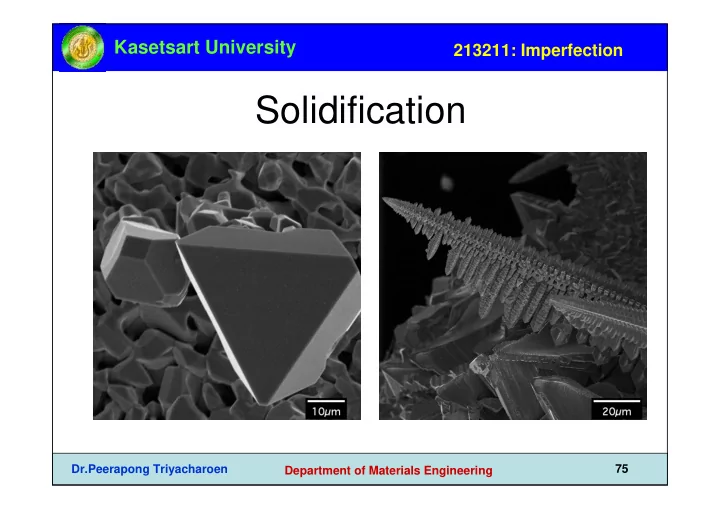
Solidification Dr.Peerapong Triyacharoen 75 Department of - - PowerPoint PPT Presentation
Kasetsart University 213211: Imperfection Solidification Dr.Peerapong Triyacharoen 75 Department of Materials Engineering Kasetsart University 213211: Imperfection Schematic Solidification Stages Formation of Nuclei Growth of nuclei into
Dr.Peerapong Triyacharoen Department of Materials Engineering
213211: Imperfection
75
Dr.Peerapong Triyacharoen Department of Materials Engineering
213211: Imperfection
76
Formation of Nuclei Growth of nuclei into crystals Completely solidified
Dr.Peerapong Triyacharoen Department of Materials Engineering
213211: Imperfection
77
v
G r ∆ =
3
π 3 4
Embryo Nucleus
γ π π
2 3
4 r G r G
v T
+ ∆ = ∆ 3 4
r = radius of embryo or nucleus ∆Gv = volume free energy γ = specific surface free energy
Dr.Peerapong Triyacharoen Department of Materials Engineering
213211: Imperfection
78
f m v
*
r* = critical radius Tm = melting temperature ∆T = undercooling (Tm – T) ∆Hf = latent heat of fusion represents the heat given up during the liquid-to-solid transformation
Dr.Peerapong Triyacharoen Department of Materials Engineering
213211: Imperfection
79
Dr.Peerapong Triyacharoen Department of Materials Engineering
213211: Imperfection
80
Tg Tm Temperature Density
C r y s t a l l i n e S
i d G l a s s Undercooled liquid Liquid
Dr.Peerapong Triyacharoen Department of Materials Engineering
213211: Imperfection
81
Planar Growth Dendritic Growth
Dr.Peerapong Triyacharoen Department of Materials Engineering
213211: Imperfection
82
Dr.Peerapong Triyacharoen Department of Materials Engineering
213211: Imperfection
83
Time required to completely solidify for a simple casting (ts) :
Dr.Peerapong Triyacharoen Department of Materials Engineering
213211: Imperfection
84
Aluminum alloy
Dr.Peerapong Triyacharoen Department of Materials Engineering
213211: Imperfection
85
Aluminum casting alloy
Dr.Peerapong Triyacharoen Department of Materials Engineering
213211: Imperfection
86
Design the thickness of an aluminum casting whose length is 12 in. and width is 8 in., in order to produce a tensile strength of 40,000 psi. The mold constant in Chvorinov’s rule for aluminum alloys cast in a sand mold is 45 min/in2.
n s
Solution
B = 45 min/in2 V = (8)(12)(x) = 96x A = (2)(8)(12) + (2)(x)(8) + (2)(x)(12) = 40x + 192
2 2
192 40 96 ) min/ 45 ( min 5 ⎟ ⎠ ⎞ ⎜ ⎝ ⎛ + = x x in
333 . ) 45 / 5 ( 192 40 96 = = ⎟ ⎠ ⎞ ⎜ ⎝ ⎛ + x x