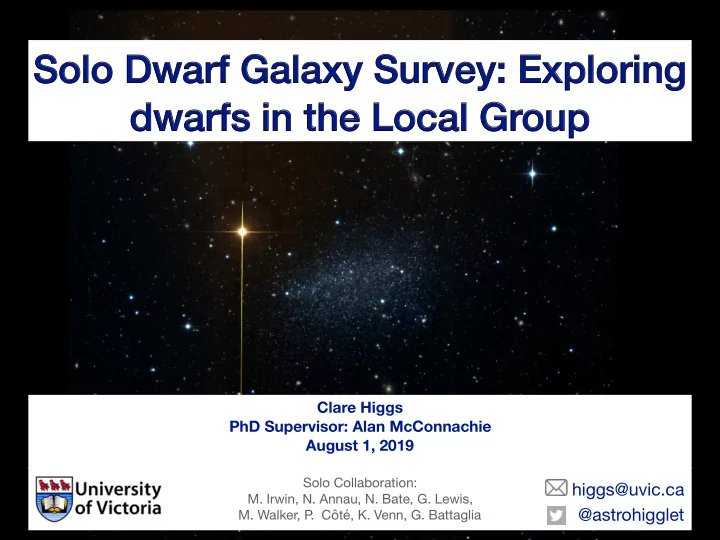
Solo Dwarf Galaxy Survey: Exploring dwarfs in the Local Group Clare - - PowerPoint PPT Presentation

▶
solo dwarf galaxy survey exploring dwarfs in the local
SMART_READER_LITE
LIVE PREVIEW

Solo Dwarf Galaxy Survey: Exploring dwarfs in the Local Group Clare - - PowerPoint PPT Presentation

Solo Dwarf Galaxy Survey: Exploring dwarfs in the Local Group Clare Higgs PhD Supervisor: Alan McConnachie August 1, 2019 Solo Collaboration: higgs@uvic.ca M. Irwin, N. Annau, N. Bate, G. Lewis, @astrohigglet M. Walker, P . Ct, K. Venn,


slide-1
SLIDE 1

Solo Dwarf Galaxy Survey: Exploring dwarfs in the Local Group

Clare Higgs PhD Supervisor: Alan McConnachie August 1, 2019

higgs@uvic.ca @astrohigglet

Solo Collaboration:

  • M. Irwin, N. Annau, N. Bate, G. Lewis,
  • M. Walker, P

. Côté, K. Venn, G. Battaglia

slide-2
SLIDE 2

DWARF GALAXIES

Local Group and a little beyond. ➡ Inside 3 Mpc. Not within the virial radius of a large galaxy ➡ More than 300 kpc from M31 and the Milky Way Low mass. MV >-18

NEARBY ISOLATED

slide-3
SLIDE 3

Why … NEARBY ISOLATED

  • Sensitive probes of galaxy formation and evolution
  • Resolved stellar populations
  • Intrinsic properties of low mass galaxies

Solitary Local (Solo) Dwarf Galaxy Survey

DWARF GALAXIES Why … Why …

slide-4
SLIDE 4

▸ Nearby (<3 Mpc) ▸ Isolated (>300 kpc from MW/M31) ▸ Wide field imaging (u), g & i ▸ CFHT MegaCam, Magellan Megacam

and Magellan IMACS

Solo Observations

Name

  • Alt. Name

RA Dec. Distance E(B − V ) Tel. Filt. [kpc] [Mags.] WLM DDO221 00h01m58.2s −15o27039” 933 ± 34 0.030 M gi C gi AndXVIII 00h02m14.5s +45o05020” 1355 ± 81 0.102 C gi ESO410-G005 KK98 00h15m31.6s −32o10048” 1923 ± 35 0.013 M ugi Cetus 00h26m11.0s −11o02040” 755 ± 24 0.038 M gi C g ESO294-G010 00h26m33.4s −41o51019” 2032 ± 37 0.013 M g i IC1613 DDO8 01h04m47.8s +02o07004” 755 ± 42 0.030 M ugi C gi KKs3 02h24m44.4s −73o30051” 2120 ± 70 0.045 M gi Perseus 03h01m22.8s +40o59017” 785 ± 65 0.062 C Eridanus II 03h44m21.1s −43o32000” 785 ± 65 M UGCA86 03h59m48.3s +67o08019” 2960 ± 232 0.918 C gi HIZSS3A(B) 07h00m29.3s −04o12030” 1675 ± 108 0.046 M ugi C g UGC4879 09h16m02.2s +52o50024” 1361 ± 25 0.215 C gi LeoT 09h34m53.4s +17o03005” 417 ± 19 0.037 C gi Antlia B 09h48m56.1s −25o59024” 1294 ± 99 C g LeoA 09h59m26.5s +30o44047” 798 ± 44 0.055 C gi SextansB 10h00m00.1s +05o19056” 1426 ± 20 0.034 C gi NGC3109 DDO236 10h03m06.9s −26o09035” 1300 ± 48 0.013 M ugi Antlia 10h04m04.1s −27o19052” 1349 ± 62 0.011 M gi SextansA DDO75 10h11m00.8s −04o41034” 1432 ± 53 0.046 M ugi LeoP 10h21m45.1s +18o05017” 1620 ± 150 0.090 C gi DDO99 11h50m53.0s +38o52049” 2590 ± 167 0.053 C ig NGC4163 12h12m09.1s +36o10009” 2860 ± 39 0.050 C gi IC3104 12h18m46.0s −79o43034” 2270 ± 188 0.065 M ugi DDO113 12h14m57.9s +36o13008” 2950 ± 82 0.049 C gi DDO125 12h27m40.9s +43o29044” 2580 ± 59 0.091 C gi GR8 DDO155 12h58m40.4s +14o13003” 2178 ± 120 0.066 M gi UGC8508 13h30m44.4s +54o54036” 2580 ± 36 0.227 C gi KKH86 13h54m33.5s +04o14035” 2590 ± 190 0.053 M ugi KKR3 14h07m10.5s +35o03037” 2188 ± 121 0.047 C gi UGC9128 14h15m56.5s +23o03019” 2291 ± 42 0.038 C g DDO190 14h24m43.4s +44o31033” 2790 ± 93 0.100 C gi KKR25 16h13m48.0s +54o22016” 1905 ± 61 0.345 C gi IC4662 17h47m08.8s −64o38030” 2440 ± 191 0.020 M gi SagDIG 19h29m59.0s −17o40051” 1067 ± 88 0.019 C ugi NGC6822 DDO209 19h44m56.6s −14o47021” 459 ± 17 0.018 C ugi Phoenix 19h44m56.6s −14o47021” 415 ± 19 0.010 M ugi DDO210 Aquarius 20h46m51.8s −12o50053” 1072 ± 39 0.026 M ugi C ugi IC5152 22h02m41.5s −51o17047” 1950 ± 45 0.016 M ugi AndXXVIII 22h32m41.2s +31o12058” 661+152

61

0.051 C ugi KK258 22h40m43.9s −30o47059” 2230 ± 50 0.011 M gi Tucana 22h41m49.6s −64o25010” 887 ± 49 0.024 M ugi UKS2323-326 UGCA438 23h26m27.5s −32o23020” 2208 ± 92 0.021 M ugi PegDIG DDO216 23h28m36.3s +14o44035” 920 ± 30 0.061 C ugi KKH98 23h45m34.0s +38o43004” 2523 ± 105 0.053 C ugi

slide-5
SLIDE 5

Why … NEARBY ISOLATED

  • Sensitive probes of galaxy formation and evolution
  • Resolved stellar populations
  • Intrinsic properties of low mass galaxies

DWARF GALAXIES Why … Why …

  • Need to minimize systematics

HOMOGENEOUS Why …

slide-6
SLIDE 6

Local Group Subsample

distance to M31

WLM = DDO 221 UGC 4879 = VV 124 IC 1613 = DDO 8 DDO 210 = Aquarius NGC 6822 = DDO 209 Peg DIG =DDO 216

  • Alt. Names:

McConnachie 2012

slide-7
SLIDE 7

Solo Dwarfs

0.5°

IC 1613 Leo T Leo A WLM Perseus Sag DIG

slide-8
SLIDE 8

Full field of view

Solo Dwarfs

0.5°

IC 1613 Leo T Leo A WLM Perseus Sag DIG

slide-9
SLIDE 9

Analysis Techniques

Resolved Stars Integrated Light

Pros:

▸

Describe the central regions well.

▸

Colour profiles Cons:

▸

Dominated by younger stellar populations.

▸

Heavily contaminated by foreground and background sources.

Combine both!

Pros:

▸

Reveals faint and extended stellar populations.

▸

Mass weighted rather than luminosity weighted.

▸

Can study the fainter old RGB population.

▸

Kinematic tracers often RGB stars. Cons:

▸

Incompleteness due to Crowding in the central part

▸

Radial profiles are not in “conventional” units.

slide-10
SLIDE 10

Resolved Stars in Nearby Dwarfs

slide-11
SLIDE 11

Resolved Stars in Nearby Dwarfs

slide-12
SLIDE 12

Extended Radial Profiles

▸

Combine resolved stellar profiles with integrated light profiles in the i band.

▸

The g band is used in dwarfs with no visible integrated i band.

▸

Combine with parameter

  • .

γRGB

Surface Brightness Radius

slide-13
SLIDE 13

Extended Radial Profiles

Surface Brightness Radius Similar “wings” observed by Bellazzini et al. 2018.

slide-14
SLIDE 14

Comparisons with Literature Values

Comparisons to values compiled by McConnachie 2012

slide-15
SLIDE 15

Trends/Future Work

▸

How does shape or size vary with distance?

▸

Indicative of tidal effects

▸

Trends with star formation histories?

▸

Reshaping due to internal processes

▸

Comparison to MW or M31 satellites, dwarfs in Fornax, M101 etc.

▸

External environmental effects

Preliminary!

slide-16
SLIDE 16

Trends/Future Work

Martin et al. 2018

▸

Martin et al. 2018 find ultra faint MW satellites are increasingly flatter with decreasing luminosity.

▸

We find the brighter Solo dwarfs are more elliptical in general

Preliminary!

slide-17
SLIDE 17

Exploring γRGB

▸

  • describes the fraction
  • f i band light resulting from

the RGB stars.

▸

Dependent on spatially resolved star formation history, metallicity, age - metallicity relation, dust reddening…

γRGB

Larger fraction from RGB stars Redder

slide-18
SLIDE 18

Summary

▸

Uniform and homogenous analysis of nearby isolated dwarf galaxies near the Local Group.

▸

Generate extended radial profiles to faint surface brightness limits.

▸

Study dwarfs collectively and individually.

Clare Higgs higgs@uvic.ca @astrohigglet