Some remarks on grad-div stabilization of incompressible flow - - PowerPoint PPT Presentation

some remarks on grad div stabilization of incompressible
SMART_READER_LITE
LIVE PREVIEW

Some remarks on grad-div stabilization of incompressible flow - - PowerPoint PPT Presentation

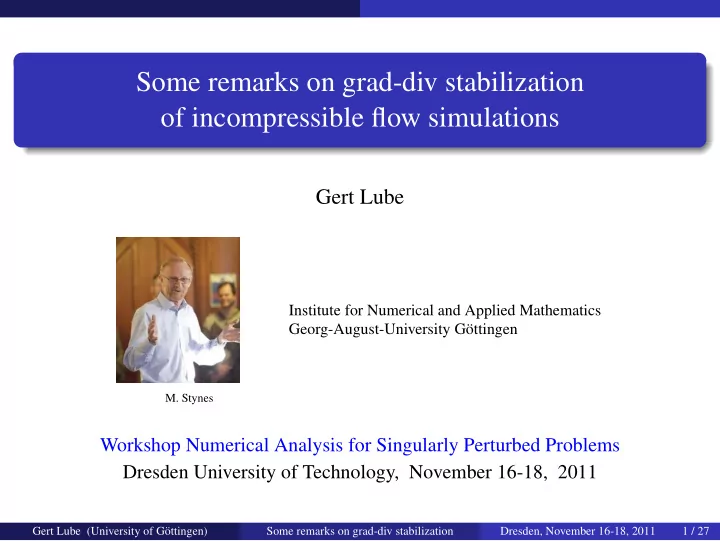
Some remarks on grad-div stabilization of incompressible flow simulations Gert Lube Institute for Numerical and Applied Mathematics Georg-August-University G ottingen M. Stynes Workshop Numerical Analysis for Singularly Perturbed Problems


slide-1
SLIDE 1

Some remarks on grad-div stabilization

  • f incompressible flow simulations

Gert Lube

  • M. Stynes

Institute for Numerical and Applied Mathematics Georg-August-University G¨

  • ttingen

Workshop Numerical Analysis for Singularly Perturbed Problems Dresden University of Technology, November 16-18, 2011

Gert Lube (University of G¨

  • ttingen)

Some remarks on grad-div stabilization Dresden, November 16-18, 2011 1 / 27

slide-2
SLIDE 2

Outline

1

Incompressible Navier-Stokes model

2

Numerical analysis of grad-div stabilized Oseen problem

3

Some recent result on limit case γ → ∞

4

A (potentially) new approach to parameter design

Gert Lube (University of G¨

  • ttingen)

Some remarks on grad-div stabilization Dresden, November 16-18, 2011 2 / 27

slide-3
SLIDE 3

Incompressible Navier-Stokes model

Navier-Stokes problem

Incompressible Navier-Stokes model: Find velocity u, pressure p ∂tu − ∇ · (2νDu) + (u · ∇)u + ∇p = f in (0, T] × Ω ∇ · u = 0 in [0, T] × Ω u|t=0 = u0 in Ω ⊆ Rd

no-slip boundary conditions u = 0 (for simplicity) deformation tensor Du = 1

2(∇u + (∇u)T)

viscosity ν (Reynolds number Re = UL

ν ).

Claude Louis Marie Henri Navier George Gabriel Stokes

Gert Lube (University of G¨

  • ttingen)

Some remarks on grad-div stabilization Dresden, November 16-18, 2011 4 / 27

slide-4
SLIDE 4

Incompressible Navier-Stokes model

Finite element approximation

V = [H1

0(Ω)]3,

Q = L2

0(Ω) := {q ∈ L2(Ω) :

  • Ω q dx = 0}

Th – admissible (possibly anisotropic) mesh Ω = ∪K∈ThK Conforming finite element spaces: Vh ⊂ V, Qh ⊂ Q

Basic Galerkin FE method:

find (uh, ph): [0, T] − → Vh × Qh s.t. ∀(vh, qh) ∈ Vh × Qh (∂tuh, vh) + (2νDuh, Dvh) + bS(uh, uh, vh) − (ph, ∇ · vh) = (f, vh) (qh, ∇ · uh) = with skew-symmetric convective term bS(u, v, w) := 1 2[((u · ∇)v, w) − ((u · ∇)w, v)]

Gert Lube (University of G¨

  • ttingen)

Some remarks on grad-div stabilization Dresden, November 16-18, 2011 5 / 27

slide-5
SLIDE 5

Incompressible Navier-Stokes model

Examples of inf-sup stable approximations

Inf-sup stable velocity-pressure FE spaces Vh × Qh ⊂ V × Q

∃β = β(h) s.t. inf

qh∈Qh sup vh∈Vh

(qh, ∇ · vh) qh0∇vh0 ≥ β > 0 No additional pressure stabilization required (at least for laminar flows) Taylor-Hood elements: for k ∈ N VTH

h

× QTH

h

= [Pk+1(Th) ∩ H1

0(Ω)]d × [Pk(Th) ∩ C(Ω)]

  • r

VTH

h

× QTH

h

= [Qk+1(Th) ∩ H1

0(Ω)]d × [Qk(Th) ∩ C(Ω)],

k ∈ N problems with mass conservation with increasing order k Scott-Vogelius elements: on barycenter refined tetrahedral meshes Th VSV

h

× QSV

h = [Pk+1(Th) ∩ H1 0(Ω)]d × [Pdisc k

(Th) ∩ L2

0(Ω)], for k ≥ d − 1

with property ∇ · [Pk+1(Th)]d ⊂ Pdisc

k

(Th) strong (pointwise) conservation of mass

Gert Lube (University of G¨

  • ttingen)

Some remarks on grad-div stabilization Dresden, November 16-18, 2011 6 / 27

slide-6
SLIDE 6

Incompressible Navier-Stokes model

Grad-div stabilized Galerkin methods

Galerkin FE method with grad-div stabilization:

find (uh, ph): [0, T] − → Vh × Qh s.t. ∀(vh, qh) ∈ Vh × Qh (∂tuh, vh) + (2νDuh, Dvh) + bS(uh, uh, vh) − (ph, ∇ · vh) + (qh, ∇ · uh) +(γ∇ · uh, ∇ · vh) = (f, vh) classical augmented Lagrangian approach, see e.g. FORTIN/GLOWINSKI [1983] also applied to Maxwell problem introduced by HUGHES/FRANCA [1986] for equal-order interpolation with γ ∼ 0(h) Numerical analysis for inf-sup stable interpolation by GELHARD ET AL. [2005] and OLSHANSKII ET AL. [2009]: Choice γ ∼ 0(h) is not correct in general case !

Gert Lube (University of G¨

  • ttingen)

Some remarks on grad-div stabilization Dresden, November 16-18, 2011 7 / 27

slide-7
SLIDE 7

Numerical analysis of grad-div stabilized Oseen problem

Grad-div stabilized Oseen model

Oseen model: For given b with ∇ · b = 0, find velocity u, pressure p −ν∆u + (b · ∇)u + ∇p + σu = f ∇ · u = 0 in Ω ⊂ Rd

C.W. Oseen

Grad-div stabilized Oseen problem: Find (uh, ph) ∈ Vh × Qh ⊂ V × Q s.t. ∀(v, q) ∈ Vh × Qh : aγ(uh, ph; vh, qh) := (ν∇uh, ∇vh) + bS(b, uh, vh) + (σ∇uh, vh) −(p, ∇ · v) + (q, ∇ · u) +

  • K

γK(∇ · uh, ∇ · vh)K = (f, vh)

Gert Lube (University of G¨

  • ttingen)

Some remarks on grad-div stabilization Dresden, November 16-18, 2011 9 / 27

slide-8
SLIDE 8

Numerical analysis of grad-div stabilized Oseen problem

Numerical analysis of grad-div stabilized Oseen problem:

  • M. Olshanskii, G. Lube, T. Heister, J. L¨
  • we: Grad-div stabilization and subgrid pressure

models for the incompressible Navier-Stokes equations, CMAME 198 (2009), pp. 3975-3988 Well-posedness: aγ(vh, qh; vh, qh) ≥ 1 2|[vh, qh]|2

b ≡ 1

2

  • ν∇vh2

0 + √γ∇ · vh2 0 +

cpqh2 ν + γmax + ν−1b2

L∞(Ω)

  • A-priori estimate:

|[u − uh, p − ph]|2

b ≤

  • K∈Th

h2k

K

  • ν + γK +

h2

Kb2 L∞(K)

ν

  • |u|2

Hk+1(K) +

1 ν + γK |p|2

Hk(K)

  • Equilibration of error terms: leads to ”dynamic” parameter version

γK ∼ max

  • 0; |p|Hk(K)

|u|Hk+1(K) − ν

  • Gert Lube (University of G¨
  • ttingen)

Some remarks on grad-div stabilization Dresden, November 16-18, 2011 10 / 27

slide-9
SLIDE 9

Numerical analysis of grad-div stabilized Oseen problem

Example 1: Vortex pairs

Oseen problem on Ω = (0, 1)2 with ν = 10−6, σ = 0 and b = u pairs of vortices strong variation of mesh Reynolds number ReK :=

u∞,KhK ν

∈ [0, h

ν ] H1- and L2-errors vs. scaling parameter γ0 of grad-div stabilization for Example 1 with σ = 0, h ≈

1 64

Gert Lube (University of G¨

  • ttingen)

Some remarks on grad-div stabilization Dresden, November 16-18, 2011 11 / 27

slide-10
SLIDE 10

Numerical analysis of grad-div stabilized Oseen problem

Example 1 ”Dynamic” vs. constant parameter design

H1- and L2-errors vs. scaling parameter ˜ γ0 of ”dynamic” grad-div stabilization for Example 1 H1- and L2-errors vs. scaling constant parameter γ0 of grad-div stabilization for Example 1 with ν = 10−6, σ = 0 Gert Lube (University of G¨

  • ttingen)

Some remarks on grad-div stabilization Dresden, November 16-18, 2011 12 / 27

slide-11
SLIDE 11

Numerical analysis of grad-div stabilized Oseen problem

Example 2: Vortex in boundary layer BERRONE [2001]

Oseen problem on Ω = (0, 1)2 with b = u counter-clockwise vortex in boundary layer ν-dependent solution with ∇u0 ∼ ν−0.35 and p0 ∼ ν−0.12.

Errors in H1-seminorm and L2-norm vs. scaling parameter γ0 of grad-div stabilization for Example 2 with ν = 10−4 Gert Lube (University of G¨

  • ttingen)

Some remarks on grad-div stabilization Dresden, November 16-18, 2011 13 / 27

slide-12
SLIDE 12

Numerical analysis of grad-div stabilized Oseen problem

Example 3: Beltrami flow EITHIER ET AL. [1994]

Time-dependent Navier-Stokes flow in Ω = (−1, 1)3 with ν = 10−6 Series of counter-rotating vortices intersecting one another at oblique angles Diagonally implicit Runge-Kutta method of

  • rder 2 with time step ∆t =

1 64 L2-error vs. t ∈ [0, 1] without stabilization for different h (left) and with grad-div stabilization for fixed h for ν = 10−6 Gert Lube (University of G¨

  • ttingen)

Some remarks on grad-div stabilization Dresden, November 16-18, 2011 14 / 27

slide-13
SLIDE 13

Numerical analysis of grad-div stabilized Oseen problem

Example 3 (continued)

L2(Ω)-error (as function of t) for different values of Re = 1

ν for the Galerkin scheme, i.e.

without grad-div stabilization (left) and with grad-div stabilization (right) Obvious improvement even with (time-independent) grad-div stabilization γK = γ0

Gert Lube (University of G¨

  • ttingen)

Some remarks on grad-div stabilization Dresden, November 16-18, 2011 15 / 27

slide-14
SLIDE 14

Numerical analysis of grad-div stabilized Oseen problem

Some conclusions

Constant value of grad-div parameter γ gives very often improvements of mass conservation and of other relevant norms ”Dynamic” design of γK ∼ max

  • 0;

|p|Hk(K) |u|Hk+1(K) − ν

  • is not feasible

Grad-div stabilization is not necessary in case of |p|Hk(K) ≥ ν|u|Hk+1(K), e.g. in shear flows ! Poiseuille-type flow: No improvement with grad-div stabilization !

Gert Lube (University of G¨

  • ttingen)

Some remarks on grad-div stabilization Dresden, November 16-18, 2011 16 / 27

slide-15
SLIDE 15

Some recent result on limit case γ → ∞

Stationary Navier-Stokes problem on SV-stable meshes

  • M. Case, V. Ervin, A. Lincke, L. Rebholz: A connection between Scott-Vogelius and

grad-div stabilized Taylor-Hood FE approximations of the Navier-Stokes equations, SINUM 49 (2011) 4, pp. 1461-1481 Stationary case: Let Th s.t. SV-elements are inf-sup stable, e.g. barycenter refined meshes.

3 × 3 mesh and barycenter refined mesh

Theorem: CASE ET AL. Theorem 3.1

For any sequence (uh)γi of TH-elements solutions with constant grad-div stabilization, there is a subsequence which converges to a SV-solution as the grad-div parameter γi → ∞, i → ∞. The sequences of TH-modified pressure solutions (ph − γi∇ · uh)γi converges to the corresponding SV pressure.

Gert Lube (University of G¨

  • ttingen)

Some remarks on grad-div stabilization Dresden, November 16-18, 2011 18 / 27

slide-16
SLIDE 16

Some recent result on limit case γ → ∞

Nonstationary Navier-Stokes on SV-stable meshes

Time-dependent Navier-Stokes flow

Remark: A similar result is valid for the time-dependent Navier-Stokes problem with Crank-Nicolson semidiscretization in time. Result from CASE ET AL. SINUM 49 (2011), Fig. 3: Flow around a 2D-cylinder with time-dependent inflow, s.t. Re ∈ [0, 100] Behavior of ∇ · un

u0 in time Gert Lube (University of G¨

  • ttingen)

Some remarks on grad-div stabilization Dresden, November 16-18, 2011 19 / 27

slide-17
SLIDE 17

Some recent result on limit case γ → ∞

Stationary Navier-Stokes problem on regular meshes

Consider the following steady state problem on regular meshes Th: ν(∇zh, ∇vh) + ((zh · ∇)zh, vh) = (f, vh) ∀vh ∈ V0

h

(rh, ∇ · vh) = ν(∇zh, ∇vh) + ((zh · ∇)zh, vh) − (f, vh) ∀vh ∈ (VTH

h )⊥

with V0

h

:= {vh ∈ Vh : ∇ · vh|K = 0 ∀K ∈ Th} VTH

h

:= {vh ∈ Vh : (∇ · vh, qh) = 0 ∀qh ∈ QTH

h }

Theorem: CASE ET AL., Theorem 4.1

For any sequence (uh, ph)γi of TH-elements solutions with grad-div stabilization parameters γi, a subsequence of (uh, ph − γiρh)γi with (ρh,i, ∇ · vh) := (∇ · uh,i, ∇ · vh) ∀vh ∈ (VTH

h )⊥

converges to (zh, rh) as the grad-div parameter γi → ∞, i → ∞. Remark: A similar result is valid for the time-dependent Navier-Stokes problem with Crank-Nicolson semidiscretization in time.

Gert Lube (University of G¨

  • ttingen)

Some remarks on grad-div stabilization Dresden, November 16-18, 2011 20 / 27

slide-18
SLIDE 18

Some recent result on limit case γ → ∞

Some further conclusions

Easy implementation of grad-div stabilization into existing code with Taylor-Hood elements ! ”Moderate” grad-div stabilization may lead to considerable improvement of mass conservation without deterioration of other solution properties ! Besides interesting results for constant γ → ∞ in CASE ET AL. [2011] results for 3D driven cavity show a deterioration of solution properties for γ → ∞ on regular meshes ”Optimal” choice of γ: ”... the search of an optimal γ as a trade-off between mass conservation and energy balance in the FE system ...” OLSHANSKII ET AL. [2009] Potential remedy: Adaptive choice of γ|K based on information from velocity gradients, see next chapter

Gert Lube (University of G¨

  • ttingen)

Some remarks on grad-div stabilization Dresden, November 16-18, 2011 21 / 27

slide-19
SLIDE 19

A (potentially) new approach to parameter design

Eddy-viscosity closure of Reynolds-averaged Navier-Stokes model

3

  • j=1

∂juj = ∂tui +

3

  • j=1

∂j(uiuj) + ∂i(p + τkk 3 ) − ν

3

  • j=1

∂2

j ui − 3

  • j=1

(2νeDij) = fi, i = 1, . . . , 3 νe :=

  • c∆2

B(u) |∇u|2

F ,

if |∇u|2

F := 3 i,j=1(∂iuj)2 = 0

0, if |∇u|F = 0 B(u) := β11β22 − β2

12 + β11β33 − β2 13 + β22β33 − β2 23,

βij :=

3

  • m=1

∂mui∂muj Vreman, A.W.: An eddy-viscosity subgrid-scale model for turbulent shear flows: algebraic theory and application. Phys. Fluids 16 (2004), pp. 3670-3681

Gert Lube (University of G¨

  • ttingen)

Some remarks on grad-div stabilization Dresden, November 16-18, 2011 23 / 27

slide-20
SLIDE 20

A (potentially) new approach to parameter design

Some observations:

Design of eddy viscosity requires information from velocity gradient (similar to classical Smagorinsky model νe = (CS∆)2D(u)F) Data can be easily derived within time discretization and linearization Design rotationally invariant for isotropic filter width ∆ Careful algebraic considerations of 320 possible cases of local behavior of flow field u: identifies 13 types of ”laminar” flow (shear-type flow) with zero energy transfer to subgrid scales νe = 0 Such cases may be identified as ”coherent structures”

Gert Lube (University of G¨

  • ttingen)

Some remarks on grad-div stabilization Dresden, November 16-18, 2011 24 / 27

slide-21
SLIDE 21

A (potentially) new approach to parameter design

Application to low-turbulent channel flow at Reτ = 360

Results taken from VREMAN [2004], Fig. 4:

Left: Mean streamwise velocity (normalized by uτ Right: Subgrid eddy viscosity νe (normalized by uτH)

DNS (circles), Vreman (solid), dynamic Smagorinsky (dashed), standard Smagorinsky (dotted), 0-model (triangles)

Important: Vreman’s eddy viscosity tends to zero in the viscous sublayer at the wall ⇒ No van Driest damping in boundary layer necessary !

Gert Lube (University of G¨

  • ttingen)

Some remarks on grad-div stabilization Dresden, November 16-18, 2011 25 / 27

slide-22
SLIDE 22

A (potentially) new approach to parameter design

A potentially new parameter design

Application to grad-div stabilization

Vreman’s eddy viscosity νe models influence of unresolved velocity fluctuations u′ = u − u Grad-div stabilization may be identified as model of unresolved pressure fluctuations p′ = p − p Application of Vreman’s eddy viscosity νe for parameter γ|K (eventually with another scaling) would deactivate grad-div stabilization for shear-type flow

To be done:

Idea can be transfered to variational multiscale approach with local projection stabilization !! Application of VMS framework of R ¨

OHE/ LUBE CMAME [2010]

Gert Lube (University of G¨

  • ttingen)

Some remarks on grad-div stabilization Dresden, November 16-18, 2011 26 / 27

slide-23
SLIDE 23

A (potentially) new approach to parameter design

  • Summary. Outlook

Improvement of mass conservation with grad-div stabilization of Taylor-Hood elements Further consideration of parameter choice γ → ∞ Analysis and test of new non-constant parameter design

THANKS FOR YOUR ATTENTION ! ALL THE BEST TO YOU, DEAR MARTIN !

Gert Lube (University of G¨

  • ttingen)

Some remarks on grad-div stabilization Dresden, November 16-18, 2011 27 / 27