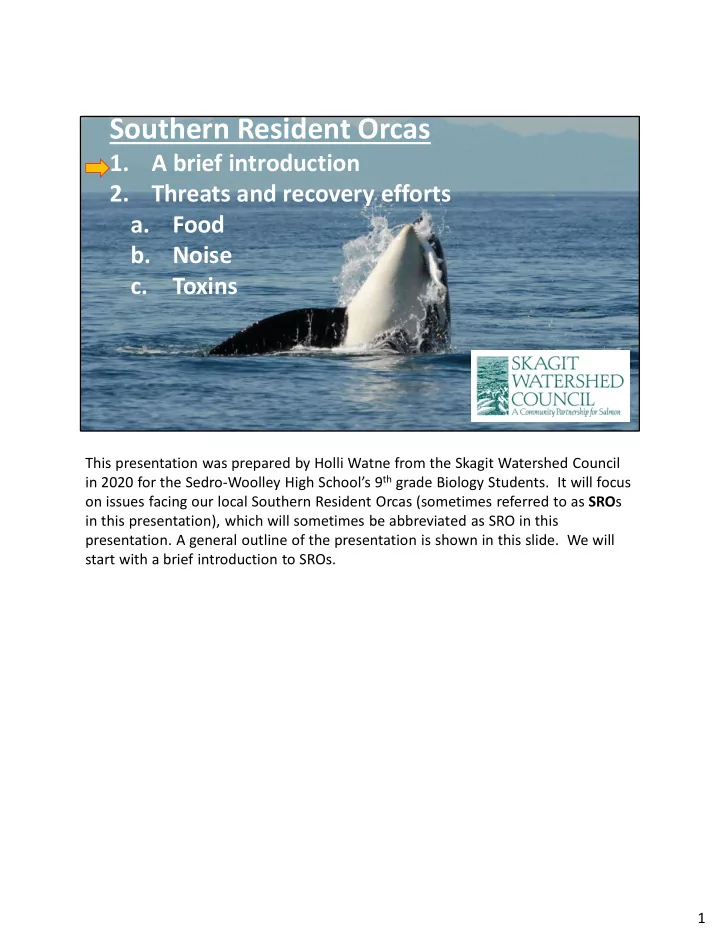
SLIDE 1 Southern Resident Orcas
1. A brief introduction 2. Threats and recovery efforts a. Food b. Noise c. Toxins
This presentation was prepared by Holli Watne from the Skagit Watershed Council in 2020 for the Sedro-Woolley High School’s 9th grade Biology Students. It will focus
- n issues facing our local Southern Resident Orcas (sometimes referred to as SROs
in this presentation), which will sometimes be abbreviated as SRO in this
- presentation. A general outline of the presentation is shown in this slide. We will
start with a brief introduction to SROs. 1
SLIDE 2
Orca/Killer Whale (Orcinus orca)
Kingdom - Animalia Phylum - Chordata Class - Mammalia Order - Artiodatyla Family - Delphinidae Genus - Orcinus Species - Orca
An Orca is the same thing as a Killer Whale. This is how a scientist would describe an orca whale using biological classification. Orca whales are animals (Kingdom Animalia) who have bones (Phylum Chordata), feed milk to their offspring (Class Mammalia), have a specific arrangement of bones in their “hands” (Order Artiodatyla). Cetaceans (whales) are a subgroup of this order. They are considered an oceanic dolphin (Family Delphinidae), a type of toothed whale (a subgroup of the cetaceans). In fact, they are the largest member of the dolphin family. Orcas are the only species of genus Orcinus currently living. The photo shows the relative size of an adult male Orca to an adult male human. 2
SLIDE 3 Local Orca subspecies
Transient (eat mammal) Southern Resident (eat salmon) Offshore (eat sharks) Source: SeaDoc Society
There are many subspecies of Orcas. Each has unique physical and behavioral
- characteristics. The photo shows typical teeth from three different subspecies of
- rcas that can be found in or near the Puget Sound (the marker is included in the
photo to show the size of the teeth). The name of the subspecies and their preferred food is in a box above and to the left of the tooth. The Southern Resident Orcas have evolved teeth, social structures, and hunting tactics that make them excellent at catching salmon. However, they would have an extremely hard time catching and eating foods other Orcas eat. 3
SLIDE 4 Southern Resident Orcas
- Apex predators
- Live in matriarchal families
(J, K, and L Pod)
75 to 100 miles per day
- Similar life histories to humans
- Endangered (74 individuals)
Photo: Robert Pittman - NOAA
Here’s some more information about SROs.
- In general, orcas are apex predators. That means they are on top of the food chain and
nothing hunts them.
- There are three different extended family units, or “pods” that typically travel and hunt
- together. Pods are matriarchal, meaning female-lead. All SROs stay in their mother’s
pod and the pod is usually directed by the eldest female in the family.
- Each pod is almost constantly on the move. Finding food is a constant struggle.
- SROs have similar life histories to humans, something this is not said about many
members of the animal kingdom. Perhaps this is part of the reason some people feel a special connection to them.
- SRO mothers give birth to a single calf at a time and remain bonded with their
- ffspring throughout their entire lives. Babies keep near their mothers, but as
they get older, they get more adventurous and seek out their independence. They become sexually mature at around 14 years. They are capable of reproducing for the next 20-30 years. After they have passed their reproductive years, they are still valuable members of their society for the rest of their lives, which may be up to another 50 years!
- As with humans, the wisdom of the elders is essential for the stability and well-
being of the entire community.
- SROS have been listed under the Endangered Species Act since 2005.
4
SLIDE 5
The map on the left shows area where SROs have been spotted (indicated with red squiggles). The white part of the map is the Pacific Ocean and the grey part is the land (western U.S. and British Columbia). The dark blue circle in this image shows the area that is included in the map to the right (the Salish Sea). In the map of the Salish Sea, the grey-and-white shaded area indicated critical habitat for the SROs. These are places that are most important for them to be able to find food. This area is protected from destruction under the US Endangered Species Act and the Canadian Species at Risk Act. The portion of Salish Sea that is part of Washington State (on the lower portion of the think black line that shows the boarder between the US and Canada) is colloquially known as the Puget Sound. Skagit Bay, where the Skagit River ends is marked with a dashed yellow circle. We will talk more later about why the health of the Skagit River is tied to the health of the SROs. 5
SLIDE 6
Scientists estimate the historical population size of Southern Residents was at least 140 animals. The Center for Whale Research has done census of SROs every year since 1976. From 1996 to 2001, the population experienced a decline of almost 20%, a fact that played a significant role in getting them listed as an endangered distinct population segment under the U.S. Endangered Species Act. Even with protections under the Endangered Species Act, the population has been on a slow decline since 2005. 6
SLIDE 7
Southern Resident Orcas (SRO)
1. A brief introduction 2. Threats and recovery efforts a. Food b. Noise c. Toxins
Why has the population of SROs been declining? There are many reasons, but scientists generally agree that the three main reasons have to do with a scarcity of food, noise pollution, and fat-soluble toxins. We will introduce the problems and how people are trying to reduce them, starting with their diet. 7
SLIDE 8 Tucker, a Conservation Canine
Source: University of Washington Center for Conservation Biology
Scientist study SRO diets primarily by collecting and analyzing their fecal matter (poop). This is Tucker, and dog that has been specially trained to find SRO poop. 8
SLIDE 9
Also endangered!
SROs are fish eaters that specialize in eating salmon. Studies show that the SRO whales eat salmon almost exclusively, at least in the summertime. Chinook salmon, also known as King Salmon because they are the largest pacific salmon species, are the most important species in their diets. In that statement there is a problem: Chinook Salmon are also listed as an endangered species. It is belief among many people that if we don’t protect the Chinook Salmon, the Southern Resident Orcas will follow them into extinction. 9
SLIDE 10 Priority List of Chinook Populations
- 1. Northern and Southern Puget Sound (fall)
- 2. Straight of Georgia (fall)
- 3. Fraser River (spring)
- 4. MCR (fall brights)
- 5. Northern Puget Sound (spring)
- 6. WA coast (spring & fall)
- 7. Central Valley (spring)
- 8. MCR & UCR (spring & summer)
- 9. Fraser River (summer)
10.Klamath River (fall & spring)
The National Oceanic and Atmospheric Administration (NOAA) is the primary federal organization that works on conserving oceanic species that are listed under the Endangered Species Act. This is a list that NOAA put together as the top priorities in conserving Chinook along the U.S. portion of the Pacific coast. The Northern Puget Sound (where we live) is #1 (fall) and #5 (spring) on that list. This concerns us especially in Skagit County because…. 10
SLIDE 11
About 50% of the wild Chinook in the Puget Sound come from the Skagit River!
… the Skagit River is the most important rearing habitat for wild Chinook Salmon in the Puget Sound! It is also the only river in Washington state that has wild populations of all five salmon species. The Skagit River is a major conservation area for Chinook and other salmon species. In order to understand the conservation work being done to protect Chinook in the Skagit, it is important to know about their life cycle. Note: All these species have a similar life cycle, but the amount of time spent in each of the main habitats (river, estuary, and ocean) differs from species to species. 11
SLIDE 12
The River Chinook live here for 12-18 months
Wild Salmon start their lives up in the river. If they are lucky, they will end their lives here too, but we’ll get to that. For Chinook, they stay in the river for a year to a year and a half – slowly heading downriver. The individuals that stay longer are usually bigger and stronger and more likely to survive once they leave the river. For this reason, a lot of river-based restoration project attempt to give salmon habitat that lets them stay in the river, especially during flood seasons. 12
SLIDE 13 Chinook spawn Sept-Dec
Chinook spawn (reproduce) from September to December. Female salmon makes a nest called a redd out of gravel of a specific size, with her eggs protected under a light blanket of gravel. Once the eggs are in place, a male will fertilize them. This photo shows two Chinook spawning. The male (top) is releasing milt (which includes his sperm) over the eggs. He will swim off and try to fertilize another batch
- f eggs. The female will stay to protect the redd.
13
SLIDE 14 This is an image of a female salmon before she has deposited her eggs. The side of her body has been cut away to show what’s inside her body: mostly eggs. Each
- range ball is an egg. A big healthy Chinook can produce over 4,000 eggs.
However, we would expect that only about 2 of those eggs would make it back to the river as spawning adults. The remaining eggs and fish that don’t make it will become food for 138 different vertebrate species, including birds, bears, fish, humans, and whales. 14
SLIDE 15
Here is a closeup image of a redd. The pearly white balls are eggs that did not develop into fish. There are lots of reasons eggs might not develop. Perhaps they didn’t get fertilized. Perhaps they didn’t get enough oxygen. Perhaps they got too hot. There are also recently-hatched salmon in this photo. That big red sack attached to them comes from the yolk of the egg. This is their first meal. They do not have to leave the safety of the redd until they have consumed all the nutrients in the sack. When the yolk sack is visible on salmon, they are known as alevin 15
SLIDE 16
Aelvin
Here is an older alevin. Soon it will need to leave the redd to feed. 16
SLIDE 17
Fry
Once the salmon leave the redd they start feeding on plankton and are known as fry 17
SLIDE 18
Parr
Once salmon are large enough to eat small invertebrates, they are known as parr. Dark vertical lines along heir body, called parr marks, help them camouflage. But they also need places to hide and keep cool. Their chances of survival in this stage increase if they have a complex habitat where they can slowly migrate downriver. 18
SLIDE 19
Lots of birds, including cormorants (shown in this photo), love to eat young salmon. Near our office in downtown Mount Vernon, we often see dozens of cormorants watching the river from telephone wires, hoping to spot a tasty young salmon. 19
SLIDE 20
The Estuary Chinook live here for about 4 months
At the end of the river the fresh water slowly gets saltier. Salmon move from the Skagit River Delta to the rest of the Skagit Bay and then onto the deeper parts of the Salish Sea. Each of these (delta, bay, sea) are an estuary (a place where fresh and saltwater mix that is semi-surrounded by land). Chinook live in estuary habitats for about 4 months before they finally make their way to the ocean. The ocean’s water is not protected by land the way an estuary is, so the Chinook will need to gain a lot of strength before they head out into the rough ocean water. 20
SLIDE 21
Smolt
When salmon are in the estuary they are known as smolt. Smolt bodies are changing rather drastically on a cellular level. In a freshwater environment, cells work hard to get rid of excess water and hold onto vial solutes (i.e.. minerals and salts). In a saltwater environment, cells work hard to get rid of excess solutes and hold onto vial water. The process that salmon go through from living in a freshwater environment to a saltwater environment is called smoltification. The smolt in this image are lucky to have lots of eelgrass to hide in. This will protect them from being eaten. It is also a good place to hunt for small invertebrates. 21
SLIDE 22
As the smolt get bigger and stronger, they head deeper into the sea and eat small fish. 22
SLIDE 23
The smolt may encounter Orcas on their way to the Pacific Ocean, but they are too small to be a decent meal for the whales at this point. The Orcas will wait for the salmon to return as adults. 23
SLIDE 24
The Ocean Chinook live here 4 years on average, but can live here up to 8 years
At the age of 1.5-2 year, the Chinook have made it to the ocean. At this point in their life cycle, salmon have finished the smoltification process and have tuned silver in color. Assuming they live a full lifecycle, this is where they’ll spend most of their lives. Chinook usually spend four years in the ocean by can stay there for up to eight years, swimming as far away as Japan! In the ocean, they eat lots of fish and put on lots of body mass before they return to the estuary. 24
SLIDE 25
At some point the adult salmon swim away from the deep ocean waters and return to the estuary where they lived in when they were smolts. For Chinooks, how big they are when the return depends on how long the were in the ocean. Most of the Chinooks we see returning to the Skagit are about 30 pounds, but Chinook that spend a longer time in the ocean can get over 100 pounds! It was a lot more common to see Chinook this size 100 year ago. 25
SLIDE 26
Summer arrival
This is the time that the orcas have been waiting for! They prefer going for the biggest (oldest) Chinook. 26
SLIDE 27 Salmon swim upriver to spawn in almost the exact same place as they were
- hatched. This can be a long and dangerous trip.
27
SLIDE 28
Females spend the rest of their lives protecting the nest
For the salmon that make it to spawn, they have made it through the full life cycle. Males will try to add their milt to as many redds as they can, but ultimately will become exhausted and die. Females will protect their fertilized redds for the rest of their lives, which may be days to weeks. Ultimately all adult salmon that make it upriver die. The decaying salmon are good for the whole river ecosystem because their bodies bring rich nutrients from the foods they ate in the ocean. Many plants and animals in the river ecosystem depend on these marine-derived nutrients. 28
SLIDE 29 Puget Sound Chinook Populations
From Puget Sound Partnership & WDFW
Skagit River Watershed
1
This figure shows the results of a study that compared the five-year averages (from 1999-2003 and from 2012-2016) of Chinook in different watershed of the Puget
- Sound. Most watershed have seen a decrease in the number Chinook. However
the Skagit River Watershed, including its major tributaries, (I’ve highlighted the region in red and put an arrow pointing to it) is one of the few places where we’ve seen increases in Chinook. These increases have been largely due to restoration work that will be discussed next. Note: the Elwha River’s increase is largely due to the removal of two dam between the time frames studied. 29
SLIDE 30 Slide 29 1
, 5/14/2020
SLIDE 31 Protected land
This is a satellite image of the upper Skagit. The colored boxes represent lands that are protected by different organizations, such as the Skagit Land Trust, the Department of Natural Resources, the Nature Conservancy, the U.S. Forest Service and the North Cascades National Park. Some of these organizations are actively trying to acquire even more land, especially in area that are essential for salmon. 57% of the upper Skagit watershed is protected by these organizations and overall within the watershed 42% of the most critical habitat is protected. This means that there are rules to prevent habitat loss. In these areas, and also sometimes in privately-owned land too, people do restoration work to improve the habitat for
- salmon. These improvement include planning trees along the river to keep the
water cool and making sure spawning areas are have the right kind of gravel. We will discuss a few other examples of restoration projects next. 30
SLIDE 32 Photo of SFEG Culvert Removal Project
Culverts are large pipes that allow people to relatively cheaply put a road across a scream or creek. Some culverts make it challenging or even impossible for salmon to move from one end of a stream to another. A lot of work had been done to replace culverts that block salmon with bridges that allow salmon to pass under roads easily. The photos above are in the same location. The photo on the left shows a culvert in a creak where young Chinook live. The photo to the right is after a restoration project. Many culverts have successfully been replaced in the Skagit Watershed, and others are currently being studied to see if they are a high priority to remove. 31
SLIDE 33
Starting in the mid 1800’s European American settlers started changing the Skagit River to make it better suited for farming and to reduce flooding. These changes included making the river straighter and armored or diked. We now realize that a lot of these changes make life challenging for salmon. To thrive, young salmon need the river to be complex (having features like channels that slow the water down). The two photos are both from the Skagit River. The image on the right (upriver) is more complex than the one on the left (down river). Historically the whole Skagit was “braided” with channels, like in the right photo. Complex rivers that can migrate over time have better spawning grounds and rearing (baby raising) habitat. When complex rivers floods, the channels fill in and fish can find pockets within the river that are safe. However when rivers that are diked and/or straitened flood, fish are blown out of the river and forced into saltwater prematurely or left stranded on dry ground. Restoration project that aim to make the river more complex may involve removing armoring or dikes or reconnecting the river to channels where it one flowed. 32
SLIDE 34
Early European American settlers also changed the way rivers entered the estuary. They built dikes over the river delta to keep salt water out of the river. This has a few negative consequences for salmon: 1) it make the transition from fresh to salt water more sudden, making the cellular change between the two environments more stressful, 2) it reduced the amount of estuarine tidal flats (shallow coastal wetlands), meaning less habitat for salmon and the eelgrass they need for protection and 3) the deeper water at the end of the river makes salmon more easily hunted by predators such as seals, sea lions, larger fish, and diving birds. A big focus for salmon restoration in the Skagit watershed is restoring the estuary by removing dikes. This image is a satellite image of the Skagit River. With help for restoration projects in this area (yellow starts show projects that have been completed or are set in motion), the Skagit River has the largest river delta of any river flowing into the Puget Sound. Note: It can be challenging to get landowners to agree to these project because they can reduce land available for farming in the lower Skagit. 33
SLIDE 35 Photo Credits: pugetsoundnearshore.com & Journal of San Juans
Shoreline armoring (like the cement walls in the “before” photo) is present along more than 25% of the shoreline around Puget Sound. Armoring is a way to control beach erosion and allow development like roads, towns, and houses close to saltwater. However, it also reduces tidal flats, which is an important salmon habitat. These habitats are also critically important for salmon’s primary food source: small fish like herring, surf smelt, and sand lance; known as forage fish. The project in the photo was intended for salmon restoration. It created a gently sloping sandy beach. The intertidal regions of such beaches is where sand lance and surf smelt lay their eggs. The photo to the right shows surf smelt eggs on a sandy beach. The penny is included for scale. Before the restoration project, sand lances might not be able to spawn in this area, meaning a lot less food for salmon in this area. 34
SLIDE 36
- SROs eat 18-25 Chinook a day!
- Current population requires a minimum of 1,400 daily
- Restored population would need 1,000,000 Chinook each year
These are just a few examples of work that is being done to increase the populations of salmon like Chinook this area. There is a lot more work to be done. In order to assure SROs have enough food, there need to be a lot of salmon. They eat 18-25 adult salmon daily and the current population requires a minimum of 1,400 salmon daily. A restores population of 140 whales would require 1 million fish/year. And don’t forget that lots of other species also love eating adult salmon, including seals and humans. 35
SLIDE 37
Southern Resident Orcas
1. A brief introduction 2. Threats and recovery efforts a. Food b. Noise c. Toxins
Now let’s discuss the problem with noise… 36
SLIDE 38 Critical Habitat
Let’s go back to the critical habitat for the SRO: in the Salish Sea. Chances are if you’ve lived in this area for a while, you’ve probably seen part of this area firsthand. Maybe you’ve been to a local state part like Larrabee or Bayview or Deception Pass? Maybe you’ve taken a ferry to the San Juan Islands or to Port Townsend or to Victoria, BC? Or maybe you’ve been to one of the major cities on the Salish Sea: Vancouver B.C., or Seattle, WA.? If you have had an experience like that, think about what the sea was like? Do you remember seeing any boats out there? Maybe you don’t remember the boat, but they were almost certainly there. The critical habitat for the SROS has high vessel traffic. For example, millions of gallons of crude oil are shipped to the oil refineries off Fidalgo Bay every day. And then there are the
- ferries. There are 22 Washington State ferries that are almost constantly in motion
in the Puget Sound. And there are also tugboats, recreational boats, and fishing vessels. 37
SLIDE 39 Photo: willows-inn.com
And let’s not forget about whale watching vessels, that specifically seek out these beautiful mammals. Have you ever been on a ferry or a whale watching boat? What did it sound like? What do you think it would sound like underwater? [Play recording] It’s important to remember that sound waves act differently in water than they do in the air. They move five times faster in water, which makes the sounds more
- intense. This means that a large boat will sound significantly louder underwater
than above it. 38
SLIDE 40 You may wonder why noise is such a problem. Consider the fact that orcas rely on their hearing more than their eyesight. They use echolocation to navigate and find
- food. Research shows that vessels up to 400 meters (about a quarter of a mile)
away can hinder the echolocation of foraging orcas. Imagine trying to go hunting in the middle of a dark forest during a thick fog. This might be what it’s like being a SRO. Orcas also use vocalizations to communicate with each other. The noise from vessels may make it hard for whales to hear signals of danger or interest in mating. Imagine you’re at a party. You see an attractive person across the room that you desperately want to dance with. You try to get their attention, but its dark and the music is too loud. They walk away. Your chance is blown. This might be what it’s like being a SRO. 39
SLIDE 41 Washington Sate Law
Vessels must
- stay 300 yards from orcas on
either side.
- stay 400 yards out of Southern
Resident orca’s path/in front and behind the whales
- go slow (<7 knots) within ½
mile of Southern Resident
- rcas
- turn off engines if whales
appear within 300 yards.
Laws have been created by Washington State and British Columbia to protect the resident orcas from interference by vessels. Of course, these laws are difficult to enforce. 40
SLIDE 42 Southern Resident Orcas
1. A brief introduction 2. Problems they face and what’s being done a. Food b. Noise c. Toxins Persistent Organic Pollutants (POPs)
Scientists have been studying the bodies of dead SROs since the early 1990s. Their research shows that SROs are among the most contaminated marine mammals in the world. Persistent organic pollutants (POPS) are toxins that get trapped in body fat and accumulate up the food chain. POPs have been found in high concentrations the bodies of SROs. A large body of evidence links pollutant exposure to disease and reproductive problems in marine mammals. Many chemicals can be found in the tissues of Orca, the but we will discuss the
- nes that are the biggest concern. Each of these chemicals were found in such high
concentrations in dead individuals that those individuals had to be disposed of in hazardous waste sites. 41
SLIDE 43
until US production ceased in 1977
PCB-contaminated animals on the planet.
Polychlorinated biphenyls, or PCBS, are a group of more than 200 physically similar chemicals that were commonly used in products ranging from cereal boxes to plastics. They were used as flame retardants, coolants, mechanical lubricants, and electrical insulators. They were banned by many nations in the late 1970s, but they are still getting into the oceans. We’ll give an example of how that can happen later. PCBs are the #1 toxin concern in SROs, by far. PCBs don’t kill whales outright, but they can interfere with natural processes of the body, especially in developing
- whales. High levels of PCBs are associated with reduced immune systems and
- fertility. The PCBs and other compounds stored in the blubber become part of the
mother’s milk and are transferred to the calf. These chemicals may interfere with the infant’s development, especially of the reproductive system. A lot more research has been done on PCBs regarding their impact on SROs relative to the next two pollutants we will discuss. However, they all bioaccumulate the same way and interfere with body processes in some way. 42
SLIDE 44 DDT introduced DDT banned
Not a lot of research has been done yet on the effects of DDT on Orca whale. However, DDT’s removal from the market was a leading reason why the Bald Eagle was removed from the endangered species. DDT in the body of female eagles resulted in poor eggs development. The eggs were weak and would sometime break during incubation. 43
SLIDE 45
DDT is a pesticide that was outlawed in the U.S. in 1972. The image is part of a advertisement for this chemical, which makes a statement which is definitely not based on scientific fact. DDT is a chemical that was found be very disruptive to the whole ecosystem, though the company that produced DDT fought very hard to keep the profitable product in production. It was commonly applied to crop fields and was even added to wallpapers designed for nurseries. 44
SLIDE 46 PBDEs
retardant
with brain development and hormone levels PBDEs are a group of chemicals that are currently being used to reduce the flammability of everyday items like furniture, plastics, and carpeting. Their presence in Orca tissues has been increasing and they have recently been added to the list of Orca concerns. 45
SLIDE 47
What do all these chemicals have in common?
They are fat-soluble!
All these persistent organic pollutants have some similar properties that make them a problem for long-living top predators like SROs. The most important is that they are all hydrophobic (meaning “water hating”) chemicals. This means that they do not interact with water but bond with other hydrophobic substances – like fat and the carbon fraction of sediments. Next, we will give an example of how these chemicals can end up accumulating in the bodies of SROS. 46
SLIDE 48
Our example starts with a couch that someone put in their front yard in hopes that someone will take away. Inside the couch, some PBDE molecules became attached to dust particles, which were pushed out of the couch when people sat on it. These dust particles remained on the driveway long after the couch was taken away. 47
SLIDE 49
Eventually it rained hard enough that those dust particles with their PBDE hitchhikers got washed into the storm drain.
SLIDE 50
You might be surprised to learn that lot of things get washed away with stormwater: dirt, heavy metals, chemicals, bacteria, and trash. The more impervious surfaces (surfaces that do not let water soak through, like concrete and asphalt) there are in an area, the less chance these things have of getting filtered out before making it to the store drain system.
SLIDE 51
In the Skagit River watershed, only a very small percentage of storm drain systems lead to a water treatment plant (these are in downtown Mount Vernon). All other storm drains in the watershed, including all the storm drains in Sedro-Woolley, take water directly into the nearest water way, and eventually into the Puget Sound and the Salish Sea.
SLIDE 52
Some of the dust particles get eaten by zooplankton that mistake it for food. The PBDEs bond to the zooplankton’s fat and remain in their body. Dust particles that don’t get eaten end up in the sediment. The PBDEs in these particles will join other persistent organic pollutants. If the sediments are disturbed, they get another chance of being eaten by zooplankton.
SLIDE 53 The contaminated zooplankton may then be eaten by small fish, like this Sand
- Lance. All the POPs in all the zooplankton that the Sand Lance eats remains in its
body, forever bonded to its fat.
SLIDE 54
When the salmon eat plankton as juveniles or small fish as adults, all the POPs in their bodies end up locked in the salmon’s. These chemicals will stay in the salmon’s fat for the rest of its life, which can be another 7 years. Each meal the salmon eats is another opportunity to add pollutants to its body fat.
SLIDE 55
Remember that SROs prefer eating the biggest and oldest Chinook? That means they’re also eating the most contaminated ones. They can live over 80 years. That’s 80 years of eating food contaminated with toxins that they can’t get rid of!
SLIDE 56 What’s being done?
- Toxicity testing/ stricter rules for chemicals
being used in the Salish Sea watershed
- Proper disposal of products with PCBs.
- Regulations on equipment containing PCBs
- Requirements for Low Impact Development
- Encourage homeowners to reduce
stormwater runoff
- Raingardens
- Impervious surfaces
Pollution bioaccumulates (increased within lifeforms) up the food chain from small/short-living animals to medium-sized animals with medium-sized life span up to the large/long-lived animals such as Southern Resident Orcas. Researchers have shown that the POPs have little affect on salmon and the pollutants are not a concern for people who eat salmon for time to time. But for SRO, who eat lots of these fish, every day for decades, it can be a big problem. Reducing chemical contamination in the whales’ habitat and food will help slow the accumulation of these chemicals in the whales over their long lives. The US and Canadian governments are working on this. We’ve listed some of the work they are doing or planning. 55
SLIDE 57 Major Sources
Lachmuth, C.L., Alava, J.J., Hickie, B.E., Johannessen, S.C., Macdonald, R.W., Ford, J.K.B., Ellis, G.M., Gobas, F.A.P.C., Ross, P.S. 2010. Ocean Disposal in Resident Killer Whale (Orcinus orca) Critical Habitat: Science in Support of Risk Management. DFO Can. Sci. Advis. Sec. Res.
- Doc. 2010/116. x + 172 p.
NOAA and The Whale Museum. 2015. Naturalist Guide to Southern Resident ORCA Recovery Efforts. San Juan Island, WA. Accessible at: www.whalemuseum.org/pages/publications. Southern Resident Killer Whale Task Force Meeting #3 Discussion Guide:
- Contaminants. 2018. Accessible at:
https://www.governor.wa.gov/issues/issues/energy- environment/southern-resident-orca-recovery
Thank you for joining us for this presentation. Here are some of the major sources
- f information that I used in putting this program together.
56